The community has overwhelmingly expressed dissatisfaction with people posting Self-Made apps/diagrams etc., especially those that use AI.
Not only do these posts ignore our AI disclosure rules (breaking rule 9), they are often better-suited for other forums (breaking rule 4), are self-promotion (breaking rule 2), are posted with no engagement in the forum (breaking rule 8), and are also made by people with little knowledge of theory or are otherwise poorly designed which opens up issues that cause rules 7 and 1 to be violated.
As such:
“I made an App/Diagram etc.” posts, as well as posts that provide non-Self-Made resources are disallowed unless they meet the following criteria, to be determined by the mod team:
The poster must be a regular contributor. Regular contributors should contact the Mod Team prior to posting.
The resource is wholly on-topic for the forum and does not break any other rules.
Any posts not meeting these criteria or otherwise breaking the rules will be removed and the user may be banned at the mod team’s discretion.
Posters that even appear to be "trying to get around” this policy by linking to their apps in responses to other posters will have the posts removed and may be banned at the mod team’s discretion.
We are NOT trying to prohibit relevant and helpful resources, and traditional websites, books, videos, and “corporate” apps, or traditionally published diagrams are exempted from these policies (so long as they do not break other rules).
In the future, we may be able to provide a “Verified App” type of post. For now, this policy is intended to limit the amount of off-topic, controversial, and unnecessary apps/resources getting posted.
A new rule (#9) has been added here at r/musictheory
Going forward:
Any post that is wholly or partially generated by AI must be disclosed as such. A simple statement like “This post was generated using AI” or “This post was created using AI assistance” will suffice.
Posts that are or are even suspected of being AI generated that do not disclose that fact will be removed at the Mod Team’s discretion.
We discourage AI creation of music and other creative endeavors. Therefore:
Healthy discussions about AI tools used in Analysis of music and in similar Music Theory areas are allowed and welcome, so long as they do not violate other rules.
Healthy discussions about the impacts of AI in music creation, performance, notation, and so on are allowed and welcome, so long as they do not violate other rules.
Linking to or including AI generated content for the purposes of discussion as in #1 and #2 above is allowed, however it needs to be disclosed that those items are AI generated. Lack of this disclosure may result in removal at the Mod Team’s discretion.
Posts that link to or include AI generated or suspected AI generated content without any other kind of meaningful discussion will be removed at the Mod Team’s discretion.
Please report suspected AI content that lacks the disclosure policies above.
Hello. I would be very grateful for any help. My problem is that I can’t identify the scale degrees in a song. The only ones I can reliably distinguish are the tonic, the 7th degree, and—if I’m lucky—the dominant. Everything else just sounds like "something above the tonic." Are there any ways to easily figure out which degree is which? I can tell when a note is "unstable," but I can’t distinguish between the VI, II, or III degrees at all. I’ve read that each degree has its own character and a tendency to resolve toward stable tones, but that’s quite difficult to apply in practice—especially when non-standard chords (like *add*, *sus*, or *dim*) are involved; then I get completely lost. I know there are plenty of existing answers to this, but I need someone to explain it to me—straightforwardly and directly—so that it finally clicks. It’s like struggling with math on your own, only for someone to explain it in a couple of minutes, and suddenly everything makes sense.
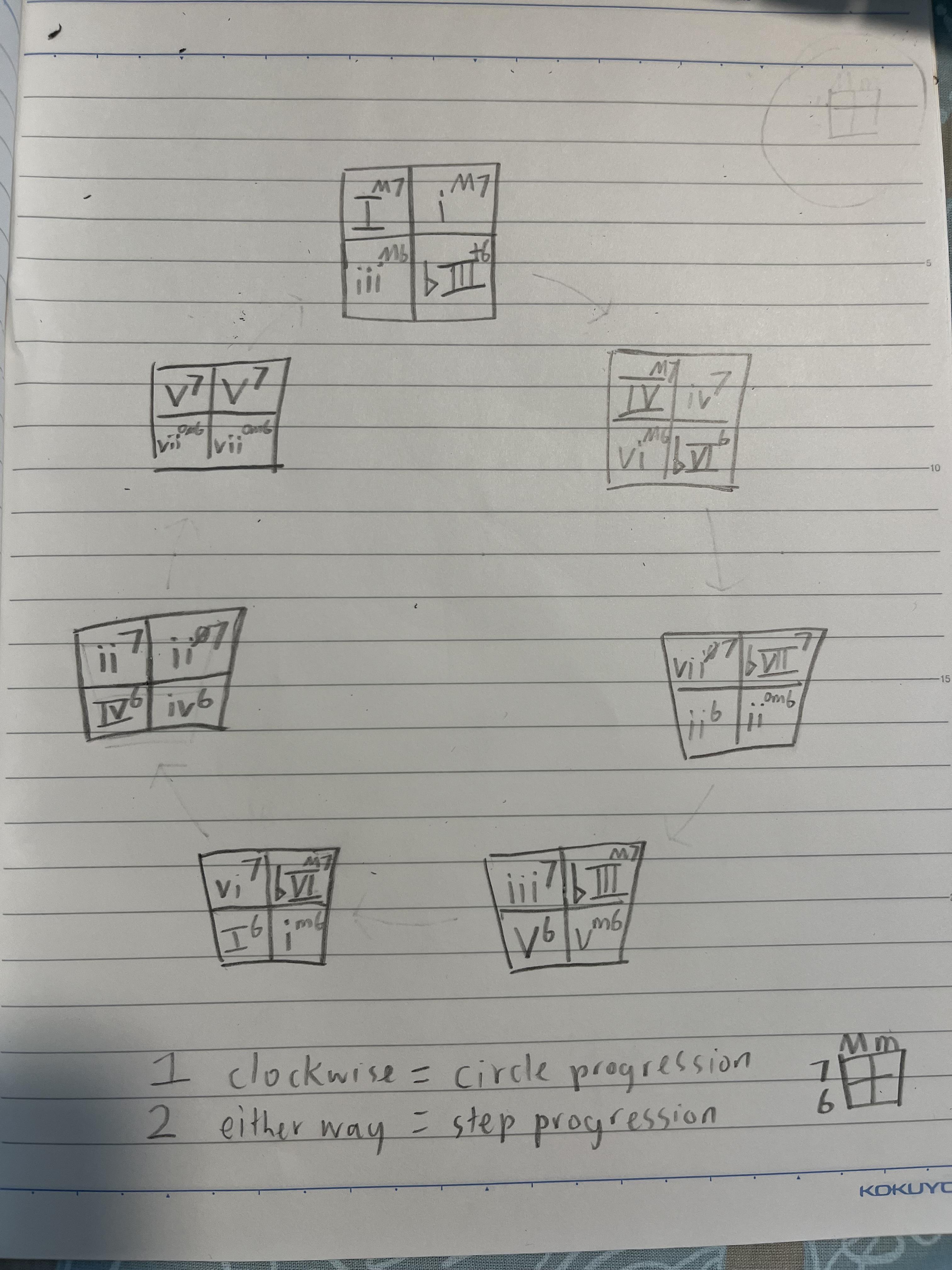
This is my attempt to Frankenstein together the chord progression and circle progression diagrams provided in musictheory.net's "Theory Lessons" app.
So top row is seventh chords, bottom row is enharmonic sixth chords, left column is major scale chords, right column is parallel combined minor scale chords.
I'm hoping this succeeds in modelling most common chord progressions and explaining why they work.
Once getting into secondary chords and chords borrowed from less common modes I assume you'd just consult the circle of fifths.
I would love to be able to figure out the chord progressions of a lot of the Fusion stuff that I’ve been listening to recently. I was wondering how I can learn to figure them out including the voicing and chord extensions etc.? If anyone has any good tips or resources to help that would be great! Thank you! :)
I am looking into learning piano music theory, coming from a completely non-musical background. I wish to do so, not by reading from a book, but from watching youtubes where musical texts are broken down and analysed. Does anyone have a channel or reference to recommend? For me my only interest is in learning piano texts.
They know theory better from the music they read and play, especially since classical musicians practically always play for many years a musical instrument, and learned scales and arpeggios (in all keys often) at the beginning of instruction. That's my theory. But once you guys finally learn how to do it, you can play theory better, knowing the chords and scales as you play it. I guess part of that is reading chord charts. It's often better musicianship in that regard than classical musicians have. In the end it's equal level of expertise in both camps, for different kinds of music. I guess more classical music theory is in the journals and not reddit.
I'm quite unwell at the moment (battling a very serious illness and being online is a bit of an escape)
What the heck is music theory? I'm 34 years old, and classically trained. And then one day I took LSD and realized I could speak music (improvise... like we all do in life everyday). All of a sudden, it all went out the window.... I'm really wrestling with the theory part... music is such a beautiful language but there doesn't seem to be a right or wrong way to create it. Why have we given it so many rules and put labels on it? Is this just how us humans handle the unknown? Where does music come from. Why do I see it everywhere... when the wind blows, a bird flies, the sun sets and the moon glows.
For example:
This is a piece I composed for my first love. Her name in Thai is Nok, which means bird. I don’t normally give too much of a backstory on my compositions, but this one is special.
We were 19 and I was living in the north of Thailand. It was my first time away from home (Thunder Bay, Ontario), and we were sitting on a bench overlooking the beautiful Nan River. The moon was so bright that night that it illuminated the golden hue of the surrounding temples... and she held my hand for the first time. I remember the feeling like it was yesterday.
Quietly, we have gone through life together. Even though we are both going through our own individual challenges, we love each other deeply, and I’m so grateful to still have her in my life.
We haven't seen each other in person in over 15 years...
So let me take you to Thailand, back to that night, the conversation we had, my feelings for her, and the life journey we are traveling through.
And I'm curious... about the theory. Does one reach a point in music where you just simply become fluent? Is it akin to how most of us forget the grammar rules we were all taught at school growing up? I remember learning about chord progressions, harmonies, figured bass, fugues, parallel fifths, octaves etc etc etc and now it just feels like a distant memory.
So, recently I've been learning how to play by ear more for the sake of songwriting and started figuring out the chords for Suffering from EPIC the musical. I got the essence of it down, but had to look up the chords to confirm what was going on in the intro: Db (1Maj7 -> 2 -> 5 -> [either 1 or 3-]). When I looked up other songs that use that progression I found close to nothing, and have been mulling over why Jorge (the composer) chose the progression. I realize that the 2- -> 5 -> 1 progression is a staple in jazz / rock theory, but here he uses a 2 major, which leads to the 5?
Is he using the 2 as a secondary dominate leading into the 5's dominate quality then back into the 1?
If so, what other songs do you know do this, and is it a common technique in musical theater as well?
For years I've been using MusicReader, the Windows alternative for forScore. I actually like it much better, it's a better, more powerful platform, but for reasons totally unrelated this, I've been moving away from Windows and all "billionaire" tech and replacing it with Linux and other open source options.
Is there a Linux alternative to forScore? I use Ubuntu on my laptop and I do not yet have a Linux-based tablet, but I'm looking into that.
A quick search turns up MuseScore and other music WRITING platforms and nothing for music READING -- so far.
I love music and I want to get a degree in it but I already have a D in the class and it’s only the 4th week of school. I am very passionate about music and I want to make a career out of it but I feel like after looking at my grade in the class, that I it’s probably better off for me to just drop my degree in general and give up on my dream career because I am not as well informed in music as I thought I was and that I should probably drop the class. It also doesn’t help that I have a learning disability that takes me longer to understand and grasp things than everyone else. So maybe I am just too stupid to follow my dreams and pursue a degree in a career I have been passionate about since I was a kid
I'm thinking about those progressions where each chord just seems to lead downward to the next one but never really resolves in a typical sense. It's not necessarily sad or dark just a continuous descent. Like a musical Sisyphus. Does anyone know if there's a name for this kind of harmonic movement?
Harmonic Analysis of the First Movement of Faust Symphony — The Opening: A Matrix of Augmented Triads and the Absence of a Clearly Perceptible Tonal Center — A Philosophical Perspective
While I was practicing harmonic analysis of the Romantic style, I worked on more pieces by Liszt than by any other composer. I managed to analyze and solve everything I practiced, but when I came across this opening, it genuinely intrigued me and caught my attention so much that I wanted to explore the harmonic analysis of the entire symphony—or at least the first movement. If the piece begins like this, who knows what other fascinating things might be hidden within it!
Since I am particularly interested in “systems,” I noticed what seems to be a quasi-system within this matrix of excessive augmented triads, known as the twelve-tone system. I have read Weitzmann's Regions, My Cycles, and Douthett's Dancing Cubes by Richard Cohn, Das Projekt »Dreiklang«. Natur und Technik bei Logier, Weitzmann, Wagner und Liszt by Johannes Menke, and other texts. I understood Neo-Riemannian theory, Weitzmann's theory, and Schoenberg's theory, and I saw that Kurth and Lewin had also written about this subject. And there is only one more female author left for me to read...
Without going into too much detail, the one thought that keeps running through my mind is that, within this twelve-tone system, the entire field of all tonalities exists simultaneously. I don't think there is any possibility or space to examine it from just one perspective.
This particular opening, specifically the way Liszt composed it, arranged the material, and contrapuntally maintained the linear voice leading, seems to me to be the strongest evidence that the twelve-tone system is a circular relationship in which all tonalities are present at once, simultaneously.
Could someone offer some thoughts on this? Because I find this idea absolutely astonishing.
Honestly, when something like this emerges as an absolute truth, it frustrates me, and I simply cannot accept it as such. I want to do something about it, driven by my frustration with the way everything is reduced to a circular relationship, where one thing becomes another and both become equivalent in their influence through enharmonic equivalence. I believe that enharmonicism could be used to derive a substantial system, one that could serve purposes far beyond those dictated by the Romantic style.
*I haven't yet put my ideas into practice or developed them into actual works. For now, I'm focused on gathering knowledge. Later, I would like to pursue all the questions and problems I find interesting and worthy of investigation professionally, as an established music theory researcher, after completing my doctorate in a few years...
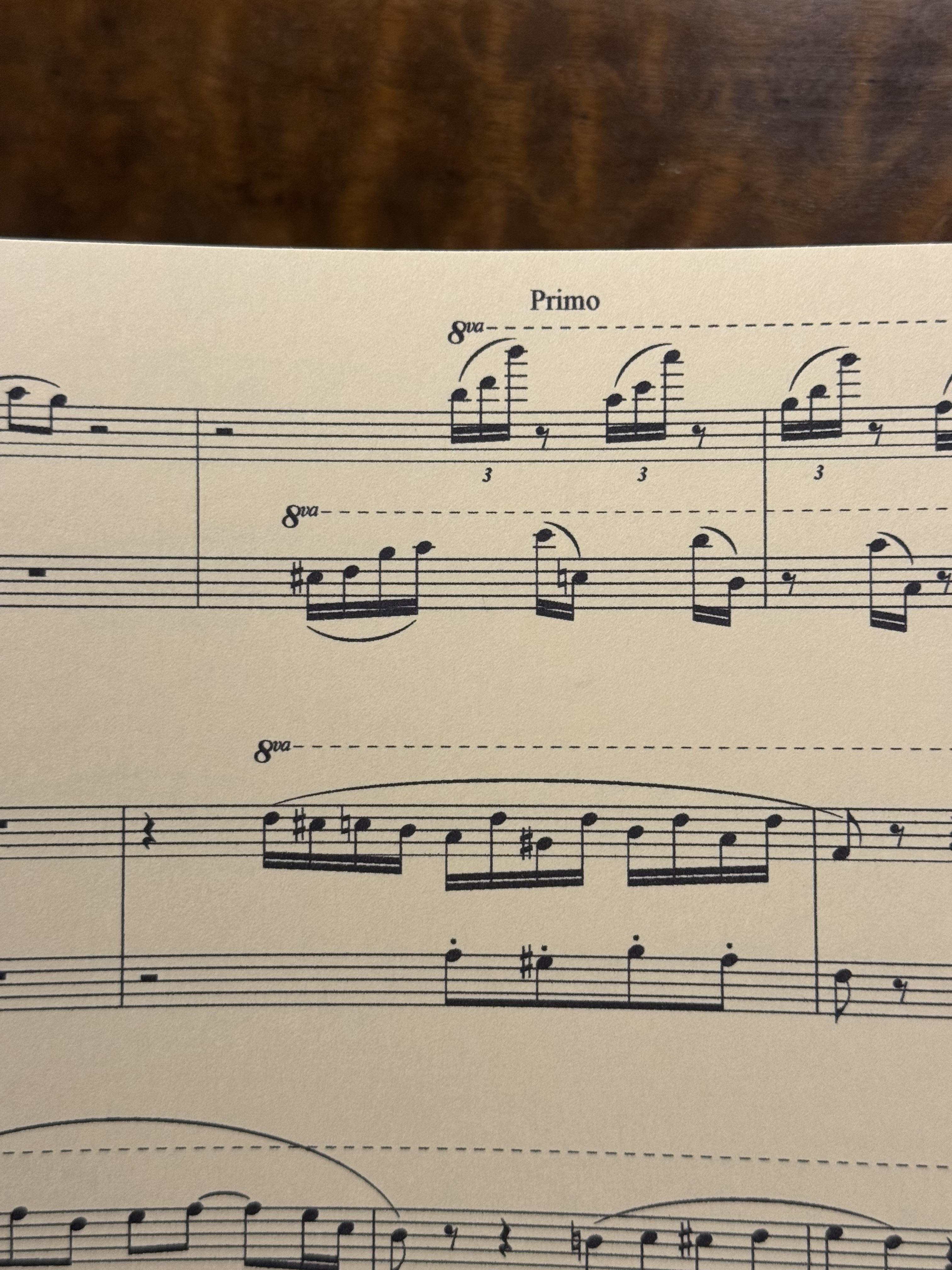
In the left hand of this measure at the top of the page (time signature is 4/4), aren’t there some missing rests? Shouldn’t there be a quarter rest at the beginning of the measure and an eighth rest in each gap?
I've been playing a lot of older RPGs lately and I'm noticing something interesting. Some composers use really unexpected chord changes in background music. It's not always functionally clear why they make those jumps. It creates a cool, unsettling, or often majestic feeling. I'm wondering if there's a specific term for these kinds of less conventional harmonic progressions in game music.
I'm a guitarist learning about intervals and triads around the neck. I'm practicing playing triads right now, and playing the intervals that ''enclose'' each triad. Like I'll play a minor triad and find the flat seventh and second next to the root, the fourth and second next to the flat third, etc.
I'm practicing playing triads along with this song (''Hold on Magnolia'' if it matters.) The song is in the key of E. The chord progression goes I vi iii V IV I IV. Ill play the I chord, then mess around with that chord's root's second and fourth and stuff. Then I'll play the vi chord and do the same. Then I'll play the iii chord, and I'll mess around, but then I hit that chord's root's second, it sounds really weird. I can't make it sound good along with the song. It's an A#, which I know isn't in the key of E, but it is in the key of G# minor, and its G#m's second.
I thought that was what playing with the changes was-- playing the corresponding scale for each chord, because even though some notes might not be in the song's key they'll sound good with the chord and it causes tension and tasty stuff. But this A# never sounds good. Why not? Only playing the A along with the G#m sounds good. Apparently I've really misunderstood what ''playing with the changes'' means. People say that to really advance, you should learn to do more than just play the key's scale over the whole song. So how do I really know which notes are good and bad?
Thanks a lot guys. I didn't really know how to ask this question so I gave a lot of information so that i hope yall can find what im confused about.