Are the stores restricted to just people below a certain income threshold? If not wouldn't it be more effective to directly give money to people who need it?
Which is why the grocery stores are pissed. They can’t sell food at a loss and absorb the costs with government subsidies. And if the government grocery stores succeeds, they either have to try and go out of business because they don’t make money, or not try and go out of business because they don’t have customers. Because the government run store subsidies their costs with taxes.
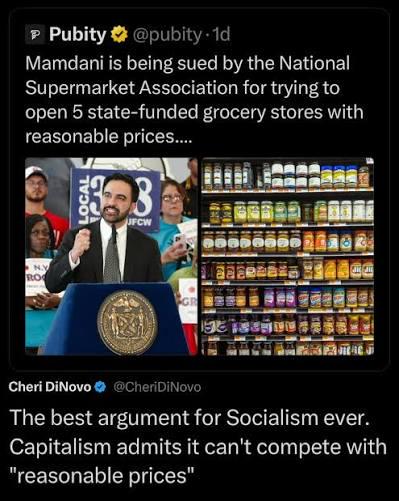
The plan is to have 5 government owned stores. There are about 5,600 grocery stores in NYC.
If these 5 stores can single handedly bankrupt 5600 stores across the city, while only selling essentials, with very limited selections, and stringent regulations, then you guys have bigger things to worry about.
5 stores go up, kill their local competitors. Then they have to expand the service and product range to compensate for the local stores closing. Mamdani stores now compete with less competition and have to expand to meet the need of more people who had their local private grocery close down.
20 years later there’s less competition overall at best or a government owned privately operated monopoly loss leader at worst.
I agree 70 million is absurd but I wouldn’t assume that they wouldn’t bend or betray the project as the problem gets bigger by raising prices or abandoning it.
I don’t think the stores would ever reach the point of monopoly because it would be pulled before it would get that bad but that doesn’t mean it isn’t set for that trajectory if it was allowed to do what many of its supporters want it to, weather they realize it or not.
What do you think happens to the immigrant-run and working class bodegas which won't be able to compete since they don't receive subsidies and therefore can't run at a loss?
And the consequence of your lovely humanitarian view is that they won't get abundant cheap food, you'll just have Soviet style bread queues down the street because prices will no longer reflect actual supply and demand, so the only thing left to do is ration supplies. And you'll have crushed the private market run by relatively poor immigrant families, making them unemployed as well, just in time to join at the back of the queue you created.
Second-order consequences are a thing, look it up!
Actually, the only people who will stand in line are the people who value saving the difference for the amount of time they would spend. If you make 200k/year, and stand in a 5 hour line for a load of bread instead of going to the for profit store down the street, that’s a you problem. NYC especially has the income distribution to support things like this. That’s why so many bodegas can exist to begin with. Because no one is traveling 30min on the subway to save 20 cents.
you arent thinking long-term or about any unintended consequences. First its super important to point out that regular grocery stores are one of capitalisms great success stories. The margins are super tight, think low single digits, because competition is so fierce.
If you think NYC can run a grocery store and better than Costo you are out of your mind. Costo's low prices are decades of research into distribution and buying at incredible scale that NYC will not be able to match with a dozen stores. and Cost margins are low single digits, think 3-6%.
if you under cut a regular grocery store making low margins by even a little bit you put them out of business. what does that mean? the City run stores will need to get much bigger because regular business is shutting down, and the city run stores instead of costing hundred million a year now costs hundreds of million a year and the City store is literally the only store in town.
This also leaves out people coming from out of state and buying and reselling and a hundred other issues when you sell something below market pricing.
There was never any reasonable risk when they started these bodegas, which run on razor-thin margins, that the state would start running state-owned grocery shops at a deliberate loss in order to put businesses owned by people out of business.
You want Soviet bread lines. You will get Soviet bread lines.
The rent is covered because they operate off of city property. (Taking off a large expense in NYC). By selling a smaller basket of white-label goods, they also eliminate a lot of operating expenses associated with managing a full supermarket.
So, yes, it won't be profitable. Might even make a loss, but not impossible to break even.
In either case, I'd rather my tax dollars feed some kid in NYC and not kill a school kid in Iran.
It’s covering a 30% discount, I don’t see that NOT operating a loss when grocery stores report razor thin profit margins as it is. Majority of grocery stores report near to nothing in profit and they make up for it by having a mass abundance of stores where they eventually get a 3% profit margin.
If they are using the property that means the government is missing out on property tax revenue from the sites too. I would much rather give my tax dollars directly to people who need it rather than the government operate a grocery store with notoriously small margins that has the potential to hurt small business owners and provide benefits to people who actually aren't income / food insecure
Maybe not, but could break even if it only provides a limited selection of white-label staples.
It still would need some subsidies. But of all the things that my taxes could fund, this would be top of the pile. I'd rather my tax goes towards feeding someone in NYC instead of killing some school kid halfway around the world.
Your city tax (which is what this will be subsidized by) doesn't go to killing kids halfway around the world. That would only be your federal tax. Any shortfall these stores make will be pulled from your city taxes, which means another city service makes do with less.
I like 90%+ of the things Mamdani does, but these completely ignore the reality of profit margins in the grocery space, which hover between 1 and 5 percent. This simply isn't a situation like Healthcare where the margins and lack of competition make government intervention worthwhile.
14
u/FedrinKeening Sep 15 '26
For the geniuses posting comments. The whole point is to use tax money to run a grocery store at a loss to make food cheaper.