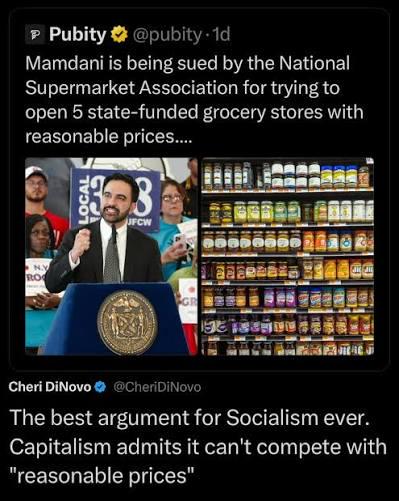
I just now looked into it and it seems that the plan is to subsidize some groceries listed as essentials. So, the plan is not to have lower prices simply by not having profits or procing bullshit. It is subsidies from tax payers.
This is not planned to turn a "marginal profit" or be self sufficient. They take a loss on the groceries and do not pay rent or property tax for a location that a business would.
Not arguing if this is good or bad, but just trying to clarify according tp the published plans.
EDIT: there is actually going to be a private-public model. The locations are going to be privately run for profit. But the city is subsidizing the initiative through the capital investment to built and/or refit the locations and through incentives like not having to pay rent or certain taxes. Not taxing is of course an indirect subsidy. The private operators then have strict requirements about pricing, labor practices, operating practices etc. So, they are required to keep prices low, but are planning to turn a profit from the subsidized operating expenses.
The military doesn't make a profit, the USPS doesn't make a profit. These are services. I don't agree with the military, it's outrageously big. Id much rather tax dollars come back to us with cheap or free services and groceries or healthcare directly, instead of funnelling them into private organizations and hoping for the best
That is correct, but it is also a misunderstood fact often pushed by people who want to privatize all mail and disband the USPS. The "losses" were essentially manufactured unintentionally by the federal government.
A significant chunk of those $120 billion in recorded losses stemmed from the Postal Accountability and Enhancement Act of 2006. This law forced the USPS to prefund 75 years worth of future retiree health benefits over a single decade. This is a strict financial burden placed on virtually no other government agency or private corporation. The USPS ultimately defaulted on tens of billions of dollars of these payments because it simply didn't have the cash. What organization would?
The act in 2006 was a bipartisan act with overwhelming support largely because congress thought they were cleverly fixing an accounting issue. The USPS was doing so well prior to this that it was overpaying into its pension funds in order to protect pensions in case of future liquidity issues. But due to quirks in federal accounting this would mean that when they stopped overpaying (because they got the rainy day funds they intended) it would have a hugely negative impact on the federal budget.
So, congress tried to keep those overpayments going with the 2006 act. But it was a huge mistake because they put the burden way too high and there was a pending revenue problem with first class mail demand plummeting. This was also bipartisanly recognized as a blunder. USPS was allowed to default on its payment obligations established in the 2006 act. Those defaulted funds are booked as losses and accumulated debts. The the act was repealed in 2022. But USPS is still dealing with the consequences.
So, these losses are basically an accounting issue caused by a legal trap that no one really intended and they have never been subsidized by tax payer dollars.
The military is government-run because of a very specific, well-understood market failure (free rider problem). There is no comparable market failure in the grocery retail sector that justifies nationalizing that industry.
Everything in the current economy is subsidized by the tax payer, look into how many grants SpaceX receives to do the same shit as NASA but worse and private. Its the same in every sector but you only hear conservatoids bitch if its going towards helping people instead of megacorporations.
Space X is actually efficient unfortunately, they do save money compared to NASA controlled missions. Now do they offer the same societal spillover benefits, research, and employment? No, they just specialize in profiteering space. Which is cool to think we're at that point in space travel. It's just bad when only one is doing it efficiently and there is no real competition for government contracts. This is when costs can skyrocket.
how is that cool when all it means is that space travel is going to exclusively be for the rich and powerful? if we keep going on this trajectory, we're going to end up with a situation not too dissimilar to the one in The Expanse (you know, minus all the obvious fiction stuff).
Cool insofar as the technology has progressed enough for that to be possible. I'm in my early 30s, and there's a very real possibility that, assuming we seize the technology at some point so it benefits the public, my grandkids or great grandkids could go on day trips to the moon for shits and giggles.
It's cool in that a non government can produce rockets at scale comparable to a government on a smaller budget. I literally follow up with that its bad when one is the only one that can do it. I'd prefer it to be 200 firms competing for contracts and grants like china currently. Air travel was privatized, auto, ship, and rail. It's government regulation, policy, oversight and support infrastructure that can make our break these forms of travel. It's always been expensive to travel to space and return.
Well yeah but only because NASA doesn’t really launch any rockets lol. The SLS is the only NASA-built rocket currently in use, and it’s only launching once every couple of years.
The rockets that SpaceX is losing are Starship, which is still experimental. They lose very few of their regular rockets.
The military started the PX system in 1895 to prevent soldiers being charged unfair prices. Price fixed goods have been a sucessful thing for a long time
That's not how it's set up. The idea is to be self-supporting. Obviously they need start up money. 70 million I believe for five fully stocked flagship stores. It will take several years to recover that investment but if it goes well it should succeed. Why else do you think the National Supermarket Association is so concerned. It's not a novel idea. Co-ops have been doing this for decades.
7
u/SoilDependent1054 Prefer Coffee But Fill My Cup 🫖 Sep 15 '26 edited Sep 15 '26
I just now looked into it and it seems that the plan is to subsidize some groceries listed as essentials. So, the plan is not to have lower prices simply by not having profits or procing bullshit. It is subsidies from tax payers.
This is not planned to turn a "marginal profit" or be self sufficient. They take a loss on the groceries and do not pay rent or property tax for a location that a business would.
Not arguing if this is good or bad, but just trying to clarify according tp the published plans.
EDIT: there is actually going to be a private-public model. The locations are going to be privately run for profit. But the city is subsidizing the initiative through the capital investment to built and/or refit the locations and through incentives like not having to pay rent or certain taxes. Not taxing is of course an indirect subsidy. The private operators then have strict requirements about pricing, labor practices, operating practices etc. So, they are required to keep prices low, but are planning to turn a profit from the subsidized operating expenses.