r/Tudorhistory • • Sep 13 '26

Modern Religious Opinions

112 Upvotes

It's come to our attention lately that discussions surrounding religion have been getting out of hand, and need heavy moderation. Especially on posts about Mary I and Catholiscism.

We are all for discussions about Tudor religion.

We will not tolerate your personal religious opinions in this sub. We don't care if you're Catholic, Protestant, Atheist or anything in between or outside of that. You are free to have those opinions, but this is not the place to express them.

Asking users about their religious beliefs, and judging them for those beliefs or telling them they aren't practising Catholics because they disagreed with you is also highly inappropriate.

An example of sentiment's that are inappropriate:

"More is joined with the angels in heaven" and "More's martydom triumphed and Henry VIII's dynasty failed".

Praising Catherine of Aragon, Mary QOS or Mary I as proud Catholics while simultaneously using derogatory remarks towards Anne Boleyn or Elizabeth I because they were Protestants, or vice versa, will not be tolerated.

Another example we will not tolerate is using the term 'bastard' as a slur aimed at Elizabeth I. Stating "Catholic's believed Elizabeth was a bastard" is fine as it's contextual of the period, and not reflective of your own religious belief.

Calling the Reformation the "Deformation" etc. It's juvenile and biased.

We want respectful discussion, which most users already practise, thank you for that! Please have respect for others' views and also, have respect for the historical figures we're discussing- they were real people. You can dislike them without resorting to name calling and derogatory remarks.


r/Tudorhistory • • 5h ago

The ONLY item of clothing belonging to King Henry VIII that still exists

Post image
514 Upvotes

His red velvet Cap of Maintenance

It's personally my favorite item from Tudor times that's still around.

By the way, if you want to see it in person, it's on display at the Medieval Museum, Waterford Museum of Treasures, in Waterford, Ireland. Why there? Because in 1536, Henry personally gifted it to the Mayor of Waterford, and fortunately, the town has taken good care of it ever since.


r/Tudorhistory • • 4h ago

Tudor Rose

Post image
103 Upvotes

The first of eight hand embroidered pieces I’m doing to represent Henry VIII, his wives, and children. Starting off with a traditional Tudor Rose with golden trim.


r/Tudorhistory • • 11h ago

Fact In 1546, the Lieutenant of the Tower of London, Sir Anthony Knyvett, Refused to Continue Torturing Anne Askew on the Rack. He Would Later Be Executed for Rebelling Against Queen Mary I.

Post image
165 Upvotes

In 1546, Anne Askew, an English Protestant writer and preacher, was tortured at the Tower of London for refusing to identify fellow Protestants. Her interrogators wanted names, potentially including women connected to Queen Katherine Parr’s royal circle.

According to John Foxe’s Book of Martyrs, Askew was stretched on the rack until she was held approximately five inches above its bed. She fainted from the pain, was revived, and the procedure was repeated twice. Sir Anthony Knyvett, Lieutenant of the Tower, refused to continue torturing her. He hurried to King Henry VIII to explain his refusal and ask for a pardon, which the king granted.

After Knyvett left, Lord Chancellor Thomas Wriothesley and Sir Richard Rich continued operating the rack themselves, severely dislocating Askew’s joints. Her ordeal ended when Knyvett ordered her returned to her cell. Despite the torture, she refused to name anyone.

Askew was convicted of heresy and burned at the stake on July 16, 1546. Her injuries were so severe that she had to be carried to the execution site in a chair.

In 1554, Knyvett joined Wyatt’s Rebellion, an uprising against Queen Mary I, sparked in large part by opposition to her planned marriage to Philip of Spain. The rebellion failed, and Knyvett was executed at the Tower of London on March 1, 1554.


r/Tudorhistory • • 5h ago

Mary I Tudor silver enamelled dress clasp (found in Leicestershire)

Post image
24 Upvotes

r/Tudorhistory • • 13h ago

If you were in Thomas Cromwell’s shoes in 1536, would you have fabricated the charges against Anne Boleyn to save your own head?

26 Upvotes

Cromwell knew Anne was almost certainly innocent of incest and treason. But Henry wanted her gone, and Cromwell’s political survival (and life) depended on making it happen seamlessly.

It makes me wonder about moral boundaries at the Tudor court. Was Cromwell a ruthless villain, or just a pragmatist doing what anyone in this sub would have done if facing the Tower of London? Where do you draw the line between pure evil and self-preservation?


r/Tudorhistory • • 11h ago

Mary I Extreme celebrations for Mary

15 Upvotes

I was looking at accounts of Mary’s coronation and there is this awesome eyewitness description of one of the more extreme celebrations…

Then was there one Peter, a Dutchman, that stood on the weathercock of Paules steeple, holding a streamer in his hand of five yards long, and waving thereof, stood sometimes on the one foot, and shooke the other, and then fell on his knees, to the great marvel of all people…

This is old Saint Pauls Cathedral.

This mad Dutchman, is about 500 feet above London. The spire of the old Cathedral was about 490 feet up (with some saying as high as 520 feet), and atop the steeple is the weathercock and he has climbed all the way up and is waving this long streamer about while performing stunts. It must have been an amazing sight.
The account goes on…

He had made two scaffolds vunder him, one about the crosse, having torches and streamers set on it, and an other at the ball of the cross, likewise set with streamers and torches, which would not burn, the wind was so great

So it’s not just this one insane fool. He has an installation. Streamers, flaming torches and winds so strong some torches won’t stay alight (this is October after all), and HE is above this, waving his long flag and seemingly performing for all the crowd. The risks would have been incredible.

The account finally goes onto say, that Peter the insane Dutchman with no fear of freights, had sixteen pounds thirteen shillings fours pence given him by the city for his costs and pains.

So, at least he got paid! Got paid a heck of a lot by the sounds of it. Good to see people appreciated high risks stunts even back then.

I run a weekly podcast dedicated to the history of London, and we deep in the Tudor era and I was looking at some primary sources, saw this and had to share with my fellow Tudorheads. It’s just a wonderful detail from Mary’s coronation I feel.


r/Tudorhistory • • 13h ago

Which Tudor monarch was actually the WORST ruler for the average, everyday peasant?

19 Upvotes

We always argue about Henry VIII vs. Mary I vs. Elizabeth I based on court politics, religion, or foreign affairs. But if you were just a random farmer in 1550, whose reign actually ruined your daily life the most?

Henry VIII’s dissolution of the monasteries (losing social safety nets/charity)?

Edward VI/Somerset’s economic chaos and enclosure riots?

Mary I’s religious reversals and bad harvests?

Elizabeth I’s harsh poor laws and constant taxation for wars?

Who takes the crown for causing the most real suffering to the common people?


r/Tudorhistory • • 12h ago

Merchandise Mondays!

3 Upvotes

Post your Tudor merch here! Do not publicly share links or sites, users must DM each other for links. The t-shirt that has been circulating will not be permitted at all.


r/Tudorhistory • • 1d ago

Question What are Your thoughts about Charles Brandon?

Thumbnail gallery
128 Upvotes

r/Tudorhistory • • 1d ago

October 18, 1550 – Somerset Snubbed Over Mom’s Death

Thumbnail
janetwertman.com
9 Upvotes

Showing how the use of the term "private citizen" has been a thing for a very long time....(I never intended to be political, I wrote this years ago!)


r/Tudorhistory • • 1d ago

Would you help the late King’s brother usurp the throne from his nephews if he promised you the earldom of Hereford for your pains?

Thumbnail
2 Upvotes

r/Tudorhistory • • 1d ago

Cinematic Sundays

4 Upvotes

Feel free to post your dream casting scenarios here!


r/Tudorhistory • • 2d ago

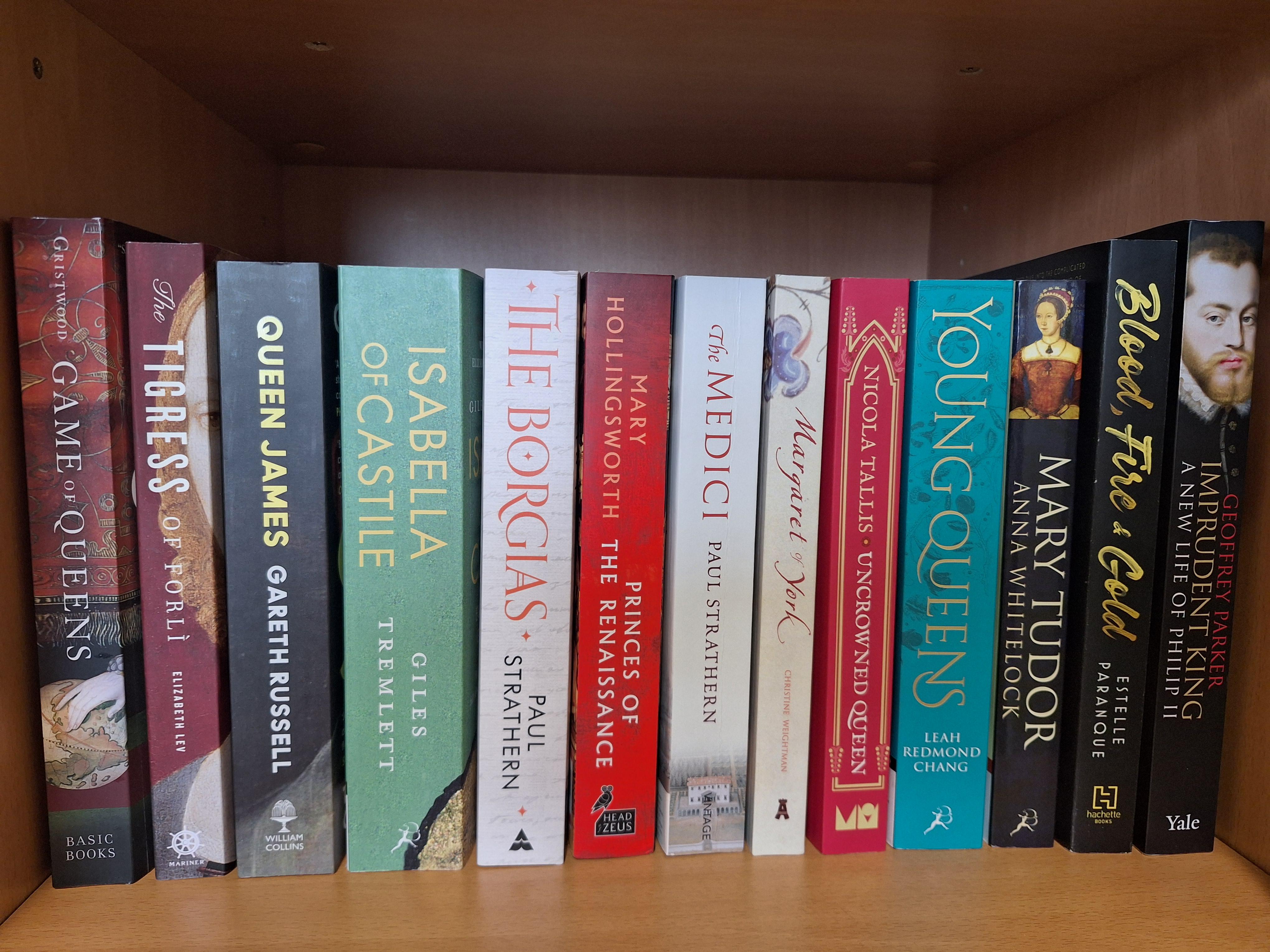
My tiny Tudor and Tudor-adjacent history bookshelf. I'd love to see yours!

Post image
119 Upvotes

After mostly reading e-books, I've only recently started to build up my physical bookshelf, so my Tudor section is still very small but growing. I'd love to see what other Tudor history buffs have on their shelves, as I'm always happy to add new books to my list!


r/Tudorhistory • • 1d ago

Question Gift idea for friend that’s really into Tudor era.

8 Upvotes

Hey everyone! I have a friend that is really into history but specifically the Tudor era. Any gifts ideas? I’ll even look into something antique. Something that was popular around that time.


r/Tudorhistory • • 2d ago

Anne Boleyn Images of Anne Boleyn: An Incomplete List

Thumbnail
gallery
185 Upvotes

I should make it clear that, to date, there’s no surviving contemporary portrait that can be said with absolute certainty to be Anne Boleyn. Almost all of them are later copies.

The only thing we can be sure of is a coin on which her features are pretty indistinct. As for the Chequers Ring, the general view is that it shows her, so I’ve gone with that and included it too.

I’ve basically posted everything I could find online. Thanks for reading and taking a look. ☺️

Edit 2: Hang on, why’s the image so blurry? 😨


r/Tudorhistory • • 3d ago

National portrait gallery visit

Thumbnail
gallery
278 Upvotes

One of my favourite places in London!


r/Tudorhistory • • 2d ago

SatARTday Megathread

3 Upvotes

Feel free to post your own artwork or any artwork here. We still won't allow AI or AI-assisted. We're also not allowing video game/simulation type character creations. Hand-drawn, sketches, needlework, anime, etc. Please, no AI.


r/Tudorhistory • • 2d ago

Question Need some advicee

16 Upvotes

I am very fixated (?) on Edward VI right now, and I really wish for advice about what book shall I buy? I would like to find out new information about him and stuff, yet I live in post-USSR country , so as you can guess, I have limited choice 😢


r/Tudorhistory • • 3d ago

Henry VIII When did Henry VIII's "cruelty" start? (regarding actually his 1st son's demise)

95 Upvotes

I was reading up on how Catherine of Aragon and Henry's first son passed at just 52 days old, and while the consensus was SIDS, why wasn't there speculation that a nurse/wetnurse/medical had anything to do with failure to treat any ailments their son had? Or just truly one night he just passed? I was reading that they gave the main nurse an annual stipend for her services and I was like, wow how gracious they didn't blame her! Would Old Henry just have executed her to put the blame someplace?


r/Tudorhistory • • 3d ago

Mary I Mary I’s Other Philip: The Failed Betrothal of Philipp the Bellicose of the Palatinate

Thumbnail
gallery
81 Upvotes

Everyone remembers the Philip Mary I finally married: Philip II of Spain. Far less well known is that the future Mary I was once betrothed to another Philip—Philipp the Bellicose, also commonly known in English as Philip of Bavaria. His titles were Count Palatine of the Rhine and Duke of Palatinate-Neuburg, though English sources often call him "Philip of Bavaria." In 1540 the two were formally engaged. This is the story of that betrothal: how it began, why it almost became a marriage, and why it never did.

For years Philipp had sought a marriage that might restore his fortunes. In 1539, a new prospect opened up to him: Henry VIII’s daughter Mary. A secretary of Henry VIII hinted to a Nuremberg merchant, Joachim Gundelfinger, that the king would gladly marry his daughter Mary to a German prince. Gundelfinger thereupon proposed Philipp, whom the secretary did not reject. Through confidential correspondence the matter was pursued further with Philipp’s knowledge, and when it was hinted to him that the king would gladly see him, Philipp set out for England. He arrived in London on 8 December 1539, and negotiations soon progressed rapidly.

For Mary, however, the prospect was far from welcome. In December 1539 Thomas Wriothesley was sent to inform her of Philipp’s candidacy. She replied that she would obey her father in all things, but would rather remain single than marry a man who was not a full adherent of the traditional Catholic faith. Nevertheless, just before Christmas she agreed to come to London, and on 26 December she met Philipp in the garden of the Abbot of Westminster. They conversed in Latin and, through an interpreter, in German. To her surprise—and to the scandal of observers—Philipp kissed her and gave her a jewelled cross. Mary responded coolly that she would do as her father determined. It was the nearest thing to courtship she ever experienced. A treaty was drafted whereby she would renounce her rights to the English throne and go to Germany with a dowry, but it was never implemented. The collapse of the Palatine scheme was bound up with Henry’s own marital failure with Anne of Cleves, and within a month Philipp had left England, a disappointed man.

On Philipp’s side, only two articles of the marriage contract caused him difficulty. He refused, on principle, to see Mary described—according to an English statute—as born illegitimate and incapable of succession. He also feared that he could not furnish a written obligation for a 10,000-florin annual widow’s dower. The English side tried to overcome this scruple by arguing that the bond would not fall due until his death, and that until then his situation might still change through his prospects of the electoral dignity. They hinted that the bond was merely a formality. Philipp also had religious scruples: he was to ally himself with Henry VIII against everyone except the Emperor and Empire, but he wanted the Pope excepted as well. Henry refused. Nevertheless, Philipp signed the treaty at Greenwich on 24 January 1540.

The terms were very favorable to him. He was promised 40,000 florins in gold as dowry and 12,000 florins as an annual pension, while he assigned his widow only 10,000 florins. With 4,000 foot and 1,000 horse he was to serve the king against everyone except the Emperor and Empire, and to approve the English statutes against the papacy. The treaty was declared void if Philipp did not produce, before Pentecost 1540, the ratification of Ottheinrich, Elector Ludwig, and Duke Friedrich.

The betrothal was celebrated immediately. Philipp gave the bride a diamond cross worth 2,500 florins; she gave him a jewel of rubies and diamonds worth 1,500 florins. On his departure Philipp received from the king 7,000 florins as a gift and valuable silverware, and his retinue was richly gifted as well. When Philipp returned to Heidelberg, he immediately began negotiating for the ratification. But the Elector, advised by the Bishop of Augsburg, rejected the article concerning Mary’s illegitimate origin—partly for religious reasons, partly because of the Emperor. The deadline passed amid hopeless negotiations. Finally, in 1541, Philipp had it declared through Gundelfinger in London that he could not acknowledge Mary’s illegitimate birth and incapacity to succeed, but was prepared to renounce in a subsidiary treaty every right of inheritance she might have. All Gundelfinger’s representations were in vain. On 13 June 1541, he received the decision: the marriage was not possible. The deadline had expired, and the main articles had been rejected.

Philipp had not yet given up hope. Against his brother’s and the Elector’s advice, he traveled to England again in 1543. Henry VIII, however, would not agree to his proposals, showed himself otherwise little accommodating, and finally demanded the return of the gifts that had counted as pledges of the betrothal. But Philipp had pawned his own in Antwerp, and he declared that before God he regarded himself as Mary’s husband, since at their betrothal they had mutually vowed to belong to no other. After this declaration Henry banished him from the realm—but still gave him 1,500 florins, without which Philipp would hardly have been able to travel home.

A third attempt followed. Henry VIII’s policy had changed, and he had all his children declared legitimate and capable of succession. Philipp took up the English marriage project anew. On his third appearance in England he was received most courteously. He was assured of marriage to Mary as heiress, and no condition was attached to the consummation of the marriage except the conclusion of an alliance with the Elector and the expansion of that alliance through the accession of other electors in the interest of the Protestant religion. Philipp returned to Heidelberg to achieve this, but the negotiation with the Elector went less smoothly. The Elector sent him back to England with Rhinegrave Friedrich Franz and the Italian physician Dr. Eustachius. There the marriage negotiation progressed so favorably that Henry definitely declared he wished to marry Mary to Philipp, even though she was his heiress after the deaths of himself and his son. He demanded only a widow’s dower bond of 20,000 florins. The king would have been satisfied with a sham bond, but the Elector would not agree even to that. When the Rhinegrave and his companion returned to Heidelberg to report, Philipp—who meanwhile had fallen mortally ill in England—waited in vain for an answer. He remained in England until Henry VIII’s death on 28 February 1547, which destroyed all his hopes.

The marriage never took place. Philipp the Bellicose died in poverty in 1548, his English hopes long dead. Six years later, in 1554, Mary married Philip II of Spain—another Philip, not this one.


r/Tudorhistory • • 4d ago

Henry VIII The Alleged Miscarriages of Catherine of Aragon and Anne Boleyn

Thumbnail
gallery
393 Upvotes

by Sir John Dewhurst, a well-respected modern gynecologist.

THE birth to a queen of England of a surviving child has, for the most part, been an event accurately recorded by contemporary chroniclers for the last 500 years. But if the child did not survive, detailed information was often lacking: the sex was generally stated, but whether the infant was stillborn or died soon after birth, whether "soon after birth" meant hours or days, and whether the birth was premature or not, are matters about which precise information is often not available.

If the queen miscarried, the documentation of the event was even less reliable, for a variety of reasons. The term "miscarriage" was, in former times, not used as we would use it now to refer to the expulsion of the child from the womb before twenty-eight weeks of pregnancy, but was very loosely used to describe the birth of a dead child whether this occurred before or after viability. Thus a queen might be reported to have miscarried when, in reality, she had had a premature stillbirth. Second, if the miscarriage had been very early in pregnancy, as many are, the physicians might have been uncertain that a miscarriage had actually occurred or, if they were certain, the event may not have been announced outside the immediate family circle. Third, any indisposition the queen may have suffered was believed to be concerned with a pregnancy; when no child was subsequently born, it was concluded that she must have had a miscarriage. Very soon, the conclusion that she "must have had" became an assertion that she "had" miscarried. Historians, sometimes of the highest repute, and other historical writers have tended to accept such evidence somewhat uncritically, so lending the weight of their authority to what was initially mere rumour.

Two of England's queens who have particularly suffered in this respect are Catherine of Aragon and Anne Boleyn. A close examination of the evidence does not suggest a series of miscarriages in either, as has been commonly asserted.

Catherine of Aragon's childbearing history has been variously reported by historians. Scarisbrick credits her with "several miscarriages, three infants who were either stillborn or died immediately after birth (two of them males), two infants who died within a few weeks of birth (one of them a boy) and one girl, Princess Mary"; this must mean a total of at least nine pregnancies since "several miscarriages" can hardly be regarded as referring to less than three. Chapman gives the total of Catherine's pregnancies as seven, one of which resulted in one live child and six that ended either in miscarriages or stillbirths. Williams is imprecise about the final total, but, commenting upon the attention Henry lavished on his wife as early as the second year of their marriage, remarks that Henry was "mindful of earlier miscarriages". Pollard, referring to events about the year 1517, wrote, "It is probable that about this time the Queen had various miscarriages"; "various" like "several" cannot refer to less than three.

If, therefore, we consider at this point merely these last two comments concerning "earlier" miscarriages around 1510 and "various" ones about 1517, at least five miscarriages are being postulated.

Not all historians accept these figures. Bowie rejects the alleged miscarriages around 1517 as inventions of Pollard, inventions that Chamberlin goes so far as to describe as mischievous. These two writers also discount an additional son, who was "no sooner christened than dead". Pollard alleges that he was born in 1514, thus bringing the total of Catherine's pregnancies, in his opinion, to at least ten! Bowie, by contrast, accepts only six pregnancies for Catherine, which ended in the birth of Mary who lived to be middle-aged, a boy who lived for fifty-two days, and four children who were stillborn or who died very soon after birth. Chamberlin accepts these same six pregnancies, disregarding other possible ones because of insufficient evidence, a view which Neale appears to accept. With such differing views being expressed, a careful reappraisal of the evidence is clearly necessary.

The Queen's first pregnancy ended on 31 January 1510, thirty-three weeks after her marriage, when she gave birth to a stillborn daughter. This information did not emerge until four months afterwards when, on 25 May on Catherine's instructions, her chancellor, Diego Fernandez wrote to her father King Ferdinand in these words: "The last day of January in the morning Her Highness brought forth a daughter ... this affair was so secret that no-one knew it until now except the King my lord, two Spanish women, a physician and I." Here was a remarkable circumstance, but the reason for the secrecy was more remarkable still. "The physician said", continued the letter, "that her Highness remained pregnant with another child and it was believed and kept secret!" Two days after the despatch of her chancellor's letter, Catherine herself wrote to her father confirming that she "miscarried a dead daughter and because it was considered here an ill omen I did not write before to tell your Highness". That the secret was well kept, there can be no doubt. On 20 April, Andrea Badoer, the Venetian ambassador, reported that "His [the king's] wife has not yet been delivered". Peter Martyr, the historian, who was at the time living with the Spanish royal family, wrote that in early April "News reached the King from England ... that the Queen of that island, his daughter, was about to be delivered of a child being then in her ninth month". Even Caroz, the Spanish ambassador in London, leaves no doubt that he had been ignorant of the stillbirth that had occurred on 31 January.

The Queen was not carrying another child, but she did become pregnant again quite soon. Fernandez included the news of it in his letter to King Ferdinand in these words - "It has pleased the Lord to be her physician ... and by His infinite mercy has permitted her to be pregnant again." Catherine herself informed Caroz, on 20 May, that she was "not pregnant for more than nine weeks". "She does not wish me to write to His Highness [the King]", wrote Caroz, "until she sends to me because she wishes to wait until the pregnancy is well established in the third month so that the good news of the pregnancy may soften the annoyance of his Highness at what has passed". Nine weeks on 20 May corresponds closely with the eventual outcome of this pregnancy, which was a successful birth of a son on 1 January 1511.

The birth was received with great celebrations. Bells rang, bonfires were lighted, guns were fired, and "207 lbs of gunpowder at 4 pence the pound" was "shot ... in the Tower of London" to welcome the new prince. In the midst of the Christmas festivities and excitement, the boy was christened Henry in the presence of the ambassadors to the Pope, France, Spain, and Venice, who afterwards visited and congratulated the Queen. Henry made a special pilgrimage to Walsingham to offer thanks to the Blessed Virgin and, once Catherine was well enough to join in the festivities, a fabulous tournament was held at Westminster. But all the joy and celebration was shortlived. The tournament had barely concluded when the young prince was taken ill at Richmond and died on 22 February, fifty-two days after his birth. A gathering of nobles for the celebration of a triumphant birth became one of lamentation for a tragic death.

There was, therefore, no time during 1509 and 1510 for "earlier miscarriages". The word miscarriage might loosely, if inaccurately, be applied to the birth of a stillborn daughter on 31 January 1510, only thirty-three weeks after Catherine's marriage; she herself used it when she wrote that she had "miscarried a dead daughter", but there was clearly no time for her to have squeezed in another pregnancy in those years.

Catherine's next confinement occurred in 1513, although we know little of the events that took place. On 17 September, she gave birth to a son who died, but it is uncertain if he was stillborn or lived a short time. The Venetian Calendar of State Papers records that the child was alive at birth: "a male heir was born to the King of England and will inherit the crown, the other son having died". The same conclusion can be drawn from the only other contemporary reference to this birth: "The Queen of England has given birth to a son", wrote Bannissius, the Imperial agent, to Lord Albert of Carpi. The absence of other references to the birth in documents and state papers lends support to the view that the boy must have died very soon after birth. There is no record of the birth being premature but, since the King was in France when it occurred and was not due to return until 21 October, labour may have begun sooner than expected - it seems unlikely that Henry would have wished to be absent when his child was born.

Catherine conceived her fourth pregnancy quite quickly, and by the summer of the following year it was evident to several foreign observers at court who reported it in their correspondence. The most important of these accounts, which we will consider again later, are from a court official, De Plein, who wrote to Margaret of Savoy on 30 June, and Di Favri, an attaché at the Venetian embassy, who wrote to a colleague in August. "It is said that the Queen is with child and, as far as I know, and can see, it is so", reported De Plein. "After the King", wrote Di Favri, "came the Queen who is pregnant clad in ash-coloured satin with chains and jewels and on her head a cap of cloth of gold covering the ears in the Venetian fashion". Regrettably, we do not know precisely when the Queen was confined nor, indeed, whether the infant was stillborn or lived a short time. Badoer, the Venetian ambassador, wrote to his senate in November that "The Queen has been delivered of a stillborn male child of eight months to the very great grief of the whole court". The chronicler Holinshed reported that, "In November the Queen was delivered of a prince which lived not long after", whilst Stow wrote, "In the meantime, to Whit, the month of November, the Q was delivered of a prince which lived not long after".

The interval between these two children was too short for any intervening pregnancy, but the interval between the births of the second and third was two years and nine months, which would have provided ample opportunity for a miscarriage to have occurred. Naturally, since the Queen had, by that time, borne two children and both were dead, everyone at court would have been most anxious for her to conceive again. It is hardly surprising, therefore, that we find Cardinal Wolsey writing to Richard Fox, Bishop of Winchester, on 11 September 1511 to report that, "It is thought that the Queen is with child". Since there is no other report of a pregnancy at that time, the phrase remains unsubstantiated and must be discounted as unfounded rumour; it is certainly quite insufficient evidence on which to postulate a miscarriage.

Setting this unsupported "thought" aside, therefore, we come to the Queen's fifth and only successful pregnancy. Catherine bore a daughter at Greenwich palace on 18 February 1516. The child was christened Mary three days later. Emotions fluctuated between elation that the infant was alive and well, and disappointment that it was not a boy. Henry, with more optimism than he can have felt, told the Venetian ambassador "We are both young and by God's grace boys will follow". Boys did not follow and Catherine was not to bear any other living child. Her sixth and last confinement was announced by Henry in a personal letter to Cardinal Wolsey on 1 July 1518: "Two things there be which be so secret that they cause me at this time to write to you myself; the one is that I trust the Queen my wife to be with child". But this pregnancy, too, ended in a stillbirth on 10 November 1518. The child, it seems, was premature: "The Queen has been delivered in her eighth month of a stillborn daughter to the great sorrow of the nation at large", wrote the Venetian ambassador Giustinian. "Never had the kingdom so anxiously desired anything as it did a prince".

Between 18 February 1516 and 10 November 1518 is presumably the interval that Pollard referred to when he wrote that "It is probable that about this time the Queen had various miscarriages". He made reference to a report in August 1517 that Catherine was pregnant again. The Venetian, Chieregato, wrote to the Marquis of Mantua and his letter contained the words "the Queen has lately been unwell, but by the grace of God is convalescent and is supposed to be pregnant". Pollard admitted that "nothing more is heard of the matter", but then, instead of dismissing it as rumour, which would seem to be the proper course since the "supposed" pregnancy was unconfirmed, went on to postulate "various miscarriages" upon no evidence whatever. Chamberlin's view that this statement was mischievous does not seem too strong a word.

Pollard, unfortunately, actually saddled Catherine with still another unsuccessful pregnancy which was a physical impossibility. His claim that Catherine had borne a son in June 1514 - a son who was "no sooner christened than dead" - rested upon a phrase in a letter from Sir Richard Wingfield to Cardinal Wolsey. The original of the letter had been damaged with other documents in a fire in Ashburnham House, Westminster School, in 1731, and all that remained of the phrase which Pollard took to refer to the christening of the King's son was "sacrying of the King's new S-". In reality, this referred to the hallowing or dedication of the King's ship Henri Grace à Dieu, to which Di Favri referred in these words "On Tuesday 13 June the King caused a very fine ship of his to be blessed . . . many masses were said on board including high mass".

Several unassailable facts indicate the impossibility of the Queen having had a baby in June 1514. As we have already noted, she was visibly pregnant to De Plein at the end of that month and to Di Favri in August, and was delivered of a son of eight months gestation in November. The delivery of a child who was christened at once and died in mid-June was impossible.

What is there left, therefore, to support "several" or "various" miscarriages in addition to the six pregnancies of which the outcome is known? Merely a phrase in one letter that Catherine was "thought" to be pregnant and in another that she was "supposed" to be pregnant. In the absence of other evidence, these can surely be dismissed as unsupported rumour and Catherine relieved of the burden of her alleged miscarriages.

A consideration of the views expressed about Anne Boleyn's pregnancies reveals similar discrepancies. That Anne gave birth to Elizabeth on 7 September 1533 is not in dispute. Nor is there dispute about the production of a male foetus in January 1536, although how far advanced in pregnancy she may have been at that time is not agreed.

In addition to these two pregnancies, a varying number of miscarriages has been postulated. Professor Elton uses the phrase "the dreary tale of miscarriages was resumed" after the birth of Elizabeth and, although this is not precise as to number, it gives the impression of three or four or perhaps even more.

Bruce has written that "during the first six months of 1534 she appears to have had one miscarriage after another". It is scarcely "conceivable" for a woman to have more than three miscarriages within a six-months period, so this figure can perhaps be accepted as the number being alleged. Chapman supposes a miscarriage in March 1534, another pregnancy in April, and perhaps a third in July which ended at the beginning of September in "what seems to have been her third miscarriage". This author believes that Anne became pregnant again around mid-June 1535, this pregnancy ending in the seventh month with the birth of a dead son in January 1536. Chamberlin, however, accepts only two miscarriages for Anne, the first in 1534 and the second in 1535. Again a reappraisal of the evidence seems essential.

When Anne married Henry about 25 January 1533, she was already pregnant and gave birth to Elizabeth on 7 September. The events of the following year are very much disputed. The observations made at the time that relate to a possible pregnancy in 1534 are these. Eustace Chapuys, the ambassador of Charles V, wrote on 28 January 1534 to inform his emperor that Anne was again pregnant. Chapuys wrote again on 26 February reporting that Henry had told him that Elizabeth was his only heir until a son was born "which he thought would happen soon". A letter sent by George Taylor from Greenwich to Lady Lisle on 27 April told her that "The Queen hath a goodly belly, praying our Lord to send us a prince". Early in July, the King sent Anne's brother, Viscount Rochford, to the French King, Francis I, to ask that an intended meeting between the two sovereigns be deferred, since Anne "being so far gone with child she could not cross the sea with the King". Chapuys makes a later reference to this postponement in a letter of 29 July, in which it is clear that he believed Anne to be pregnant; he remarked that she could not be present without postponement "on account of her condition".

It is remarkable, to say the least, that no details so far discovered refer directly to the outcome of this pregnancy - if indeed it was a pregnancy. Many views have been put forward nonetheless. Chamberlin suggested that since the Queen was "far gone with child" at the beginning of July, the outcome must have been "a miscarriage, not an abortion"; by "miscarriage" he was referring to a pregnancy coming to an end after the conclusion of the fourth month, but before the beginning of the eighth. This view, nonetheless, is pure supposition.

We have noted Bruce's comments that Anne had one miscarriage after another during the first six months of 1534 and Chapman's statements that there was a miscarriage in March, a new pregnancy in April, another pregnancy in July (presumably preceded by a miscarriage in June) leading to the third miscarriage in September. The evidence just quoted supports none of this. If the Queen had "a goodly belly" when George Taylor wrote in April, she must have been at least sixteen weeks (four months) pregnant. She cannot, therefore, have had a miscarriage earlier that year. If she had miscarried and become pregnant again in April she would not have had a "goodly belly". Moreover, the only way the Queen could possibly have been "far gone with child" in July was for her pregnancy to have dated from at least the beginning of the year, probably late the previous year. If we accept this evidence of an apparent pregnancy that was "far gone" in July, the Queen cannot have miscarried at all earlier that year.

So what happened to the pregnancy? A stillborn or premature child who died very quickly is a possibility, but there is no reference whatever to such an event. There is, however, a curious reference to the pregnancy in a further letter from Chapuys dated 27 September 1534: "Since the King began to doubt whether his lady was enceinte or not, he has renewed and increased the love he formerly had for a beautiful damsel of the court". Why should the King have doubted the Queen's pregnancy except for her failure to go into labour and produce a child? Had Anne miscarried, there would have been no doubt that she had been pregnant, but her failure to produce either an abortion or a child would certainly have led to doubt about the reality of her pregnancy. This failure can best be explained by postulating that Anne's supposed pregnancy was a pseudocyesis. This curious disorder, which is associated with visible swelling of the abdomen despite the fact that no pregnancy exists, classically occurs in women who are desperate to prove their fertility or who dread the possibility that an unguarded act of intercourse might have led to an unwanted conception. Anne was certainly in the former category, since her very life, literally, depended upon giving the King the son he longed for. If this were so, Anne would not be the only queen of England to be so affected, since both Mary I and Mary II had similar episodes. Muriel St Clair Byrne, editor of the Lisle letters, also suggests a phantom pregnancy for Anne in 1534, and points out that Honor Lisle was similarly affected in 1536-7. Neale is not explicit about a possible pseudocyesis but does appear to reject the notion of a pregnancy "in the summer of 1534", since he wrote "by September Henry knew that it [the supposed pregnancy] was untrue".

So if we consider the evidence written at the time, we find scarcely any support for a miscarriage and none whatsoever for a series of miscarriages in 1534. What about 1535? The only evidence for a miscarriage in that year arises from part of a single sentence in a letter written by William Kingston to Lord Lisle on 24 June 1535: "Her Grace has as fair a belly as I have ever seen". No child is known to have been born from this supposed pregnancy, and a miscarriage has been presumed. In Chamberlin's words, "It would appear reasonable to conclude that she had had a miscarriage and had recovered from it". Accepting Kingston's letter on its face value, Chamberlin's conclusion does seem reasonable, but the publication of the Lisle correspondence shows this possible pregnancy in a different light. The editor has dated this letter 1533 or possibly 1534, the former being the more probable. The letter appears to make reference to Sir Christopher Garneys and his wife. Sir Christopher died on October 1534 and was succeeded by Sir Thomas Palmer, who was unmarried. Whether it was written in 1533 or 1534, therefore, the letter can hardly have been written in 1535 and the only evidence of the pregnancy in the summer of that year disappears. If this redating is correct, as seems likely, we have absolutely no reason to presume a miscarriage for Anne in 1535.

Some time in the autumn of that year, however, Anne must have become pregnant, since she miscarried on 27 January 1536, the day of the funeral of Queen Catherine. Chapuys reported the event in a letter to Charles V dated 10 February: "On the day of the interment [of Catherine of Aragon] the concubine [Anne] had an abortion which seemed to be a male child which she had not borne 3½ months". However imprecise the term miscarriage may have been when used in former times, Chapuys' reference to a child "which she had not borne 3½ months" seems to make it clear that Anne lost this child at a comparatively early stage in her pregnancy. Sex would have been visible at 3½ months, so we need not postulate, because the child was known to be male, that the duration of the pregnancy was more advanced. Chapuys' phrase does not support the suggestion that Anne was in her seventh month when she gave birth to this child.

Thus the Lisle letter relieves Anne of the burden of one alleged miscarriage and careful examination of the evidence surrounding a possible pregnancy in 1534 provides little if any support for any miscarriage that year. She is left with only two pregnancies, one successful and one unsuccessful.

Perhaps the oft-repeated assertions that both Catherine and Anne had a series of miscarriages may be laid to rest.


r/Tudorhistory • • 4d ago

What Tudor-related tv shows have you been watching lately, if any?

Post image
26 Upvotes

I've been watching season 1, I like the escapism of it.


r/Tudorhistory • • 4d ago

Henry VIII All of them died...for “Catholic” reasons

Post image
591 Upvotes

r/Tudorhistory • • 4d ago

Mary I Eric Ives on Mary I in Lady Jane Grey: A Tudor Mystery — thoughts?

Thumbnail
gallery
34 Upvotes

Excerpt from Eric Ives, Lady Jane Grey: A Tudor Mystery

In the summer of 1553 Jane Grey was just sixteen years of age. Her cousin Mary was past thirty-seven, but the twenty years between them might as well have been fifty. Religion was the dominant factor in the life of each, but Mary had been reared in the richness of late medieval Catholicism while Jane had known nothing but reform. Her contacts were with reformist chaplains and tutors at home, and Protestant leaders abroad. Mary had seen her spiritual mentors executed one after another and her ties with the Western Church stigmatized as treason. A story, possibly apocryphal, points the contrast. In one of the visits which, as we have seen, Jane's mother made to Mary, Jane was passing through the chapel with Anne Wharton, one of Mary's ladies. Over the altar was the reserved sacrament, the consecrated wafer which was Christ's body, and Anne dropped a devout curtsey. 'Why do you so?' asked Jane. 'Is the Lady Mary in the chapel?' 'No, Madam,' came the answer, 'I make my curtsey to him that made us all'. 'Why?', responded Jane, 'How can he be there that made us all, and the baker made him?' The modern reader is left to decide whether Jane spoke innocently or was being disingenuous or, as Foxe clearly prefers, taking the opportunity to witness to the truth.

The cousin who challenged Jane Grey in the summer of 1553 was short, skinny, myopic – she could only read by holding the page close to her face – old for her age, wrinkled with anxiety and with a piercing voice which was loud and rough. She loved finery and fabrics, had no dress sense and no sexual magnetism. One of Prince Philip's courtiers wrote in 1554 that although his master was not marrying her for 'fleshly' reasons 'It will take a great God to drink this cup'. Impressions varied from 'not at all beautiful', 'small and rather flabby than fat' to 'were not her age in decline, she might be called handsome'. Her manner was that of a saint and something of a martyr. Mary had not always been thus. When young she was thought to have 'beauty exceeding mediocrity'. Educated for a brilliant future as the wife of a major European sovereign, Mary at fifteen was described as 'not very tall but has a pretty face and is well proportioned, with a very beautiful complexion'. Even at the end of her reign a neutral observer could still call her 'a seemly woman and never to be loathed for ugliness, even at her present age'. Throughout her life she inspired great affection among those close to her. At the height of rejection by her father, even Anne Boleyn's cousin, who was acting as her guardian, defended Mary by saying that even if 'she was the bastard daughter of a poor gentleman, her kindness, her modesty and her virtues called forth all respect and honour'. Judged as a private person, Mary was probably the most attractive member of the Tudor family.

It is one of history's ironies that such a woman should have earned the name 'Bloody Mary'. None of the thousands who rallied to her support in July 1553 had any inkling that her five-year reign would arguably be the most inglorious in English history. Admittedly, in recent years some scholars have made strenuous efforts to rescue her reputation, stressing the good sense which justified many of her policies (even when they failed), noting her run of bad luck and her limited freedom of action (for neither of which was she responsible). The more extravagant allegations about incompetent government have been shown to be groundless. Her reign was not the total disaster which extreme Protestant propaganda portrayed and it at least ensured that the Tudor dynasty survived. Nevertheless the need for such special pleading tells its own tale. Making a bitterly unpopular marriage which dragged England into a disastrous foreign war, losing possession of Calais by negligence and instigating the only true religious pogrom in English history is a record hard to live down. The absence of popular mourning at her death in November 1558 said it all. Yet while a full rehabilitation is unrealistic, after five centuries the verdict should perhaps be mitigated by sympathy. In one of the ironies of history, Mary Tudor, like Jane Grey, was a victim of her family. True, she was not, as far as we know, physically abused but a messenger from her father went so far as to tell her that if she was his daughter 'he would beat her to death or strike her head against the wall until he made it as soft as a boiled apple'.

Even Mary's birth at Greenwich on 18 February 1516 was not greeted with unmixed joy. Her parents had been married for nearly seven years and this was the first of several pregnancies to produce a child which survived more than a few weeks. Evidently, despite rumours, the Spanish princess Katherine of Aragon was able to produce a healthy child. But a girl? What the country and Henry had desperately wanted was a son. His own parents, in seven years of marriage and despite disappointments, had produced two sons and one daughter. In a similar period, his grandfather Edward whom Henry so much resembled had fathered one boy and three girls, all healthy. On one hand, therefore, Henry treated Mary as any excited father would, carrying her about and extolling her good temper: 'By God, this girl never cries.' On the other he had to pretend that she was an earnest of better things. 'The queen and I are both young, and if it is a girl this time, by God's grace the boys will follow.' But by contemporary standards the queen was not young. Henry might be only twenty-five, but his wife Katherine was thirty-one, and her best chances of child-bearing were receding rapidly. Henry's sexual preference was for mature women, but that was not the best route to parenthood. As it was, although Katherine did conceive two years later, that was for the last time; again the baby was a daughter, and this time did not survive. Like it or not, Mary was Henry's sole legitimate offspring.

In a century when gender equality is taken for granted, it is hard to imagine the unease which the prospect of a woman ascending the throne caused in Tudor England, and, not least, in Henry personally. It was only thirty years since his father had seized the crown, and continued stability demanded a strong succession. Yet for a woman to rule would be against all precedent. Four hundred years before, Henry I's daughter Matilda had transmitted the claim to the crown to her son, but despite a lengthy armed struggle had never worn it herself. More recently Henry's grandmother, the Lady Margaret Beaufort, had openly devoted her life to promoting first his father and then Henry himself to the English throne, ignoring the fact that if their claim was legitimate, her own title had priority. Foreigners – including Queen Katherine and her Habsburg nephew the emperor Charles V – found this suspicion of female inheritance hard to understand. A crown was a piece of property; and property passed by accidents of birth. But that was precisely the problem. Property went in the male line so that when a female ruler married, her dominions simply passed to her husband, just as any other piece of real estate. Habsburgs, of course, would think that way. The family's vast empire had been built over the previous seventy years on the principle 'Let others fight, you, oh happy Austria marry'. In consequence, as well as being Holy Roman Emperor, Charles V ruled directly not only his ancestral Austrian lands but the formerly separate kingdoms of Aragon and Castile, plus the dynastic complex which the dukes of Burgundy had built up in the rich Low Countries. In a similar way dynastic marriage had enabled France to absorb Brittany, and within twenty years Scotland would be facing a similar fate. Nobody, however, could absorb France. Its so-called Salic Law provided that the nearest male heir would always succeed on the death of the king. The recently crowned Francis I, Henry VIII's rival, would otherwise not have inherited, and the kingdom of France might have been added to the possessions of a non-French dynasty. England had nothing equivalent, but the continuous history of inheritance in the male line 'time without mind' certainly created a parallel expectation on this side of the Channel. Indeed, after Mary eventually reached the English throne, she would find it necessary to silence the 'error and folly' of 'malicious and ignorant persons' by securing a statute declaring that 'the kingly or regal office of the realm and all dignities . . . being invested either in male or female are and be and ought to be taken the one as in the other'. And that was not the end of the risks. A female sovereign was expected to marry and so bring in a new king to rule for her – in Mary's case, the emperor's heir Philip. Hence her reign became the reign of Philip and Mary. Moreover, if Mary had had a child by him, it would not only have inherited England but the Low Countries and in certain circumstances Spain also. Indeed, the interest of Philip and his father was precisely to get their hands on England, as the latter wrote, 'I trust [the marriage] will prove a factor of weight in our endeavours to serve God and guard and increase our dominions'.

The baby girl, of course, had no awareness that she was a mixed blessing. She was given her own well-funded household almost immediately and by the time she was four was under the charge of her godmother, Margaret Pole, countess of Salisbury, Edward IV's niece. However, it seems that in the early days she may have been more often with her parents than the average royal princess. On one Sunday when she was two, the Venetian ambassador was presented to her and solemnly kissed her hand. But Mary caught sight of the king's chaplain and choir master and called out 'Priest, Priest' until he came over to play for her while her father picked her up so she could watch. It also seems that her mother taught her to read and write. Outside the family circle her importance was that of every royal princess, as a diplomatic asset and ultimately a diplomatic bride. At two-and-a-half Mary was betrothed to the dauphin of France who was two years younger. When she was six, that engagement was broken in favour of her cousin the 22-year-old Charles V. He visited England in 1522 and actually met Mary who danced for him. However, at the same time abortive discussions were opened for an alternative match with her cousin the king of Scots. When in 1526 Charles jilted Mary to marry a Portuguese princess, Henry's response was to dangle his daughter before Francis I, a man only two years younger than he was himself. The result was the Treaty of Amiens of April 1527 but with Francis's second son, Henry, as a possible (and more realistic) alternative to his father.

Mary was then eleven, only a year below the minimum age for marriage, and her education went on apace. She was taught to write in the new italic style and careful attention was given to courtly behaviour and accomplishments. Her father's personal contribution was to encourage her musical talents – spinet and lute – and she became good enough to teach her maids of honour, though Mary appears to have let her own playing slip somewhat in later life. From an early age, despite Henry's masculine assumptions and those of the nation, Katherine of Aragon saw Mary as potentially queen of England. Her own mother, Queen Isabella of Castile, had made sure that she and her sisters were given a sound humanist education – her Habsburg cousins too had a record of producing competent female rulers – and Katherine now ensured the same for her daughter. She commissioned educational books for women and more specific guidance for the daughter she believed was Henry VIII's heir. One scholar she commissioned was the Spanish educationalist Juan Luis Vives who in 1523 produced De Institutione Foeminae Christianae [The Instruction of a Christian Woman], and followed that up with more specific advice for Mary, De Ratione Studii Puerilis [On the Education of Children]. This recommended Thomas More's Utopia, Erasmus's Institutio Christiani Principis [Handbook for Christian Princes], his most important work on government which he wrote for her cousin the future Charles V, and his handbook on practical Christian living, the Enchiridion Militis Christiani [The Weapon of the Christian Soldier] along with a number of Latin authors. At the age of twelve Mary 'could not only perfectly read, write and construe Latin, but furthermore translate any hard thing of the Latin into our English tongue'. Erasmus commented when she was some months older that 'We have in the Queen of England a woman distinguished by her learning, whose daughter Mary composes fine Latin epistles'. True, she was not a bluestocking like Jane and seems not to have tackled Greek, but Katherine Parr did recruit her to translate Erasmus's Latin paraphrase of the Gospel of John. In the event ill health meant that this had to be finished by her chaplain, but Mary's contribution drew considerable praise. Her modern languages were also notable: fluent French and Spanish and the ability to understand Italian, though not speak it. However, unlike Jane, she did not prefer books to people, and her greatest love was dancing. In May 1546 the nine-year-old Prince Edward wrote to his stepmother asking her to preserve 'my dear sister Mary from all the wiles and enchantments of the evil one, and beseech her to attend no longer to foreign dances and merriments, which do not become a most Christian princess'.

Love of dancing notwithstanding, the dominant theme of Mary's training was the service of God. Humanism in northern Europe was anything but irreligious – witness Thomas More – but Katherine of Aragon brought Mary up in the fervent Catholicism she had herself imbibed in Spain from her mother Isabella. It was Isabella who, with her husband Ferdinand, secured permission in 1478 to establish a state-controlled Inquisition, principally to deal with Jewish converts to Christianity who had relapsed. Two years later, with Isabella much in evidence, the crusade against the Moslem emirates in southern Spain was triumphantly revived and Granada captured (when Katherine was six). Weeks later Isabella achieved a long-cherished ambition and expelled all practising Jews from Spain. Then the Moslems of southern Spain were pressed to convert and, six months after the sixteen-year-old Katherine sailed for England, her parents expelled all adult Moors who refused baptism. During these formative years Katherine must also have known her mother's confessor and ally, Cardinal Ximènes, whose substantial efforts at church reform married humanism and rigid orthodoxy. Nor is there much to suggest that England softened this Hispanic Catholicism. Richard Fetherstone, the only one of Mary's teachers we know of, was warmly commended by the queen and would die a martyr for tradition.

Preparing Mary to serve God and to govern might satisfy Katherine but not Henry. By the mid-1520s it was clear that he had no hope for a son by her – indeed he had given up marital relations. However, he did have a bastard son, and in 1525 Henry Fitzroy was brought out of obscurity and created earl of Nottingham and duke of Richmond, the title which Henry VII had enjoyed. The implication infuriated Katherine and some of her servants were dismissed as a warning. However, in the following year when Richmond was sent north as the king's nominal lieutenant, Mary was sent to Ludlow to head the Council of the Marches of Wales, a role which under Henry VII had been fulfilled by the prince of Wales. Henry VIII did not go so far as to create her princess of Wales but the move seemed to suggest that he wanted to keep her in play as well as his son. If so that intention did not last. The dangers of being succeeded by a bastard or a woman were simply too great. By the spring of 1527 Henry had decided to have his marriage with Katherine annulled and to seek a new wife who would give him a son. Of itself that would not have been unusual. Annulments for reasons of state raised few eyebrows; Henry would only be following the example of other contemporary rulers who exploited loopholes in canon law when faced with succession problems. Nor would Mary have been threatened. According to the law of the church, the offspring of a marriage entered in good faith [bona fide] remained legitimate, even if its validity was subsequently impugned. Thus while the ending of her parents' marriage would undoubtedly have hurt Mary, if handled properly it would hardly have affected her status or her diplomatic value. But the route Henry chose was different. Katherine had previously been married to his brother, Arthur Prince of Wales, and Henry claimed that because of this his subsequent marriage to the widow was not just invalid but an affront to God; it had not been an error in canon law which the pope could put right; it had been contrary to immutable divine law as laid down in scripture. And the proof that it had been sinful was that none of his sons had lived, and he believed he had a Bible text which threatened exactly that. At this Katherine – who might have responded positively to quiet reason – became totally intransigent. Live in fornication for twenty years? Her babies die because of her sin? Mary a bastard?

As well as the personal affront, Henry's determination to challenge the head of Western Christendom went directly against Mary's devout upbringing and her mother's influence. And if that was not offence enough to Mary, a second decision made by Henry in the summer of 1527 was an even more intimate blow. To replace Katherine, he chose Anne Boleyn. That had not been his original intention. Anne was exciting but not immediate queen material and for more than a year he had sought her as his mistress. In the summer of 1527 she refused him clearly and finally, and, with his emotions deeply engaged, Henry saw a way to resolve both of his needs. Anne Boleyn, not a foreign princess, was the wife to make him happy and give him a son; he would marry for love. We do not know when it was Mary discovered her father's intention, but its impact was all too predictable. Not only was her father determined to reject her mother, but also to demean the established practice of princes by wedding beneath him. Katherine and Mary might well have tolerated Anne as his mistress – the queen had, as far as is known, already tolerated an earlier affair with Anne's sister – but if Henry did succeed in marrying Anne, the daughter of a newly ennobled courtier and sister of an ex-mistress would become Mary's stepmother.

How long it took for parental difficulties to affect Mary is difficult to tell. Her mother continued to reside at court in a curious ménage à trois and Mary spent a month with her in March 1531. Almost immediately, however, the princess fell ill with some menstrual problem so it is not improbable that the implications of what was going on had hit her at last. In June the king paid her a visit, but in July he split with his first wife. Henry did allow mother and daughter to stay together for some weeks, but the two were then separated for good. Eighteen months later Henry married his new wife and proceeded to assert that he, not the pope, was head of the church in England, and in May 1533 the English Church declared that his union with Katherine of Aragon was void. This reduced her to the status of dowager princess of Wales and left Mary in limbo waiting for the result of Anne's pregnancy. In September Princess Elizabeth was born and declared to be the king's heir. Mary's household was reduced, her servants instructed now to wear the king's livery, not her own, and she was no longer to be addressed as 'Princess'. When Mary insisted on her title and status, Henry cut her off from her friends by dissolving her separate establishment and sending her to live in the household set up for the infant Elizabeth. Mary responded with intransigence made worse by her offensive treatment of Anne Boleyn's attempts to make peace. On one occasion Queen Anne mistook Mary's bow to the altar as a personal courtesy and sent a message that 'she desires that this may be an entrance of friendly correspondence which your grace shall find completely to be embraced on her part'. Mary declared that the queen could not possibly have sent the message because she was 'so far from the place'; the messenger should have said 'the Lady Anne Boleyn for I can acknowledge no other queen but my mother, nor esteem them my friends who are not hers'. Pressure on Mary continued and in the autumn of 1534 she again collapsed. Even when her mother became terminally ill in November 1535 Mary was kept from her and Katherine's death on 7 January meant that she was now on her own.

Then, out of the darkness, the sky seemed to brighten. On May Day 1536 Anne Boleyn was suddenly rejected and in three weeks she was dead. Mary at once assumed that her sufferings were over and at the end of the month she wrote to Henry begging his forgiveness and promising to obey him in all things 'next to God'. But it was a false dawn. Henry had no intention of backing down. The reservation in Mary's letter showed that she was as intransigent as ever on the key points of the validity of her mother's marriage and the king's headship of the church. Henry responded with a document which left no doubt that he would only accept her if she gave way unequivocally on both issues, and at the same time legislation was prepared declaring both her and Elizabeth illegitimate. On 15 June Mary was faced with a blunt demand to accept the supremacy and the nullity of her mother's marriage and, in a stormy scene, refused. That was an act of treason. There was talk of condemning her and she found her sympathizers were being interrogated and arrested. After a week of agony, Mary broke, and wrote to her father surrendering unconditionally. Kind messages immediately came from Henry and his new wife, Jane Seymour, and early in July they visited her and stayed for two days. Mary had saved her friends and recovered her royal status, but at the expense of her integrity. She begged the imperial ambassador to secure absolution from the pope, but all she received from Rome was vague reassurance. Securing anything like a formal papal exoneration would have alienated Henry beyond all recovery. Instead Mary had to bury her conscience and meticulously endorse her father's position.

When her father decided to divorce her mother, Mary was eleven years old. When she finally admitted that she was illegitimate she was twenty, and those teenage years scarred her for life. They ruined her self-confidence. She had broken under pressure, accepted a lie, and dishonoured her mother and all that Katherine had stood for and suffered for. Worst than everything, she had betrayed her God. Nor had her humiliation brought anything except worldly comfort and status. True, after her surrender, her father had asserted his right to nominate her to succeed, despite being a bastard, and had assured the French king of that, but his eyes were on his pregnant third wife, Jane Seymour, and from the birth of their son Edward in October 1537 he had little thought for anyone else. Although reinstated as a princess, Mary was not employed in government as she had been in the 1520s, even when in 1544 an act of parliament confirmed that she was illegitimate but nevertheless able to succeed if her brother died. She received none of the instruction which, as Isabella of Castile's granddaughter, she might have expected. Nor had she been found a husband, despite being used as a counter in diplomacy. Instead she had to watch the normal prospects for a princess steadily recede. In 1542 she was reported as being convinced that she would never be allowed to marry while Henry was alive, saying that 'she would be, while her father lived, only Lady Mary, the most unhappy lady in Christendom'. When Henry died in January 1547, Mary was coming up to her thirty-first birthday; her mother had been married a month short of her sixteenth.