r/WorkReform • u/zzill6 • 2d ago
⚕️ Pass Medicare For All Opponents of Universal Healthcare always bring up "wait time". Abdul El-Sayed sets them straight.

11.0k
Upvotes
r/WorkReform • u/zzill6 • 2d ago
r/WorkReform • u/RoKhannaUSA • 2d ago
I received this text and it is going to all California voters.
r/WorkReform • u/Minervas-Madness • 1d ago
Not only are they trying to normalize getting tons of work cake in your off hours, they're doing it to push another AI tool?
Though, let's not pretend this is to make the workers' lives easier. Sounds more like a test case to let AI take over more work tasks.
Yes, let the AI do your job overnight, just make sure to jump on a quick call the second you wake up. If you're lucky, your bosses will realize how much AI can do your job and you'll be first in line for the next wave of layoffs. Won't have to worry about work cake then!
r/WorkReform • u/Conscious-Quarter423 • 2d ago
r/WorkReform • u/zzill6 • 2d ago
r/WorkReform • u/zzill6 • 2d ago
r/WorkReform • u/gashtal_man • 3d ago
r/WorkReform • u/Holy-Cancer • 2d ago
Let’s talk about something that should piss off every working person.
Between 1950 and 2025, total after-tax corporate profits in the United States increased by approximately 914% after adjusting for inflation.
Over roughly the same period, inflation-adjusted hourly wages for production and nonsupervisory workers in goods-producing industries increased by approximately 80%.
Read that again.
Corporate profits grew more than tenfold in real terms, while workers’ hourly purchasing power increased by less than double.
And no, this isn’t just inflation. These figures already account for it.
So where the fuck is all that extra wealth going?
Because it sure as hell isn’t showing up proportionately in ordinary workers’ paychecks.
Where did all the economic growth go?
Think about how much the world has changed since 1950.
We have computers, automation, advanced machinery, global supply chains, and technology that allows us to produce things faster and more efficiently than previous generations could have imagined.
We’ve made enormous technological progress. Businesses have access to tools that make countless tasks easier, faster, and cheaper.
Yet somehow, we’re still telling ordinary people that the reason they struggle financially is that they aren’t working hard enough.
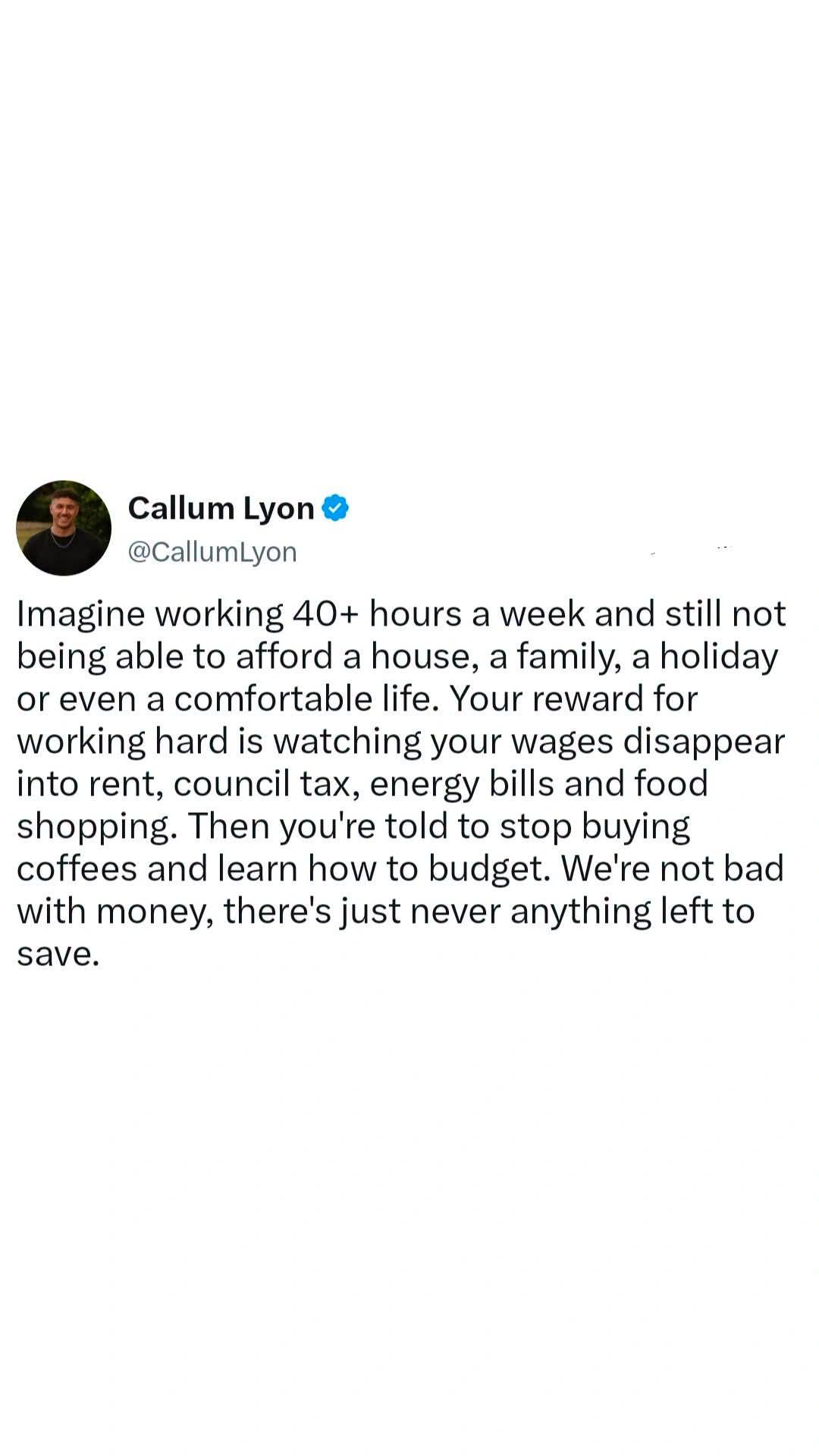
Work harder. Get another qualification. Find a better job. Stop buying coffee. Cancel Netflix. Learn to code.
Seriously?
Of course, personal decisions matter. But at what point do we acknowledge that individual responsibility cannot explain everything?
If corporate profits can grow by 914% beyond inflation while workers’ hourly wages grow by 80%, perhaps we should stop pretending that telling people to budget better is an adequate answer.
I’m not saying every dollar of corporate profit should go directly into workers’ pockets. Businesses have expenses, investment needs, and legitimate reasons to make profits.
But I am saying that we should be asking some serious questions about who benefits from economic progress and why the rewards are so unevenly distributed.
Workers build, manufacture, transport, maintain, sell, and provide the goods and services that keep the economy running.
They aren’t spectators watching the economy grow. They’re participants in creating that wealth.
So why are we so willing to accept a system in which the financial rewards of corporate ownership can grow so dramatically faster than the purchasing power of the people doing the work?
Most people can’t even afford a fucking house anymore
Let’s bring this back to something people actually experience.
Housing.
For generations, owning a home was a realistic goal for many working people. You got a job, worked hard, saved money, and eventually had a reasonable shot at buying a place to live.
It wasn’t guaranteed, and the experience varied enormously depending on where you lived. But for many people, it was an attainable milestone.
Now, in many housing markets, people can work full-time, earn a respectable salary, and still struggle to afford a home.
They save for a down payment while prices keep climbing. They pay rent that eats up a huge chunk of their income. They postpone having children or starting a family because the numbers simply don’t work.
And then someone who bought a house decades ago tells them they should stop wasting money on avocado toast.
You couldn’t make this shit up.
If housing costs hundreds of thousands of dollars more than an ordinary worker can reasonably afford, cutting out a few coffees isn’t going to solve the problem.
You cannot budget your way out of a housing market that has become disconnected from ordinary people’s incomes.
And housing is only one part of the problem. Groceries, childcare, healthcare, education, and retirement all compete for the same paycheck.
People aren’t asking for private jets or mansions. Many just want a decent place to live, enough money to raise their children, and the ability to retire without spending their final working years terrified of running out of money.
How have we reached a point where these basic expectations can sound like unreasonable demands?
What is the point of an economy generating extraordinary amounts of wealth if so many people who participate in it struggle to build a stable life?
At what point is someone rich enough?
Let’s talk about billionaires.
A million seconds is about 11.6 days.
A billion seconds is about 31.7 years.
A trillion seconds is about 31,700 years.
We throw these numbers around so casually that we barely stop to think about what they mean.
No human being needs a trillion dollars.
Not to live comfortably. Not to travel the world. Not to own beautiful homes, eat at the best restaurants, or provide for their children and grandchildren.
At that level, we’re talking about a concentration of wealth that is almost impossible to comprehend.
Yes, much of a billionaire’s net worth is tied up in stocks and other assets rather than sitting in a bank account. That is an important distinction, but it doesn’t make the concentration of ownership or economic power meaningless.
Meanwhile, ordinary people work for decades and still struggle to buy a home.
Some people work multiple jobs and barely keep their heads above water.
Others have to choose between paying a bill and dealing with an unexpected expense.
And somehow, we’re expected to see nothing particularly troubling about these realities existing alongside fortunes approaching a trillion dollars.
Question this, and someone will inevitably accuse you of being jealous or hating successful people.
No. There’s a pretty big difference between wanting to punish someone for being successful and questioning whether the rules governing our economy are producing a reasonable outcome.
I don’t care if someone is rich enough to live like royalty. Good for them.
But when the accumulation of private wealth reaches a scale that dwarfs the resources available to entire communities, while millions struggle to afford basic necessities, I think we’re entitled to ask whether something has gone seriously wrong.
The problem isn’t that some people have more money than others. The problem is when the gap becomes so enormous that people effectively live in different economic realities.
And wealth isn’t just money. It’s freedom.
It’s the ability to refuse a terrible job because you have enough savings to survive. It’s the ability to move somewhere better, take risks, start a business, or pay for an unexpected emergency without worrying about losing everything.
If you’re living paycheck to paycheck, your choices are much more limited.
That difference matters.
Why the fuck are we all fighting each other?
This is what really gets me.
People are constantly fighting about sexism, racism, religion, gender, immigration, political parties, and whatever controversy is trending this week.
Social media has turned outrage into entertainment. People spend hours arguing with strangers, insulting people they have never met, and treating anyone who disagrees with them as an enemy.
And for what?
I’m not saying racism and sexism aren’t real problems. They are. Discrimination matters, and people deserve equal rights and opportunities.
But we seem to have lost the ability to put things into perspective.
We can care about multiple problems at once. We can oppose discrimination while also demanding better wages, affordable housing, and a fairer economic system.
Yet so many people seem more interested in fighting someone who earns roughly what they earn than questioning why their own financial situation is getting harder to manage.
Why are we so eager to hate our neighbours while being so reluctant to question the people and institutions that have enormous influence over our economic lives?
Why do we keep treating ordinary people with different political opinions as our greatest enemies when we have so many problems in common?
A conservative working-class family struggling to pay rent and a progressive working-class family struggling to pay rent still have something important in common: neither family can pay its landlord with political opinions.
We don’t have to agree about everything. We don’t even have to like each other.
But we should be capable of recognizing that our disagreements don’t erase our shared economic interests.
Instead, we get caught in an endless cycle of outrage, while the underlying problems continue.
And here’s the really stupid part: people often defend economic arrangements that work against their own interests because they’ve convinced themselves that criticizing those arrangements means siding with the political tribe they dislike.
If someone proposes stronger labour protections, better access to healthcare, or policies that make housing more affordable, why should your first question be whether the idea came from someone on your political side?
Judge the proposal on its merits.
Stop treating politics like a sports team where your side must win every argument, even when you’re the one getting screwed.
Fix your own country before trying to fix everyone else’s
Another thing I find ridiculous is how eager people are to lecture the rest of the world while ignoring the problems in their own backyard.
People will spend hours arguing about what another country should do, how its government should operate, or which foreign conflicts their country should intervene in.
Meanwhile, people at home are struggling with housing, poverty, healthcare, infrastructure, and the cost of raising a family.
How about we get our own house in order first?
I’m not saying international problems don’t matter. Wars and humanitarian crises can be serious, and some situations deserve international attention and action.
But there’s a difference between caring about the world and constantly focusing on problems abroad while treating problems at home as someone else’s responsibility.
Your government has responsibilities toward its own population.
If people in your country cannot afford housing, why isn’t that a major priority?
If families are struggling to afford childcare, why isn’t that a major priority?
If people are working full-time and still living paycheck to paycheck, why isn’t that a major priority?
If young adults are beginning to believe that they’ll never own a home regardless of how hard they work, why isn’t that a major priority?
Instead, we often get endless political theatre, culture wars, and arguments designed to keep people angry at one another.
Foreign affairs matter, but they shouldn’t become an excuse to ignore the conditions under which your own citizens are living.
You can care about the rest of the world without neglecting your own people.
And you can criticize another country’s government without pretending your own government has everything figured out.
Maybe we should spend a little less time explaining how everyone else should run their country and a little more time demanding that our own governments address the problems we’re actually living with.
We’re living in completely different economic realities
Consider two people.
One owns several properties and a substantial portfolio of investments. When property prices rise, their net worth increases. When the stock market performs well, their wealth can grow without them working another hour.
The other rents an apartment, depends on a monthly paycheck, and spends a significant portion of their income on basic necessities.
When property prices rise, the first person gets richer. The second person may find that buying a home becomes even less attainable.
When living costs rise, the first person may have assets that appreciate in value. The second has to find more money to cover the same bills.
When work becomes unbearable, the first person can afford to walk away. The second might have to stay because missing a paycheck means missing rent.
These two people aren’t experiencing the same economy.
And this is why extreme wealth inequality matters beyond simple envy.
It’s about the distribution of security, opportunity, and freedom.
The person who owns assets has opportunities that someone who depends entirely on wages may never have.
And the more wealth becomes concentrated, the more important ownership can become in determining who gets ahead.
We tell young people to study, work hard, save money, and build a future.
But what happens when they do everything they’re told and still find themselves priced out of housing?
What happens when a decent salary no longer provides the security people reasonably expect from full-time employment?
At what point do we stop blaming individuals for failing to achieve goals that are becoming increasingly difficult to reach?
Hard work matters. Personal decisions matter.
But hard work cannot guarantee financial security when the economic conditions surrounding that work make financial security increasingly difficult to achieve.
We need to be honest about that.
So what the hell are we supposed to do about it?
I’m not suggesting that we abolish businesses, eliminate profits, or make everyone earn exactly the same amount.
Businesses need to make money. Investment matters. People should be able to benefit from their work, their ideas, and their willingness to take risks.
But none of that means we have to accept the current distribution of economic rewards as inevitable.
We can support stronger collective bargaining so workers have more leverage when negotiating wages and working conditions.
We can address housing shortages and reconsider policies that make housing increasingly inaccessible to ordinary people.
We can examine tax systems that treat different forms of income and wealth differently.
We can enforce competition laws, protect public services, and question whether productivity gains should translate into better wages, shorter working hours, or greater financial security.
We can vote for people who take these issues seriously instead of choosing politicians solely because they share our views on cultural controversies.
And we can stop automatically dismissing every discussion about economic inequality as jealousy or class warfare.
Because here’s the thing: the people benefiting most from the current economic arrangements have very little reason to change them voluntarily.
Some wealthy people support reforms, and some businesses treat their employees well. But we cannot build an entire economic system around the hope that everyone with power will always use it generously.
Rules matter. Institutions matter. Collective bargaining matters. Political participation matters.
And none of these things improves when ordinary people are too busy fighting one another to demand change.
We don’t have to agree on every policy. We don’t even have to agree on what the ideal economic system should look like.
But we should at least be able to agree that people who work hard deserve a realistic chance at a decent life.
We should be able to agree that housing shouldn’t be an unattainable dream for so many working people.
We should be able to agree that children shouldn’t grow up believing that financial security is reserved for people who were fortunate enough to be born into wealth.
And we should be able to question why an economy that generates so much wealth leaves so many people feeling financially insecure.
Stop fighting your neighbour over every political disagreement long enough to ask who actually benefits from the way things are.
Start paying attention to the policies that affect your wages, housing costs, and financial security. Hold politicians accountable, regardless of which party they belong to. Support workers who are fighting for better conditions, and stop dismissing economic inequality as someone else’s problem.
We don’t need to agree on everything, but we need to stop accepting that working hard and still struggling to afford a decent life is just the way things have to be.
If we want things to change, we need to stop treating the status quo as inevitable and start demanding better from the people who have the power to change it.
PS:
I don’t want to make it political, it’s strictly an economical rant.
TLDR: After adjusting for inflation, US corporate profits have increased by roughly 900%, while real hourly wages for production and nonsupervisory workers in goods-producing industries have increased by only around 80%.
In other words, corporate profits have grown more than 10 times as much as workers’ wages. Meanwhile, ordinary people are struggling with housing costs, bills, and the rising cost of living.
Maybe it’s time we stopped fighting each other over everything and started asking who this economy is actually working for.
r/WorkReform • u/Conscious-Quarter423 • 2d ago
r/WorkReform • u/Affectionate-Fix4671 • 2d ago
r/WorkReform • u/Lord-Notorious • 3d ago
r/WorkReform • u/itsCS117 • 3d ago
MODS, this is not a post glorifying violence but shows how society can progress when there's nobody on planet earth hoarding a billion dollars.
r/WorkReform • u/Haunting-Park8052 • 2d ago
And now if you want hours you have to sale sale sale to add seconds to the labor available
r/WorkReform • u/Affectionate-Fix4671 • 3d ago
r/WorkReform • u/UnionStaffSEIU • 2d ago
Enable HLS to view with audio, or disable this notification
r/WorkReform • u/Conscious-Quarter423 • 3d ago
r/WorkReform • u/zzill6 • 3d ago
r/WorkReform • u/Jet_the_fem_bean • 3d ago
r/WorkReform • u/StealthMan375 • 3d ago
Get ready because Brazilian politics are a mess. This might be a simplification and my main focus is getting the message out about possibly the greatest win in South American working class history, if other Brazilians want to tip in then yall are more than welcome my fellow anti-facistas.
Context: the standard work model for unspecialized labor is 6x1 (you work 6 days, and get one day off), either via 8hours Sun-Mon and 4 hours on Saturday (office jobs) or via 7:20hs 6 days a week.
Most work contracts in Brazil follow the CLT (Consolidation of Workers' Laws), which estabilishes a few mandatory rules that companies have to follow (salary has to be above the base salary for that specific field - i.e all cashiers in Brazil earn at least X, all nurses earn at least Y, 13° salary, 30-day vacation, equal pay for everyone in the same role, the right to a doctor's note), as well as many NR (normas regulamentadoras/regulamentary norms) regarding many workplace aspects like mental health, accidents, heavy equipment, PPE, forklift licenses, medical leave and etc. as well as companies being forced by law to have at least one workplace safety technician (equivalent to an OSHA member) whose sole job is to make sure these guidelines are being enforced properly.
The left-wing's main representant is Lula, current president of Brazil (2002-2010, 2022-2026) who was previously a metalworker himself who lost a finger in a workplace accident, led multiple massive worker's strikes during the country's military dictatorship in the early 70's, became a union leader before becoming a congressman and is up for his 4th term as President, backed by the PT - Worker's Party. He was around to see the workweek be reduced from 48 to 44 hours, was pushing the 40-hour workweek for the last 20 years and is totally onboard with ending the 6x1 work schedule.
The right-wing (spearheaded by Flávio Bolsonaro and the PL - Liberal Party, son of Jair Bolsonaro who is mostly known to foreigners for his catastrophical handling of COVID-19 during his own stint, an attempted coup as well as our own January 6th) wants to phase out CLT altogether and replace it with a system where the employer negotiates terms with the employee in a similar vein to the US's own system, complete with an hourly wage and all the drawbacks, which would indirectly force a 7x0 (no guaranteed days off) since you'd no longer be paid on a salary. During the 1st turn of elections, loads of right-wing candidates, as well as most of the Bolsonaro family, got elected to Congress.
The "voting" in question pertains to a PEC - Process for Constitutional Amendment, which pertains to the process needed to add a new clause to the Constitution.
PEC 221/2019 estabilishes reducing the workweek to 5x2 (5 days working, 2 days off) and 42 hours in a max of 2 months after this amendment is successfully approved plus a further reduction to 40 hours in another 12 months.
Flávio and his posse have deliberately articulated to delay the voting for as long as possible, however the fact we are only 2 weeks away from runoff day between Lula and Flávio basically forced their hand, and it's almost a certainty that "yes" will get enough votes.
As for the comic itself, the bosses parrot around the idea of 6x1, while the worker would clearly prefer 5x2 but can't voice it for obvious reasons. The penultimate strip shows our eletronic ballot, while the last strip shows a privacy cabin with the saying "Now it's your turn", as it's now her turn to actually express her opinion.
r/WorkReform • u/zzill6 • 3d ago
r/WorkReform • u/LuckyBastard001 • 3d ago
r/WorkReform • u/zzill6 • 3d ago
r/WorkReform • u/gashtal_man • 4d ago