I mean, as silly as it is to question the dictionary, it is a second hand source. Their job is to compile information, while they have researchers on staff the dictionary isn't the primary source, and definitely not the social media side. Probably not something a random person cares about, but eytomology is a real scientific study and needs evidence and primary sources to back it's claims.
Now, I decided to search to see where the dictionaries are getting their primary source from. Most of the sources just stated it as known fact, didn't attribute any source, or attributed the dictionary. The dictionaries I looked at didn't have a source listed either. Merriam-Webster only gives themselves as a citation.
So I did some looking into it, there was a book published in 1999 by Leslie K. Arnovick titled "Diachronic Pragmatics: Seven Case Studies in English Illocutionary Development" which on page 99 and 100 contains a table showing examples of what they view as the same phrase altering from "god be with you" in the 1400s becoming "goodby" in the 1720s-1750s. However, while they cite a number of sources about the meaning of prayer, they don't give any citations for the table itself. Furthermore all of their citations are from other books written in the 1900s, no citations to works in the described times. So this source is yet again another secondhand source that isn't attributing the original research it supposedly is writing from.
They do go on to cite some sources from the 1600s a few pages later where within the same play different characters will use variations of expressions ranging from "god-b'w'y" and "Good b'we" which comes with a question. Why does the expression differ within the same text? And not just in one text, but across multiple different texts multiple variations in which both good and God are used, seemingly interchangeably as a generic parting phrase. Just because two expressions can be used interchangeably doesn't mean that one came from the other. On page 104 they speculate that good may have been intended as a secular variation of the same parting gesture.
Something that I'm curious about however is that the word "good" while being used interchangeably with the word "god" during the 1500s and 1600s, it appears to have been its own word during the 1200s with a similar meaning to what it has now. So purely as my own conjecture as a layperson, it seems reasonable that a highly religious population without a standardized pronunciation and spelling would partially combine the words good and God given that they had a favorable disposition of God and that good was a word with a positive meaning, and that "god be with you" meaning a message of positive departure, and "good be with you" as an alternative phrasing of the same thing wouldn't be entirely out there.
But in the end it's all speculation. I found another source, "Confusing Etymological Facts with Uncertainties" by Anna Faktorovich published in the Pennsylvania Literary Journal Volume 16 Issue 1, where she points out that a lot of eytomological research is based on flawed secondary sources. She mentions the "Richard Vertegans Restitution" published in 1673 which is available on internet archive in middle English, is a source for much of our understanding of middle English and that author regularly tried to use words he didn't understand or were straight up invented by Vertegans. That a lot of dictionaries just pull this guys research without attribution.
I don't really know what my main takeaway from all of this is. I was expecting to find a source that either confirmed or denied the connection. Instead I found speculation with some weird inconsistencies, which I shouldn't be surprised by given that the only primary sources are over 400 years old and didn't have the kind of scientific rigor that I would prefer. I kinda wish that Merriam-Webster would explain the uncertainty of the connection rather than presenting it as certain fact, and I would definitely prefer that they make it known what primary research and sources they pull from, if not on their social media posts then on their actual website and dictionary. I dunno, I guess I just feel a little disappointed with the field of eytomology.
I mean, you shouldn't trust reddit comments as a source, this is a tertiary source at best. Its why I included the sources I read from so that people interested could read for themselves and make up their own minds about it.
Too late, your Reddit post has been cited in a foundational paper of the field and now several hundred scientific articles have made your argument load-bearing in their analyses, sorryyyyyy
The reason why you're "disappointed with the field of etymology" is because, as you acknowledge, you're a layman in the field of etymology. So you bring in glancingly related secondary sources to incorrectly undermine the question at hand, and since you don't understand foundational elements of the field you think that there are uncertainties behind totally straightforward phenomena.
For a latter example, you say "within the same play different characters will use variations of expressions ranging from "god-b'w'y" and "Good b'we" which comes with a question. Why does the expression differ within the same text?" In reality, this is totally unsurprising and very common. Since spelling was still being standardized at the time period, different spellings for the same phrase -- yes, in the same text, by the same author -- are totally normall and expected. This does not raise any notable questions.
For a former example, you use a minor journal's review of a pop-humanities book, which briefly mentions the "goodbye" etymology, to cast doubt on that etymology -- based on a claim that the field as a whole is gullibly using one problematic source to motivate this etymological claim. But field as a whole is not resting on the Verstegen source. Critical analyses of this and other sources is the central basis of the field.
The etymology of "goodbye -> god be with you" is frankly totally uncontroversial. It is based on multiple strands of evidence, from extensive historical examples (the OED has many longstanding examples and the editors are not just mindlessly citing these examples but instead using decades of research as a basis), to parallel formations in other words and other languages (just off hand, consider gospel and adieu, but there are more).
"But in the end it's all speculation" -- yes, if you think all of historical study is speculation, then it's all speculation. But when you don't know what you don't know, that's where you end up.
Merriam Webster is a popular dictionary. It is not sensible for a commercial product like this to spend thousands of words backing up the etymology of each phrase it includes. Instead, it is efficiently presenting the critical consensus on facts like this in order to better inform readers. If that's not what you want, don't read Merriam Webster. Instead, you can make a career change and get a PhD in historical linguistics.
I need to tell you thank you for this comment. As I get further into my own education, I realize both how little I know, but even moreso how little most redditors know. You've put it perfectly in this comment the issue with most laymen on this site
For the commenter you are responding to, this paper has some good discussion on the etymology of the word goodbye, and provides a good demonstration of the strategies linguists need to use when determining a word's etymology.
They seem to think they should be able to find a smoking gun, a primary source where someone in 1600 writes "Boy I'm glad we aren't using that clunky old god be with ye phrase any more, goodbye is where it's at!". But for the vast majority of words in any language, people aren't talking about them like that.
Instead linguists have to use tools like:
reconstruction of transitional forms
language trends
analogous constructions
phonetic analysis
A layperson almost certainly isn't going to find a satisfactory explanation just by looking at old documents. And dictionaries are going to continue their business of being descriptive by citing the occurrence/usage of words, but they certainly aren't going to go into all the business above. They are simply going to report the common consensus from the people who do go into all of that.
If they think that's speculation...well, sure, I guess? But in that case, so is any fact reconstructed on the basis of evidence rather than direct observation.
You know, you are right, in retrospect I'm not disappointed with the field of eytomology as a whole, I'm disappointed specifically in how Merriam-Webster reports findings within the field. The few secondary sources I used in my comment were the few that I found that mentioned the phenomenon, most sources I did come across were non-academic so I stuck to the few I could find. And it was neat seeing the chart of the expression changing over time, though I would have preferred it that 1999 text had a specific citation for the table.
What I found most disappointing was that almost every "source" I could find would only lead back to Merriam-Webster, and Merriam-Webster does not serve any viable way to continue searching for more primary documents. The 1999 text had interesting insights and while I dislike their citation style, I did appreciate that they had sources for their claims.
And presumably Merriam-Webster does have thousands of words of discussion over the eytomology of words because they hire linguists to research and discuss it. Its just that the process is internal and opaque to the public. And yeah, they don't have to release it, it's proprietary and they aren't a scientific journal, but I still find it disappointing that they don't link or publish at least some of that process for peer review.
How are you searching for your sources? Are you just using a websearch or do you have access to an academic database? While I strongly believe that academic study should be freely available to all, the reality is that much of it is locked away behind paywalls.
You also seem to have missed the source I cited in my reply to the parent comment you are responding to. See that comment for a better explanation of why you are not finding what you are looking for, and why you are almost certainly going about this entire process the wrong way.
That's the issue with just being interested in etymology without the academic knowledge/access. My best bet is etymologyonline and whatever relevant books and quotes I can find publicly available. Which often means that "why" is answered with "inconclusive"
I have no doubt that my process was not ideal. I do have access to an academic database, but unfortunately I could not find anything directly related to what I was looking for. Part of this is probably my own inexperience with searching for eytomological sources. All of the research I do is related to biomedical studies.
After I failed to turn anything up with my university database I turned to a generic web search which failed to yield any results that were directly academic, but did yield some people in a forum which did cite several resources that I looked into next. I also did a search on Google scholar, but the majority of what I found were books related to theology rather than eytomology.
My disappointment with Merriam-Webster is not really their fault. I went to their dictionary expecting something akin to an academic journal, but they're a product for general public use. I don't blame them, but it also doesn't really change how I feel
To echo what other people say, linguistic changes are gradual and the studies relating to this are much more concerned with shifts over time.
An intuitive site for etymology trees is Wiktionary. Their entry on “goodbye” has the tree that you probably want to look at for all the words it was originally composed of (God, be, with, you) and the other versions of Goodbye and its shifts such as Godbwye and Godby.
Furthermore, Merriam-Webster traces its etymology into Old English and its needed language, but “generally do[es] not provide an etymology for words created by English by the combination of existing constituents or by functional shift.” (Merriam, How to Use the Dictionary)
It is for this reason, that while goodbye is a cool fun fact, it does not warrant an etymology in their definition under their principles. While that would be nice to explore, that likely falls under the jurisdiction and niche of interactive etymology trees.
But what you’re saying is fair. The overall gate-kept nature of many academic disciplines places paywalls and esoteric barriers in front of people who would greatly benefit from reading citations and further studies.
A little condescending, don't you think? They did some research, acknowledged they weren't an expert, and lamented the authority on the matter didn't provide direct sources to prove their claim. In turn, you mocked and dismissed them.
I would love to see Merriam/Webster digitalize what they have for their research and whatnot, just for the english language. I imagine it would put encyclopedias to shame.
It’s unfortunate to that the social media post doesn’t actually mention any of this, and refuses to actually back up its credibility as a reputable source of information.
For what it's worth, Merriam-Webster is the authority on American English. If I'm writing a paper and cite them, the professor wouldn't ask for a better or more primary source. That doesn't mean they don't exist, but the understanding is that if Merriam-Webster prints it, it means they did the research to back it up; and, if another dictionary disagrees with them, they probably (but not definitely) didn't do the same level of research.
While it's fair to say it's speculation, it's informed speculation. Like when a physicist tells you that some particle probably behaves a certain way but it hasn't been confirmed, it's still safe for you to assume that's how it will be.
Only to a certain level of rigor. If you're writing a paper about another topic and you cite Merriam-Webster for a related claim that's fine, but if you need a primary source on the eytomology then they aren't good enough, and by them not listing what their source is means that proper peer review can't occur.
The highest level of rigor possible. You do know this is the internet and these things need to be taken seriously. What would happen if people just started communicating made-up nonsense? Absolute chaos, I tell you!
Presumably you aren't just citing the twitter. My complaint about a lack of citations goes all the way to their dictionary itself. Granted, I only read their online version, not their physical copy, but in the short search I did I could not find references to primary or secondary source documents.
Looking at primary and secondary source documents does suggest that Merriam-Webster is probably correct in their claim about the word "Goodbye", but it still feels like poor practices to not make your sources known, for both crediting the secondary sources and their authors, but also to lend credibility by making the process of peer review easier.
but they don't need to lend credibility, that's kind of the point. I don't think you really understand, I mean of course you have a right not to use them as a source or give them any credibility in your own mind. but for you to formally question them, you would have to be yourself an etymologist, not just someone who went down an internet research rabbit hole for a Reddit comment. like you don't really have any standing to say "this didn't mean my threshold for an acceptable reference" if you yourself are not an expert in this field. they don't need you to accept their information, they provide it based on the research that they've done, but fundamentally etymology involves a lot of uncertainty and what you get is what you get.
it's kind of like questioning a meteorologist, like sure you're not beholden to listen to them, but fundamentally they're making an argument about something that's not entirely certain, they're giving evidence and that's the most that can be done with it. you can say you don't agree but... if you yourself are not also a meteorologist then you just said no to the best guess you have of what the weather is going to be. now you know nothing as opposed to something uncertain.
What you are saying makes sense when you are talking with an expert in a field of something. But Merriam-Webster is a corporate entity. And as such they are comprised of a multitude of people and subject to change in leadership that can in the future or present morph them into an entity controlled by non experts. Which happens to corporations all the time.
So it is not too unfair to hold them to a higher standard when it comes to having sources available. After all, they are literally a dictionary. Why shouldn't sources to etymological claims within the dictionary link to primary sources.
I've got no clue why anyone would be arguing that some kind of entity don't need to post their sources to substantiate their claims. Them saying something without sources does not make it a fact. Whoever it is.
That is just basic. And if anyone asks for sources, why not provide them?
I'm only commenting because I enjoy this type of thought experiment. That said, can you imagine the size of the books(yes with an s) that would be needed to provide sources for just the english dictionary? I feel it would put the encyclopedias of old to shame. In our info era, I would love to see Merriam/Webster digitalize what they have for their research and whatnot.
As a source in etymology they probably aren’t appropriate as a primary, but as a source about definition, they are. They are the source that describes the meaning of words as they are used.
I mean that would (or should) depend on the paper you're writing. If it's actually a paper in etymology, then dictionaries, even reputable ones, are not a source that should stand unquestioned.
How does the average person know to trust them in this manner? If they cite no sources and have no paper trail, or in other words, if there is no pressure for them to be transparent about their research process, then why do we trust them to maintain the same level of rigor going forward?
if it's informed speculation, it is completely reasonable for somebody to ask what specifically informed it
there's no such thing as an authority that I trust to the point where they never have to provide the derivation of their statements, unless they are specifically empowered to decide the answer by fiat. Merriam-Webster might get close to that for the definition of words but they are absolutely not that for etymology. if you cited Merriam-Webster as your source for the etymology of a word, your professor should not accept it anymore than they would accept a popular science magazine as a source for a physics question
so the person's question was perfectly reasonable, and for anybody in the game of doing actual empirical research, the natural answer would either be to excited explain it or to be curious themselves if they don't know the answer.
"what" is a bad answer
edit: looking further, it does look like they provide their derivation of etymology behind a paywall. In which case I was wrong about citing them for etymology. but then a better answer would be to just point the guy at where they can go find the answer to these questions and not with "what"
of course it's probably just some intern but whatever. I mostly don't like people reacting like it was unreasonable for somebody to ask about sources for a factual assertion
His whole job is to engage with the public and he has been doing tweets that don't include looking up words in a dictionary as well. Do you think he went to the etymologists to ask them to fact check foldable dictionaries before posting? And don't try to strawman me, if you have nothing more to say then just keep quiet instead of trying stupid logical fallacies to win an argument you lost.
Also now that I actually bothered to look up more on their social media stuff, the person at the head of it is a woman named Lauren Naturale.
But a scientist (physicist) calls it a theory until proven... MW shouldn't pretend this question is settled. And no single person or group on Earth will ever be 'the authority' for any topic that exists in every situation. That is just silly.
You're right on the first point, I stupidly mixed up theory and hypothesis.
However, saying someone is the "authority" on a subject, you have to be referring a specific situation. You cannot say that a single dictionary company is the sole authority on the English language. That is a ridiculous notion and why I commented in the first place.
I didn't say it was the sole authority. I said it was the authority (as in, most respected and trusted) on American English. For UK English and the language in general, you turn to the Oxford English Dictionary. That doesn't mean other dictionaries are not also authorities on English. That's kind of the point of a dictionary. Just that Merriam-Webster is, among scholars, the highest authority in American English and second only to the OED.
That physicist comparison is pretty weak. Physics is a science you actually can back up with experiments and proofs. Some kind of historian would be a better parallel.
Eh, six of one. The point is, "speculation" is accurate but misleading if you think of it as just dudes making shit up off the top of their heads. They are a scholarly organization doing rigorous research and their speculations are as close to the truth as anyone is likely to find.
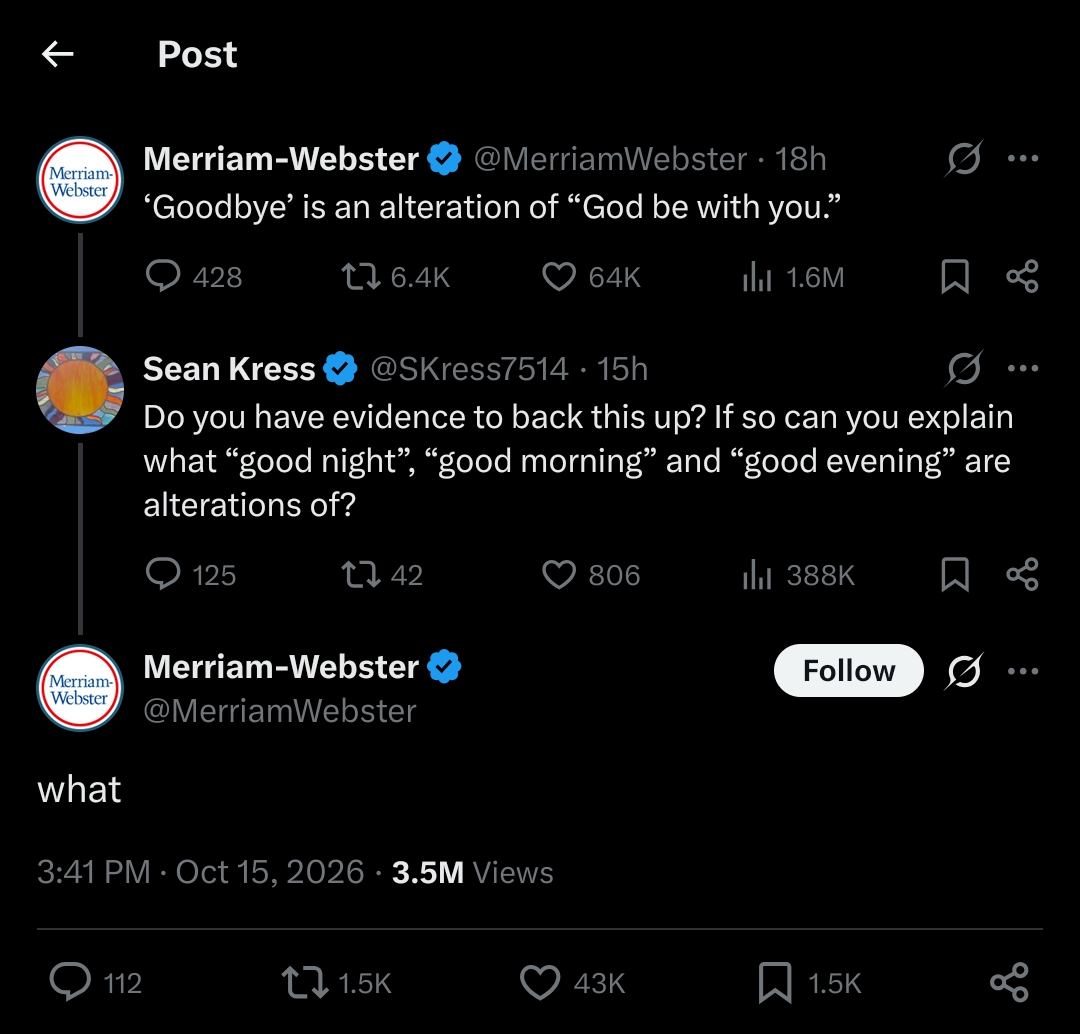
While questioning the first half is reasonable (though a sufficient expaination wouldn't fit in a twitter post), I think the deadpan "what" is in response to the second half. The origins of "goodbye" may be ambiguous, but "good morning", etc... aren't shortened forms of anything and have incredibly straightforward etymology. It's just wishing someone have, well, a good morning.
I think your expectations of what you wanted to find to satisfy yourself were not completely realistic.
Etymology is the study of how all words being spoken by the entire population of speakers have changed across all of time.
It is exceedingly rare that you would ever have a single event to document when words universally change for the whole population, in the same moment.
You seem to have been expecting a scenario where there was a single day in the past when a single person announced that there was a new spelling for a phrase, and that everyone switched over. Goodbye doesn't have a moment like that, but there's more substantive evidence for the god-be-with-ye than any other theory. That's not "it's all speculative and every theory is just a guess". That kind of conclusion shows less scientific rigor, not more.
It's even a little like the creationists who think that it's somehow damning that people who study evolution can't point to a single photograph of apes becoming humans, and that it somehow means there's no way that evolution has scientific rigor.
I think you are dismissing academic work without understanding its value.
"It's a good general theory with academic support, but I won't be convinced without a single moment of undeniable evidence that will convince a casual non-academic. Where's the Smoking Goon?"
Oh, it's time for uncharitable takes? Here's mine: no one should read engage with etymology works unless they plan on praising them. People should remain in the folk etymology cave, watching the shadow play "Fornication Under Consent of King"
I tried to say that gooning and masturbating aren't even the same thing, and the automod called me a transphobic Karen for some reason. Now I can't even focus on what I was trying to say because I'm so confused. What kind of moderation does this sub have???
Regarding the point you were trying to make, I know! Gooning is technically a very specific form of masturbating. The automod calling you a Karen for that is really funny though
I figured it out! I tried to type "it matters to me" with asterisks for emphasis, but an asterisk next to "it" set it off. Honestly kind of funny 🤣 accidentally unwoke, my bad
I guess I don't expect a perfect answer that is without any doubts. But I would like the claims that I see to be substantiated. Dictionaries hire linguists, that much I know, but coming from other areas of scientific research, when someone makes a claim you expect to see it substantiated with either original research or a citation to who did the research. For a dictionary (not the tweet, but the actual webpage for the dictionary) to not include which textual pieces of evidence they used to draw their conclusions means that peer review can't be properly performed. I find it disappointing that the claim which is stated as determined fact is substantiated by only decently strong speculation.
I suppose it's not really a testable hypothesis, they have what literature survives, and they can't go back and see how it's spoken. The only way it gets disproven is if a substantial portion of literature of the time happens to get found documenting it better than what we have already.
I guess what I would really want is for the dictionaries to be more clear where the claims for their eytomology come from.
I find it disappointing that the claim which is stated as determined fact is substantiated by only decently strong speculation.
But in this case the claim in the general readership dictionary is substantiated by more than "decently strong speculation". It's substantiated by many years of primary source analysis from both the OED and academics working independently.
They studied primary source writing. There's a clear trend of attestations of people using God Be With Ye to greet people in primary source writing. Later it shifts to people saying Goodbye, with documented primary source stops along the way (that any independent researcher can reference and confirm in the primary sources cited) of [god be wy you, god-b’w’y, godbwye, god buy’ye].
Your own review of the academic work shows it's a claim based on cited primary source databases. You, or someone else, can independently confirm their research in Chadwyck-Healey yourself, if you wanted to.
There is good evidence for the claims that dictionaries make, I would like to see the dictionaries cite that evidence though. And I don't mean for the tweet, it's just a tweet, but for when I open up the Merriam-Webster website and I'm looking at the stated etymology for a word, I don't just want a statement declaring the proposed origin, I'd want something of more substance, detailing how they know it to be true.
I understand the preference to not have capitalism-induced gatekeeping in the immediate flow of information.
Is this just that you want the material found in the Merriam-Webster Unabridged website and the full OED to be in the unpaid sections of their website?
The free section of the OED is a little more generous. and it gives some of the primary source examples and an academic summary for goodbye.
Again, I feel like this is more that the information is out there, but it's unfamiliar or unrecognized at the moment, for you. Mostly because of the paywall, and not because it doesn't exist and dictionaries are making random unacademic guesses from nothing.
Yeah this is exactly the kind of thing I'm looking for.
And I always assumed the dictionaries were making educated guesses based in the historical record, I was just disappointed that Merriam-Webster didn't make their citations evident on their website.
I feel like this entire train of thought you've had is one of a person who has never used a dictionary for its intended purpose.
According to Google right now (poor sourcing, I know), Merriam-Webster’s main unabridged dictionary contains 470,000+ words. Do you really expect them to provide full, extensive, primary source academic documentation for nearly half a million words? And if they did, of what use would it be, and to whom? And in what building or buildings would the physical copy of that dictionary reside?
The people who actually have a use for that level of detail, beyond random curiosity about a popular word or phrase, probably already have access to the documentation that exists and training in properly interpreting it. For everyone else, which is almost everyone, they're mostly looking for the definition, spelling, and pronunciation. The bits provided about the words' origins add flavor and interest and such, and can provide valuable additional information about why it means what it means, and is pronounced or spelled that way, and the right ways to use it. Reading the blurb about what "palimpsest" means and where it came from is extremely interesting. But I do not need a list of the original sources in ancient Greek; nor do I need a completely sourced history of how the word came to be generalized from a piece of paper that has been scraped off and reused to the current metaphorical usage (which in this case is reasonably self explanatory).
This is a very valid point regarding their dictionary, and I am in the weird position of having a casual enough interest to want to skim primary sources occasionally, but not enough interest to become a linguist.
I really would appreciate a supplemental guide which explains the thought process behind the words, their definitions, and eytomologies in the dictionary though. Because they do employ linguists and historians to comb through documents to assemble their dictionary, and I'm certain that they had fascinating discussions and from an academic perspective their insights and discussions surely must have been valuable.
But I imagine not profitable. And that's the deciding factor.
Well I think the reaction here is less about them questioning the second hand source and more about the logic of asking what "good evening" and the like is an alteration of...because it's sorta self explanatory lol.
AFAIK bye is simply a shortened form of goodbye. I think the dude questioning the dictionary doesn't understand that. If you interpret bye as its own standalone word, then it's easy to think "good evening" might be related.
They're wrong, but I can see where the logic lies.
This by itself is not a satisfactory explanation at all. There are plenty of words which are contractions of two other words that don't necessarily form contractions* with other words.
Which would mean that “goodbye” forms no connection to “good evening” or “good morning” in the sense that the user in the image assumed, yes. Unless I read your comment wrong, aren’t we agreeing with each other?
I mean, it sounds self explanatory, but if goodbye comes from an unexpected place than perhaps other common expressions involving good also come from unexpected places. There's the impulse to assume that it comes as a branch of goodbye, but what if it didn't. I wouldn't be shocked either way at this point. Word evolution is weird
Where “goodbye” comes from tells us where “good” and where “bye” comes from.
To know where “good evening” comes from, not only is the information contained in this very comment already enough to show it didn’t come from the same place (it is two words instead of one, alongside other things), but you’d only need to know where “evening” comes from (“good” has already been sorted out)
It's the other way around. The "good" in "goodbye" comes from a corruption influenced by "good morning", "good day", "good night" and the like because those were already common greetings/farewells, not just in English but in the germanic languages that influenced English.
Because it probably isn't an alteration at all. Goodbye may very well be extrapolated from "God be with you", so let's assume that that is correct. But "good morning", "good night", "good etc" are clearly contractions of words. And they are both said in greeting and leaving, with the exception of "good night". So you could then make the assumption that there is no connection between "goodbye" and the other, separate word "good"s. They are simply the wishing by the speaker to have a good whatever, or to hope that their whatever is good.
So, you and everyone upvoting/rewarding have a fundamental misunderstanding here: etymological research does NOT work like a modern scientific investigation. In historical linguistics, primary evidence consists almost solely of surviving historical records (e.g., plays, manuscripts, printed books, etc.). A sixteenth century play containing God b’w’ye is itself primary evidence.
More importantly, historical documents do not to have been produced with scientific rigor to serve as valid scientific evidence. Since we can compare dated occurrences of related expressions AND determine whether the proposed evolution is consistent with known linguistic processes, we can support a reasonable conclusion without needing it explicitly being stated that “we shortened God be with you into goodbye.”
So if I understand you correctly, you're saying that "what" is an alteration of "bitch, I'm a dictionary. Do I look like a motherfuckin encyclopedia to you?"
1) Good and god have different origins, one did not come from the other (tho good came from proto-germanic "gōdaz", similar word but that is not the origin of "god" in english. "Gōdaz" from proto-germanic became gut in modern german [good] too).
Because good and god have separate origins, the expressions "good night, good evening, good morning" developed completely independently from god be with ye. These expressions have been in use alongside each other for a while.
Contraction of god be with you to Godbwye, God b'uy (and some other variations) are documented with primary sources.
No way to prove with a primary source but a process which has been documented for other analogous situations suggests that because Godbwye was contemporary to "good night, good evening and good morning" some part of the language users changed Godbwye simply to fit the mold of these other common expressions because it sounded right.
So yeah, that is pretty common in etymology. There is no first hand source for the actual transformation but they know that some processes happen commonly for a number of reasons. Documented with primary sources for some subset of them.
One of these common processes is exactly this: When expressions are commonly used during the same time period and location, if they sound like or are spelled similarly to each other and have similar use cases, they commonly get gradually changed to sound more similar to each other, specially back in periods of high rates of illiteracy and no standardization bodies. This is called "analogical remodeling".
Godbwye became Goodbwye because it was contemporary to good evening, good night and good morning with a similar use case.
Why does the expression differ within the same text?
Spelling consistency was not a thing back then and with texts that old it's very common to see the exact same word spelled multiple ways in one text. For instance, William Shakespeare spelled his own name 3 different ways in his last will and testament: William Shakspere, Willm Shakspere, and William Shakspeare. Of course this was also true of the words in his plays scripts.
This is really interesting, thank you.
Interesting implication that the field is so ambiguous. What is truth and what is materially important and all that
I am so disappointed that your comment history is hidden. I went looking in hopes of more deep dives on niche topics. I would like to subscribe to your substance please!
I have good news and bad news. But news you should be aware of for your safety. Hiding comment history does nothing. You can just google the username. As of the last month or so gemini will also provide you a helpful "summary". Or completely dox the user in question. Heres one I prepared earlier. This is intended behaviour - reddit and google have a $50 million for reddit to channel all its user content directly into gemini.
I am in stem. If I had to boil down exactly what my complaint is, it's that Merriam-Webster doesn't make their process of eytomology discover clear enough for peer review. I would be fascinated if on their website where they list the definitions for words and their eytomology they include the sources they use.
For the eytomology especially, the knowledge has to be based in old English literature, documents spanning centuries where they document the use of words and their spelling. Wouldn't it be really fascinating if they could list those uses as they occured. Or if they are pulling from another source who did that, then it would be really helpful for the dictionary to point to that source.
Ok, first thing's first: You do realize that the "what" is in response to asking what "good night" "good morning" and "good evening" area alterations of, right? Because they aren't alterations of anything.
I really hope you didn't write seven paragraphs after being whooshed.
Personal anecdote: I have relatives in a religion where after Sunday service they would part ways with "God's peace". But they would do it so often and so quickly that it became one continuous word "Godspeace" sounding towards "Gospeace" such that you wouldn't really know what they were saying if you didn't already know. A very young cousin you didn't know asked "Are they saying 'capiche'?"
I wasn't there in history for the "Goodbye" alteration. But, I've personally witnessed a small moment of a close analog of it in the wild.
Thank you for doing the research! One connection that may have happened that I wonder about is God and good being switched around, due to the fact that “good” used to mean that which is holy (such as with the holiday Good Friday)
Just in case you hovered over the "cancel"/"discard" button, because "who would even read this?": I appreciate your lengthy comment :)
With that out of the way, I'd like to push back a little on this part:
a lot of eytomological research is based on flawed secondary sources. [...]
I dunno, I guess I just feel a little disappointed with the field of eytomology.
Because this isn't limited to just etymology, it's everywhere!
Take any random article about history, the arts, even the oh so mighty hard sciences and you'll likely find issues in sources, citations, attributions, methodology, etc., if you drill down deep enough.
Usually, whatever you find doesn't completely destroy whatever argument is being made, it does showcase that it's maybe not quite as solid as the confident headline or assertion makes it out to be.
I'm in no way trying to discredit science (it's still the best thing we've got), but as someone who has studied both history (as in historiography – the process of writing/creating of history) and a hard science/engineering (looking at and analysing lots of data, as well as methodology), I've learnt to essentially mentally prefix anything with "to the best of our understanding". Seems so painfully obvious to the point of being pointless, but I find it helpful to be explicit about it. Another related thing: instead of, for example, "Nero played the flute as Rome burnt", "Sueton writes that Nero..." makes quite a big difference (really wish that this was enforced on /r/TIL, for example).
You're very valid with this take, recently within a field related to the field I'm in someone got discovered to have been commiting fraud across dozens of papers, and it took years for them to get caught.
One of the biggest things we get taught is to never falsify our data and yet it's everywhere. I've had labs for school where we knew we were supposed to get a certain result and didn't for some reason and it's always so difficult to convince my fellow students that it's okay to report the data we collect.
We ended up being one of the few teams that properly reported our results, which were tainted alongside everyone else's because one batch of product had unexpected animal proteins in it. So many groups lied about their data because they were afraid they would get a bad grade for having a result that seemed strange
But that's also why properly citing where you get your sources from is so important. We don't know where Merriam-Webster gets it's information for any given word eytomology. I'm pretty sure that they're right about the "god be with you" thing but I can't know if the data came from a reputable source if they don't cite it. And without those citations we can't gauge quality of research on a word by word basis. Maybe they're almost always right, but occasionally they slip up on a word and use a source that is later debunked. If they don't have a clear paper trail detailing which sources were used for each word then it may slip under the radar.
Furthermore, without clear citations you end up with circular sources. This happened a lot with wikipedia articles a while back. Someone would write something in Wikipedia without a cited source, some site or book would copy it in its entirety, and then when someone looks to add a citation to the wiki they'll cite the source that links back to that site or book that copied Wikipedia. Its not unreasonable to worry about something like that happening to a dictionary. Now presumably Merriam-Webster has strict quality control, but without citations that quality control isn't transparent, and mistakes can fall through the cracks.
Yours and some of the other comments made it more clear to me that I'm not upset with the field of etymology, I'm just upset with Merriam-Webster's lack of source citations. They have a team of people who debate over the exact wordings within their dictionary, and they host it online, surely they could include a discussions portion where they list the varying viewpoints of their scholars, where they agree and disagree, and the evidence they use in their arguments.
Furthermore, without clear citations you end up with circular sources. This happened a lot with wikipedia articles a while back.
It's also ridiculously common in online newspaper articles.
A small, local paper reports something. They know that their source is maybe a bit iffy, but hey, they're a small paper with limited resources and impact. The story gets picked up by a bigger paper and properly cites the small one. Maybe adds some of its own details and/or additional sources. This then gets picked up by more and more papers, big and small, ideally all citing properly.
The small paper, worried about their initial article being built on somewhat shaky ground, looks for confirmation. And wouldn't you know it, there's a bunch of articles, from prestigious papers no less, confirming it! They confidently cite them and the circle is complete.
Now even if the initial source turns out to have been garbage, it can be safely removed. It was the foundation for everything, but "everything" now happily floats on its own.
There’s a lot of uncertainty inherent in tracing language evolution. We’re trying to understand a mostly illiterate group that thought of language as spoken. Those that could write didn’t have standardized spelling because writing was just a representation of the language, which was spoken.
Fun fact, reading in the Middle Ages was always aloud. The ability to silently read would have been remarkable, even among literate people.
All this to say that a primary source can’t really exist until we can go back in time and talk to medieval peasants.
A case of "This is as far as I can go so I hold the truth", sad. They could easily say "We think after our research that goodbye comes from God be with you".
There's nothing wrong in accepting the limits of current science, in fact, it's the correct thing to do.
Thanks for doing this research.
Nonstandardised spelling is not really an issue, because that wasn't really codified until the likes of Mirriam-Webster. English accents also have ridiculous regional diversity and the way they spelled words reflected that.
Shakeapeare is a good example of this, because many of his rhymes and meters don't work unless you speak it with the period appropriate accent and pronunciation he wrote it for.
Etymology, and most of history, etc, isn't as straight forwards as 'this is proven by this formula/this text', the more you read, I'm sure the more you realize there are a number of sources that give similar but not identical conclusions.
But these sources remain available to this day precisely because a number of people in the past, possibly working for this exact dictionary, decided these sources are the more accurate ones, while other historical documents/records were not reliable.
Etymology is speculation. Merriam Wester is collectively agreed to be the most authoritative source on these speculations, so to ask them to provide more sources for this speculation doesn't quite make sense.
I mean, there's also the point that at various points in history, some cultures and societies had a ban on using the word God for various reasons. So they'd use different words. It's why there's the older saying 'by jove' instead of 'by god.'
Not such a leap to think that, at some point, 'good' instead of God happened.
It's still a dumb question. It's like asking a doctor for the side effects of chemo after they give you antibiotics.
Like, yeah, the patient in question would've identified that antibiotics and chemo are both medical interventions, but conflating the two because of that is...well, dumb and confusing, and any answer is going to require so much effort that it's easier and more understandable to just say, "No".
Doesn’t it rely solely on human records/journals/manucripts that were only maybe kept if you were already considered noteworthy? It’s not like everyone was mic-ed up.
Materials and knowledge to read and write were not guaranteed socio-economically - woman? Nonwhite person? Native? Prob not super adept at science adjacent documentation nor respected or expected to add color to the records back in the day (if you were lucky enough to learn how to read and write) 🤷♀️
Also why not accept the general consensus Merrill Webster signed off on. They’re way more reputable than the effing bible?
220
u/ChrisTheWeak 1d ago edited 1d ago
I mean, as silly as it is to question the dictionary, it is a second hand source. Their job is to compile information, while they have researchers on staff the dictionary isn't the primary source, and definitely not the social media side. Probably not something a random person cares about, but eytomology is a real scientific study and needs evidence and primary sources to back it's claims.
Now, I decided to search to see where the dictionaries are getting their primary source from. Most of the sources just stated it as known fact, didn't attribute any source, or attributed the dictionary. The dictionaries I looked at didn't have a source listed either. Merriam-Webster only gives themselves as a citation.
So I did some looking into it, there was a book published in 1999 by Leslie K. Arnovick titled "Diachronic Pragmatics: Seven Case Studies in English Illocutionary Development" which on page 99 and 100 contains a table showing examples of what they view as the same phrase altering from "god be with you" in the 1400s becoming "goodby" in the 1720s-1750s. However, while they cite a number of sources about the meaning of prayer, they don't give any citations for the table itself. Furthermore all of their citations are from other books written in the 1900s, no citations to works in the described times. So this source is yet again another secondhand source that isn't attributing the original research it supposedly is writing from.
They do go on to cite some sources from the 1600s a few pages later where within the same play different characters will use variations of expressions ranging from "god-b'w'y" and "Good b'we" which comes with a question. Why does the expression differ within the same text? And not just in one text, but across multiple different texts multiple variations in which both good and God are used, seemingly interchangeably as a generic parting phrase. Just because two expressions can be used interchangeably doesn't mean that one came from the other. On page 104 they speculate that good may have been intended as a secular variation of the same parting gesture.
Something that I'm curious about however is that the word "good" while being used interchangeably with the word "god" during the 1500s and 1600s, it appears to have been its own word during the 1200s with a similar meaning to what it has now. So purely as my own conjecture as a layperson, it seems reasonable that a highly religious population without a standardized pronunciation and spelling would partially combine the words good and God given that they had a favorable disposition of God and that good was a word with a positive meaning, and that "god be with you" meaning a message of positive departure, and "good be with you" as an alternative phrasing of the same thing wouldn't be entirely out there.
But in the end it's all speculation. I found another source, "Confusing Etymological Facts with Uncertainties" by Anna Faktorovich published in the Pennsylvania Literary Journal Volume 16 Issue 1, where she points out that a lot of eytomological research is based on flawed secondary sources. She mentions the "Richard Vertegans Restitution" published in 1673 which is available on internet archive in middle English, is a source for much of our understanding of middle English and that author regularly tried to use words he didn't understand or were straight up invented by Vertegans. That a lot of dictionaries just pull this guys research without attribution.
I don't really know what my main takeaway from all of this is. I was expecting to find a source that either confirmed or denied the connection. Instead I found speculation with some weird inconsistencies, which I shouldn't be surprised by given that the only primary sources are over 400 years old and didn't have the kind of scientific rigor that I would prefer. I kinda wish that Merriam-Webster would explain the uncertainty of the connection rather than presenting it as certain fact, and I would definitely prefer that they make it known what primary research and sources they pull from, if not on their social media posts then on their actual website and dictionary. I dunno, I guess I just feel a little disappointed with the field of eytomology.