For what it's worth, Merriam-Webster is the authority on American English. If I'm writing a paper and cite them, the professor wouldn't ask for a better or more primary source. That doesn't mean they don't exist, but the understanding is that if Merriam-Webster prints it, it means they did the research to back it up; and, if another dictionary disagrees with them, they probably (but not definitely) didn't do the same level of research.
While it's fair to say it's speculation, it's informed speculation. Like when a physicist tells you that some particle probably behaves a certain way but it hasn't been confirmed, it's still safe for you to assume that's how it will be.
Only to a certain level of rigor. If you're writing a paper about another topic and you cite Merriam-Webster for a related claim that's fine, but if you need a primary source on the eytomology then they aren't good enough, and by them not listing what their source is means that proper peer review can't occur.
The highest level of rigor possible. You do know this is the internet and these things need to be taken seriously. What would happen if people just started communicating made-up nonsense? Absolute chaos, I tell you!
Presumably you aren't just citing the twitter. My complaint about a lack of citations goes all the way to their dictionary itself. Granted, I only read their online version, not their physical copy, but in the short search I did I could not find references to primary or secondary source documents.
Looking at primary and secondary source documents does suggest that Merriam-Webster is probably correct in their claim about the word "Goodbye", but it still feels like poor practices to not make your sources known, for both crediting the secondary sources and their authors, but also to lend credibility by making the process of peer review easier.
but they don't need to lend credibility, that's kind of the point. I don't think you really understand, I mean of course you have a right not to use them as a source or give them any credibility in your own mind. but for you to formally question them, you would have to be yourself an etymologist, not just someone who went down an internet research rabbit hole for a Reddit comment. like you don't really have any standing to say "this didn't mean my threshold for an acceptable reference" if you yourself are not an expert in this field. they don't need you to accept their information, they provide it based on the research that they've done, but fundamentally etymology involves a lot of uncertainty and what you get is what you get.
it's kind of like questioning a meteorologist, like sure you're not beholden to listen to them, but fundamentally they're making an argument about something that's not entirely certain, they're giving evidence and that's the most that can be done with it. you can say you don't agree but... if you yourself are not also a meteorologist then you just said no to the best guess you have of what the weather is going to be. now you know nothing as opposed to something uncertain.
What you are saying makes sense when you are talking with an expert in a field of something. But Merriam-Webster is a corporate entity. And as such they are comprised of a multitude of people and subject to change in leadership that can in the future or present morph them into an entity controlled by non experts. Which happens to corporations all the time.
So it is not too unfair to hold them to a higher standard when it comes to having sources available. After all, they are literally a dictionary. Why shouldn't sources to etymological claims within the dictionary link to primary sources.
I've got no clue why anyone would be arguing that some kind of entity don't need to post their sources to substantiate their claims. Them saying something without sources does not make it a fact. Whoever it is.
That is just basic. And if anyone asks for sources, why not provide them?
I'm only commenting because I enjoy this type of thought experiment. That said, can you imagine the size of the books(yes with an s) that would be needed to provide sources for just the english dictionary? I feel it would put the encyclopedias of old to shame. In our info era, I would love to see Merriam/Webster digitalize what they have for their research and whatnot.
As a source in etymology they probably aren’t appropriate as a primary, but as a source about definition, they are. They are the source that describes the meaning of words as they are used.
I mean that would (or should) depend on the paper you're writing. If it's actually a paper in etymology, then dictionaries, even reputable ones, are not a source that should stand unquestioned.
How does the average person know to trust them in this manner? If they cite no sources and have no paper trail, or in other words, if there is no pressure for them to be transparent about their research process, then why do we trust them to maintain the same level of rigor going forward?
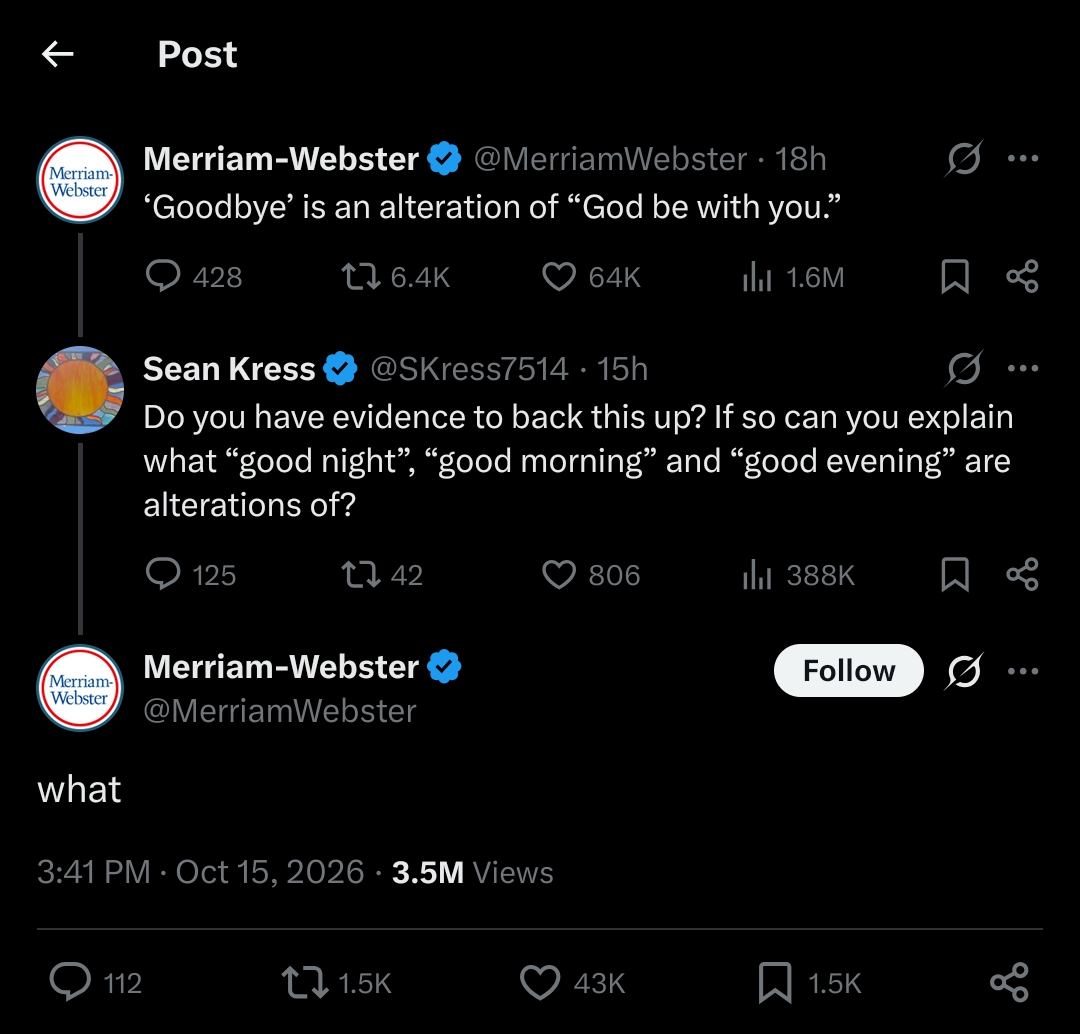
if it's informed speculation, it is completely reasonable for somebody to ask what specifically informed it
there's no such thing as an authority that I trust to the point where they never have to provide the derivation of their statements, unless they are specifically empowered to decide the answer by fiat. Merriam-Webster might get close to that for the definition of words but they are absolutely not that for etymology. if you cited Merriam-Webster as your source for the etymology of a word, your professor should not accept it anymore than they would accept a popular science magazine as a source for a physics question
so the person's question was perfectly reasonable, and for anybody in the game of doing actual empirical research, the natural answer would either be to excited explain it or to be curious themselves if they don't know the answer.
"what" is a bad answer
edit: looking further, it does look like they provide their derivation of etymology behind a paywall. In which case I was wrong about citing them for etymology. but then a better answer would be to just point the guy at where they can go find the answer to these questions and not with "what"
of course it's probably just some intern but whatever. I mostly don't like people reacting like it was unreasonable for somebody to ask about sources for a factual assertion
His whole job is to engage with the public and he has been doing tweets that don't include looking up words in a dictionary as well. Do you think he went to the etymologists to ask them to fact check foldable dictionaries before posting? And don't try to strawman me, if you have nothing more to say then just keep quiet instead of trying stupid logical fallacies to win an argument you lost.
Also now that I actually bothered to look up more on their social media stuff, the person at the head of it is a woman named Lauren Naturale.
Glad that you understand. For the record I use the words I use because I find they are the best words to use in that context. I am not sesquipedalian; I do not use arcane or esoteric terms as an ostentatious exhibition of my lexicon, it is simply my vernacular (and I hope this example demonstrates what it would sound like if I did).
The social media head being female isn't important, it was to gently correct you about calling it "his" job without drawing too much attention to it.
But a scientist (physicist) calls it a theory until proven... MW shouldn't pretend this question is settled. And no single person or group on Earth will ever be 'the authority' for any topic that exists in every situation. That is just silly.
You're right on the first point, I stupidly mixed up theory and hypothesis.
However, saying someone is the "authority" on a subject, you have to be referring a specific situation. You cannot say that a single dictionary company is the sole authority on the English language. That is a ridiculous notion and why I commented in the first place.
I didn't say it was the sole authority. I said it was the authority (as in, most respected and trusted) on American English. For UK English and the language in general, you turn to the Oxford English Dictionary. That doesn't mean other dictionaries are not also authorities on English. That's kind of the point of a dictionary. Just that Merriam-Webster is, among scholars, the highest authority in American English and second only to the OED.
That physicist comparison is pretty weak. Physics is a science you actually can back up with experiments and proofs. Some kind of historian would be a better parallel.
Eh, six of one. The point is, "speculation" is accurate but misleading if you think of it as just dudes making shit up off the top of their heads. They are a scholarly organization doing rigorous research and their speculations are as close to the truth as anyone is likely to find.
34
u/RhynoD 1d ago
For what it's worth, Merriam-Webster is the authority on American English. If I'm writing a paper and cite them, the professor wouldn't ask for a better or more primary source. That doesn't mean they don't exist, but the understanding is that if Merriam-Webster prints it, it means they did the research to back it up; and, if another dictionary disagrees with them, they probably (but not definitely) didn't do the same level of research.
While it's fair to say it's speculation, it's informed speculation. Like when a physicist tells you that some particle probably behaves a certain way but it hasn't been confirmed, it's still safe for you to assume that's how it will be.