r/riddles • u/_TheSiege_ • 8h ago
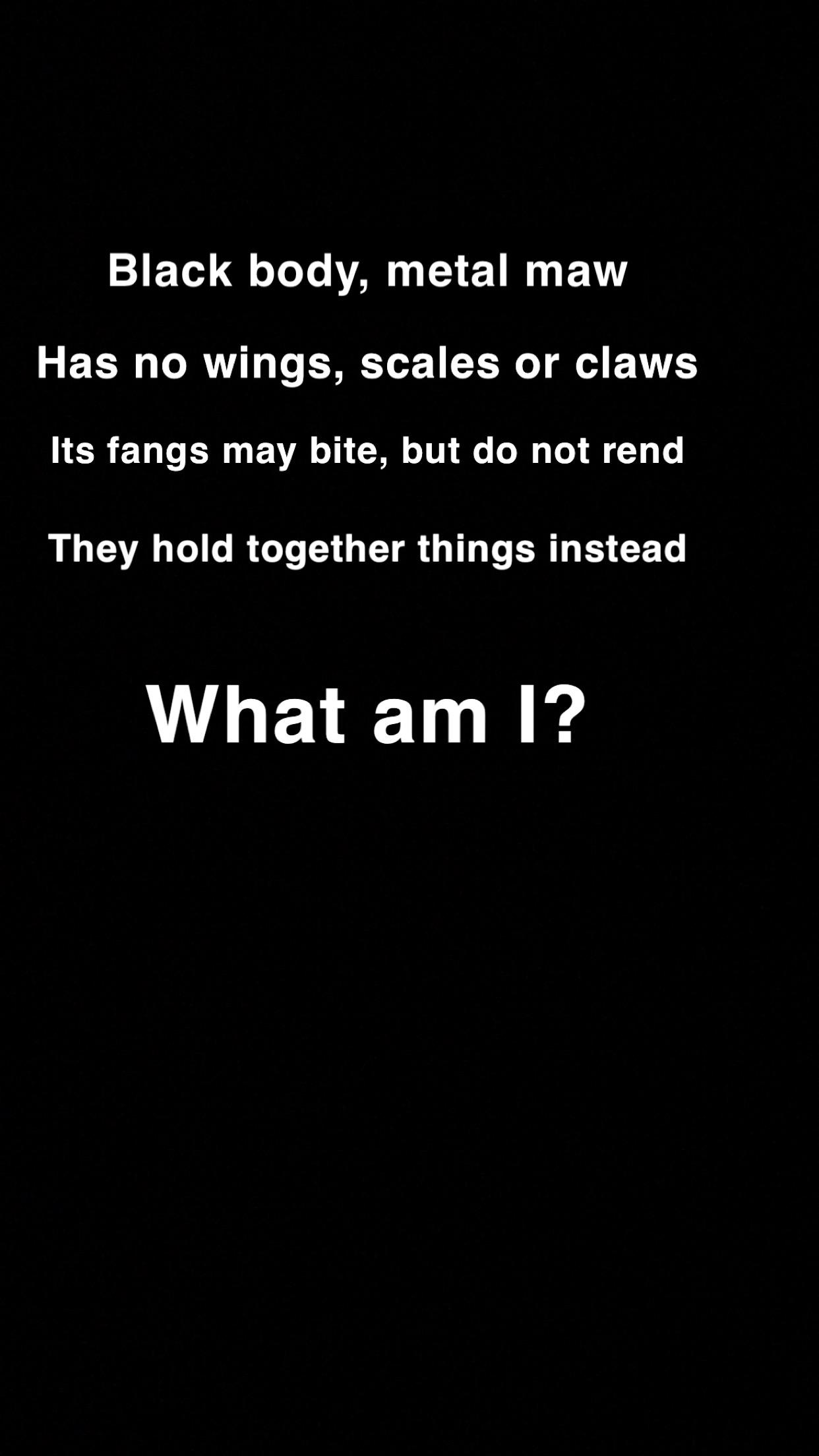
Unsolved (OC) Black body, metal maw
98
Upvotes
Black body, metal maw
has no wings, scales or claws
its fangs may bite, but do not rend
It holds together things instead.
r/riddles • u/_TheSiege_ • 8h ago
Black body, metal maw
has no wings, scales or claws
its fangs may bite, but do not rend
It holds together things instead.
r/RiddlesForRedditors • u/gimmeabreak01 • 8h ago
Hey all, I made up a riddle for my DnD party and I want to see if it’s unsolvable or too easy, the answer is one word. If you could attempt it that'd be incredibly helpful!
Binds and suffuses
The world revolves on its axis
The reason for being
Cause of all war and strife
r/mathriddles • u/mathklein • 3d ago
Klein One I POLISHED A LITTLE BIT THE TEXT WITH vibe AI Inventé a propósito una teoría matemática falsa. Cuatro axiomas, bien pulidos, lo bastante claros como para que cualquiera los entienda en una tarde — y una pregunta central pensada para que ningún sistema formal pueda matarla jamás. Es matemática de ficción, pero cada teorema dentro de ella está sacado honestamente de los axiomas, y una parte incluso es comprobable con tus propias manos.
LA CONFIGURACIÓN
El universo 𝕂 contiene objetos llamados espejos. Cada objeto tiene una sombra x′ (lo que ve cuando se mira a sí mismo) y una operación binaria de encuentro ⊕.
Los cuatro axiomas:
K1 (Espejo): (x′)′ = x. La sombra de la sombra es la original. Ninguna reflexión cae dos veces.
K2 (El Uno): Exactamente un objeto, 1, satisface 1′ = 1. Exactamente un punto en el universo se mira a sí mismo y se reconoce. Todo lo demás ve a un extraño.
K3 (Encuentro): ⊕ es conmutativa, 1 es su identidad, y los espejos respetan los encuentros: (x ⊕ y)′ = x′ ⊕ y′.
K4 (La Fractura): Ninguna función de Klein-computable enumera 𝕂. Ninguna máquina construida a partir de ⊕ y ′ puede listar todos los objetos del universo. El dominio de la teoría se pasa de cualquier cálculo que la teoría pueda hacer sobre sí misma.
K4 es el axioma envenenado. K4 es la puerta tapiada.
EL MONSTRUO — Pregunta Cero
¿Existe alguna estructura que satisfaga los cuatro axiomas a la vez?
La teoría no pregunta qué hay dentro de 𝕂. Pregunta si 𝕂 es. Del monstruo crecen dos ramas:
La rama Hueca: nada satisface K1–K4. Entonces toda la teoría es un retrato perfectamente consistente de la nada — cada teorema es verdadero de manera vacía, con la elegancia exacta de una religión sobre un dios que nunca existió.
La rama del Fuego: algo satisface K1–K4. Entonces ese mundo es imposible de mapear por cualquier máquina que viva dentro de él: tiene objetos que ningún algoritmo puede nombrar, y la soledad del Uno, por una vez, es real.
El Teorema de los Dos Espejos (boceto): La Pregunta Cero es independiente de K1–K3. Intenta enumerar 𝕂 y las respuestas a K4 con una diagonal: la máquina que lista termina siendo, ella misma, un objeto-espejo, y su sombra se escapa de su propia lista. Intenta probar la no-existencia y K4 se esconde: un mundo sin testigos de K4 es indistinguible de uno que lo satisface en silencio. Ambas ramas se mantienen consistentes. No puedes matar al monstruo. Solo puedes elegir una rama.
Eso es lo que lo vuelve distinto de cualquier problema abierto que conozcamos: no es que no sepamos la respuesta. Es que la respuesta no pertenece al “suelo” donde se hace la pregunta.
LA PARTE QUE SÍ PUEDES COMPROBAR
Hay un modelo pequeñito que satisface K1, K2, K3 — y hasta una conjetura extra debajo. Los enteros, con:
x′ = 2 − x
x ⊕ y = x + y − 1
Verifícalo tú mismo:
(x′)′ = 2 − (2 − x) = x ✓
Punto fijo único: x = 2 − x ⟺ x = 1 ✓
Identidad: 1 ⊕ y = 1 + y − 1 = y ✓
Los espejos respetan los encuentros: (x ⊕ y)′ = 2 − (x + y − 1) = 3 − x − y, y x′ ⊕ y′ = (2 − x) + (2 − y) − 1 = 3 − x − y ✓
Conjetura del Abrazo: x ⊕ x′ = x + (2 − x) − 1 = 1, siempre ✓ — cada objeto se disuelve cuando se encuentra con su propia sombra.
Los enteros casi alojan al monstruo. Falla exactamente un axioma — K4 — porque son contables. Esa es toda la razón por la que existe K4. K4 no es un axioma sobre espejos. Es una puerta tapiada cerrada sobre los enteros.
El monstruo no vive en ningún lugar que ya conozcas. Vive en el único sitio al que la aritmética nunca pudo entrar: la habitación donde lo computable se acaba antes de que llegue lo real.
PREGUNTAS FRECUENTES ANTES DE PREGUNTAR:
Sí, sé que el argumento de independencia es un boceto, no una prueba. Hecho a propósito.
Sí, es ficción. Se supone que es ficción. El chiste está en encontrar exactamente dónde chirría.
No, esto no pertenece a r/math, por eso está aquí.
Si puedes romperlo, rómpelo. Esa es la idea.
r/sleuths • u/duckduckduckmoose • Jan 08 '24
This bone was found under my porch in Western Washington. Looks too big for a cat, rabbit, or a bird. Any ideas?
r/sleuths • u/Solid-Choice-1228 • Jan 08 '24
https://fruitanews.org/4394/stories/the-cold-case-of-christi-thornton/
Anyone familiar with this story?
r/RiddlesForRedditors • u/BrainTest_Official • 9h ago
I have hands but cannot clap. What am I? 🤔
A) Clock B) Glove C) Robot
Only a true genius can get this right! Comment your answer below 👇
r/RiddlesForRedditors • u/BrainTest_Official • 10h ago
A) Tomorrow B) Future C) Yesterday
Only 1% can answer correctly! Comment your answer 👇
r/RiddlesForRedditors • u/BrainTest_Official • 11h ago
A) Age B) Smoke C) Balloon
Comment your answer below 👇
r/crosswords • u/Vivid_Temporary_1155 • 11h ago
r/mathriddles • u/lizardpq • 4d ago
I'm thinking of a function f:ℕ→ℝ. As many times as you want, you can give me a set S⊂ℕ and I will reveal to you the restriction of f to S. At some point you must choose a number x not in any of your queries and guess the value of f(x). Show that there is a randomized strategy that gives you a 99% chance of guessing correctly, no matter what f is.
r/crosswords • u/Using_Tilt_Controls • 8h ago
This is my first cryptic clue!
r/crosswords • u/sarashinai • 10h ago
Most of the clues for the October 13, 2026 Guardian cryptic went way over my so I moseyed over to Fifteen Squared (https://fifteensquared.net/2026/10/13/guardian-cryptic-crossword-no-30136-by-fed/) to be edified. I followed the explanations but even loonapick couldn't explain 8d. After reading all the related comments, I'm no closer to understanding the first part of the clue (I understand "at all times" as the definition).
Any insights would be appreciated!
r/crosswords • u/Imaginary__Bar • 12h ago
r/crosswords • u/Vivid_Temporary_1155 • 11h ago
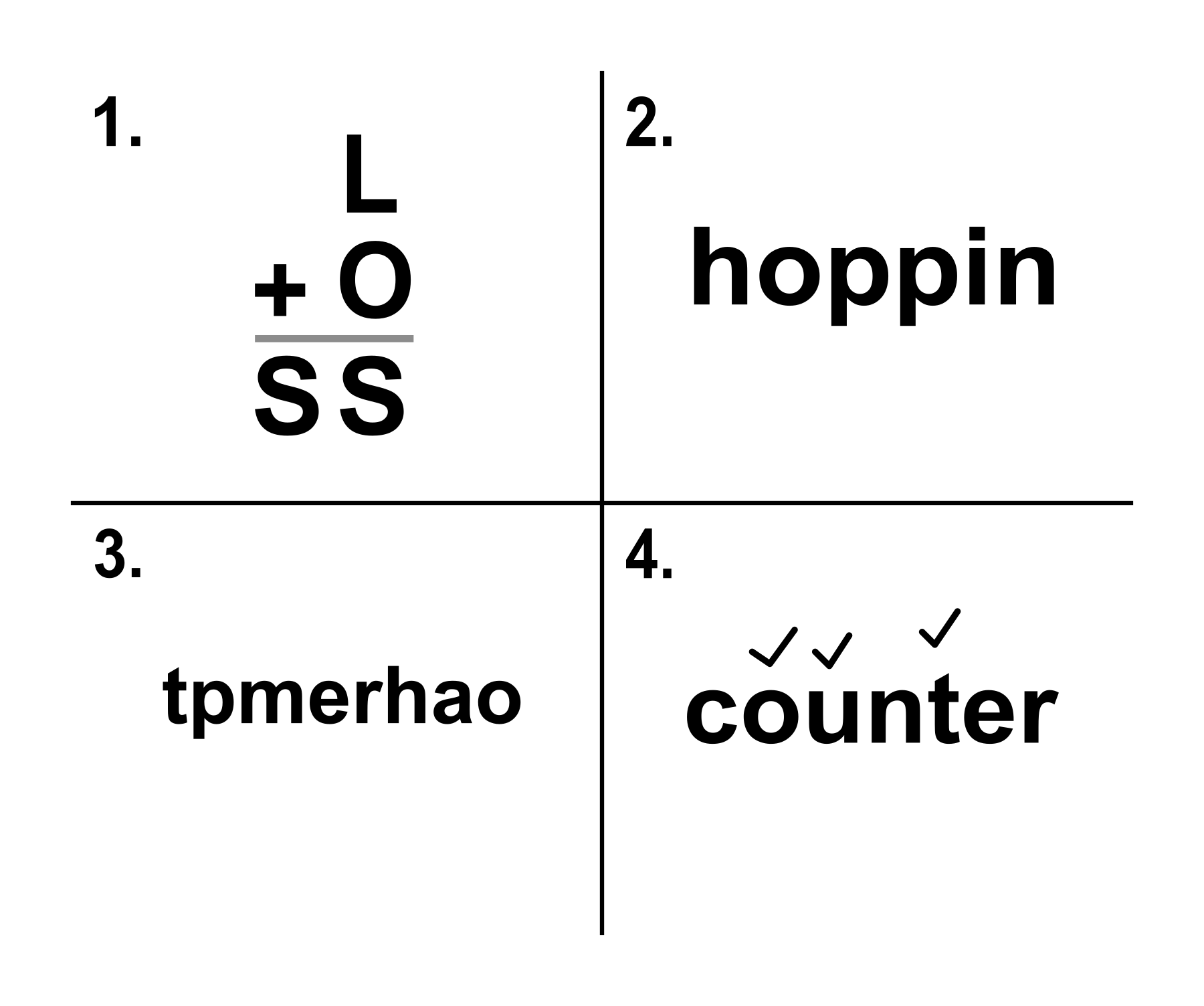
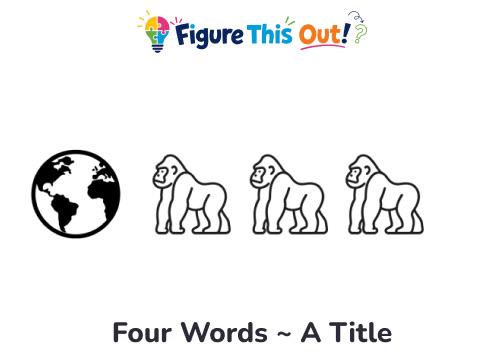
r/rebus • u/bikingbill • 12h ago
r/crosswords • u/Responsible_Rub_4737 • 13h ago
I'm not sure if this clue is fair... Have been tinkering with the wording around and not sure if I am fully happy with it.
Would love some feedback!
r/crosswords • u/zem • 1d ago
r/crosswords • u/wordboydave • 10h ago
I will start with an unpopular assertion: I think that, in general, American cryptic clues have better editing standards and are better written. I say this because American cryptics came AFTER they'd already been established in Britain, and during the translation American editors made a few improvements. (It would be odd indeed if they hadn't made a few helpful innovations in the process.)
They eliminated "cryptic definition" clues, which in America we just call "regular clues." Since cryptic clues in the US are thought of as a mini-puzzle (wordplay + definition), cryptic definition clues don't even qualify for inclusion; we already have cryptic definition clues at home. (Unless you add wordplay, but let's get to point #2)
They eliminated boring double definitions. We all know that puzzles in both the US and UK are not allowed to use the same word in the definition as the solution (i.e., in a puzzle, you'd never define SNOWMAN as "a man constructed by children" or "creation in snow"). But for some reason, British clues have no problem using boring pairs of definitions in their double definition clues. In American puzzle magazines, e.g. it's considered interesting to assert that BEAM can mean "a shining ray" and "a wooden support structure." It is much less interesting to point out that BEAM can mean both "a shining ray" and "a bright smile"--because the second concept is obviously related to the first. So to my American brain, a clue like "Light smile (4)" can't possibly be beam because it's too obvious and not interesting...so it becomes that much harder to solve, and not satisfying when the penny drops.
This applies to other types of wordplay, too. In the US, the only time you'll see a two-word phrase defined with wordplay that breaks on the words (cluing FASTBALL as FAST + BALL, e.g.), is when the setters use another sense of the word ("Go without food before dance and strike attempt?(8)"). In Britain it seems acceptable to use both words in their plainest, most obvious sense ("Quick piece of sports equipment pitch (8)"). I've certainly seen SIDEWALK clued as SIDE plus WALK and wondered why anyone bothered.
They made sure definitions match the defined word's form: nouns clue nouns, verbs clue verbs. I have seen British clues where RAIN is defined as "falls from the sky." This is an abomination to grammar, and "it falls from the sky" or "something that falls from the sky" is actually precise and not that much harder to write, and more in keeping with American practice, which, perforce, has had to focus on definitional clarity for 100 years.
American cryptic editors eliminated British-style inside references that would absolutely baffle outsiders. The most amazing to me is the tendency in British puzzles to use "film" to clue ET. (By this reasoning, couldn't "film" be a legitimate clue for any of a thousand different words?) Because Americans have been trying to draw in new solvers, they've tended to make sure every part of the clue is gettable by a newcomer--or at least by someone coming from standard American crosswords, who might be assumed to know ABS as a word for "sailors." If you're using "film" to clue ET because "film" always means ET, you're just writing a dull synonym for insiders.
And in the one knock I have against American puzzles, they always skew toward simplicity and clarity of parsing. But to be fair, what they were fixing was the British tendency to be quite wordy, often valuing surface sense over elegant wordplay. I recently saw an Independent puzzle that clued REINFORCES as REIN + FORCE + S. So it not only clued "reinforce" using "force" (see point 2), but threw the S on the end instead of making it the more elegant REIN + FORCES or REIN(FORCE)S. I see eight letter words chopped up into two-letter bits all the time for no fun reason, and with a shaggy, twenty-word clue the inevitable consequence.
I assume that some of this unfortunate cluing comes from the sheer volume of puzzles being written. When a country has multiple daily cryptic crosswords to cope with, I understand that quality control on the editing side can be hard to count on.
I SAY ALL THIS TO ASK: Are Magpie/Listener puzzles--the creme de la creme--inclined to the same shagginess as other British puzzles, or are they more American in their editing? I would hope that unusually difficult puzzles would also strive to be unusually strict in their accuracy, but if Magpie puzzles have clues like "End of day tans film (6)" for SUNS + E.T., it'll spare me the difficulty of trying to track down their collections.
r/crosswords • u/jowowey • 14h ago