r/ArtFundamentals • u/xXbehramXx • 4d ago
25 boxes in , i feel like the challenge practices more of ghosting and linework than actually teaching perspective.
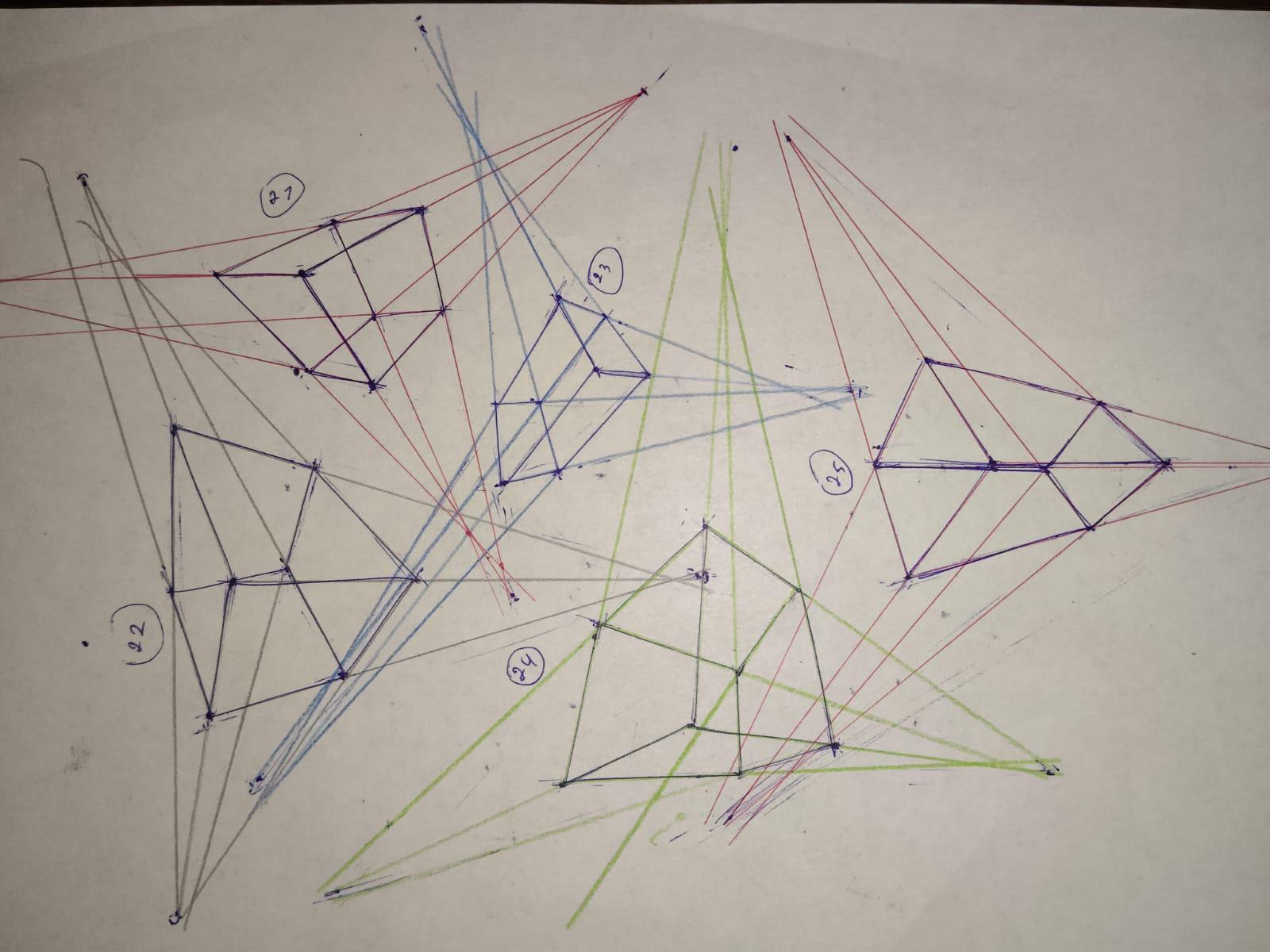
As the title suggests, i do not feel like I'm learning or I'm going to learn much 3d spatial awareness from constructing boxes on the paper using the Y method. The exercises overall feel like a roundabout way of practicing longer-than-usual ghosting between two points and adhering to above a certain standart of line quality.
Even if the result comes off as a decent looking 3D-ish box at almost no point of the construction phase that i feel like i am really using my spatial awareness or I'm really pushing my brain to think in 3d( compared to when i was learning the loomis method and applying it to references, which was very intensive), how the planes should be positioned regarding one-another. The method already gives you 3 vanishing points so all I'm left to do is to correctly guess the intersection points and mark down the back edges before lining.
This is not to say that I'm already a master in linework or ghosting , i oftentimes lose my patience and not ghost enough, or lose my ideal drawing posture and draw from elbow or the wrist, or subconsciously try to rush the process and "be done with" this day's 5 boxes, so to say. This last page definitely came off as the messiest one since a bit of demotivation-fueled autopilot mixed up with tryning to use both sides of the page with a oily pen.
To sum it up I'd like to change my approach to the exercise so I'm more cognitively active in the process and actually learning something about 3D rather than feeling like doing a really long warm-up.
2
u/Ok_Initial_5184 2d ago
I did this challenge and failed many times but if YOU have strong perspective skill go for it
5
u/Burgandy_the_Great 3d ago
Personally I really hate this challenge unless you already have a strong perspective skill built up as it could inadvertently reinforce bad habits if you don't know what you're doing
7
u/NaaviLetov 3d ago
it's to create repetition in your brain about covergence. You're gonna draw loads of boxes and cylinders when drawing, so having that become automatic is almost a prerequisite.
However, at around 150/200 boxes I started using references. Trying to make boxes that where human sized, but heavily forshortened. Tall skinny boxes etc.
1
9
u/Arcask 4d ago
Learning doesn't always feel like learning, but you might still pick up a lot while doing it.
It seems you rely on some kind of internal feedback that tells you this exercise is helpful and that might not always exist or is as reliable as you would expect.
This exercise really has more of an effect on drawing intuitively. You don't draw the lines for the sake of drawing the lines, but because they converge at different points and this way they become visual feedback. And something within you adjusts your internal judgement and actions according to it. It's a comparison and refining process of expectation, judgement and action.
Your actions rely on expectation and judgement of where the lines will converge, but they don't always converge where they should. So something has to be adjusted for more accuracy. And you don't need this process if you strictly follow grids, you need it if you want to eyeball it.
3
u/Apocalyptic-turnip 4d ago
if you want a real challenge, just add a horizon line and make it so youre drawing the same box in the same space at different distances and rotations. remember it has to be the exactly same box. ;)
15
u/boringboringsnow 4d ago
I’ve always loved drills, I feel like they are magic and I come out the other side “getting” what I couldn’t see going in.
I will just give a testimonial and say, this challenge was excellent for my ability to judge convergence and for my line quality. Also, boxes go so quick when I am constructing something more complex because it’s second nature now. Been very useful as I moved over to NMA. I highly recommend you stick with it!
36
u/Uncomfortable 4d ago
The box challenge's primary purpose isn't actually to develop your spatial reasoning skills - we target that most directly through the constructional drawing exercises we perform from lessons 3-7. While the box challenge does provide a considerable bump to students' ability to execute confident, clean linework and internalize principles relating to the ghosting method, that also isn't its main focus.
There are two primary purposes the challenge serves in the scope of the course as a whole:
- Developing discipline and familiarizing students with how to break large, complex problems down into individual steps, and giving each of those individual steps (simplistic and individually less significant though they may be) our full and undistracted attention so as to complete them to the best of our current ability. This helps a great deal in ensuring that students give their constructional drawings - which further into the course can take hours and necessitate being spread out over numerous sessions or days to complete to the best of our current ability - all that they can, so as to benefit from them as much as possible. Or rather, "ensuring" is a strong word, because students are still prone to rushing and still have to be reminded against that, but they are far less inclined to do so than they were before the box challenge was instituted as a required part of the course.
- Developing one's ability to judge and estimate the convergences of sets of lines, so that given two or more consistently converging edges, they can add more lines that converge consistently with them (or close to consistently, anyway). This is an important piece of internalizing how perspective works, and ingrains a level of awareness of the relationships between the marks we draw on the page, and the relationships they're meant to hold in the 3D space being represented.
I understand that you may feel frustrated with the task, but this course is designed to be performed in a specific way. It may not always seem clearly beneficial to you now, but every piece is a part of the whole - and in, as the student who is not yet in a position to really see the big picture, choosing to modify the path risks derailing your progress in more significant ways.
That's not to say the changes you might institute wouldn't be to your benefit - but that if they were, it's more a matter of luck. After all, as a beginner, there's a lot about learning to draw that you don't necessarily grasp or understand just yet (especially given the prevalence of some pretty boldly incorrect assumptions about how it works that most beginners hold based on what appears to be most obvious). Like deciding to go off-trail when navigating an unfamiliar forest, you might stumble upon a shortcut, but the chances of a more dire outcome are considerably higher.
To that end, this compulsion is by no means unnatural or uncommon. In fact, the second-guessing of individual parts of a process is among the most common struggles students face, to the point that we've made a comic about it, and how ultimately all one can really do is decide who (or rather which resources) they're willing to trust. If you trust in a resource, then you can follow its processes (even in the presence of doubt and uncertainty) - until such time that you can no longer trust in it (which is entirely okay and normal, as doubts accumulate). But when that trust wanes, it is often a better idea to find a different resource that is still able to maintain your trust.
What isn't a good idea is, as the student, constantly being in the position to waffle and second guess the instructions you're following, as in that state it is very difficult to apply them in good faith.
•
u/AutoModerator 4d ago
To OP: Every post on this subreddit is manually approved, once we make sure it adheres to the subreddit rules, the main ones being the following:
If you find that your post breaks either of these rules, we would recommend deleting your post yourself, and submitting on one of these other more general art communities instead:
Just be sure to read through their own individual submission guidelines before posting.
To those responding: If you are seeing this post, then it has been approved, and therefore is related to the lessons on drawabox.com. If you are yourself unfamiliar with them, then it's best that you not respond with your own advice, so as not to confuse or mislead OP.
Thank you for your cooperation!
I am a bot, and this action was performed automatically. Please contact the moderators of this subreddit if you have any questions or concerns.