r/CanadaPersonalFinance • • Feb 03 '26

What’s the most underrated money-saving hack you’ve discovered in Canada that more people should know about?

91 Upvotes

Living in Canada can get pricey with rising costs of everything from groceries to housing. But sometimes, it’s the small, creative hacks that save the most money. Maybe it’s an unconventional tax credit, an overlooked cashback program, or a local loyalty scheme that works wonders.

What’s one money-saving tip or trick you’ve found that makes a noticeable difference? Share your hidden gems for saving money, building wealth, or getting more bang for your buck in Canada!


r/CanadaPersonalFinance • • 7h ago

How quickly you can burn through $1,000 CAD?

48 Upvotes

Can you believe that sum of following small numbers is $1000+!!

Yes and I calculated multiple times,
So… PLEASE do Budgeting before you purchase🤦

$29.9 $49.9 $9.9
$19.8 $59 $79.9
$9.9 $69 $128
$168 $16.8 $39.9
$35.8 $99.8 $189


r/CanadaPersonalFinance • • 9h ago

Retirement plan without investing

6 Upvotes

My spouse (early 30s) does not want to invest in the stock market. I'm no expert but my plan has been to choose 1-2 diverse ETFs (ie. XEQT, HBNK) and just keep holding until retirement. My spouse finds the companies being traded in those ETFs morally reprehensible and doesn't want to participate. I've suggested that ESG ETFs or socially conscious ETFs like XUSR or XCSR might be a decent compromise but I don't want to find out I'm wrong 30yrs later. Right now she is investing with a CIBC advisor in socially conscious mutual funds and ETFs and I suggested that the fees are not worth her not having to make any decisions. What's the best move here? Is there a better option I'm not considering?

I have DB pension so I'm a little less stressed about my rrsp.


r/CanadaPersonalFinance • • 1d ago

Canada has had 5 consecutive months of double-digit producer inflation while losing jobs. Are we heading toward 1980s-style stagflation?

Thumbnail
163 Upvotes

r/CanadaPersonalFinance • • 1d ago

Kia Canada’s lease return experience has been a nightmare. 10 years in the car industry and I’ve never experienced this.

63 Upvotes

Just wanted to share my experience with Kia Canada and hopefully get some advice.

I recently returned my 2024 Kia Telluride. I genuinely loved the vehicle and was planning on getting another one. Unfortunately, the lease return process has completely changed my opinion of Kia Canada.

For some background, I’ve worked in the automotive industry for over 10 years. I’ve personally leased BMWs, Mercedes-Benz and Audis, all with lease end protection, and never experienced anything like this.

I returned my Telluride early and fully accepted the approximately $830 early termination charge. No issues there.

What I wasn’t expecting was a bill for roughly $2,300, especially considering I purchased Kia’s Lease End Protection.

Some of the additional charges included:

Over $500 for two window mouldings, despite Kia having recalls involving Telluride mouldings.
$599 for an alleged 11-inch scratch.
$248 for a previously plugged tire.

I understand lease end protection has exclusions, but I was surprised by how little seemed to be covered.

**The worst part has been dealing with Kia Canada.**

The first level of customer service didn’t seem to fully understand how leasing or lease end protection works. Eventually, I spoke with a manager in the lease end department who was extremely rude and condescending.

Rather than addressing my concerns, he repeatedly brought up the fact that I hadn’t purchased another Kia and essentially told me I wasn’t a loyal customer.

Here’s the funny part. **I actually want another Telluride.**

My wife is on maternity leave, so we don’t need another vehicle until she returns to work. I was planning on waiting for the new Telluride to arrive in Canada.

I was told I could receive a $500 loyalty credit if I ordered another Kia. No problem, I contacted my dealership and placed a preorder for the new Telluride.

Now I’m being told the vehicle must be in stock and delivered within 30 days to qualify.

How am I supposed to take delivery of a vehicle that isn’t even available in Canada yet?

After several conversations, the lease end manager finally agreed to cover $200 towards one of the moulding charges, which was approximately $299 plus tax.

He promised to send an updated invoice. **I still haven’t received anything.**

Just automated responses. When I follow up, I’m now being told they don’t email anything.

My invoice is due, and I’m apparently expected to pay the original amount and just hope they eventually refund the difference?

I’ve even reached out to higher-level Kia Canada executives through referrals and connections I’ve made during my 10 years in the automotive industry. Not a single response.

That’s what blows my mind. We’re in an industry built around customer service, relationships and repeat business. I couldn’t imagine treating one of my customers this way.

I’m not asking for special treatment or trying to avoid legitimate charges. I just want an accurate invoice, clear explanations and someone to follow through on what they’ve promised.

The most disappointing part is that I actually enjoyed my Telluride enough to preorder another one. Yet Kia Canada seems more interested in telling me I’m not loyal than helping resolve a relatively straightforward issue.

**Has anyone successfully escalated a complaint with Kia Canada beyond the lease end department?**

At this point, I’m genuinely looking for advice. I’ve never experienced this level of customer service from any other manufacturer I’ve dealt with.

What a shame, because the vehicle itself was great.

r/CanadaPersonalFinance • • 11h ago

What do to with an inheritance?

Thumbnail
0 Upvotes

House has $140k left on mortgage, interest rate on that is 3.85%. No other debt. Cars are all paid off. no credit card debt Salary with my partner combined is around $150k and my bartners company already contributes to RRSP plus has a great pension plan. We are already saving around $800 a month in a regular savings account. We also have liquic savings of around 50K in a regular savings account. We are 30.


r/CanadaPersonalFinance • • 4h ago

Can my wife not work?

0 Upvotes

Looking for some objective perspectives on whether my wife can stop working for the next 2 years.

For context, we’re a married couple in our late 30s living in Toronto. We’ve both worked hard to build our careers and save, but I’m finding it difficult to gauge whether we’re actually doing well financially or should be further ahead.

Our financial situation (all CAD):
Combined household income: ~$360K gross annually
My income: ~$180K
Wife’s income: ~$180K
Total savings and investments: ~$930K (excluding home equity)
Property: Own a relatively small condo in Toronto, worth approximately $500K
Remaining mortgage: ~$350K
Estimated household net worth: ~$1.1M including home equity
Other debt: None significant
Lifestyle: Relatively modest compared to our income. We don’t live extravagantly and generally prioritize saving and financial security.

Here’s our dilemma:
We’re thinking about starting a family, and there’s a possibility my wife may want or need to take approximately two years off work.

That would reduce our household income from ~$360K to ~$180K annually during that period.

We also eventually want to move into a larger home, but we’re hesitant to take on a much larger mortgage while potentially becoming a single-income household.

Despite having accumulated savings, I sometimes feel we’re behind, particularly considering Toronto’s cost of living, housing prices, and the fact that we’re approaching a stage where family-related expenses could increase significantly.

A few questions for the community:
Would you prioritize buying a larger home, continuing to invest, or maintaining flexibility while living on one income?

For couples who temporarily went from two incomes to one, how significantly did it affect your long-term financial trajectory?

Are we being unnecessarily conservative, or are our concerns justified given how expensive life in the GTA has become?

I’m not looking for validation or a humble brag. I’m genuinely interested in understanding how others assess financial security, particularly when deciding whether to prioritize family time over maximizing household income.
Would appreciate perspectives, especially from couples who have navigated something similar


r/CanadaPersonalFinance • • 13h ago

Investment advice

0 Upvotes

How would you invest $50,000 right now?


r/CanadaPersonalFinance • • 8h ago

For the next 12 months, most of my monthly pay will be taken by rent and I’m honestly lost from here

0 Upvotes

I’m a student and I graduate by the end of 2027.

I make about $25 (digital tips included) and I try to work less than 20 hours to meet as much OSAP grant as possible.

My rent is $1,200 everything included.

I take home about $900-950 after taxes bi-weekly.

I have zero credit card debt. I have 3 credit card and 2 of them don’t have fees except one. I have $20,000K limit in all of them and I plan to use my TD First Class VISA infinite card starting this point on.

So I have about $600 monthly budget.

$200 of that is spent on subscriptions.
(Apple care, iCloud, school subs, insurance, phone)

So I have $300 take home.

Right now, I have about $3,000 in my chequings from OSAP that I’m trying to get it to last until end of the year.

I receive $300 monthly from someone who owes me money until the end of 2027 as well.

So if I could last without going broke until next year, it’d probably help a lot.

This doesn’t account for my transportation, grocery, food, and some snack/social time.

I know that sometimes $600 won’t be enough (and this is why I have $3000 for emergency until the end of this year and I receive more OSAP funding)

I have $40,000 in TFSA investment, and $15,000 in RRSP/DPSP.

I really don’t want to touch my TFSA investment as much as possible but it’s the only other liquid cash I have aside from my chequings, and credit card.

How should one proceed if I have to budget like this until the end of 2027?

Should I open a LOC/personal loans? This might hurt my OSAP but I really don’t know how to proceed from here.

I understand that spending within my budget is the best thing but there are outliers out there that just will not go as planned.

Should I just depend on my credit card until then?

I pay my credit card diligently and for the last 5 years that I’ve had my credit card… I don’t think I’ve ever incurred much penalty except when I really forget to pay monthly.

I also have a lot of credit card points I can convert worse come to worse.

I’d really like another person’s feedback and any idea or help is greatly appreciate.

Thank you


r/CanadaPersonalFinance • • 14h ago

Financial advice RRSP w/ BP pension

Thumbnail
1 Upvotes

r/CanadaPersonalFinance • • 1d ago

Advice?

Thumbnail
1 Upvotes

Wife and I live in Canada.

We are 31yr old and are married with a 1yr old.
We own the apartment we live in and have about 200k left in the mortgage.

She is on maternity leave. I work a couple of jobs that bring in about 150k net.

We have:
- 120k in equity in our apartment
- 135k in savings
- 235k in investments earning ~11% a year over the last 6 yrs.

We own our cars outright.
We pay about 3.5k a month in fixed costs. The rest we either use for investment, travel, helping family get ahead etc.

We are about to come into an inheritance of about 4m or a touch more. This was a bit of a shock as it wasn’t expected. When her dad passes there is another 3m coming to her.

What do we do with it? Do we try and retire? My wife wants to buy a house with a yard… probably around ~1.5-2m. Do we buy it outright or do we use the investment income to pay it down using a mortgage?

We are fairly risk-averse.
Honestly I feel very guilty about her inheritances as my family doesn’t come from much in terms of assets.

Advice?


r/CanadaPersonalFinance • • 2d ago

Families making $200-250k in Ontario, how much are you actually saving?

187 Upvotes

Curious how much families with young kids are realistically saving every month.

We’re a family of 5 (2 kids and one dependent parent) with a combined gross income of around $250k, but our actual take-home is only about $12k/month.
Sounds like a lot on paper, right? But between a $5k mortgage (GTA), $500 daycare cost, $1500-$2k groceries, $600 property taxes, $500 insurance, $200-300 utility bills, and never-ending kids’ and other home related expenses, the money disappears pretty quickly. And we’re not living a luxurious lifestyle!
It makes me wonder how families are managing to save, invest, travel, and still enjoy life.

For those with young kids:

-What’s your household income and monthly take-home?
-How much do you actually save after ALL expenses?
-Are you managing to contribute to RRSPs, TFSAs, and RESPs?

Genuinely curious if others feel the same way. $250k sounds like a great household income, but the reality feels surprisingly different!


r/CanadaPersonalFinance • • 1d ago

What should I be doing?

2 Upvotes

Wondering how we should budget. We are a family of 5 and are pretty good at saving our money, but we don’t really have a strategy, all we do is try not to waste money on things we don’t need, don’t eat out all the time and try to be frugal. What steps should we be taking right now to monitor spending and budget? Are there popular apps people are using? How can we be smarter with our money.


r/CanadaPersonalFinance • • 16h ago

Getting paid Friday doesn’t help if your PAD comes out Thursday.

0 Upvotes

Something I think gets overlooked in the usual “just budget better” advice.

A lot of Canadians get paid biweekly, but rent, insurance, phone bills, etc. run on fixed dates.

Say your insurance payment comes out Thursday and payday is Friday. You might have enough money for the month, just not on that particular day. And now you’re dealing with a bounced payment.

Canada capped NSF fees at $10 for personal accounts at federally regulated banks earlier this year. That’s a big improvement, but it doesn’t fix the timing issue.
One boring thing worth trying: ask your billers if they can move the automatic withdrawal closer to payday. Some will, some won’t. Setting up low-balance alerts helps too.

Obviously, if your income doesn’t cover your expenses, moving dates won’t solve that. That’s a different problem.

I used to work in banking/payments and now I’m building a Canadian consumer fintech. This is one of those small things I think deserves more attention.


r/CanadaPersonalFinance • • 2d ago

Appreciation of Condos

27 Upvotes

Hey all,

I am in my early 30's, F. Started working at 28. I have about $100,000 that I have been saving with an intention to buy a house by my mid 30's. I have a budget of $300K-$350K for my house. Being a SINK (may marry, but will be child free), my purpose of buying a home was having my own place, a sense of security and an investment.

I was holding off looking at buying a home as I was focused on career progression. My current role isn't ideal to buy a house (Customer Service, burned out and not a steady paycheck). Nevertheless I would reconsider buying a house in 3 years from now. Can't afford it as of today.

I have been researching on the gap I need to fill - Down payment, emergency funds, moving, furnishing etc and some buffer. I have also been looking at market for the kind of houses that fit my budget. Realistically it will appreciate when I am ready in 3 years from now. Feels like a daunting task.

Anyways in 2026, prairie province, one can buy a condo with $300K-$350K. ($350K is a stretch for me). I am not inclined to buy a townhouse/ house given the maintenance etc it will require. On researching and talking to a mortgage advisor I learnt, condos have the least and slowest appreciation average 2% maybe. I am curious to know if that is the case, why do people in general buy condos? Especially other provinces.

I am not buy small, and upgrade later multiple times, kind of person. It will be my only home. Given the age I am at, and only growing old, my mortgage will be stretched to 25 years, even with 20% down. Have crunched numbers here to check my affordability. Also, I got to know the concept of FIRE, a couple of years ago. The idea is extremely appealing though not sure if I can pull it off with my income and inflation currently.

I am trying to decide if I should keep my hope of buying a home burning and invest my savings in registered accounts in ETF's, conservative through RBC and buy a condo when I am ready in at least 3 years or more OR just invest my savings in XEQT with WealthSimple or index funds (obviously maxing out the registered accounts first) and forget about it until 50-55 year old me.

I had clarity until recently about buying a home(read condo) but the reality of unaffordability month to month, never ending gap of having savings/buffer, anxiety with house repairs has really made me question my path forward. If I suffer through this and the outcome is 2% appreciation, I am not sure if it's worth it. Also coming from a non western culture, have been conditioned to buy a home. It will be an acceptance journey and grieving a dream I had.

On the contrary, the savings may compound to become something to live at a cheaper place/ country as a 55-60 year old me. I will not hit insane numbers but close to $800K ish. Given my inexperience, I am not sure how much is enough to live a stress free life. Financial advisors have said there are too many variables to calculate and work on a number for retirement. And I don't want to grind and work towards arbitrary 2-3M in my 30's-40's.

Thoughts please? Especially from folks who have seen a little more life than me.

TL; DR - Positives of buying a condo as your only home with long term appreciation of an average 2%.

Do you know anyone or are yourself who pulled off retirement earlier than 65 and moved to a country where you can stretch the dollar? Is this a reddit thing, or people actually do this in real life.

How do you handle home repairs anxiety? Beyond emergency funds, and learning to do it by yourself. I'll build the fund, though majority of my savings will just go there. Learning to do projects is not my interest, expertise and something I grew up learning. No time or energy either. Living in a rental where my landlord handles everything, yet I feel crippled when something breaks down. Especially, plumbing and electrical.

TIA!

P.S - First time adulting. Solo superwoman. :)


r/CanadaPersonalFinance • • 1d ago

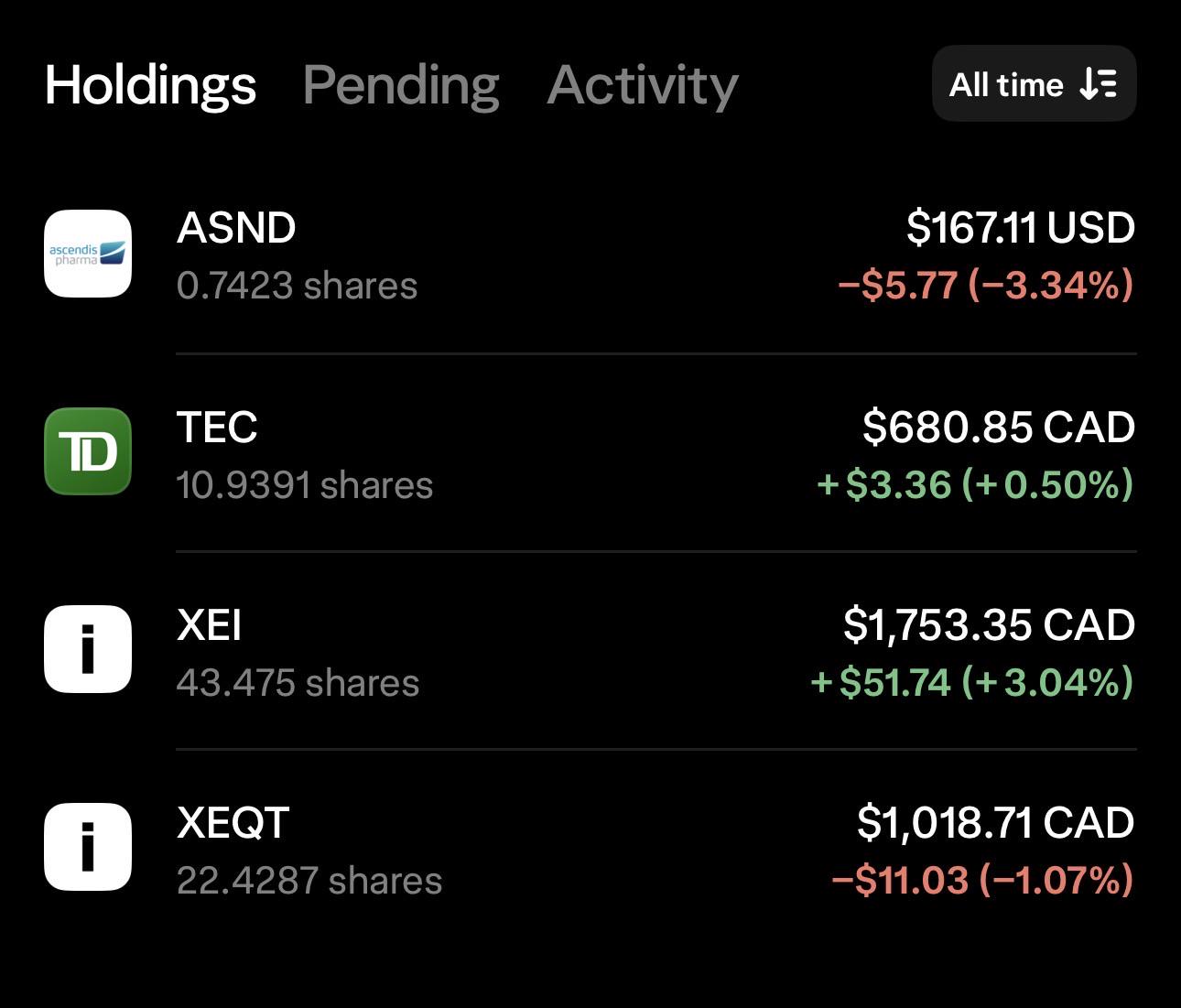
FHSA investment structure

Post image
1 Upvotes

25F with a good gig and horses that cost a lot of $$. I opened my FHSA this June and have about $3700 invested so far. I prioritize between XEI and XEQT depending on where they are at when I deposit my $500 by weekly until I max it out at the end of 2027. The rest goes into TEC and I have my ASND in all accounts as it’s projecting well.

My dream is acreage. I need room for ponies, however my timeline can be flexible. 3-5 years ideally… am I invested in too much equity in this portfolio? If they hit a high, do I move some shares into bonds to be safe but continue as I do? Thanks.


r/CanadaPersonalFinance • • 1d ago

incorporating cottage

Thumbnail
1 Upvotes

r/CanadaPersonalFinance • • 2d ago

Would it be a stupid idea to move to Vancouver and live out my car?

11 Upvotes

I finished nursing school (RN) months ago and I’m in a really bad spot now. I have $300 to my name, credit score is trash, lots of debt and all my credit is maxed out. I don’t have any stable employment either so that 300 needs to last me until my birthday in late November. I have applied all over the gta to positions and at this point I’m pretty sure I’ve applied to every hospital in Ontario as far as thunder bay, Ottawa, Hamilton, Sudbury and the same for long term care homes. I’ve been trying corrections as well but it’s the same story no call backs and I don’t hear anything back after hundreds of applications. 

A while ago I applied to positions in bc but they needed me to relocate before reimbursement and I didn’t have any money plus signing bonuses would take some time. So I turned it down but it’s months later and I’m basically on the brink of financial collapse. I keep selling my stuff to keep a float but it can’t last forever. I’m literally on the verge of either selling possession or my body every month atp and even minimum wage jobs outside of nursing or entry level stuff won’t take me. 

My current situation has me considering just driving to Vancouver with the last of my money, take a job and live out my car until I get funds to in a month or 2. I probably won’t be able to get the relocation reimbursement cause I won’t actually be relocating but I can get a signing bonus for about 10k which I’d get in roughly a month on my first pay. Only issue is I’d have to live out my car so im worried about being in a new place I don’t know living in car. But really I just need to know if there is any holes in my plan or something I’m missing that would get in the way of this?


r/CanadaPersonalFinance • • 2d ago

Is Consumer Proposal a good idea for a current student graduating in a year and a half drowning in debt?

2 Upvotes

Hi everyone, I live in Alberta. And I am currently in my fourth year out of five in engineering co-op. I am a full-time student and have limited earnings except for my co-op income. I have about $16k in credit card debt that I am drowning in. Besides that I have about $70k in Student Loan Debt (federal and provincial). I am contemplating applying for consumer proposal because I just do not see how I have any reasonable way to pay off my credit card debts. I contacted a Licensed Insolvency Trustee and they told me that I will basically pay around $250 to $300 every month for 60 months, thus I basically start paying my student loans earlier than I was supposed to. It does not make sense because my credit card is $16k. I am not graduating till 2028 and student loans are not supposed to be paid till 6 months after graduation (2 years from now). I do not understand why the student loans are being counted in my consumer proposal when it is not even dischargeable. Is there a possibility that my consumer proposal can focus solely on my credit card debt?

The LIT offered another route which is bankruptcy but this basically means I will not be able to apply for defense jobs in the future and any security sensitive jobs. Also, I basically cannot do anything financially for the next seven years.

Can someone offer me advice. I would really appreciate it.


r/CanadaPersonalFinance • • 2d ago

How do taxes and Inflation interact?

9 Upvotes

I was looking at teachers salaries recently. Someone mentioned that in 2009, top of grid was 90k. Now it's 120. A quick Google search tells me that 90k in 2009 dollars should be 130k, so obviously salaries have NOT kept up with inflation. But beyond that, 90k after taxes in 2009 would have been 67k net. 130k today is 90k net. But 67k net is equal to almost 100k today! So not only are teachers making less money now than back in 2009, due to the progressive tax system, after taxes they are earning less as well (because the dollar values getting taxed at a higher amount, even though it doesn't buy more).

On top of that observation, id MUCH rather be making 90k in 2009 than 130k in 2026 (quality of life in terms of affordability was much better than today - especially housing).

This isn't a conversation about if teachers are paid fairly. Just an observation about how taxes interact with higher salaries.

Am I correct in this observation? Or am I missing something?


r/CanadaPersonalFinance • • 2d ago

Help a newbie

2 Upvotes

I registered as self employed from working with US based company (need to register but dont need to file gst because of type of work) while having a fulltime job here in Canada.

Help me where to invest and help me how to reduce my tax. My money rn is just invested in my savings account.

I dont have a tax accountant yet. Where do you recommend?

Thank you


r/CanadaPersonalFinance • • 2d ago

Large downpayment vs keeping money in investments

9 Upvotes

I'm considering buying a first home (condo in Montreal). My wife and I have about 300k saved that we could use for a downpayment, though the minimum downpayment would only be something like 30k. Currently, the 300k is in unregistered investment accounts which seem to make about 7-9% interest.

I'm new to all this, but it seems like we could:

a) make the minimum downpayment, get a large mortgage (at 3-5%), and keep 270k in the investment accounts making 7-9%

b) make our maximum downpayment (300k) and get a smaller mortgage

Does anyone have opinions on which option makes the most sense? What should we be considering?


r/CanadaPersonalFinance • • 3d ago

Why do people employ wealth advisors rather than just investing on XEQT or other indexed fund ETFs?

56 Upvotes

Why would people just not buy some index fund ETFs? Do wealth advisors actually make better returns?

I am 24, and my current portfolio is 70% equity (XEQT) and 30% fixed income across my registered accounts on Wealthsimple. I will make over 100k annually in the next 3yrs and I do believe I have the potential to reach a 200k - 300k salary in the next 30 yrs. For now, my plan is just XEQT and DIY investing, and I am wondering at what point I should hire a wealth advisor.

I work a government job, so my tax planning options for now really are just an RRSP.


r/CanadaPersonalFinance • • 2d ago

Looking for a Questrade referral

1 Upvotes

r/CanadaPersonalFinance • • 2d ago

Getting a ~$60K CAD lump sum, what would you do if you wanted to buy a condo in the next 18–24 months?

3 Upvotes

Hey everyone!

Fairly new to Reddit and this is actually one of my first posts, so figured I'd throw something out here that I've been thinking about for a while 😅😅

I'm in my mid 20s, single, living in Toronto and have a stable full-time job. Sometime in the coming months, I'm expecting to receive roughly **$60K CAD from a one-time employer equity payout**.

I don't need the money for day-to-day expenses, and my biggest medium-term goal is potentially buying a condo within the next **18–24 months**.

That's where I'm a little torn about what to actually do with the money.

A few options I've been thinking about:

* Keep most/all of it somewhere relatively safe and liquid for a future down payment

* Use available TFSA/FHSA room and invest at least a portion

* Split it: keep whatever I realistically expect to need for the condo safe and invest the rest for the long term

* Or maybe there's another obvious option I'm not considering

I'm **not really looking for specific stock/ETF picks**. I'm more interested in how people here would think about the decision itself.

My biggest hesitation is the time horizon. If I might need this money in 18 or 24 months, putting a large part of it into equities feels like taking unnecessary risk with money earmarked for a home.

At the same time, keeping the entire \~$60K in cash/GICs/cash-like investments feels a little overly conservative if the condo purchase gets pushed out or doesn't happen.

So I'm curious; **if you were in this position, how would you approach the $60K?**

And more importantly, **how would you decide what portion should remain safe for a down payment vs. what portion can actually be treated as long-term investment money?**

I'm intentionally keeping some of the numbers/details broad for privacy, but happy to provide any information that's actually relevant.

Would love to hear how others would think about this!