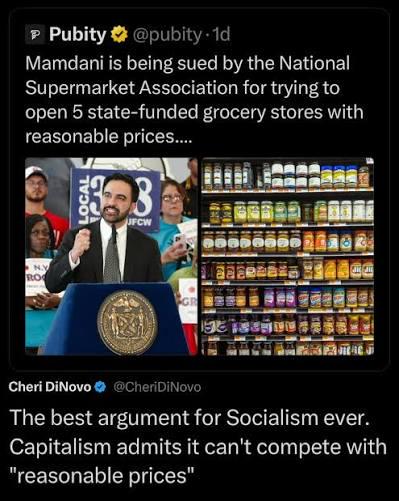
The city run grocery stores are not planned to be self sufficient. They are subsidized and will pay no rent or income tax where a business would.
If you are in favor of this initiative, you should be in favor of it as a public service. The stores will run at a loss made up by tax payers. The idea is wealth redistrubution, not market competition.
Wouldn't directly giving money to people who need it be more effective than spending money on overhead, subsidizing losses, and missed tax revenue of running a public grocery store?
Like its somehow ok to pay individuals and businesses to "subsidize prices" but when everyone actually gets access to subsidized prices it becomes an issue. Sorry people don't like to wait for trickle down.
If I understand correctly, and I did look this up just now to refresh my memory, farming subsidies are not just checks given to farmers for being farmers. They are mostly federal crop insurance. A bad year that has nothing to do with the farmer's abilities and just results in bad yields is devastating to a farmer. Conversely, a good year can also be devastating. Prices can fluctuate wildly. If there is a really good year for soy bean crops across the country, the prices can drop so severely that the farm loses money despite record output.
The biggest costs are the government insuring and subsidizing the insurance for those two kinds of losses. Now, I am not an economics expert and I don't know whether these are the best programs or whether they are too generous despite being sounds ideas etc. But the "point" is not to lower consumer prices by x% by giving farmers money. They are to lower the risk of farming so that we will have farmers.
Again, not arguing that I know it is good or bad. Just clarifying my understanding as to why it is unique vs other kinds of subsidies and why it is not simply using tax payer money to redistribute wealth or help low income households directly.
The program that sometimes really bothers people is the conservation programs that pay farmers not to farm their land. The intention there is to manage soil erosion and other ecological concerns.
I mean at the end of the day its still using taxpayer dollars to ensure profitability of businesses. Also, to that point, a humongous portion of these subsidized crops are put towards things like corn syrup, cattle feed, and ethanol. Literally only around 1% of the crop is actually consumed by people. Cattle ranching is a whole other discussion about pollution, water waste, and efficient food production. We don't need this much meat in our lives, much less shitty cheap foods made with corn syrup. We also sure as fuck aren't the ones profiting from all this bullshit, so tell me how the average person benefits.
I think a lot of people do say that. Government intervention often leads to unintended consequences. Would love if the government didn't influence the free market more in most cases
So that's my point. It's never a problem to interfere in the "free market" until the interference directly benefits the average person. Then suddenly it's a bad idea and "inefficient." Ya know, because subsidizing a car company that 3% of Americans own makes sense.
What do you mean it's never a problem? Lol I just said it's a problem. Also "directly benefits the average person" in this case means helping whoever shops there regardless of whether they actually need help. I'd much rather directly benefit those who need it than a blanket dump of tax dollars into a store that anyone can shop at
Let's face it, rich people aren't shopping at some discounted federal store. I say "never a problem" as in it's not covered in the news or have posts on social media bitching about it. I would love it if they just cut taxes instead or ya know, paid back the people for tariffs instead of corporations but we would have to just settle for this. As inefficient as you think this is it's literally better than anything else they have been doing.
What are people going to do with the money if there's no access to decent grocery stores? A major point was to prevent food deserts by offering a place within a reasonable distance that people can buy quality, nutritious foods.
I am not an expert, so I am not going to claim I know or even have a strong argument to offer there.
I mean, I guess what you are comparing it to is essentially the federal SNAP program (aka food stamps). I think part of the answer might be hat "giving money to people" also has overhead and administrative costs. I don't know how those compare though.
I assume that these stores will accept SNAP. So, maybe it is doubling the effect in poor areas. SNAP is a federal program and these stores are city run. So, SNAP benefits will stretch farther in these stores.
I am not going to claim that I know these areas personally, but I believe it is generally true that low income urban areas in the US actually have higher cost of groceries. Because there are not as many big box stores around.
33
u/MAATMOM Sep 15 '26
Can’t compete or won’t compete? There is a big difference.