Bangin' on Wax, Damu Ridas & Nationwide Rip Ridaz: One of the Most Overlooked Movements in West Coast Gangsta Rap History
When people discuss the greatest eras of West Coast gangsta rap, they always bring up Death Row, Ruthless Records, N.W.A., Snoop Dogg, and Dr. Dre. But I think the Bloods & Crips' Bangin' on Wax movement deserves a bigger place in that conversation.
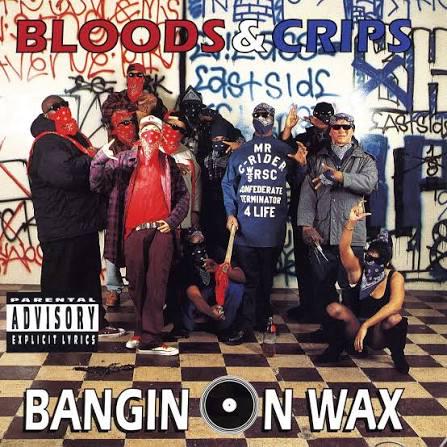
In 1993, actual Bloods and Crips from rival Los Angeles neighborhoods came together to record Bangin' on Wax. Instead of settling their differences in the streets, they were given an opportunity to battle on records.
The project brought together underground artists like Bloody Mary, O.Y.G. Redrum 781, Sin Loc, Blue Ragg, and Lil' Stretch.
The original album introduced West Coast underground favorites like "Piru Love," "Steady Dippin'," "Shuda Beena B-Dog," and "Crip, Crip, Crip."
Then came Bangin' on Wax 2: The Saga Continues in 1994, featuring records like "Mafia Lane," "Crip 4 Life," and "Can't Stop Won't Stop."
But what people sometimes forget is that the movement didn't end with those two albums.
The Bloods continued recording as Damu Ridas, while the Crips established Nationwide Rip Ridaz. Both groups released their own albums in 1995, followed by additional projects later in the decade.
Damu Ridas gave us songs like "Damu Ride," "Why Must I Be Like That," "True Flue Killer," and "Comin' Straight from the Brain." Their follow-up, How Deep Is Your Hood, continued that underground Los Angeles gangsta rap tradition.
Nationwide Rip Ridaz delivered "Throw the C's in the Air," "Nationwide Rip Ridaz," "Crip Keeper," "Swervin' Thru the Eastside," and "Everything Gonna C Alright." Their second album, Betrayed (Can't Trust Nobody), expanded their catalog.
And we're talking about more than just music.
These projects featured actual people from the neighborhoods being represented, not simply rappers adopting gangsta images for commercial success.
That's what separated Bangin' on Wax from much of the mainstream gangsta rap explosion.
The movement wasn't built around superstar producers, expensive music videos, radio-friendly singles, or major-label marketing campaigns. It was raw Los Angeles street rap, documented by people who lived within those environments.
That doesn't mean every aspect of the movement deserves celebrating. Some records contained extremely hostile lyrics and reinforced the same gang rivalries the original project attempted to redirect into music.
But there's something significant about rival gang members demonstrating that they could enter a recording studio and participate in the same creative project.
And the legacy becomes even more meaningful when you consider how many artists associated with these projects are no longer here.
Bloody Mary, O.Y.G. Redrum 781, Tweedy Bird Loc, B-Brazy, A.W.O.L., Big Freeze, and several other reported contributors have passed away over the years.
That's an important part of why I believe this music deserves to be preserved and discussed.
These weren't just anonymous voices on underground gangsta rap compilations. They were artists with stories, musical abilities, personalities, and contributions to Los Angeles hip-hop history.
I think Bangin' on Wax deserves recognition as one of the most unusual and culturally significant experiments of the 1990s West Coast rap era.
The original Bloods & Crips collaboration, the two Damu Ridas albums, and the two Nationwide Rip Ridaz albums collectively created a body of music that documented a side of Los Angeles rap culture rarely represented in mainstream hip-hop histories.
You can acknowledge the creativity and historical importance of these records without glorifying the gang violence reflected in their lyrics.
And that's ultimately why I believe the movement has been overlooked for too long.
Do you consider Bangin' on Wax, Damu Ridas, and Nationwide Rip Ridaz underground West Coast classics? And which group had the better music, the Bloods or the Crips?