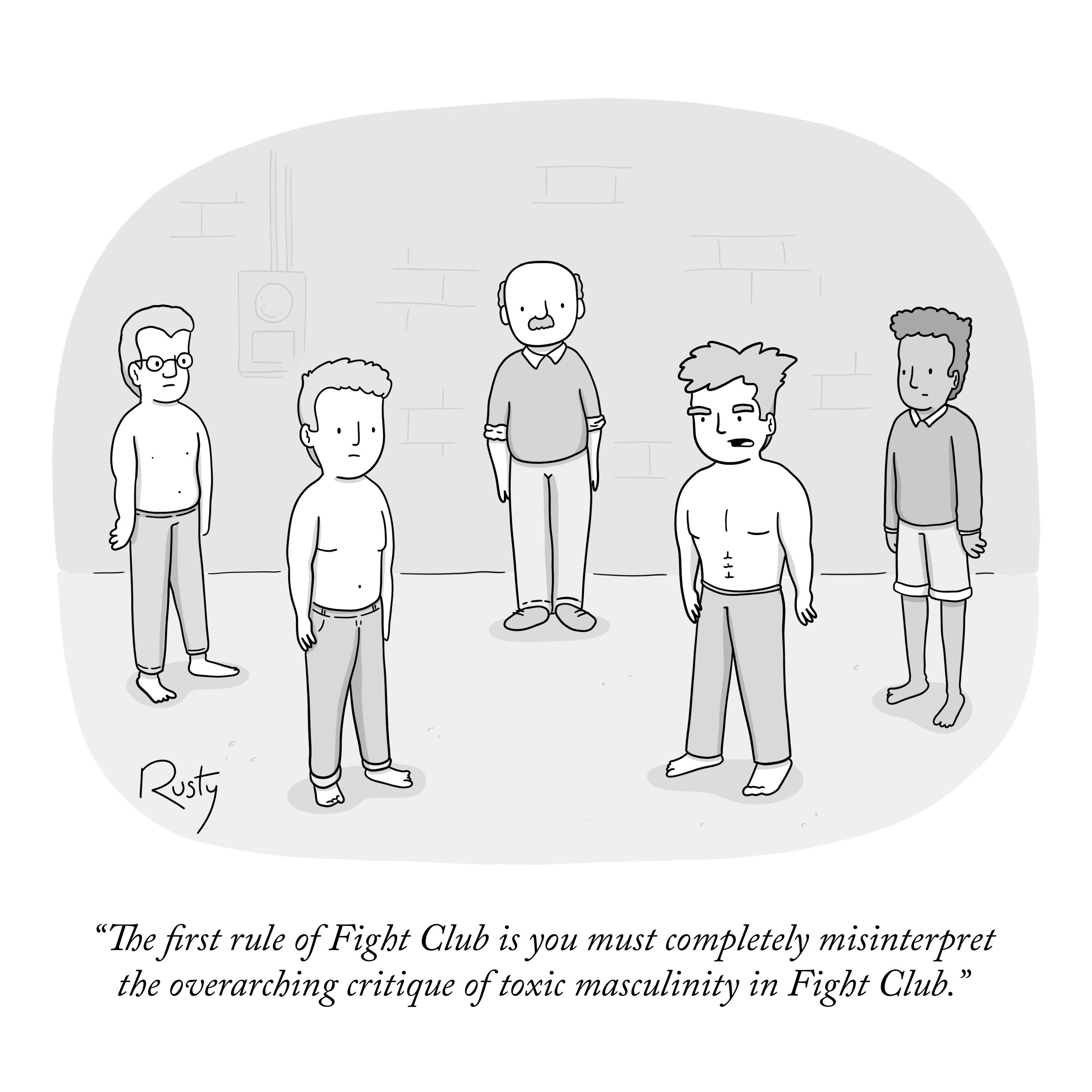
I see everyone discussing the toxic masculinity themes of the book & movie but that's still missing the full depth. Fight Club posits that existential dissatisfaction is a disease of privilege and comfort, and that it breeds reactionary, radical, and authoritarian sentiments. It is a scathingly accurate prediction of what we're living through right now.
In the words of Fukuyama, which slightly predate Fight Club:
"Experience suggests that if men cannot struggle on behalf of a just cause because that just cause was victorious in an earlier generation, then they will struggle against the just cause. They will struggle for the sake of struggle. They will struggle, in other words, out of a certain boredom: for they cannot imagine living in a world without struggle. And if the greater part of the world in which they live is characterized by peaceful and prosperous liberal democracy, they then will struggle
against that peace and prosperity, and against democracy."
Excellent quote. Definitely need to learn more about the author.
I rewatched the film recently because, "it's been at least a decade and it's Fincher."
I couldn't believe how different my take was watching several times near release (99', at about 20), and now in my late 40's. This movie spoke so profoundly to men of my age, the movie version of Nevermind or Downward Spiral. I think there was a deep dissatisfaction in my generation with a range of topics, materialism, corporatism, etc. What I think was missing from the discourse was a sense of responsibility, "Great. You're dissatisfied. So what are you going to do about it?"
Durden felt like some kind of role model at the time. Watching it this last time was a completely different experience. Durden, or the main character depending on your point of view, seemed like a madman. Sure the critiques still resonate, but the prescription?
"In the world I see - you are stalking elk through the damp canyon forests around the ruins of Rockefeller Center. You'll wear leather clothes that will last you the rest of your life. You'll climb the wrist-thick kudzu vines that wrap the Sears Tower. And when you look down, you'll see tiny figures pounding corn, laying strips of venison on the empty car pool lane of some abandoned superhighway."
I couldn't believe how I missed the Apocalypse Now parallels before. Durden's literally talking off-screen to a dazed 'main character' about his vision. Kurtz and Durden are perfect parallels, critique without answer, a certain logic followed to the point of the illogical.
Since those early watching's near release and now, I finally found a career that I find rewarding in healthcare. The money's fine, the real treasure is in the feeling of making a difference, helping people because "it's the right thing to do," and it makes me feel good.
What I would say to my past self, or young men like you referenced with Fukuyama's quote, is "there are other struggles." You can struggle for justice, struggle to provide resources to those without, struggle reveal that which we do not know or haven't explored. Tearing things down for the sake of it does nothing besides fulfill a selfish desire to feel righteous among the ashes.
Durden's pursuit of the pure naive experience is also thoroughly childlike in lacking any real answer to the problem or the question of 'what then?' as a civilization.
Exactly! Plus, you're just starting over. Is this going to magically put mankind on a better course, or are we just going to fuck it up again? Why "pound corn" and make "leather clothes?" Feels to me like you either get rid of all of it, or try to fix what we have.
462
u/Grigorios 23d ago edited 23d ago
I see everyone discussing the toxic masculinity themes of the book & movie but that's still missing the full depth. Fight Club posits that existential dissatisfaction is a disease of privilege and comfort, and that it breeds reactionary, radical, and authoritarian sentiments. It is a scathingly accurate prediction of what we're living through right now.
In the words of Fukuyama, which slightly predate Fight Club: