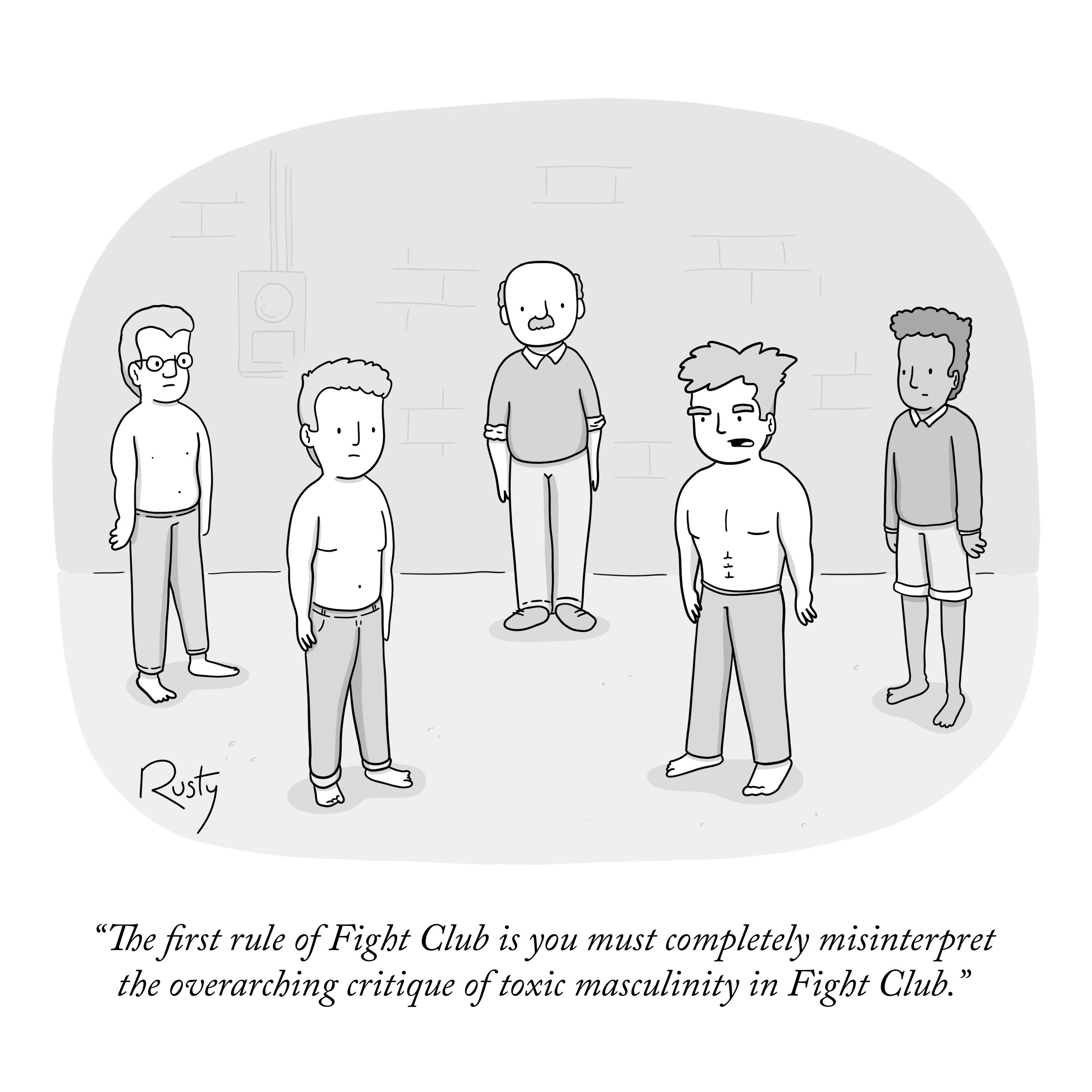
I see everyone discussing the toxic masculinity themes of the book & movie but that's still missing the full depth. Fight Club posits that existential dissatisfaction is a disease of privilege and comfort, and that it breeds reactionary, radical, and authoritarian sentiments. It is a scathingly accurate prediction of what we're living through right now.
In the words of Fukuyama, which slightly predate Fight Club:
"Experience suggests that if men cannot struggle on behalf of a just cause because that just cause was victorious in an earlier generation, then they will struggle against the just cause. They will struggle for the sake of struggle. They will struggle, in other words, out of a certain boredom: for they cannot imagine living in a world without struggle. And if the greater part of the world in which they live is characterized by peaceful and prosperous liberal democracy, they then will struggle
against that peace and prosperity, and against democracy."
Excellent quote. Definitely need to learn more about the author.
I rewatched the film recently because, "it's been at least a decade and it's Fincher."
I couldn't believe how different my take was watching several times near release (99', at about 20), and now in my late 40's. This movie spoke so profoundly to men of my age, the movie version of Nevermind or Downward Spiral. I think there was a deep dissatisfaction in my generation with a range of topics, materialism, corporatism, etc. What I think was missing from the discourse was a sense of responsibility, "Great. You're dissatisfied. So what are you going to do about it?"
Durden felt like some kind of role model at the time. Watching it this last time was a completely different experience. Durden, or the main character depending on your point of view, seemed like a madman. Sure the critiques still resonate, but the prescription?
"In the world I see - you are stalking elk through the damp canyon forests around the ruins of Rockefeller Center. You'll wear leather clothes that will last you the rest of your life. You'll climb the wrist-thick kudzu vines that wrap the Sears Tower. And when you look down, you'll see tiny figures pounding corn, laying strips of venison on the empty car pool lane of some abandoned superhighway."
I couldn't believe how I missed the Apocalypse Now parallels before. Durden's literally talking off-screen to a dazed 'main character' about his vision. Kurtz and Durden are perfect parallels, critique without answer, a certain logic followed to the point of the illogical.
Since those early watching's near release and now, I finally found a career that I find rewarding in healthcare. The money's fine, the real treasure is in the feeling of making a difference, helping people because "it's the right thing to do," and it makes me feel good.
What I would say to my past self, or young men like you referenced with Fukuyama's quote, is "there are other struggles." You can struggle for justice, struggle to provide resources to those without, struggle reveal that which we do not know or haven't explored. Tearing things down for the sake of it does nothing besides fulfill a selfish desire to feel righteous among the ashes.
I appreciate your commentary here, but I think it somewhat takes the issue and just creates its opposite. My view - and this aligns with many of my takes on several philosophies - is that there is often an attempt at arriving at binary conclusions, when such is usually inaccurate, and more, even unnecessary.
The example you use - the return to simplicity. In one view, it is a regressive concept. In another view, it is not. The same goes, generally, with the appetite/motivation to tear things down. Tearing things down and destroying can be good, and necessary. On the other hand, tearing things down and destroying, can also be bad, and unnecessary.
Additionally, I think Kurtz and Durden certainly have parellels, but I disagree with your analysis. For instance, I think Kurtz does not necessarily champion war, rather, he speaks to life in the context of war - this is easier to ascertain in Apocalypse Now, precisely because the setting is so strong - they are in war. Durden may have a similar dichotomy (nonwar vs war setting), but Durden exists in the whole context of the modern reality, not simply one aspect of it.
So, where I think the parallel exists, is in their destruction of a value system within their worlds. Kurtz argues for a destruction of values when in war. Durden argues for a destruction of values in the context of the modern world.
Kurtz has an easier argument to mount, as the premise is narrower and easier to defend its goals - wining/victory and survival are all that matter.
Durden's argument is more tenious, precisely because the defense of its goals are so amorphous - destroying the values of the modern world requires a solution that is better than the current one/the modern world values.
In the end, the problem I have with your comment, is that it diminishes the real thrust of Fight Club. You point out the extremes and short-sightedness of the fight club philosophy, but ignore the defensible elements of it, namely, that (at least some, many, etc.) modern world values need to be destroyed and there is an inate feeling many (especially men) have toward that end.
Indeed, at its most macro, Fight Club (and Apocalypse Now) are rebellions against values - very Nietzche-esque.
Excellent critique and I admit the Kurtz and Durden parallels are tenuous at best. That was mostly a film oriented parallel. I just never noticed how similar the scenes were, the relationship between the two main protagonists. They are just as different as they are similar as you rightly point out.
I completely agree with your point:
(at least some, many, etc.) modern world values need to be destroyed and there is an inate feeling many (especially men) have toward that end.
That's exactly what I felt when it came out, and still feel today. What I reject these days is the "blow it up and start over," mentality. My B.A.'s in history, and I've come to the point where I think revolution should be a last resort. The history of revolutions is incredibly bloody, with mixed results at best. I might be too much of an optimist, but I feel like most of our problems can be fixed with a change in culture and government.
Take the U.S. as a brief example. We can identify the major problems fairly easily. It's essentially greed writ large. You could theoretically legislate your way out of it. We could do each and every step with the system we have: ensure healthcare as a right, remove money in politics and punish transgressions severely, ensure proper compensation for work, create a framework such that housing is cheap and affordable, etc. We could do all of it.
Now if the argument is that the darkness in men's hearts won't allow it, I'm listening. I worry about that. I also see good on a daily basis. Where I work, the vast majority of the employees spend all day trying to build up their fellow humans, even at their own expense. I think there's a lot of fields with people working tirelessly to "make things better." It feels like we could continue to increase that sentiment with the right cultural orientation.
I could of course be totally wrong and high on 'hopium'.
468
u/Grigorios 23d ago edited 23d ago
I see everyone discussing the toxic masculinity themes of the book & movie but that's still missing the full depth. Fight Club posits that existential dissatisfaction is a disease of privilege and comfort, and that it breeds reactionary, radical, and authoritarian sentiments. It is a scathingly accurate prediction of what we're living through right now.
In the words of Fukuyama, which slightly predate Fight Club: