r/guitarlessons • u/JustSK StringKick • Jul 17 '26
Lesson For those working through Absolutely Understand Guitar, here's a guide for what to actually practice with each video
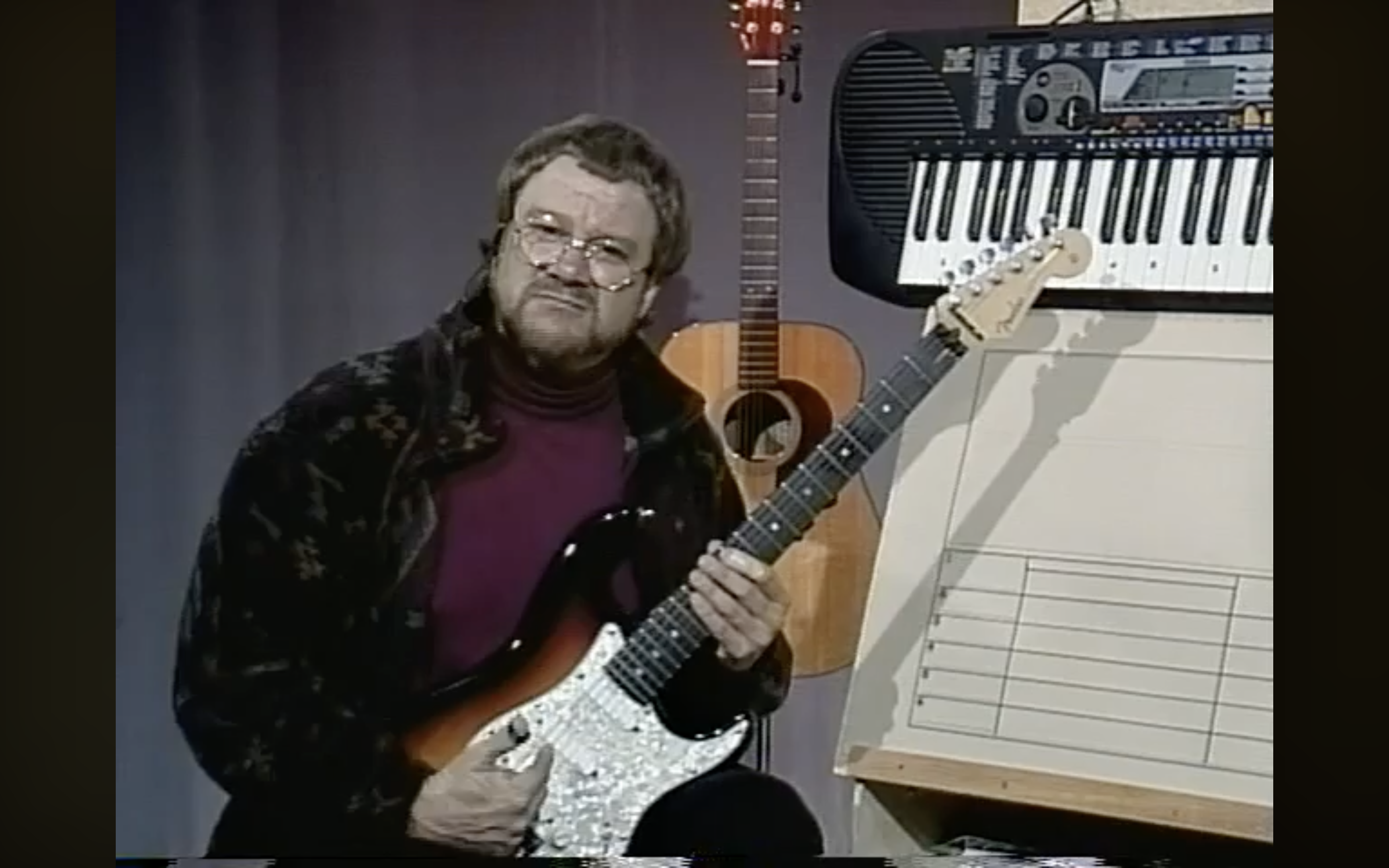
A few people in this Absolutely Understand Guitar thread asked me to expand the comment I posted there about what you should actually practice going through AUG. So here's that guide, expanded to cover the first 10 lessons. Hope it's helpful!
Guitar teacher here. AUG is a great series that makes a number of great points that I love seeing shared more widely, such as how intervals are key for understanding theory, and the importance of ear training.
I hear from a lot of students though that they're not sure how to put what they learn into practice. Generally, I think we should follow the 90-10 practice rule, where you spend 10% of your time learning about new things, and 90% of the time mastering it on your instrument.
So I started putting together a practice companion a while back. Not finished yet, but should be useful already. Let me know if it'd be helpful to expand. This isn't a replacement for watching the videos of course, but meant to tell you what to do after.
Scotty also sells the official course handbook on his site for $20. I haven't used it myself, so this isn't a review, but if you're getting value from the videos, buying the handbook is the way to support him: https://absolutelyunderstandguitar.com/index.php/printed-support-material-package
Lessons 1 & 2: Watch these as the intro
Scotty sets up the big picture: what music actually is, how the guitar works as a sound machine, and the 12-note musical alphabet. Nothing to practice yet.
Lesson 3: The Dumb Machine
This is where physical practice starts.
- Learn your string names: E-A-D-G-B-E. You need these for chord diagrams, tabs, and talking to other players.
- Then learn the notes on the low E string: Play each fret on the low E string and name the note. E, F, F#/Gb, G, G#/Ab, A, and so on up to the 12th fret where it repeats. Memorising these notes will be incredibly useful when we get to bar chords.
- Extra credit: learn the notes on the A string too
- Chromatic scale: Scotty introduces the chromatic scale exercise, playing through all 12 notes across the strings. It's a finger coordination exercise, not a musical one. Do it a few times to understand how the fretboard connects, but don't feel like you need to grind it daily. Your time is better spent on things you'll actually play.
Lesson 4: Basic Chords
Scotty introduces the 30-shape chord chart (6 types x 5 forms/shapes) and bar chords. Here's the plan:
- Learn the open chord shapes first. Start with E, Em, A, Am, D, Dm, then the 7th and minor 7th variants. Of course, learn the open C and G chord as well, but they wont' be as relevant for the next steps here. You don't need to memorize chord spellings right now, just learn the shapes. But know that each shape exists for a reason: your fingers are landing on specific notes that spell out the chord. This becomes important later when you start moving these shapes up the neck.
- Root notes: Every chord has a root. It's the lowest note in the chord. Know where it is and don't play the strings below it. (Below = lower in pitch, so that's the thicker strings)
- Bar chords: These are the same as open chords, just moved up the neck. For example, the open E chord is the E form, the open A chord is the A form etc. This is where knowing the notes on the low E and A string pays off: you can take an open chord shape (or what Scotty calls a form) and move it up the fretboard to 'transform' it into any key. So the open E can become an Ab chord, or an open Em7 can become a Cm7.
Lesson 5: More About Chords
- Major seventh chords: We skipped over major seventh chords in the last lesson, so we're catching up on that. Scotty teaches an angled bar chord version of it for the E form/shape, but if that's tricky to play, feel free to leave out the high E string.
- Chord name decoding: Every chord name has three parts: root note, type, and form. Your teacher says "Bb minor 7, A form." Can you figure out where to put your fingers? Practice going from name to shape, and from shape to name. Scotty walks through several examples.
- Chord pair switching: Pick two chords. Set a drum machine or metronome. Switch between them every 4 beats. Scotty recommends doing this for 5 minutes straight. Focus on the next chord, not the one you're playing. You might supplement this with a similar exercise from Justin Guitar called one minute changes, where you try to switch between two chords as often as you can in 60 seconds.
Lesson 6: Still More About Chords
The chord pair switching is continued here. Scotty recommends this drill to increase chord switching speed:
- Start switching chords at whole note speed (strum once per 4 beats, so you have 3 beats to form the next chord)
- Move to half notes (strum on 1 and 3. That's 2 beats to switch)
- Then quarter notes (strum on every beat. Only 1 beat to switch)
- Then eighth notes ("1 and 2 and 3 and", half a beat to switch)
Super important strumming tip/technique: your hand goes back and forth like a pendulum at a constant speed. You create rhythm by missing certain strokes, not by changing hand speed.
Lesson 7: Music By The Numbers
- Chord and scale spellings change with every key (A major = A-C#-E, but B♭ major = B♭-D-F), which is why memorizing them by letter would be a lot of work. Using the slide rule, Scotty shows that what doesn't change is the spacing between the notes. The number system names notes by their distance from the key's home note, so a major chord is just "1-3-5", in every key, always. (You already know the numbers: do-re-mi-fa-sol-la-ti-do is 1 through 8.)
- A half step is a distance of 1 fret on guitar. A whole step is 2 frets.
This is mostly a concept lesson that will land fully over the next couple of lessons. But to put the concept into practice:
- Take a few of those 1-3-5 chords and work them out on the low E and A string (that you memorised in lesson 2 and 3). (For example, G major would be E3-A2-A5)
- The Do-re-mi scale (i.e. the major scale) is all whole steps, except between 3–4 and 7–8 (W-W-H-W-W-W-H). Try to work this out on a single string. Don't worry about speed, it's about the discovery.
Lesson 8: Caveman Music Theory
Wrapping up the number system: the 9, 11 and 13 you might've seen in chord names are just the same notes an octave up (9 = 2, 11 = 4, 13 = 6). File that away, nothing to practice. He just doesn't want the symbols to scare you.
Three major scale fingerings. Scotty doesn't teach these as shapes to memorize. Instead he builds each one fret by fret from the whole/half-step pattern you learned in lesson 7. This is one of my favourite moves in this series, because it steers you away from memorising shapes you don't understand, which is a real trap.
Practice each of these three positions: - root under your 2nd finger on the low E string - root under your pinky on the A string - root under your pinky on the low E string (this one has a reach around the 7)
Heads up: when a fingering crosses the B string, everything on that string shifts up one fret (that tuning quirk from lesson 3). Say the numbers out loud as you play. The point is not to memorise these shapes. The shape is a side effect; the numbers-to-frets mapping is the point.
- Finally, there's a bit on harmonics and the power chord. Play around with harmonics and listen to their sound. Nothing critical to memorise about that for now.
Lesson 9: Notation
Scotty wraps up power chords and their 1-5-8 structure. To get the sound in your ear, listen to the opening of the 2001: A Space Odyssey theme (Also Sprach Zarathustra). That melody is exactly 1-5-8. You'll never unhear it.
The rest of the lesson is about music notation. Just watch it and you'll understand the basics of how musical notation works. Nothing to practice.
Lesson 10: More About Notation
A quick wrap up on written notation, before Scotty goes into how rhythm is written (time signatures, note values, rests, dots and ties), and a quick intro to tablature at the end
Two things to do:
Count along with the weird ones: Take Five and the Mission: Impossible theme are in 5, Money by Pink Floyd is in 7. Count "1-2-3-4-5" along with them to experience why they feel different from most music we hear (which is in 4).
In the video, Scotty shows measures and asks whether they "add up" to the time signature. Pause and actually figure out your answer before he tells you.
That's all for now. Hope this is helpful!
19
u/LungHeadZ Jul 17 '26
Super helpful mate, thank you. I follow the Justin guitar module (sparingly) when I'm not playing rocksmith 2014.
The latter I find more enjoyable obviously but I'm aware it doesn't help me with song memory or deeper theory. Whilst it has helped me play faster and more accurate, I can't play nearly anything on rocksmith without seeing the notes coming.
Having bullet points like you have given allows me to break off from the routine and come back knowing where I stand. It's what makes Justin's modules so good because you know what is needed to move forward.
6
u/wakeofchaos Jul 17 '26
You could try just playing the songs from Spotify or whatever without rocksmith if you feel like you’ve memorized them. Rocksmith also doesn’t often include every actual guitar part in the song. Moving into tabs from ultimate guitar is generally the next step up from rocksmith imo. It’s surely a fun way to be introduced to playing with a band, but depending on how serious you wannna take guitar, these next steps are really the only thing keeping you from doing that
Because once you have the song memorized (and tested against the tab to ensure you’re playing all the parts) without any sort of “sheet music” to reference, you’re pretty much there
That said, sometimes guitarists in cover bands keep an iPad or something on stage because it’s difficult to remember what parts are on hundreds of songs, especially if you play similar sounding songs and a different set based on what the fans would likely wanna hear (e. g. more country in a country bar, rock in a rock one, etc)
Keep it up!
3
u/LungHeadZ Jul 17 '26
I appreciate you taking the time to help me out mate!
Like a lot of folk did I player guitar hero and then clone hero a lot and a couple years back I just thought I could put this effort into learning guitar instead and then found rocksmith and that was just seamless in terms of transition. Clone hero had taught me some basics like hammer ons, pull offs, dexterity, hand eye coordination etc.
Obviously guitar is an entirely different beast but I've practiced every day for the last 15 months. Give or a take a few weeks total. Did a couple modules of Justin guitar to the point I discovered anchor points (which I then utilised in rocksmith to my joy) and learnt stand by me and take me home country road. So I know a couple of songs, weirdly I know the opening riff to axes of evil by 3 inches of blood which is way out my league but somehow that stuck with me.
I do need to take it seriously though even with no immediate intention to play in public or with people. I want to learn it properly, not quite to the point of Steve Vai but enough that I can start to identify notes from ear and play that way.
I had a friend who could play most any song from hearing it once and it always amazed me. I understand how he did that now but if I can impress a layman like he did me, I'm content :)
I need to work out a balance I think and use rocksmith as a treat!
Thanks again mate, gave me food for thought.
1
1
u/m3n00bz Jul 21 '26
I used to be addicted to Rocksmith too! I've found that YT channels like Mr. Tabs are much "healthier" of a habit.
14
u/Burwhale_The_Avenger Jul 17 '26
Much appreciated!
If you do the back half, would it be possible to return to this post and edit in a link to the follow-up? I'm saving this post and will return to it periodically.
13
15
u/magiCAD Jul 17 '26
This is great! Thanks.
There should absolutely be an r/absolutelyunderstandguitar subreddit.
12
u/benji1304 Jul 20 '26
why did this get removed by the mods?
6
u/JustSK StringKick Jul 20 '26
I asked, but no reply yet. For now, I've put up the guide here.
1
u/benji1304 Jul 21 '26
Nice one. Such a shame, as it was so popular! I'm so surprised the original post was removed too
edit: just realised it's back too!
7
9
Jul 17 '26
In the Lesson 4, Root Notes, what do you mean by “don’t play the strings below it”? The strings for the E major chord are A, D, and G, are you saying don’t play the B and high E chords?
5
u/spankymcjiggleswurth Jul 17 '26
"Below" tends to mean lower pitch strings. I think they mean that for a chord like D major (xx0232), the lowest root is found on the D string, so don't play the E and A strings.
5
u/Chris-MelodyFirst Jul 17 '26 edited Jul 17 '26
Everybody's answered you already but I'll add one tip - Tab can help. If you look at tab, you can see that the thick E string is the lowest line. Therefore it is the low E string. And the thin E string is the highest line. Therefore we call it the high E string.
Some self-taught YouTube teachers don't use pitch to orient the guitar. But they are wrong.
Side note - this is the same for all string instruments including the violin, cello, etc. The cello's physical orientation puts the strings going from left to right. But you would still say "go up a string" if you want to go from the C string (the string closest to the right leg) to the A string (the string closest to the left leg). You're not physically going "up" but you are going up in pitch.
3
Jul 17 '26
Hey I appreciate that, I didn’t realize learning guitar would challenge me spatially like this. Like when they say go “up the fretboard” and their hands are moving down lol.
3
u/JustSK StringKick Jul 17 '26
Like other other commenters already said: lower in pitch. I've updated the guide, good question.
1
u/Dan_Coyote Jul 17 '26
In this context the b string and high e string would be above the root note as they’re higher. When we look at a guitar we consider the high e string the first string.
What he means is if you were playing a chord with the root note on the a string don’t play the low e string.
1
u/GhostbustersActually Jul 17 '26
By "below" he means the strings physically above the root note. It's how the string order is described. Your "low" E is actually the first string from top to bottom.
1
Jul 17 '26 edited Jul 17 '26
But even then, aren’t all strings strummed in E major? Even the strings musically and physically above and below the root note?
Edit: strings not chords
1
u/SeraphSlaughter Jul 17 '26
You’re using “chords” when you mean “strings” here.
But yes, the classic E Major chord shape has a root on the lowest (thickest) string. Low here is in musical terms, not physical space. So, you can hit all the strings.
In the long run, the root does not have to be the lowest sounding note or string. But it’s a good way to get oriented at the start.
1
Jul 17 '26
Yeah my bad I meant strings. But anyways not trying to be hard headed, just pointing this stuff out because it throws beginners like me for a loop.
1
u/ConstructingBelief Jul 17 '26
If you play an open E chord, then the low E string is the root. But if you play a barred E (in the A position: so, x79997) then you don't play low b (what youd get if you played the E string on the 7th fret). Not because b isnt part of the chord, but because it changes the "sound" of the chord. Knowing where your lowest root is allows for cleaner-sounding chords and from there you can intentionally add other notes (like a low b) to create certain effects.
I dont know if that makes sense. Thats my best attempt at a simple explanation.
1
u/MATRIX1171 Jul 17 '26
Yoo same twin
4
u/BeachBum_InPA Jul 17 '26
Below it = lower in pitch. If you're playing an open D chord, your root note is D, which is the open D string, so you don't play the "lower" A or E strings. Same with the open C chord, the root is C, the 3rd fret on the A string so you don't play the low E string.
For something like the B chord, which is a barre chord, your root note is B, the 2nd fret on the A string, so you don't play the low E here either.
0
u/cayoloco Jul 17 '26
Below is reverse on guitar, meaning the lower strings or the ones closer to your head. E major uses all 6 strings, but with a D major it only uses the top 4 strings. A or Am uses 5. You don't play the strings below the root note, so nothing lower in pitch.
3
u/ArcticBeavers Jul 17 '26
This is majorly helpful! I stopped the series because I felt I needed to do a ton of practicing before continuing.
3
2
2
u/Dear-Dragonfruit-894 Jul 17 '26
Commenting to anchor this thread in my feed please like and reply as if it were an actual comment with any actual content. 🔥🔥🔥
2
2
2
2
u/Swimming-Bite-4184 Jul 17 '26
This great. Saved to go thru it when I have time to digest and note it.
Appreciate the effort for a pretty necessary thing as I think its a very common need for people who end up in front of those videos.
I personally went thru the bulk of them quickly or in the background to just get the general ideas then later went back more slowly as I was applying things to my practice or ran into the concepts again.
2
1
1
u/Soulfreezer Jul 17 '26
Saving this, planing to use the August to go trough the course. I am already pretty decent on guitar but I hope this gives me even more.
1
1
u/kkeut Jul 17 '26
thanks for this. love to see people contributing to the knowledge here, and not just linking to some app or website
1
1
1
1
u/OprahsSaggyTits Jul 17 '26
Is Absolutely Understand Guitar free?
1
u/JustSK StringKick Jul 17 '26
It used to be a paid VHS course I believe, but it's free on youtube now
1
u/copces Jul 18 '26
It's free, but I strongly suggest that you download the lesson material from the website for roughly $20. It's very helpful when reviewing past lessons, also a nice way to support Scotty's work.
1
1
1
1
1
1
1
1
1
1
1
u/SurroundNew5386 Jul 21 '26
Dude thank you so much im on lesson 8 and was starting to feel a little lost
1
1
1
1
1
1
1
u/LittleCopy2893 Aug 01 '26
My man
1
u/cosmicfish- Aug 13 '26
Scotty is the man, and tutorial is like no other. I recently interviewed him for my channel: https://youtu.be/Dii02kh2TEQ?is=F3HKXHtfdkQrmwuw
1
u/General-Rest-3571 Aug 13 '26
Thank you so much! Started the course in January and did the first ten lessons, but stopped because I was overwhelmed about what to practice. This should help, and it's nice to know that in some areas I've converged on the right track :)
1
1
u/SouthernZorro Aug 17 '26
I started playing an instrument and learning about music when I was 11. Played trumpet in Jr High, HS and college bands and can read music like a newspaper.
Started picking up guitar in college and have been working on that for the decades since. What I'm saying here is that I thought I had a good bit of essential knowledge. OK, a lot.
Well in the 2nd lesson Scotty says something I had never known before or maybe realized. In the 2nd lesson. My mind is officially blown.
1
1
u/eliguitar Aug 23 '26
Amazing. Kudos. Hope you keep going and finish the rest. Already bought the book!
1
u/tenaciousBLADE Sep 08 '26
This is great! Please do continue on through the series 👍 👍
I'd also love to hear from you on how you'd suggest going about selecting which chord sets to switch between when working on chord pair switching (lesson 5) instead of just randomly selecting each time.
We humans tend to not truly randomize that well and we each have bias. And perhaps randomizing isn't the best practice either? I don't know 🤷. But what I do know is there are about 435 sets of 2 chords in that page alone (before even introducing them as barre chords), so it gets a bit overwhelming and just "human random selection" may lead to missing out on some sets.
Though that count includes the C & G forms of these chord types and you did already recommend putting less emphasis on those, at least at the very beginning👌
If you dislike long comments please stop here and ignore the attached image, rather than skimming through 🙏
Especially since the question above is of more use to me and I bet others too, than the subject below.
Otherwise, if I may add a note on the chord form lessons (4 & 5): In the (attached below) handbook chart of chord forms, I have noticed Scotty shows almost all chord forms in their respective open position shape; and he shows in the video how to add the barre and move on up the neck to make chords of different roots with these same shapes.
One exception you have already mentioned is the Emaj7 form which has a diagonal barre, which is represented nicely on the page with one "fingering" mark behind the nut (or the zero fret, or whichever is equivalent to the zero fret where you happen to be playing the shape at that time). He also makes a special note on that in the More About Chords lesson. And as you mentioned, the note on the low E Form can also be omitted if one chooses to 👍
However there are 4 more exceptions I noticed, which I believe he doesn't mention directly like he does the Emaj7. See, on the Power chord column, the C form is the only one shown in open-position (without the barre) just as the rest (non power chords) are shown in the other types/columns. But if you look closely, you may notice the E, A, D, and G power chord forms are shown not as the equivalent open positions, but rather as the full shape (including the "1 note barre", so to speak). This creates a situation in which, unlike the rest of the chord charts on the page, you do not get E5, A5, D5, and G5 if you just plug-in those shapes as-is (despite the fact that the C form power chord shown is unbarred and does result in C5 if plugged-in as-is on the closest position to the nut, and unlike the non-power chords shown on the rest of the page). Again, I do understand that the page is there mainly to represent the shapes movable across the neck; but the fact of the matter is most of them are shown in open position and moving up the neck requires adding a barre on most, which is explained well in the video. And yet for some reason these 4 (out of 5) power chords are not shown in open position, so if plugged as-is would actually result in F5, A#5, D#5, and G#5, respectively. Right?
I have made a post about this recently, but it wasn't received well. I may have not communicated my question well over there, and people kept commenting trying to explain to me that those are merely the form shapes, and not the open positions; which was quite clear to begin with, imho. And of course it's a fair point, but commenters got stuck on that and missed my point: It may be confusing for some that all but those 4 form shapes are shown on open-position and yet these exceptions are not. I know it was for me, at first.
This is why I am commenting this here. I want to make clear that the E5, A5, D5, and G5 would be a half-step backwards (aka 1 fret towards the nut) of the shapes shown for the E, A, D, and G Power(5) forms in the handbook chart.
And OP, please do correct me if somehow this is incorrect. But please do so kindly. I have had a bad experience with the tone most commenters (except one) chose to react with in that post. And that one got a bad impression of me too, which I deeply regret tbh. I also regret not being more patient with them in return, but it's too late for that now.
In case I wasn't clear with this so far, if I understood this correctly, apart from the above 4 power chord forms, the Emaj7 form shown in this page of the handbook also wouldn't form an Emaj7 if placed as-is on the closest position to the nut.
It would form an Fmaj7, right?
Just as Scotty teaches, we can decipher that by looking at the root note.
I realize if this was directly an open-position chord chart, the nut would likely be shown as a thicker line to directly represent the nut, and not "any fret at the back of that chord-shape". But I wanted to:
- Make things clear for anyone experiencing the same confusion I initially experienced, following the fact that all other shapes here correlate with the open-positions named in the page by following the row+column.
and - Keep myself accountable by presenting what I have noticed to someone more experienced than me (who hopefully will be patient with an older student rather than judge, shame, and discourage, as they did in my aforementioned post).
Now, clearly point #1 above isn't very successful here, since it takes reading this very long of a comment to hopefully understand what I'm even talking about here. But my hope is that since you are a teacher, you may potentially find a more concise and clearer way to express this and alleviate any confusion other students may have, similar to the confusion I initially had (and had to decipher) about those 4 power chords and that one Maj7 chord not showing the same shape as the open-position shapes, in the AUG handbook page accompanying lesson 4. And also about how the actual open-position shapes for E5, A5, D5, G5 (and if there is an open position for it than also Emaj7) would look like instead.
Lastly, I again sincerely ask for your patience 🙏. I am trying to regain trust in this sub and your post was so well written and kind that it gave me the courage to try and post here again despite the previous bad experience.

1
93
u/GhostbustersActually Jul 17 '26
This is helpful, please do this for the other lessons