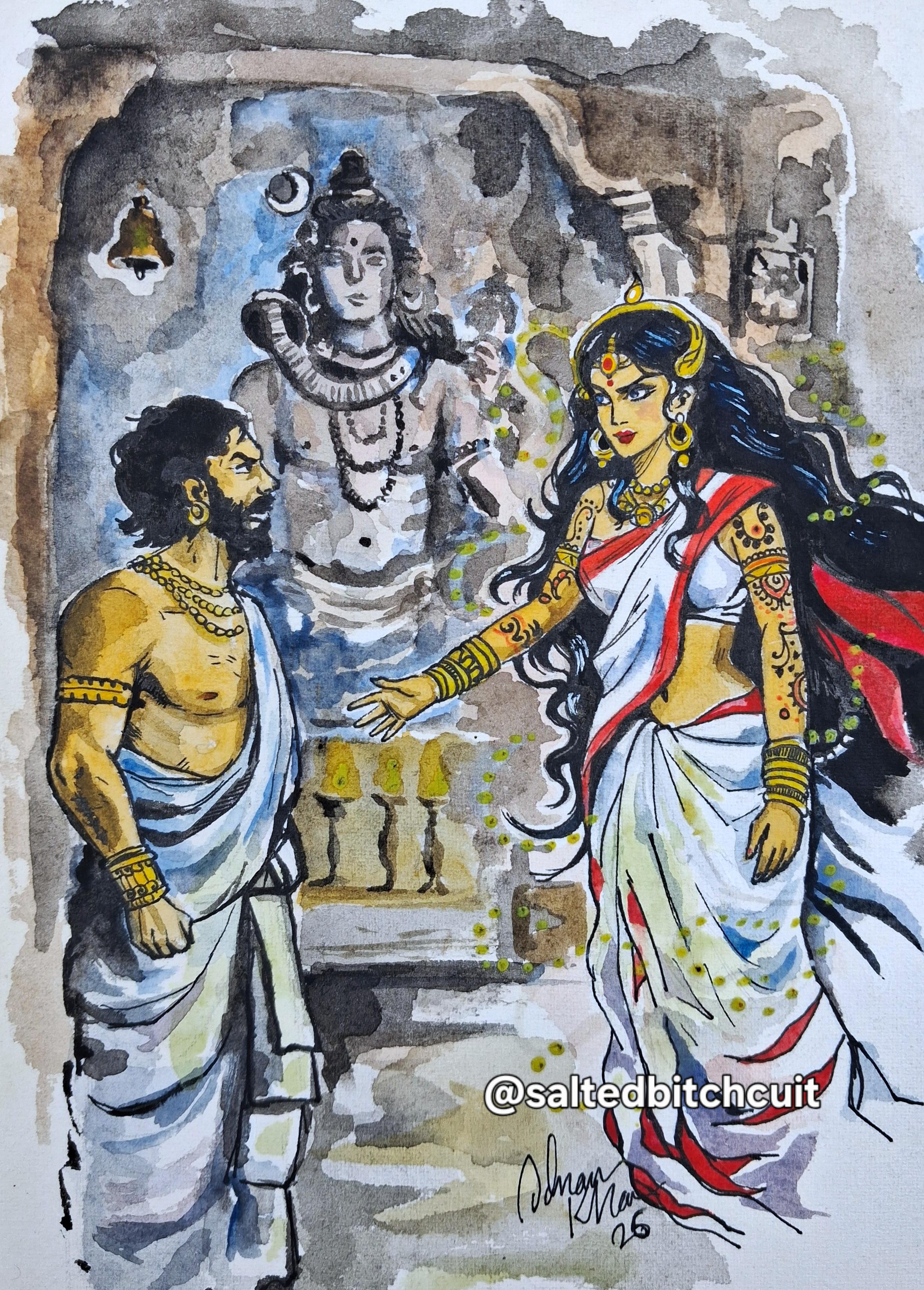
Are We Truly Understanding the Divinity of Shri Rama/Krishna? Give this post 5 mins. I apologise for this long post ig it's worth it though.
Before beginning, I want to clarify something: I am not trying to differentiate our Thakur Ji from Narayan. My intention is not to create divisions between our beloved forms of Bhagavan, but rather to explore their relationship and the divine unity they embody through the words of our own Goswami Tulsidas Ji and the Bhagavatam.
Goswami Tulsidas Ji describes Shri Rama in a manner that places Him beyond even Vidhi, Hari, and Hara. But what does this actually mean? Who is our Thakur Ji, whom the Tridevas themselves revere?
Let us explore this through the scriptures.
- The Penance of Manu and Satarupa: Who Were They Seeking?
We know the account of Svayambhuva Manu and Mother Satarupa performing intense penance to obtain the darshan of their beloved Lord.
Goswami Tulsidas Ji writes in the Ramcharitmanas:
"बिधि हरि हर तप देखि अपारा। मनु समीप आए बहु बारा॥"
Witnessing their extraordinary penance, Brahma Ji, Vishnu Ji, and Shiva Ji approached them repeatedly.
Yet Manu and Satarupa remained absorbed in their austerities. Why?
They were not performing penance merely to obtain the darshan of the Tridevas. Their desire was for the darshan of their beloved Thakur Ji Himself.
The Lord they sought is described as:
"नेति नेति जेहि बेद निरूपा। निजानंद निरुपाधि अनूपा॥"
He is the One whom the Vedas describe through neti, neti — not this, not this. He is self-blissful, beyond limiting designations, and incomparable.He cannot be confined within our limited conceptual understanding of divinity. He is complete in Himself, beyond the limitations of material designations and ordinary perception.
- The Supreme Lord Responds to His Devotees
Witnessing the extraordinary devotion of Manu and Satarupa, our merciful Bhagavan, the protector of His devotees and the refuge of the surrendered, finally spoke through a divine voice from the celestial realm of Saket.
Goswami Ji writes:
"मागु मागु बरु भइ नभ बानी। परम गभीर कृपामृत सानी॥"
"Ask for a boon, ask for a boon," declared the celestial voice, profound and saturated with the nectar of divine mercy.
Simply hearing that compassionate voice restored their strength and filled their hearts with hope.They requested the darshan of the Lord, and Bhagavan manifested before them in His beautiful saguna form:
"नील सरोरुह नील मनि नील नीरधर स्याम।
लाजहिं तन सोभा निरखि कोटि कोटि सत काम॥"
His complexion resembled a blue lotus, a blue jewel, and a rain-bearing cloud. His divine beauty was such that millions upon millions of Kamadevas would pale in comparison.
Yet what fascinates me most is what Manu says upon beholding Him.
Manu addresses the Lord as:
"सुनु सेवक सुरतरु सुर धेनू। बिधि हरि हर बंदित पद रेनू॥"
O Lord, You are the wish-fulfilling tree for Your servants and the celestial cow that fulfils their desires. The dust of Your feet is worshipped by Brahma, Vishnu, and Shiva.
Just pause and reflect upon this.
The very Lord whom Manu and Satarupa desired to behold is described as the One whose foot-dust is worshipped by the Tridevas.This raises a profound theological question: Who, then, is the Supreme Thakur Ji whom the Tridevas themselves revere?
- The Same Supreme Lord Becomes the Four Sons of Dasharatha
The story becomes even more beautiful when we understand what Manu and Satarupa ultimately desired.They wished to experience the relationship of parents with the Supreme Lord Himself. In response to their devotion, Bhagavan granted them the opportunity to become Dasharatha Ji and Mother Kaushalya in a future birth.And our merciful Lord did not manifest merely as Shri Rama. He appeared as all four beloved princes of Ayodhya — Rama, Lakshmana, Bharata, and Shatrughna.
Here, I would like to draw attention to a verse from the Shrimad Bhagavatam, in the account of Shri Rama's appearance.
Shukadeva Goswami Ji states:
"तस्यापि भगवान् एष साक्षाद् ब्रह्ममयो हरिः।
अंशांशेन चतुर्धागात् पुत्रत्वं प्रार्थितः सुरैः॥"
The verse describes Bhagavan Hari, the Supreme Divine Reality, appearing in four forms as the sons of King Dasharatha.
The word that particularly catches my attention is "साक्षात्" — directly, personally, or in His own presence.
This is not language that should be overlooked when discussing the divinity of Shri Rama and His brothers.Their appearance is presented as the manifestation of Bhagavan Himself, not merely as an ordinary birth.
- The Word "Sakshat" and the Appearance of Shri Krishna
Now consider another verse from the Shrimad Bhagavatam, describing the appearance of Shri Krishna:
"वसुदेवगृहे साक्षाद् भगवान् पुरुषः परः।
जनिṣ्यते तत्प्रियार्थं सम्भवन्तु सुरस्त्रियः॥"
Here, Bhagavan, the Supreme Person, is described as appearing directly in the house of Vasudeva.
Once again, we encounter the word "साक्षात्".This invites us to reflect on the scriptural language used to describe both divine appearances.
Shri Rama and Shri Krishna are not ordinary beings. Both are worshipped as the Supreme Lord in Vaishnava traditions, although different sampradayas explain the relationship between their manifestations in different ways.In Gaudiya Vaishnava theology, Krishna is specifically understood as Svayam Bhagavan, the original Supreme Personality of Godhead. Other Vaishnava traditions articulate the relationship between Narayana, Rama, and Krishna through their own scriptural and theological frameworks.
Nevertheless, the unity of the Supreme Lord remains central to Vaishnava devotion.
- Are Rama and Krishna Merely Amsha or Kala Avatars?
This brings me to the central point of my post.
When we speak of Shri Rama and Shri Krishna, should we understand Them merely as partial manifestations — amsha or kala avatars — or should we recognise the complete divinity attributed to Them in their respective theological traditions?
My intention is not to establish one form of Bhagavan against another.I am simply asking us to examine the language of our scriptures carefully.
Shri Rama is revered as Parabrahman in Rama-bhakti traditions. Shri Krishna is explicitly described as Svayam Bhagavan in Gaudiya Vaishnavism. Both are worshipped as the Supreme Lord, not as beings separate from the ultimate divine reality.
I would genuinely appreciate the perspectives of fellow Vaishnavas, particularly those familiar with the Ramcharitmanas, Shrimad Bhagavatam, and the teachings of the different Vaishnava sampradayas.
Please share your scriptural references and interpretations. I am interested in understanding this subject more deeply through shastra and the teachings of our acharyas.
https://www.reddit.com/r/hinduism/s/XMoWegZzIL
https://www.reddit.com/r/hinduism/s/KuKlUsDSBl
Shree radhe Shyam