r/interestingasfuck • u/The_Love-Tap • 9h ago
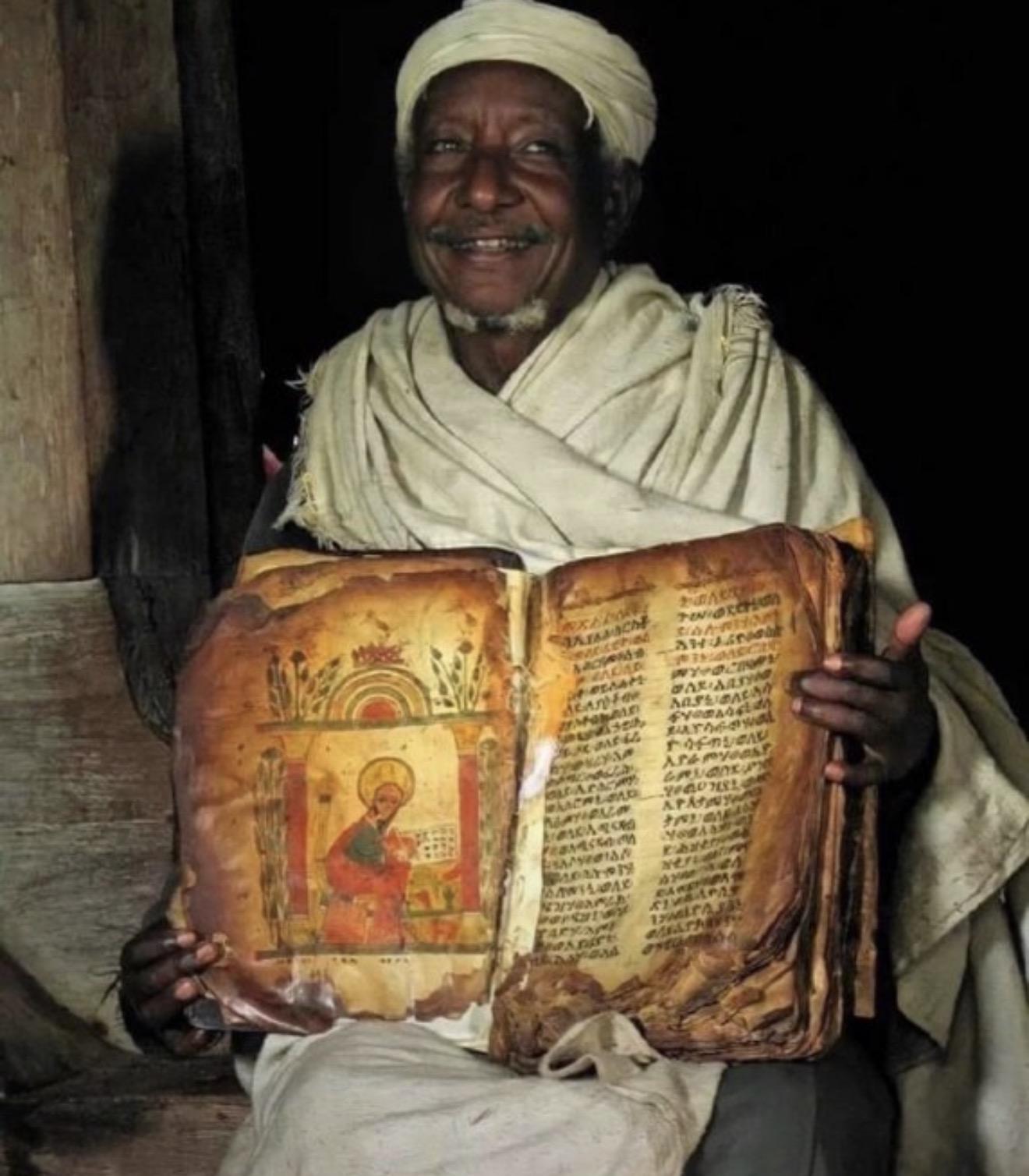
These illustrated Christian Gospels have survived for roughly 1,500 years in an Ethiopian monastery
•
u/wonderfulkneecap 9h ago
God bless the librarians!!! This man's grin is absolutely sending me!!
•
u/The_Love-Tap 8h ago
It’s incredible what generations of caretakers and conservators have managed to preserve. Makes you wonder how many other manuscripts are still waiting to be studied!
•
u/YorathTheWolf 6h ago
The collection of manuscripts in Timbuktu has a fascinating contemporary history because the librarians, both public and private (There's a strong tradition of private collections preserving heritage works), had to smuggle the entire collection out of Timbuktu under the noses of Jihadist militias who had taken over the city during the Malian civil war and were destroying heritage sites like the many shrines to saints and scholars still revered in the city. They literally had to ask their foreign donors, alongside the Dutch government, who had been paying for them to hire staff and researchers to instead get them the money to buy dozens upon dozens of lockers, bribe checkpoint guards, and to fund a literal snuggling operation. They managed to get the entire collection out of Timbuktu and to Bamako without Ansar Dine being any the wiser
•
u/Loki_of_Asgaard 5h ago
A snuggling operation sounds extremely cozy
•
u/YorathTheWolf 5h ago
God damn it xD TBF, I guess they got pretty cozy with the checkpoint guards by the end
•
•
u/thesituation531 1h ago
Alright I'm gonna sound really stupid but I have to make a confession here.
I never realized Timbuktu was an actual place, I thought it was just something my grandma and mom used as a saying when I was a kid.
•
→ More replies (8)•
u/EtherealHeart5150 2h ago
As a retired librarian, I almost wept. Just to be in the same room with that book...
•
u/wonderfulkneecap 2h ago
It's genuinly such a physical testament to humans' obsessive, loving, and uninterrupted capacity to care for books!
•
u/NotThatAngel 8h ago
The Ethiopian Orthodox Church recognizes 81 books in their bible. The King James version only has 66 books.
•
u/Cold-Relief-4184 5h ago
Like the gospel of Thomas
•
u/AeneasVII 5h ago
Sixth and Seventh Books of Moses.
They don't want you to know about Moses' super powers
→ More replies (1)•
•
u/FlattenInnerTube 8h ago
The other 15 didn't fit the narrative
•
u/blahblah19999 5h ago
12 yr old Jesus killed a playmate... oops.
•
u/Instroancevia 3h ago
It's fine he revived him after iirc
•
u/blahblah19999 2h ago
He revived a kid who fell off a roof to prove he was innocent. But he didn't revive the kid he actually killed.
•
→ More replies (1)•
u/The1Sbeve 3h ago
You joke but when it comes to the Gospel of Thomas… yes. It contradicts a lot of what the bible says, written in the other gospels, which naturally casts doubt as to its validity. In Christianity, the books are “inspired”, which means God Himself had a hand in what was written. Obviously there’s a human element too, and therefore it’s not totally infallible, but there should at least be a narrative consistency. Another testing method was how many churches claimed it as authoritative. Pretty much every church was founded on the the Synoptic gospels (Matthew Mark Luke John) so its obvious they were canonical. But if only church in the middle of nowhere claimed “The Testimony of Bob” was canonical, then yeah it was probably rejected.
•
u/Snoo_17771 2h ago
Smh the rest of the church did my boy enoch dirty. His book is the wildest
•
u/Empty-Dragonfruit656 23m ago
All other orthodox churches consider the books of Enoch(any many other books) to be apocrypha, in that they do not serve a purpose to be read in the liturgy, but should be read in private study to add understanding to the liturgical cycle.
•
u/JimTuesday 42m ago
Nitpick here but there are only three synoptic gospels, Matthew, Mark, and Luke. John is generally thought to have been written later than those three, and is likely a response to other gospels (like the gospel of thomas) that were being written around the same time. Even within 50 years of Christ’s death there was arguments and disagreements over what his message meant.
•
u/Mak062 6h ago
The King James Bible is a collection of stories that the king of England gathered to support his beliefs and dogma such as cutting out political and anti-monarchical notes and verses that challenged the "divine right of kings".
BUT, king James did gather 47 leading Greek and Hebrew scholars from England's top universities to create a translation that was both faithful to the original languages and dignified in style.
So one can argue its a cherry picked version of the Bible. But more faithful to the literal translation of the original text
•
u/120z8t 6h ago
But more faithful to the literal translation of the original text
More faithful compared to what?
•
→ More replies (1)•
•
•
u/worldlyfoolish 4h ago
This is simply not true. The KJV didn’t cut out verses. It relied on manuscripts available at the time which actually had a few more verses. The original KJV even had the deuterocanonical books in between the OT and NT, following reformed tradition. Newer translations have access to even older manuscripts which means modern bibles have more cut out text (technically cutting out additions). There are no verses about the divine right of kings that were cut out, that’s just misinformation.
•
u/Mak062 4h ago
You can believe what you want, but check out the Geneva Bible, it was the popular versionof the time. Its creators held strong Calvinist views that emphasized God's supreme authority over earthly rulers. Thus angering the local monarchs, and inspiring james to ban marginal commentary entirely in his new 1611 translation.
→ More replies (1)→ More replies (2)•
u/Antique_Weekend_372 6h ago
This is such a dumb comment. Martin Luther rejected a few Old Testament books that were only in Greek and not in the Hebrew bible, and KJV followed his lead, nothing political about it. The Ethiopean Bible has extra books that orthodox/catholic christianity rejected like the book of Enoch.
The real political aspect of the KJV was translating it to English at all.
•
→ More replies (41)•
u/iam1whoknocks 7h ago edited 6h ago
Book of Enoch (excluded from modern Bible but in Ethiopian) teaches happiness and everything you need is already within you...that's where you have to seek...you don't need a Church to find it. The Roman Church couldn't have that kind of thinking so Enoch books were removed.
•
u/dehydratedrain 6h ago
I remember it being more about the angels breeding with human women (discussed a bit on Gen 6).
•
•
u/IReplyWithLebowski 6h ago
Enoch is fucking crazy but I don’t remember it teaching that.
→ More replies (1)•
•
u/JangoDarkSaber 5h ago
Literal straight up misinformation.
The Catholic Church didn’t remove Enoch. Enoch was never apart of the Old Testament. Ancient critics before Jesus was even born doubted its authorship. It was never accepted by Judaism to begin with.
→ More replies (1)•
u/LazarusArise 4h ago edited 3h ago
It's correct that it wasn't in the Old Testament so could have never been removed. However, it was found among the dead sea scrolls and ideas from it seem to be referenced in the New Testament. So there was some acceptance of it in ancient Judaism. Several early Church fathers like Irenaeus considered it to be inspired scripture. But yeah it's not canon because it wasn't in the Septuagint or Old Testament.
•
→ More replies (2)•
u/Antique_Weekend_372 6h ago
It wasn’t removed it was never in the canon and it’s not in the canon because it is a bunch of apocalyptic angelology that fell out of favor in the Byzantine empire. It was also written quite late for Old Testament material.
•
u/hrtofdrknss 8h ago
I've been there and seen the book (and that guy!). It is pretty amazing, especially given conditions of its storage and handling.
•
u/The_Love-Tap 8h ago
That’s incredible that you’ve actually been there and seen the manuscripts in person! What was the experience like? Were visitors able to see the books up close, or were there restrictions on how they could be viewed?
•
u/hrtofdrknss 4h ago
The book is brought out by this keeper for small groups, arranged beforehand. No one can touch it but him. He usually displays maybe a dozen pages for viewing, carefully turning to book-marked pages. You are allowed to get pretty close.
There are similar old books and manuscripts in other Ethiopian churches in pretty rural areas. Each of these places has special caretakers, usually passed from one generation to the next in a family, whose sole role in the community is to care for the church treasures. There are usually old priestly garments and headgear that is purported to be hundreds of years old, as well as silver trays, carved and painted chests and boxes, etc.
And at least one such place in Axum claims to have the original Ark of the Covenant, never displayed and only seen by a small number of priests. https://en.wikipedia.org/wiki/Church_of_Our_Lady_Mary_of_Zion
•
u/strong-like-iraq 3h ago
Yes, and the country that has the ark of the covenant can never be defeated in battle . . Ethiopia is one of only two countries in Africa that were never colonized
•
u/Adventurous-Emu-9345 6h ago
That's something that stood out for me here at well. The man seems pretty nonchalant with what has to be some very fragile paper and binding.
•
u/slavuj00 5h ago
They're made of goatskin vellum, not paper. We now know that vellum survives longer and is stronger if it's handled without gloves than with any kind of protection. It's theorised that this is because the oils in our hands help to "moisturise" the vellum almost. It's interesting reading, looking at how librarians handle ancient texts these days.
•
u/Everkeen 5h ago
Sure but this book is clearly hurting for some restoration and protection so it will actually last.
•
•
u/Fearless_Push_4227 8h ago
My guess is that they have stable weather all year long?
•
u/CloudsAndSnow 8h ago edited 8h ago
Why? There are plenty of 1500 year old and even older manuscripts all across Europe from Barcelona to Uppsala, so arguably weather stability is not that big a factor. More important is religious stability which Ethiopia relatively had, and Codicology knowledge of Ethiopian shcolars to keep the treatries in good shape, which they still have
•
u/Fearless_Push_4227 8h ago
there are single or several sheets in europe that look exactly like how old they are-more than a thousand years old. The one in the photo looks like it was made last century. So I figured there are some reason for their well preservation
•
u/CloudsAndSnow 6h ago edited 4h ago
Not at all!
The scholar in the picture is holding the Garima Gospel II which was composed between the 6th and 10th centuries ref. As way of comparison, the Codex Vaticanus which is at least 200 years older is in much, much better shape see for yourself.
If we go to examples that are actually contemporary to Garima2, we have a lot more examples of full codices in Europe (and elsewhere) still in perfect shape, like the Littera Florentina_fol._112v-113r_Pandects_excerpt.jpg), the Chronicle of Edessa just to name a few
•
u/The_Love-Tap 9h ago
The Garima Gospels are among the oldest surviving illustrated Christian manuscripts, preserved at Abba Garima Monastery in Ethiopia. Radiocarbon testing dates parchment from the manuscripts to approximately 390–660 CE. According to tradition, Saint Garima completed the Gospels in a single day through divine assistance. That’s a religious tradition rather than a historically verified event. What amazes me most is that these manuscripts survived for around 1,500 years. Do you think historical manuscripts like these are better protected in museums or in the religious communities that have preserved them for centuries? Source: Ethiopian Heritage Fund
https://www.ethiopianheritagefund.org/completed-project-3-the-abuna-garima-gospels
•
u/gnarzilla69 8h ago
Idk they've done pretty well for the last 1,500 years... As another comment noted, idk of any museums that have lasted that long. They have been admirable stewards and no one should have the hubris to think that they are more entitled to preserve these manuscripts then the souls that have been doing it for millenia
•
u/CloudsAndSnow 8h ago
Do you think historical manuscripts like these are better protected in museums or in the religious communities that have preserved them for centuries?
found the bot
•
•
•
u/gladys-the-baker 8h ago
Definitely in museums, this dude is handling them without gloves in what appears to be a cave lol
•
u/knobunc 8h ago
From the Library of Congress:
Are gloves required for handling rare books?
Contrary to popular belief, gloves are generally not recommended as proper handling for rare books! The best way to prepare for handling rare materials is to simply wash and dry your hands thoroughly.
In cases where the books contain photographs or are decorated with metal or ivory, clean gloves (nitrile, vinyl, or lint-free cotton) will be provided.
We hope that this is helpful; If not, please feel free to submit your question to begin a conversation with a Reference Librarian.
https://ask.loc.gov/rare-books-special-collections/faq/305906
→ More replies (1)•
u/The_Love-Tap 8h ago
That’s a really useful clarification! I think a lot of people, myself included, assume gloves are always safer for ancient manuscripts. Interesting that clean, dry hands can actually be preferable for handling certain rare books. Thanks for sharing the Library of Congress source!
•
u/liverswithfavabeans 8h ago
You have a more nuanced grip on the book and can in many cases be even gentler because your fingertips are so sensitive.
→ More replies (1)•
u/vonbauernfeind 3h ago
And beyond that, the oils from your hands are good for vellum, assuming these are made of that.
Vellum isn't paper. It's thin specially made animal skin. Skin oils from hands help to keep it moisturized and in good condition; frankly, vellum isn't really at risk from tearing being handled, it's at a higher risk of drying out and cracking.
•
u/AnAge_OldProb 8h ago
Gloves are not the standard for old books. They make it easier to tear the material. The cave is also maybe what kept it going this long dark and cool is generally good for preservation. Given the age and it’s Ethiopia so I’ll assume it’s dry enough for the main downside of caves to not be a problem.
•
u/Weekly_Ferret_meal 8h ago
In fact I'd say the cave probably maintains constant temperature AND humidity throughout seasons without the need of extra hardware.
Then we can debate whether the humidity % is the ideal for these type of preservations... but at the very least is constant.
And simply washing and drying your hands is better than gloves
•
u/Khelthuzaad 7h ago
In Romania we had an ancient Christian painting that stayed most of it's existence inside a monastery with no utilities inside,no light etc.
A few months after it was sent to an museum it started to flake and crack because the air wasn't humid enough and the room temperature too warm,so it was restored and sent back
In a similar vein,artificats found in the bottom of the Black Sea are mostly NOT to be excavated at first sight because oxidation with air contact will accelerate degradation of said object.
•
•
•
u/henrysradiator 7h ago
I work in a museum, you're not actually supposed to wear gloves when handling ancient books! Easier to damage with gloves on, dexterity is better, gloves reduce tactile sensitivity and can hold tiny bits of moisture and dirt.
→ More replies (5)•
u/tommytraddles 8h ago
survives longer than any other illustrated version
clearly they are incapable of caring for it
•
u/TabbyOverlord 7h ago
One of the main reasons for their preservation is they are written on vellum rather than paper. This is usually goat or calf skin scraped really thin the curing/tanning process.
It is much more stable than even good quality paper, which lasts a mere few centuries.
•
u/Asleep-Card3861 8h ago
Its recommended to not use gloves on rare old books. Bare well washed dry hands provide better tactile feedback to feel how brittle or how much pressure is needed.
Caves strangely enough would probably provide a cool steady temperature due to their thermal mass. Temperature fluctuations are destructive.
Perhaps try educating yourself before making fun of others.
→ More replies (1)•
→ More replies (5)•
u/Around-3-ish 8h ago
Yes but they have survived 1500 years. The British Museum cleaned the Parthanon Marbles with bleach snd a wire brush.
•
u/MegazordPilot 8h ago
in a single day through divine assistance
You mean vibe-written with GodGPT 1.0
•
→ More replies (3)•
u/Ghost_of_Cain 7h ago
Is this the one where Peter enables a street dog to speak and makes it tell off Simon?
•
u/SelfishGeneAndMeme 6h ago
This man looks like he belongs in a village in my country, Egypt. The Coptic Church is definitely a unifying thread between them. It’s a shame Egypt and Ethiopia are locked in geopolitical conflict
•
u/DRHOYXI 2h ago
Folio after creepy long fingers
https://www.vhmml.org/readingRoom/view/132897
https://en.wikipedia.org/wiki/Ge%CA%BDez
Dillmann lexicon
www.lexilogos.com/keyboard/amharic.htm
Aksumite --> Ge'ez --> Amharic (It appears that Amharic contains but expounds on the Ge'ez language system)
The text begins at 8r.
The text does not appear to include 1:17 with the rest of the genealogy, unless it is within the red-coloured text at the end of 9r. This red text does not appear to include an nh3t. If the red text followed the Matthew version of 1:17, then it would be reasonable to expect 3 HNWs, and at least 2 HNWs following reduction, but it does not appear to contain any HNW's.
The text appears to be reductive, representing the understanding of the content of the scripture, and not a verbatim direct translation. Nonetheless, I assert that it would not omit "Joseph" if it were present in the source text.
"nh3t:" = "was the father of"/"begat"/"fathered", as in "fathered Abraham Isaac", or "fathered Isaac Abraham"
"nh3t:" = B- -'(a with umlauts, "glottal e" in Amharic)- -N(upside-down e)- -T(a with umlauts)
"nh3t:" = B-glottal E-N-Te. This is perhaps very close to "Ben", Hebrew for "Son", and "Te" could easily mean "Of", becoming "Son Of".
"HNW" repetitively follows "nh3t:", but only twice consecutively on the second-last segment of the first page, the fifth segment of the second-last page, and the last four segments of the text.
That the last four segments of the text would each say "Son Of HNW..." is peculiar... unless a sacred term is being applied to the immediately preceding generations before and including the Christ. The question then becomes, why are there other dignitaries within the middle of the text? King David or King Solomon would be stand-outs for most, and appear next to each other roughly one-third through the genealogy, which is actually representative within the corpus of this text. There is substantial lacunae in the line immediately preceding the "HNW" at subject, so the probability of it representing Solomon is greater. It does appear as though the remnants of another "HNW" are still visible. "HNW" seems to mean "King". If this language does descend phonetically from Hebrew, then it would be reasonable to expect "HNW" to transliterate from "MLK", "MLCH", "MLC", etc., but the Amharic script offers a "Z" sound for "H".
"Kirubel" and "kiruben" appear to be the female (bel) and male (ben) forms of cherubim, revealing a semitic root for "son" and/or "young male".
By this logic, the Ge'ez word for "cherub" is not "kirub", but "kiru" (possibly a somewhat inverted derivative of the Greek Κύριε/Kyrie).
Leslau offers "between" for "bēn", which is also plausible, and transliterates "son" to "wald".
The words "Jesus" and "Christ" should appear on both the first (8r) and last lines (9r) of this chapter.
"Jacob" should appear on roughly the second verse (8r) and roughly the last or near last verse (9r).
Final segment (transliterated phonetic):
S'
"Jakob" or "YKB" does appear from right to left on the final line, as "BKJ", or "nh9". That words would be written backwards is exceptional.
10 Royal nh3t's in succession in standard Matthew.
At least 14 section markers (perhaps verse numbers) or nh3t's on the left column of 8v, and 14 section markers on right column of 8r.
39 nh3t's on 8v/9r = ~69 sections.
41-42 sections in standard Matthew (from Abraham), my list (from YHWH) contains 62-65.
YHWH to Abe is 20-22 generations. The Ge'ez scripture might be expected to start at YHWH or Adam.
"nh-" is very close in appearance to "ab / abba" or "father" spelled backwards in Ge'ez script. That this script's words would be written backwards would be completely unique to my experience.
The final "section marker" begins with a symbol that is similar to the Amharic symbol that means "40" if it were rotated 90 degrees counter-clockwise. The final characters of all 3 of the last section markers could be interpreted as "6", "7", and "8".
Matthew 1 in Garima 2/III contains 68 verses of iron gall script.
That the last and fourth-last section markers of 8v both appear as near-identical characters ("40") is not troublesome, due to the similarity between "1" and "4". The final section marker of 8v is verse "54".
"10s" appear as a singular line, "I" or "l".
"20s" appear like "Th".
"30s" appear as a rotated "S" shape like "jn".
"40s" appear like "jH" in Ge'ez, unlike Amharic.
"50s" appear like an open English "4".
"60s" appear like an Amharic "40" rotated 90 degrees counter-clockwise.
https://i.pinimg.com/originals/2b/e0/97/2be097372f6a0183d2b0877579409b7d.gif
https//i.pinimg.com/originals/2b/e0/97/2be097372f6a0183d2b0877579409b7d.gif
https://en.wikipedia.org/wiki/Ge%CA%BDez_script
(last character) Hartford Whaler lightning bolt = " jn-e " (white reference) ኘ
(second-last character) long-tailed lower case "h" = " '-a " (Amharic) አ
(third-last character) right-footed capital "H" = " 3-i " (white reference) ዚ
(fourth-last character) E.T. 9 = " g - upside-down e " (white reference) ግ
(fifth-last character) long-tailed lower case "h" = " '-a " (Amharic) አ
(sixth-last character, first character of word or sequence) large lower-case "n" = " k-a with umlauts " በ
The possibilities of this word or sentence are expected to be or include Christ, Jesus, Mary, or Joseph.
As it appears in the manuscript:
----------------------------------------
First segment
"k-a with umlauts" (white), "Hartford Whaler lightning bolt", "n-schwa" (white) , "t-a with umlauts" (white) , ":" "s-a with umlauts" (white) , "k-schwa" (the "n" has a "left leg" which is only associable with schwa, and also a left "stem" on top, white; Amharic offers an alternative in "kwa"), " '-a with umlauts" ("the single zigger", white), ":" , "s-schwa" (white), "g-schwa" (white), "r-e" (white)
kay nuh tay say kuh/kwuh ay suh guh ree
ree guh suh ay kuh/kwuh say tay nuh kay
[kay] [nuh tay] say kuh/kwuh ay suh guh ree
ree guh suh ay kuh/kwuh say [tay nuh] [kay]
Abraham Isaac Jacob Adam Seth Enos Cainan
----------------------------------------
Second segment
"k-a with umlauts" (white), "Hartford Whaler lightning bolt" - or " '-schwa" (white), "n-schwa" (white) , "t-a with umlauts" (white) , ":", "Hartford Whaler lightning bolt" (which is the double-zigger) - or " '-schwa" (white), "b-e" (white, though the hoop is somewhat indistinct), ":" , "k'/q-a with umlauts (white), "t-a" (white), "b-u" (white), "p-a with umlauts" (white), "4" ("top" bracketed "elongated O", Amharic), "n-a" (white), "ts'-o (with the accent-eh-whatever, of course" (white),
kay uh nuh tay uh bee kay/quay tay bu pay 4 nay tso
tso nay 4 pay bu tay kay/quay bee uh tay nuh uh kay
[kay uh] [nuh tay] uh bee kay/quay tay bu pay 4 nay tso
tso nay 4 pay bu tay kay/quay bee uh [tay nuh] [uh kay]
•
u/DRHOYXI 2h ago
Last segment:
[Right to left]
: (wordspace), "uh", glottal "ay", "zi", pharyngal "o", glottal "ay", "bay", :
"k-a with umlauts" (white), "Hartford Whaler lightning bolt", "n-schwa" (white) , "t-a with umlauts" (white) , ":" , "z-a with umlauts" (white) , "k-a with umlauts" (white) , "m-a with umlauts" (white) , ":" , "s-a with umlauts" (white) , " '-a" (white)
kay uh nuh tay zay kay may say ay
ay say may kay zay tay nuh uh kay
[kay uh] [nuh tay] zay kay may say ay
ay say may kay zay [tay nuh] [uh kay]
"b-i" (white) , ":" , "h-schwa" (white "h" + there is a right arm at the middle, which elsewhere is associable with a schwa) , "s-e" (white) , "f-schwa" (white) , ":" , "s-schwa" (white) , "g-a" (white)
bi : huh see fuh : suh gay
gay suh : fuh see huh : bi
bi : huh see fuh : suh gay
gay suh : fuh see huh : bi
Whole:
[kay uh] [nuh tay] zay kay may say ay bi : huh see fuh : suh gay
gay suh : fuh see huh : bi ay say may kay zay [tay nuh] [uh kay]
Zadok Achim Eliud Eleazar Matthan Jacob Mary Jesus
Eleazar Matthan Jacob Joseph Mary Jesus
ሁ : በ አ ዚ ግ አ ኘ :
Phonetics in square brackets:
ሁ [hu]
በ ["bay" (white) or "kay" (Am.)]
ን n-schwa [(white) "nuh"]
ዚ ["zi" (white)]
ግ ["g-uh" (white)]
ን n-schwa [(white) "nuh"]
ኘ ["nah"/"nay" (white)]
"Guh-zi" may be "Jesus". "Guh-zi Kay" could possibly be indicative of "Jesus Christ".
"Nah-nay" could be "mother". Leslau posits " 'əmm ", but also allows for " ənnat ".
So... "Nah-nay Guh-zi Kay" could be "Mother Jesus Christ".
1 This is the record of the genealogy of Jesus Christ, the son of David, the son of Abraham:
[1] 2 Abraham was the father of Isaac,
[2] Isaac the father of Jacob,
[3] and Jacob the father of Judah and his brothers.
...
[39] Eleazar the father of Matthan,
[40] Matthan the father of Jacob,
[41] 16 and Jacob the father of Joseph, the husband of
[42] Mary, of whom was born Jesus, who is called Christ.
-----------------
17 In all, then, there were fourteen generations from Abraham to David, fourteen from David to the exile to Babylon, and fourteen from the exile to the Christ.
-----------------
The red script could be verses 17 or 16.
17 ought to include the number "14".
The numbers are written left to right, so the letters are more likely to also be written left to right. It is unlikely that this manuscript was numbered by another pen. It may be that the "10's" were written after the "1's" in Ge'ez.
YHWH
Adam
Seth
Enos
...
Abraham
Isaac
Jacob
Judah
...
Matthan
Jacob
Mary
Jesus
ree guh suh kuh say [tay nuh] [kay]
tso nay 4 pay bu tay kay/quay bee uh [tay nuh] [uh kay]
ay say may kay zay [tay nuh] [uh kay]
[kay] [nuh tay] say kuh suh guh ree
[kay uh] [nuh tay] uh bee kay/quay tay bu pay 4 nay tso
[kay uh] [nuh tay] zay kay may say ay
"tay nuh" and "uh kay" or "kay uh" and "nuh tay" (and presumably "kay") are commonly grouped together, indicating that they are repeating elements within this presumed list of names, which reasonably indicates that they mean "fathered", "begat", "son of", etc... so the other shit is names. It is more reasonable to hypothesize that the [kay uh] [nuh tay] components are between and before names, and not following.
[kay uh] [nuh tay] zay kay may say ay
"ZayKay MaySayAy " could be "Jesus Christ Messiah".
Second last line
በ (Bee)
፡ (Wordspace)
ዮ (Yo)
ሴ (See, hoop doesn't close)
ፍ (Fuh, line goes through like cent sign)
፡ (Wordspace)
ሥ (Szuh)
ጋ
በ፡ዮሴፍ፡ሥጋ
Bee : Yo See Fuh : Szuh Gay
"Yo See Fuh" is almost certainly "Joseph"... and my interest here is lost.
•
•
u/LightheartedLemon 8h ago
How did the British Museum miss this!?
•
u/Foxtrot-13 7h ago
It is from Ethiopia so it would be in the Museo Africano in Rome.
Or an American museum after being looted from Italy during the Second World War.
•
•
u/brundlfly 8h ago
Digitize this ASAP. Not that I give a wet slap about religious text, but it has cultural and historical value and should be preserved.
•
u/freezing_banshee 8h ago
I don't care for religious texts either, but they're usually some of the best preserved texts over hundreds of years. For example, one of the most legible Romanian texts written in the cyrillic alphabet is the bible.
→ More replies (1)•
u/Trademarkd 1h ago
subtle references in the text can often be used to corroborate other sources even if you're not interested in the religious aspect.
•
u/moljnir40 8h ago
I was going to say this but you got it. I completely understand keeping the documents under the control that had done so well for so long but PLEASE let the world digitize them so that they can be studied and preserved.
•
→ More replies (4)•
u/Arminius_Fiddywinks 7h ago
I’m in a Discord server dedicated to Manichaeism. While I don’t believe in that faith at all I still think that its associated documents and artwork should be preserved. This faith was a world religion in multiple continents in late Antiquity and the early Middle Ages, it competed with Christianity for believers. It is such a fascinating part of human history that’s getting slowly digitized by random people on Discord. Incredible.
→ More replies (1)•
•
•
•
u/Update_Later 5h ago
Way too many people caught up being atheist they don’t have time to say “wow, that’s a real old book I’ll tell you what.”
→ More replies (10)•
•
•
u/fd1Jeff 8h ago
I am very curious. Has anyone compared these to the modern translations of the Bible?
•
u/journeymansave 8h ago
Yes, many times. There was even an academic conference on them in 2013.
https://web.archive.org/web/20170503173517/http://www.ethiopianheritagefund.org/document-page-2
→ More replies (1)•
u/ZzzzzPopPopPop 8h ago
TLDR? I’m mostly curious what specific books/verses they kept or omitted that are not in he King James or similar versions.
•
u/PartyWooden6249 7h ago edited 7h ago
Ethiopian canon is slightly different than the traditional western canon, they were kind of there own church that the west didn’t know much about until recently. The earliest (complete) copies we tend to recognize as authentic are The Septuagint, which is a 3-2nd century Greek translation of the Hebrew Bible. There is also the Latin Vulgate which translates the Old and New Testament into a “modern” form of Greek. A lot of modern bibles use those + the masoretic text as the base of their translations
→ More replies (1)•
u/journeymansave 8h ago
I believe it’s largely in-line with (though it does differ from) the Ethiopian Orthodox canon, and likely represents a step in its development.
•
u/parkinthepark 4h ago
The Ethiopian Bible does contain some books that are considered apocryphal in mainstream Christianity, but the KJV contains the same books as more modern translations.
The main issue boils down to 3 things:
- We have since discovered older versions of the source texts- the KJV contains inherited mistranslations, scribal errors, redactions, and interpolations.
- We know more about Biblical Hebrew and Classical Greek today than the KJV translators did. Modern translations are truer to the original intent of the texts.
- Modern translations are (or can be) less biased- the KJV (among other translations) intentionally soften the language in certain places to be more flattering to the religion- notably obscuring the way Mosaic law deals with slavery and rape.
Fascinating side note on point #2: we know more about Biblical Hebrew than the actual authors of the New Testament. There are several points in the NT which misquote the Old Testament, repeating errors from the Greek Septuagint- which was the Greek translation of the Hebrew Bible in circulation in 1st Century Judea. This has major theological implications for Christianity- Luke quotes Isaiah 7:14 as prophesying a virgin birth, because that’s how the Septuagint translated the prophecy- but the original Hebrew better translates to “behold, this young woman is pregnant”, not “behold, the virgin is with child”.
→ More replies (2)•
u/Moggetti 6h ago
Why is everyone always fixated on the King James? Most churches don’t use that translation anymore.
•
→ More replies (2)•
→ More replies (1)•
u/Aksds 7h ago
This is more about differences between NKJ and NRSV and other literal translations that scholars use (I am not a scholar)
From memory one big difference between the KJ and NRSV is that KJ uses gendered language a lot, so where something can be interpreted to mean an entire community, KJ uses Brothers or Man, NRSV uses brothers and sisters or anyone. There is also a bit more of putting a King in a higher place in the KJ version since it was commissioned by one.
One example is Isaiah 7:14 “…Therefore the Lord himself will give you a sign. Look, the young woman is with child and shall bear a son and shall name him Immanuel.” NRSVUE vs “Therefore the Lord Himself will give you a sign: Behold, the virgin shall conceive and bear a Son, and shall call His name Immanuel.” NKJV
There is also difference in how Women are presented, in the NKJ version it will call someone a servant of the church while NRSV will say deacon or apostle (NKJ used to have a male name instead of Julia for that one)
•
u/Aksds 7h ago
Yes, all the time, it would be why (among many reasons) why the New standard revised version was updated in 2021. Bibles get updated when new old text is found, it’s why you have the KJ bible and NKJ, and NRSV and NRSVue (not that the N/KJ bible is a fully faithful translation)
→ More replies (3)•
u/PsillyFunGuy2 5h ago
Which is pretty hilarious when you consider that millions of people treat any given version as “holy scripture passed down by god” but it keeps changing and there are a bunch of different versions 😂
•
u/protossaccount 3h ago
It doesn’t keep changing like that, it’s adjustments in translation.
The Bible is also not seen as a written document straight up handed down by God. God is writing with humans and humans have an impact on what’s written. The idea that the Bible is this pure book that can’t be translated poorly is idiotic and makes no sense. A central theme in the Bible is how flawed humans are but that God loves us and wants to walk with us.
Hell, a lot of beliefs about Christianity and homosexuality come down to translations and people applying scripture to modern situation over understanding the historical context.
The Bible has humans, history, language, and culture all influencing the book. That’s why a MAJOR theme in the Bible is that God is accessible and he isn’t just an idea in a book. The God of the Bible can actually be encountered.
→ More replies (1)→ More replies (3)•
u/EpicAura99 5h ago
This is why the Quran is only in Arabic, anything else is just a translation of the Quran and not considered the actual text
→ More replies (4)•
u/Ok-Interaction804 3h ago
The idea that the Quaran has been unchanged is a myth too.
→ More replies (6)•
u/LickinThighs2 4h ago
Ethiopian / Coptic churches are basically why there is a complete 'bible' in the first place, some of the oldest 'source' texts were maintained by the scholarship within those Christian movements and are what really lent themselves to scrutinizing the source of materials for the western bible in general
I think Orthodox / Catholic christianity basically recognizes that, however a lot of evangelism does away with learning about liturgical history and so on in the first place if people just go to church as opposed to going to bible school etc where they actually would learn about how the bible was canonized etc
→ More replies (1)•
u/Activated1994 8h ago
Extensively. They share scriptures, doctrines, and translations with other oriental orthodox churches.
→ More replies (51)•
•
u/cobaltium 8h ago
Neighboring small building became an Ethiopian Christian church here in Phoenix. Lovely, reserved people.
•
u/MajesticMurray 8h ago
OP is a bot
•
•
→ More replies (2)•
u/OddlyTemptedFish 8h ago
What makes you say that?
•
u/MajesticMurray 7h ago
Take one good look at the account itself with a critical eye. This was purchased, set to private, and is now a “viral content machine” that’s apparently trying to sell a book. Didn’t even bother to remove the em dash, nor include a link or context in the post.
•
u/Charming-Station7157 6h ago
Good thing arab colonialism didn't reach ethiopia
→ More replies (5)•
•
•
•
u/Kristianushka 2h ago
With the way he’s handling these, I’m surprised they managed to survive this long
•
u/bluetree2993 5h ago
These should be in a museum or at least a protective enclosure.
•
u/Biscuits4u2 3h ago
Survived 1500 years in their care not sure why you think it needs to be taken from them.
→ More replies (1)•
•
u/LickinThighs2 4h ago
I mean, you're taking a single out of context picture to imply they aren't, lol, they are. This is just a dude holdin' them. The old Coptic/Ethiopian texts wouldn't have survived as long as they did (and even provide some of the earliest proofs for a complete western Christian bible) if they were just sittin' out lol
•
u/VegetableArtistic705 4h ago
They're in ancient churches, in the middle part where only priests are allowed.
→ More replies (3)•
u/Witty_Ad_898 4h ago
They’ve survived for 1500 years. Moving them to a modern facility is more risky than leaving them in the conditions that preserved them for so long. A sterile and climate-controlled room on-site would be best.
→ More replies (2)•
u/VoraciousTrees 4h ago
Why? What museum has preserved artifact manuscripts for 1500 years in better condition?
→ More replies (5)•
u/SinisterCheese 3h ago
Why?
It is a religious artifcat of that monastery which, and it has already survived for 1500s year.
Let the Tewahedo's have their things and hold it as they see fit.
•
u/bluetree2993 2h ago
I didn't say they couldn't have it, I just would like to see it presented as best they can for future generations.
•
u/Ok_Cockroach8063 4h ago
but then Redditors will act like it’s stolen kinda like how Britain bought most of its pieces from warlords who stole it to begin with
•
→ More replies (8)•
u/Wareve 4h ago
Britan gets that reputation for things like stealing Easter Island heads and extracting the Kohinoor diamond to put in their monarchs crown.
→ More replies (10)•
u/NorfolkingChancer 2h ago
The Indian government (and the Indian Supreme Court agreed) has stated that the Koh-i-Noor diamond wasn't stolen.
→ More replies (2)•
u/Wehti 4h ago
Yes. We in the west need to immediately steal these artefacts from their rightful owners
→ More replies (1)•
u/bluetree2993 4h ago
did I say that?
•
u/TheChaoticElk 4h ago
I agree that was a fucking WILD jump from suggesting placing the artifacts in a controlled environment such as a museum.
→ More replies (2)
•
•
u/Affectionate-Print81 7h ago
Must be super dry in Ethiopia. I had some books in my basement that got moldy in 10 years.
•
u/Long_TimeRunning 6h ago
Well then by all means just manhandle it like it’s Sports Illustrated Swimsuit Edition
•
•
•
•
•
u/KlausKinki77 2h ago
Some even say they date before the birth of Jesus. But that would be to confusing for Christians.
•



•
•
•
u/Dejantober 5h ago
We should send this document to one of the big AI companies. I hear they’re doing a fantastic job of digitizing rare and unattainable literature.
•
•
u/Robert_Fowley 5h ago
The fact that this is probably the most accurate version in existence yet mainly ignored shows how accuracy doesn’t matter in this topic
•
u/Watsel11 4h ago
idk who pr where they are kept as long as they are properly kept and cared for. In fact, I don’t think they should be handling them without a proper sabilization
•
•
u/Automatic_Record6200 3h ago
I love that it goes back to the roots of Christianity as a West Asian, North African religion. Eurocentrism really fucked it, ESPECIALLY in USA. Evangelicals 🤣
•
•
•
•
•
•
•
u/mindgardening 1h ago
I wonder what kind of “change the world” info it (and the Vatican, for that matter) contains….
•
•
u/ANameForThisShite 45m ago
I get crazy as fuck ads about the Ethiopian Bible version on Youtube, where they’re talking about how Angels are secretly running the Earth over an AI generated video of Legos. I doubt the dude in the photo is involved with it, but I don’t know where else to bring it up.
•
u/gtwizzy8 8h ago
I have seen these first hand in Lalibela when we travelled there. We were so incredibly fortunate to be in the rock hune churches on a day when one of the local priests was hosting other more senior priests (sorry I don't really know what to call it I'm in no way religious) from outside of the Lalibela region and our guide happened to take us to the churches just as they had finished their gathering. When we entered the priest welcomed our guide and they had a quick conversation and he welcomed us and our guide told us that he always loved having foreigners visit he then he asked if we would like to see some of that specific church's own historic gospels that the priest had with him for the special coming together that they'd just had with the other priests. They weren't 1500 years old but they were over a thousand years old. It was incredible to be that close to them.
Again I'm not religious in any way but it's difficult to not feel the reverence of a item like that that has been cherished and loved and protected and handed down in order to maintain their faith. It was quite a moving thing to be in the presence of.