Yeah that realization of our cosmic insignificance can hit hard.
What's crazy to me too is that that grand scale also exists, just in reverse when you talk about the quantum scale. (And to think, you can hold that grand-minuscule scale in the palm of your hand)
And we just happened to land somewhere in the middle.
The real truth is that we do not even know if the planck length is a true physical limit of the universe or if things can get even smaller from there, it's just the physical "limit" to when our standard model theorem breaks.
That coupled with the inherent limitations to our viewing of the "observable universe" and it's accelerating expansion - I feel it's kinda moot to argue anything other than "we fall generally in the middle" when we don't actually fundamentally know the true limits on either end.
What's crazy to me too is that that grand scale also exists, just in reverse when you talk about the quantum scale.
I've had similar thoughts. I used to think that Hell -- for some -- would actually be Heaven but when you got there you'd be given the choice of perfect, total knowledge & understanding of either of 2 things, but not both:
The universe (is it really infinite? If so, how does that work? If not, what shape is it and what's "outside" of it? Are there multi-verses? What is dark matter -- or what caused us to believe dark matter has to exist if it turns out it doesn't? And so on. )
OR
The quantum realm (What's up with quantum tunnelling, particle/wave duality, uncertainty, etc.? Why can't there be a spatial or time length smaller than Planck length/time? And so on.)
Heaven would be acquiring perfect, total knowledge & understanding of both :-)
Can't remember where, but one freak-out calculation I saw was "There are approximately the same number of Planck lengths in the THICKNESS of a sheet of paper as there paper thicknesses in the diameter of the observable universe)
It's such a fun yet daunting rabbithole to explore, it really blends philosophy, religion, and sci-fi, and really shows why people love sci-fi stuff so much probably. We are innately curious creatures since it happens to be evolutionarily advantageous.
I've personally spent a lot of my youth losing my Catholic faith and exploring similar thoughts. I definitely landed squarely agnostic I'd say as a result, but I really love this theory:
Fits all my boxes, inflates our egos a bit, gives us some "grander purpose" after life, and would probably result in a more hospitable planet if more people believed it.
"So in a sense we're medium-sized. Compared with the quantum foam, a proton is as huge as a person is compared with the whole galaxy, roughly 20 orders of magnitude in each case. The cosmos is unimaginably large, but the tiny scale goes just as deep in the other direction." - Claude
Put very basically, the size of a proton (MUCH smaller than an atom, but not the smallest thing since you have fundamental particles and the planck scale even beyond that) is roughly the same size to a human, that a human is to our Milky Way galaxy. (TINY compared to the rest of the entire Universe)
Ergo, we fall "roughly" somewhere in the middle. We get to look deep down into things around us just about as much as we get to look outward at them. (Similar in scale)
Wtf I had this exact thought earlier today. Like, space is a frozen vacuum, and the only thing keeping us from dying a terrible death is an invisible force field.
You're reminding me of this video I watched about the real effects that would occur if Earth had rings like Saturn. The visuals would obviously be greatest the further north or south you went, but the ecological effects would be greatest closer to the equator due to the shadow it would cast making the sub tropics swing wildly in temperature between summer and winter depending on which way the shadow was hitting.
I took an astronomy class in college and we would go up on the roof at night with high powered telescopes. One project was measuring the rings on Saturn. It was so cool.
You know what’s really crazy and puts the vastness in perspective? There are supposedly 40 supernova explosions happen in every second in the universe. Think about how long a star burns for and for 40 to hit consistently all in the same seconds just doesn’t even make sense to me
This makes me intensely uncomfortable for some reason. (I love astronomy. Just something about either how big it feels or how weird it feels to see during the day. Just like a weird uncanny valley or megalophobia effect.)
Astrophobia, I have it too and I love astronomy as well, I started realizing I had it when I kept having recurrent nightmares when I was a kid of looking in the sky and seeing various planets and constelations "invading" earth.
I never understood why, maybe it's because it's something that doesn't feel familiar. I'm confortable seeing illustrations and pictures but I honestly would feel uneased seeing it with my own eyes
Stay far away from the 2011 film Melancholia. For those who want to see why, check out the unofficial music video for M83's song Outro, which is made up entirely of scenes from the movie.
Pick a random direction. If you were to fly perfectly straight (no gravity) at the fastest speed any artifact has ever travelled, you would probably not hit a single thing in the known universe. You would travel for just shy of 1 trillion lifetimes (avg for developed countries) and never hit a single thing. 1 trillion lifetimes of oblivion.
In the rare chance that you do hit something, it would be dead. We have surveyed billions of celestial objects and never found a single compelling sign of life. We have surveyed thousands of planets beyond earth and haven't found a single one that could support life. Every time there's a new habitable planet candidate discovered, we get more data within a couple years and find a reason it's uninhabitable.
The universe is nearly endless oblivion punctuated by the tiniest fragments of dead objects. It's absolutely terrifying.
SoOort of, but not really. Galileo saw that it wasn't just a "regular" planet, but what he saw wasn't clear enough (1610). He wrote "oOo" into his notes basically. I.e he didn't know they were rings. He thought it's maybe three planets. And when they seemed to disappear, it was even weirder for him.
He also described the rings as Saturn's "ears". In 1612 the Earth passed through the plane of the rings and they became invisible. Mystified, Galileo remarked "I do not know what to say in a case so surprising, so unlooked for and so novel."\2]) He mused, "Has Saturn swallowed his children?" — referring to the myth of the Titan) Saturn devouring his offspring to forestall the prophecy of them overthrowing him.\5])\6]) He was further confused when the rings again became visible in 1613.
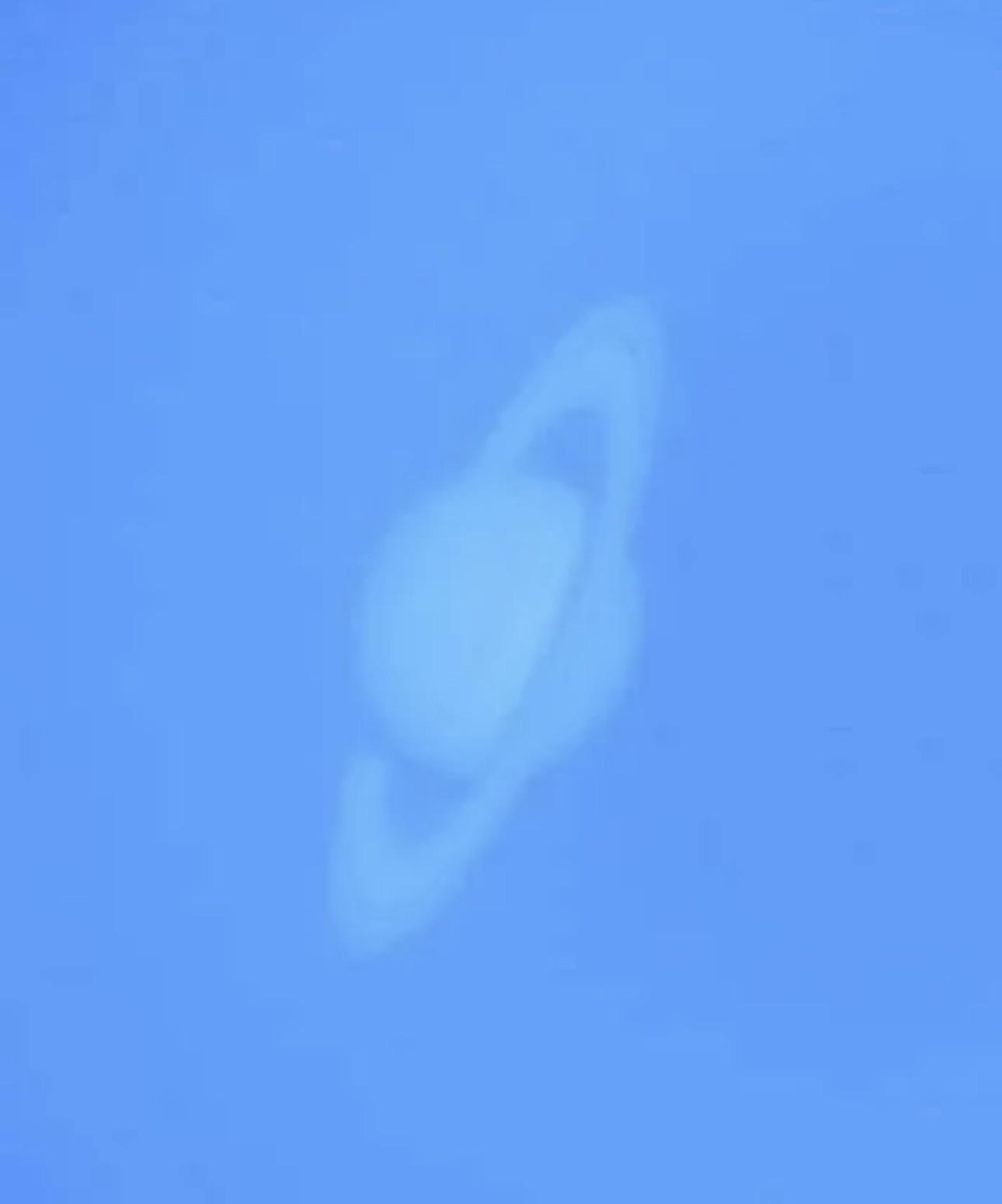
Nice shot. What equipment? Mine was shot from my driveway in light-polluted suburbia with a Celestron 6SE and a ZWO planetary camera. I know I can do better.
I get it's a telescope, but still... It's so damn impressive that Saturn is visible. This must be impossible to see with the human eye? I think the blue sky make it feel as if you could!
It's definitely a cool image. But would it be possible to get the telescope specs and rough location this was viewed from (not specific) before we accept this as real. I'm not saying it isn't real. But we live in a time where we need to verify these things.
I can promise you it's real. Go to a astronomy/astrophotography meetup and people would happily let you see this with your own eyes. It's a super cool experience.
I think they were referring to some modern telescopes with electronics in them. There have been cases where the telescope shows you not what's actually there, but stored/downloaded images from real telescopes. It defeats the purpose of a telescope, but I guess the manufacturers expect end users to just not know enough to care.
But this is a composite photo. You need ti Stack a lot to see that much detail. On a bigger garden telescope, it's still only about as big as your pinky nail on an outstretched arm.
Gotta say I was surprised by this too. I saw Saturn and a few of its moons through a telescope in a historic observatory (Copenhagen) and they were just glimmering little white things. No rings or anything. But then that do I know. There could be all sorts of reasons why it was like that.
Yes, you can observe the brighter planets during the daytime through an ordinary telescope. Sometimes the moon passes in front of a planet in the daytime
The rings of Saturn appear to wobble as it processes around its rotational axis, its pretty cool to check out. Look at it on https://stellarium-web.org/ and skip around by year and it makes it clear. You can see by the inclination of the rings in the photo, its either recent from the southern hemisphere, or a few years old from the northern hemisphere.
I'm terrible with a telescope but I got one for my brother and once managed to capture a glimpse of saturn and its moons and it was truly otherworldly.
I would be extremely nervous using my telescope while the sun is still visible. If I accidentally slewed too close to the sun I could fry the telescope internals, or even worse, blast a lick of hot lava into my eye. I suppose a solar filter could be used until on target then take it off.
If you are pointing it in a totally different direction than where the sun is it seems that is not a problem. If it's behind you, ... nothing could happen



•
u/Confident-Ask-601 3h ago
It blows my mind that we can just point a glass tube at sky and see a whole ass planet with floating rings from earth. It's insane.