Many of the workers themselves also like tipping because their peers will pay them better than their bosses ever would. Waitstaff in the US can make very good money, and they'd never get an equivalent salary if it was switched.
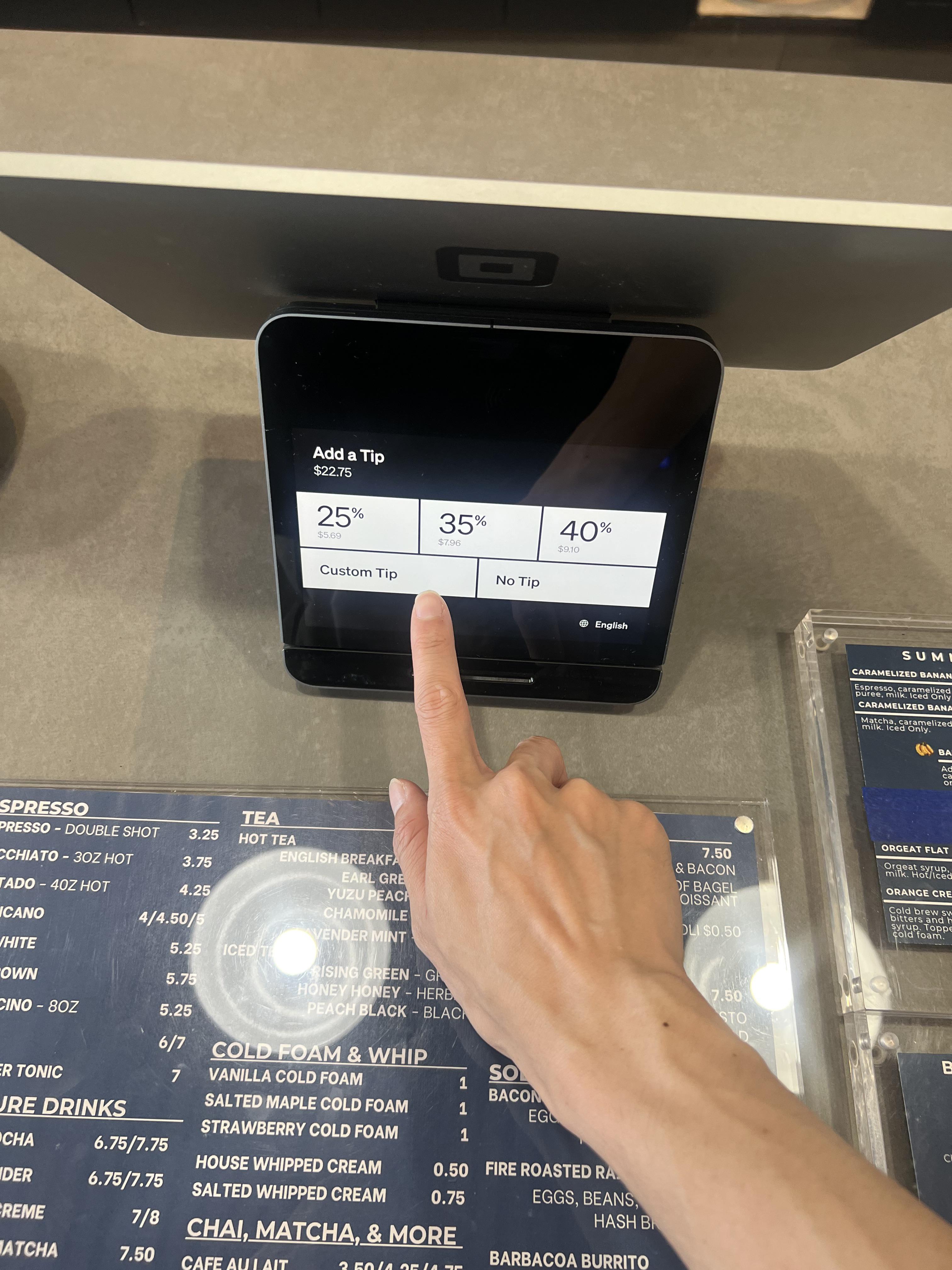
This tipping of cashiers and other random employees started during COVID and needs to stop though. Constant begging for donations and tips like I'm not already giving them money
I would bet servers in the US make more than just about anywhere else in the world, so for them it’s a pretty good deal. I’m definitely for getting rid of the system, but it’s an uphill battle.
Well from a quick Google search, it would appear that perception is way off. From what I’m seeing take-home pay for American servers is roughly $30000 to $70000. Seems like the lower end is more or less commensurate with other countries, while having a much higher earning potential.
Interesting. So what dollar value do you apply to health coverage, time off, and all the other benefits that restaurant owners effectively skip taxation on by having their customers pay their employees directly?
Servers at high volume locations, or fine dining, can pull in >$500 in tips a night. If that price was included into the bill, comparing the place with tips and with out tips, the with tips will always be cheaper, significantly. So restaurant owners can either have a 20% discount on their prices (with the rest made up in tips), or have all their prices be 20% higher and not take tips.
With all of that said, I was in food service for over a decade. Good servers are cool and all, and can make the experience better, but relative to other jobs, they really don't deserve $50+ an hour (I was making avg $55/hr in 2014 as a server in a place without alcohol). Ofc everyone deserves $50 an hour, but I am a teacher now and make less money/hr and my job is way more difficult and has a much bigger impact on society.
If capital is the systems confidence in your ability to allocate resources, yes the default confidence level should be around that. The fact that we make the poors work hourly wages for survival, without a real way to access capital markets without multiple years of sacrifice is horribly inefficient.
Blind financial reasoning aside, if someone is dedicating their 1/3 of their entire life to supporting the economic system, yes they should be able to live comfortably and invest/participate in price discovery.
Waiting is hard work but it is surely not worth 50 an hour. If minimum wage was raised to a living wage, it has been calculated to be around 23 an hour. That‘s more than fair to a waiter who needs literally no experience to start.
I think … we place a disproportionate amount of the blame on people from certain demographics when, historically, they have faced discrimination as a part of every day life. They are genuinely offered lower wages and minuscule opportunities. It’s not a fair system, and it crosses over to many nations.
I’m not condemning anyone, I’m just saying I feel we have a flawed system.
A little more googling would tell you that the only source for that was a ceo trying to explain why A&W failed under him and you probably shouldnt just take his word on that.
20 seconds of googling would show you that the claim came from a single source: the person who took over A&W to try and rescue it and failed. He mentioned it in a memoir he wrote decades later. Of course he would want to blame the customer for that failure.
No, it wasn't. The only source for that claim came from the person who took over A&W to try and rescue the restaurant and failed to rescue it. In a memoir he wrote decades later, he made this claim without providing any proof for the claim. And since it was a cool headline, it took off.
There are 3 entities to consider regarding tipped culture.
The owner who set the hourly wages and makes the menu prices.
The staff that serve and get tips as a significant portion of their income.
The customer who can endorse/boycott with their wallet.
This is where the arguments are for each entity:
Passing off a portion of the employee's income onto the customer in the form of the expectation of tips, hidden behind the guise of "it encourages good treatment of the customer by the staff to get good tips," allows the owner to lower menu prices so they look more attractive.
The staff, even though they are, on paper, making an hourly wage that is less than the normal minimum wage, the tips they receive often bring them well over the normal minimum wage. And in the rare cases where they don't, the employer has to make up the difference so they always make an hourly rate that is no less than the normal minimum wage. With that said, you RARELY see these workers on the side of "get rid of tipping culture" because they do make very good money. In many cases, this entity would make less money overall if tipping culture was nixed, hence why they seem to be silent in these debates.
The customer. The customer likes to say a lot of things about tipping culture, but their wallets do most of the talking. When businesses try to take a stand against tipping culture, change the hourly wages to a normal wage rather than tipped minimum wage and raise menu prices accordingly, a couple of things happen. First, it makes it harder for them to keep good staff because the staff will make less money. Second, in raising menu prices accordingly, it makes the menu prices generally higher than other places. And this is where the customer comes in. The customer speaks with their wallet and due to the higher menu prices, the business is less attractive even if it is explicitly advertised why the prices are higher.
With everything you see above, it really explains why it is so difficult to fight against the system organically. It will have to come from laws/regulations to enforce the change on the industry as a whole, all at once, because not enough parts of the paradigm gain an economical benefit for being the one that takes a stand against the industry. Because the businesses that try always fail because they are less competitive, the servers would rather worked for tipped wages because they make more money than non-tipped-hourly-wage counterparts, and the customer speaks with their wallet by choosing to patron businesses that have tipped wages. To make the change away from tipping culture happen organically, the whole of any one of those entities could cause that change to happen. Either ALL businesses just stop the tipped wages altogether, or ALL customers stop going to businesses that pay tipped wages, or ALL servers stop applying/working for tipped wages. And neither of those will ever happen, which leaves it up to the lawmakers to force it to happen.
Edit: Something else to add, is that the restaurant industry is already operating on VERY slim margins. We're talking around 5% profit margins for most. If a restaurant is running on a 10% profit margin, that would be considered doing very well. So it is already a tight window for profitability, which makes it even more difficult to try and go against the system on principle alone.
My problem with it is prices will just go up by 20% across the board using the lack of tipping as justification but that money isn't going to go to the employees and they'll end up taking a pay cut overall
So we don't actually end up paying less and the employees end up in a worse spot
Plus I no longer get the option to skip the tip when ordering food to go
The way it’s “meant” to work is the workers wouldn’t apply at the place with shit pay and would instead apply for the one that paid well. Driving the person who paid poorly out of business unless they improved it.
Unfortunately the current status quo is so heavily entrenched in the US you’d need massive reform to make something like that work and I can’t see that changing anytime soon, people are struggling already
116
u/Which-Break5673 11d ago
We need to change the fu¢king law allowing this !