r/radioVibes • • 5h ago

My Hobby Workshop

3 Upvotes

Good Afternoon Everyone,

I’ve been having a lot of fun experimenting with using AI to make software.

My Hobby Workshop is here: www.WT3O.com
Here, I have all of my software projects and guides. There’s everything from realtime audio analysis, metadata analysis, a nationwide GMRS/amateur repeater directory, electronics software and references, a relational database of vacuum tubes, etc… it’s an ongoing project, and I do have quite a few ham tools on there.

I also documented the process: www.VerificationCoding.com
I took notes as I was making everything, so I worked on this side-project - it’s how I used to make all of my software in my Hobby Workshop.

Which then led me to: www.ModernGeoCities.com
I’m able to put all of this online for free because my costs are low. I already have web hosting for my law practice, so I figured I’d just put it all on there (seeing as how static HTML is a very low server burden). However, I didn’t realize not everyone knew how to get domain names and web hosting, so I set up a guide.

All of these URLs are shortcuts to my law firm’s website: www.proylaw.com

I’m adding projects often!

73 de WT3O

EDIT: I forgot to add www.ZoningForHams.com. I used AI to compile the local and municipal zoning ordinances for Maryland and Pennsylvania. I thought I’d help hams with their zoning because it’s the most common legal-inquiry I get for amateur radio.


r/radioVibes • • 7h ago

WebCHIRP - CHIRP in your browser

Post image
5 Upvotes

r/radioVibes • • 10h ago

HamChat, Like AOL Instant Messenger, but for hams

4 Upvotes

Ever have a QSO with someone and want to continue the conversation, but looking up their email on QRZ is a PITA, especially on mobile?

That’s why I built Hamchat. Try it out right in your web browser, or download clients for Mac, Windows, Linux.

https://hamchat.app

QRZ account required


r/radioVibes • • 17h ago

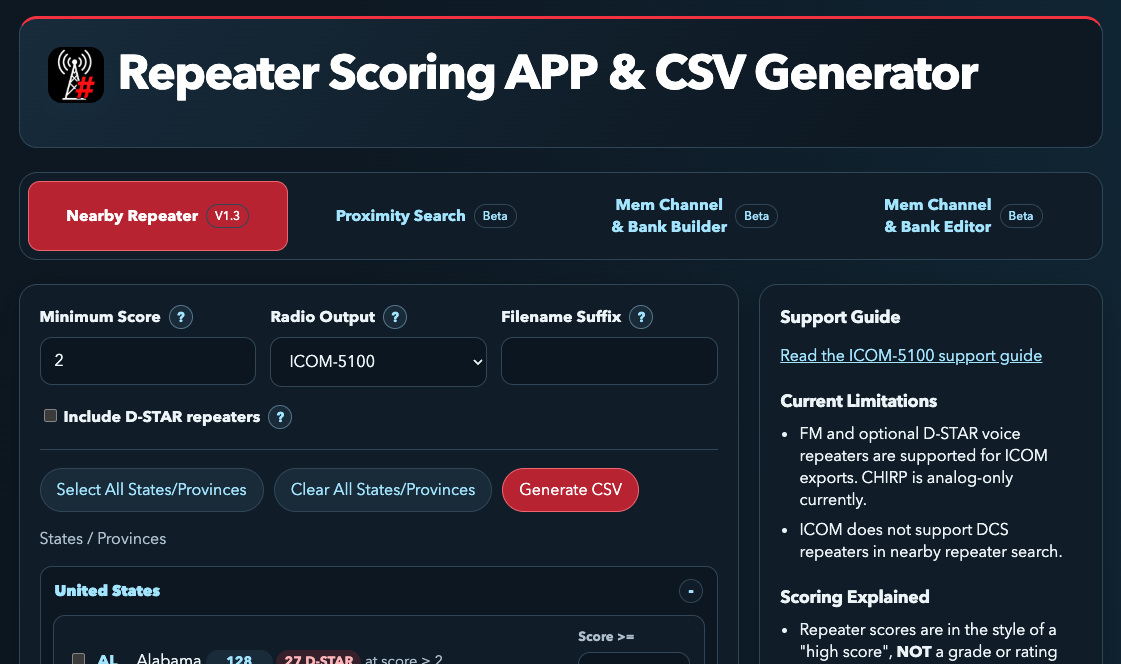
Repeater-Scores.app -- A mostly ICOM 5100/52/5200 Nearby Repeater Search Overhaul webapp.

Post image
3 Upvotes

Hey there folks! So I wrote a little webapp that mostly makes my own life better, and I like to share with fellow ICOM 5100/52/5200 users.

For those unfamiliar with these radios, there is a Nearby Repeater search functionality built into them, which is friggen GENIUS idea on the part of whomever came up with it. I recently took a road trip around the SW part of America and being able to with a few clicks search nearby repeaters or just constantly scan nearby repeaters while traveling is a total game changer. KUDOS to the ICOM team for that!

Unfortunately, ICOM came up with that great idea, but then failed to execute on it terribly well since getting a populated list of useful repeaters is nigh impossible, and even then there were limitations such as... ICOM can only scan so many nearby repeaters (25) and what happens if all 25 of those are low elevation, low use backyard or club repeaters? See the picture above... those low use repeaters clog up your list and you cant see the slightly further away high elevation heavily trafficked repeaters. Oh and let's not even begin to get into how the 5100 didn't allow two repeaters with the same callsign... and there's 17 friggen K7RPT's alone!

So I wrote Repeater-Scores.app . I connect to the Repeaterbook.com api, get all the repeaters for the USA, make a few deteriminations about what a repeater listing has going for it, and give repeaters a "score" and let users filter out repeaters below a certain score. Now it's not a school grade or a rank, it's just a tally of the things I've seen indicate a repeater is busy to help you quickly find likely busy repeaters somewhere you don't frequent. I look at details such as nets, system links, wide area coverage, ARES/RACES use, and I definitely throw in some bonus points for being the only VHF/UHF repeater within a reasonable distance because then you're kind of all that is going on anyways.

If you want to see an example of a very high ranking repeater... here's KB3AWQ on repeaterbook, which scores a 14 if I recall last looking. Pretty sure if you've cruised more than 3 repeaters on Repeaterbook you'll see why that one scores high and kind of get the jist of things.

Anyways, figured I'd share. I coded this in collaboration with CodeX in Python. I have a fair bit of coding experience from my current career in coding, and was more of a lead developer than a detached project manager. It's also been a fun personal project to share, and nice to do something for myself.


r/radioVibes • • 1d ago

590Ctrl Kenwood TS-590sg Control Software for Mac and Linux

Thumbnail
gallery
6 Upvotes

https://github.com/kingsqueak/590Ctrl

This control software surfaces the User EQ function with an 18 band EQ without having to have a Windows machine to do it.

This release is very early but most all functional features are implemented.

QRZ call lookup and logging are enabled, CW decoder and keyboard interface for sending is built in.

The dmg should run on M silicon Macs with Mac OS 26.0 and newer. The tree will build for linux.

Looking for testers and feedback, I am currently testing on a TS-590sg and this may work on an 's' as well but not sure.

This software surfaces the USB input and output level controls for sending PC microphone or processed audio over USB

In data mode the TX button will pass the USB audio or you can make a hardware keyer on the ACC plug if you key the data PTT.

Using USB audio you can process outgoing audio and also the receive audio adding VST plugins for noise reduction on receive. Breathes more life into the rig.


r/radioVibes • • 1d ago

TCIdigi a TCI fork of fldigi in Qt for Mac and Linux

Thumbnail sourceforge.net
4 Upvotes

TCIdigi is a fork of fldigi specifically for TCI controlled SDR radios.

In the build tree, that will build for Mac and Linux you also have fldigi as well.

The work adds full TCI support for audio channels and CAT control. TCIdigi has a Qt6 interface.

Support for QRZ lookup and logging have been added.

The dmg is for M silicon Macs on OS X 26.0 and newer. No package up as of yet for linux but building from the repo works.


r/radioVibes • • 2d ago

Free client for AllStarLink, EchoLink, IAX Direct, DMR, System Fusion, M17, P25 and D-Star

Thumbnail
qso1.net
6 Upvotes

r/radioVibes • • 3d ago

Mr. Ham Radio - Print Your Amateur Radio License

Thumbnail mrhamradio.com
4 Upvotes

r/radioVibes • • 3d ago

How Unified Radios handles digital voice codecs 🎙️

Thumbnail
2 Upvotes

r/radioVibes • • 8d ago

[OP] built an app to help me catch callsigns during QSOs – here’s the listening part in action

2 Upvotes

from /u/Papalima01:

https://v.redd.it/77i7u4e76wuh1

Hi everyone,

I’m a fairly new radio amateur from Denmark, and one of the things I’ve found surprisingly difficult is catching callsigns when people are speaking quickly, signals are weak, or there’s a lot going on during a QSO.

So I started building a small iPhone app called QSO Transcriber.

In this video I’m showing the listening and transcription part of the app. It listens to the radio audio, transcribes the conversation in real time, and tries to identify possible callsigns and other useful QSO information.

Detected callsigns are highlighted in the transcript and collected in a list, so you can quickly go back and check what you may have heard.

It’s definitely not magic. Speech-to-text can still struggle with poor radio audio, but that’s actually one of the things I’ve spent a lot of time working on: interpreting amateur radio speech, phonetics and callsign patterns on top of the transcription.

It was created to help myself and other new radio amateurs have more relaxed, less stressful and more enjoyable conversations on the air.

The app is currently going through the Apple App Store review process, so I’m hoping it will be available soon.

I’d genuinely be interested to hear what other radio amateurs think of the idea and whether you could see yourself using something like this.

M0MCX has very kindly given me permission to use some of his highly inspiring QSOs for testing and demonstrating the app.

73 from Denmark
OV9PL
QSOtranscriber.com


r/radioVibes • • 8d ago

from /u/Mastodon987: DMR Craftbox

1 Upvotes

from /u/Mastodon987:

Hi guys. I'd like to share with you my tool where you can craft in GUI DMR bursts and streams (Single channel). Main purpose is for experimenting and learning about DMR protocol. Supported only ETSI standard.

Main features are:

  • Create IQ File for SDR apps

  • Stream into audio device baseband transmission

  • rtl_tcp supported

Tested on:

IQ: SDRSharp, SDRPlusplus

rtl_tcp: SDRSharp, SDRPlusplus, dsd-fme, dsd-neo

WAV file: dsd-fme, dsd-neo, DMRDecoder (by IanWraith)

Known issues - not working:

  • UDT LIP protocol

  • USBD Response

I developed it due to i do have working on multiple DMR related projects and i wanted to make my own library and GUI for testing.

Notes:

  • Source code is not published.

  • GUI was made with LLM assistance. DMR library itself i spent few years my own work on dev and testing.

  • Ready for translations

  • Dark/White theme supported

Releases available for Windows/Linux:

https://github.com/mastodon987/dmr-craftbox


r/radioVibes • • 9d ago

QRZero: a free, fast logger for DXers and CW ops (Windows, Mac, Linux), looking for testers

Post image
7 Upvotes

I've been building a logging program called QRZero. I wanted something that stays quick with a big log and doesn't get in the way mid-QSO. It's an alpha, free, and open source.

What it does today:

- Fast logging. The log is one SQLite file, and searches stay quick on a 200,000-QSO log.
- Every ADIF field is kept, including fields other programs add. Daily automatic backups.
- Talks to WSJT-X, JTDX, N1MM+, Hamlib, TCI (AetherSDR/Flex), serial CAT and rotators (GS-232).
- DX cluster and band map with a "Needed now" list. Spots that would be a new DXCC, band or mode raise an alert, and spot split comments like "UP 5" are handled.
- Awards: DXCC, WAS, WAZ, WPX, plus SKCC, CWops (with CWT medals), NAQCC and FISTS.
- Uploads and confirmations: QRZ Logbook, Club Log, LoTW and eQSL. Paper QSL and OQRS tracking, with Brother QL label printing.
- Layout is dense and classic. Panes can be moved, tabbed and popped out to a second screen.
- Local first. Your log stays on your machine, and passwords go in the OS credential store.

Windows is the main platform and gets the most testing. There are also Linux (.deb, .rpm, AppImage) and macOS Apple Silicon builds, and a headless server you can reach from a browser.

I'm a DX chaser and hand-key CW, so that's where most of the testing has been. Much of the online service code (QRZ, Club Log, LoTW) hasn't been tried against live accounts by many people yet. I'd really like testers, bug reports and feature requests, especially from people running other rigs and setups than mine.

Downloads: https://github.com/nreed97/QRZero/releases
Source and docs: https://github.com/nreed97/QRZero

73


r/radioVibes • • 9d ago

[OP's] windowsill antenna hears aircraft at ~350 km, so [OP] built a free open-source tool for planning where to point an antenna (Poland only)

Post image
2 Upvotes

r/radioVibes • • 9d ago

5XJ Station Clock & Propagation Dashboard

Thumbnail reddit.com
2 Upvotes

r/radioVibes • • 9d ago

by /u/HamLife-org: Amateur Radio LTE & Ham Radio Cellular — XCL.is

Thumbnail
xcl.is
2 Upvotes

r/radioVibes • • 9d ago

/u/gerald_artner built an AI voice spotter that automatically spots voice-modes calling CQ to the DX cluster

2 Upvotes

as posted by /u/gerald_artner:

Hi everyone!

My article about ARTNER (AI Radio Transmitter Notification and Emission Reporter) has been published in the October 2026 issue of QSP, the magazine of the Austrian Amateur Radio Society (ÖVSV).

DX clusters and the Reverse Beacon Network have long supported automated spotting of digital modes and CW. Voice transmissions still depend on manual spotting.

ARTNER is my experimental approach to closing that gap. It combines speech recognition with a large language model to identify amateur radio callsigns and determine whether a station is calling CQ. The system then automatically submits suitable spots to the DX cluster.

I've tested it during the ARRL International DX SSB Contest in March 2026 and have been running a longer experimental test on the 70 cm Kahlenberg repeater OE1XUU in Vienna.

Amateur radio operators can try it themselves via EchoLink OE1XUU. Spell your callsign and call CQ several times to get spotted! Enjoy the contacts with Vienna.

It's still experimental, and false recognitions, missed callsigns and operating costs remain challenges. I discuss the implementation, test results, limitations and potential for further development in the article.

📡 Read more:

I'm curious what the amateur radio community thinks: Could AI-based voice spotters become a useful complement to CW Skimmer and the Reverse Beacon Network? What would be the biggest technical challenges in your opinion?

73 de Gerald, OE1GAQ 🇦🇹