r/selfevidenttruth • u/D-R-AZ • 16h ago
Self-Evident Truth MS NOW Host Spots Troubling Trend Behind Trump Official Firings And Resignations
3
Upvotes
r/selfevidenttruth • u/One_Term2162 • 5d ago
Author’s Note: Are you so inquisitive that others find you incorrigible? Do you meddle in matters others would rather leave alone, driven by an insatiable hunger to understand how things work? If your curiosity leaves you restless, take heart. The most inquisitive citizens have always been a little troublesome, especially to those who would rather we stop asking questions.
What one reader’s comment led me to investigate about wages, benefits, taxes, and who pays for care.
A comment from on "The Great Shift: Where Did the Gains Go?" sent me down a rabbit hole (that infuriated the very fabric of my being.) They raised executive compensation, including the stock options and shares executives receive beyond their salaries. I told her that her comments had a habit of sparking ideas. This one certainly did.
The investigation led from executive pay to ordinary workers’ wages, then to employer health benefits, taxes, and laws reaching back to World War II. Along the way, some of my assumptions needed correcting. I wanted to understand where the evidence led, even when it complicated the argument I expected to make.
The clearest finding so far is that a paycheck does not show the full cost of compensating a worker, and an insurance premium does not show everything a household pays for healthcare. Understanding either requires following several connected payments without counting the same money twice.
This investigation does not yet explain where all the gains in the American economy went. It has uncovered one important part of that larger question: how healthcare became tied to compensation, and why the bill is so difficult to follow.
When companies pay executives with stock or stock options instead of cash, that compensation still has a cost. Accounting rules require companies to report that cost, even if the company isn't immediately paying money out of its bank account. This was one of the first things I learned: what a company pays in cash and what it actually spends on compensation aren't always the same thing.
Workers receive more than just their regular paychecks. Many employers also provide benefits, including health insurance. According to KFF’s 2025 employer survey, the average annual cost of family health insurance was $26,993. Of that amount, workers paid an average of $6,850, while their employers paid the remaining $20,143.
Those are national averages, so the amounts vary from one workplace to another. But here's what's important: the money employers spend on health insurance is part of what it costs them to employ someone, even though that money never shows up in the worker's paycheck.
As healthcare becomes more expensive, employers may have less money available for raises. That doesn't mean every dollar spent on insurance would otherwise go directly into workers' pockets. Wages also depend on company profits, productivity, competition for employees, and workers' ability to negotiate. But it does mean that rising healthcare costs can affect how much workers take home, even when they don't see those costs on their pay stubs.
That led me to yet another question: why did we make health coverage part of the employment relationship in the first place?
How We Got Here: Following the Money
During World War II, the government limited how much employers could raise wages to help control inflation. But there was an exception for benefits like health insurance. This meant companies could attract workers by offering healthcare instead of higher pay. In 1943, the IRS gave favorable tax treatment to employer-paid health insurance, and Congress later made those rules part of federal law in 1954. This helped create the system we know today, where millions of Americans depend on their jobs for health insurance.
Here's what surprised me. Businesses can generally deduct both wages and healthcare expenses from their taxable income. But providing health insurance comes with an additional tax advantage. If a company gives someone a $10,000 raise, it generally pays another $765 in Social Security and Medicare taxes, assuming the full amount is subject to those taxes. If that same $10,000 goes toward qualifying employee health insurance, those payroll taxes generally don't apply. Workers also receive tax benefits from the arrangement. In other words, the tax system made providing healthcare more financially attractive than giving workers the same amount in additional wages. That doesn't prove Congress intended to keep wages low, but it helps explain why the arrangement became so widespread. (IRS)
As we followed the money, another problem became clear. Americans pay for healthcare in several ways: through taxes, paycheck deductions, employer contributions, insurance premiums, and medical bills. Some of these payments overlap, so we have to be careful not to count the same money twice. For example, in one hypothetical Wisconsin case, a $548.05 monthly insurance premium includes $422 paid by the household and $126.05 covered by a government tax credit. That's one payment split between two sources. But even after paying for insurance, people can still face deductibles, copays, and other medical bills. Having insurance doesn't necessarily mean you can afford to use it. (IRS)
What became especially frustrating was how difficult it was to determine where all the money actually went. Some employers pay their workers' medical bills through company-funded insurance plans while hiring outside businesses to handle claims and paperwork. We examined one such arrangement and found the worker's insurance costs, but the public records we reviewed didn't reveal exactly how much the employer spent on medical care or how much the company handling the paperwork earned. Even federal agencies calculate the value of healthcare tax benefits differently. If it takes this much work to understand where the money goes, how is an ordinary person supposed to make sense of it? (Treasury | CBO)
And then there's the legislation. Over the decades, Congress created Medicare, Medicaid, employer insurance protections, prescription-drug programs, and government assistance for purchasing insurance. Many of these laws helped people, but they also had to work alongside older rules. Sometimes Congress even passed new laws to address problems created by earlier ones, as happened with prescription-drug pricing rules in the early 1990s. Other laws were specifically intended to make things simpler or protect patients. So the question isn't whether every law was good or bad. It's whether we've built a system that serves the people paying for it, or one that has become so complicated that even understanding the bill is a challenge.
Does unfairness make it unconstitutional?
What Does It Mean to Protect Life?
Perhaps the greatest irony is that our Constitution has never been beyond revision. Throughout American history, we have amended it when we believed something was important enough to deserve constitutional protection.
We passed the Thirteenth Amendment to abolish slavery, although it left an exception for punishment following a criminal conviction. We passed the Eighteenth Amendment to prohibit alcohol, only to reverse that decision fourteen years later through the Twenty-first Amendment.
And then there are the amendments that rarely receive much attention.
In 1789, Congress sent twelve proposed amendments to the states. Ten became our Bill of Rights. The original Article the Second, concerning congressional compensation, remained unfinished for more than two centuries before finally becoming the Twenty-seventh Amendment in 1992.
What's particularly interesting is that Congress had already passed the Ethics Reform Act of 1989, establishing automatic cost-of-living adjustments for congressional salaries. The Twenty-seventh Amendment required an intervening House election before a law changing congressional compensation could take effect. A federal appeals court subsequently ruled that the existing adjustment system did not violate that amendment.
Meanwhile, the Equal Rights Amendment, proposed by Congress in 1972 to guarantee equality under the law regardless of sex, remains the subject of a constitutional dispute over its ratification. More than fifty years later, it has not been officially certified as part of the Constitution.
And what about Article the First?
The very first amendment proposed in 1789 concerned representation in Congress. It addressed how the size of the House should relate to population growth. (And here's an interesting side note. On May 14, 2026, Representative Darrell Issa introduced H.J.Res. 186, attempting to impose a December 31, 2026, ratification deadline on Article the First, more than 230 years after Congress originally proposed it without one. If enacted and upheld, the resolution would effectively close the door on future ratification. We challenged that proposal in An Open Letter to Representative Darrell Issa. The resolution remains in committee.) That amendment was never ratified, and today the House remains effectively capped at 435 voting representatives under federal law.
We explored both proposals in an earlier post, Pop Quiz: How Many Amendments Were Originally Sent to the States for Ratification?
Consider what this history tells us. We've amended our Constitution to abolish slavery, prohibit alcohol, repeal that prohibition, expand voting rights, and regulate congressional compensation. We've spent generations debating equality and representation.
Yet when it comes to healthcare, something that can determine whether a person lives or dies, we still have no explicit constitutional guarantee of access.
And here's another irony I find difficult to ignore.
We hear a great deal about protecting the unborn child. Following the Supreme Court's 2022 decision overturning Roe v. Wade, states have adopted different abortion restrictions, often justified by the government's interest in protecting unborn life.
Some of the same voices arguing that government must intervene to protect unborn life also insist that healthcare should remain primarily a matter for individual states.
Apparently, protecting life is a matter of principle before birth, but afterward we're supposed to check whether the parents have met their deductible.
I recognize that supporting abortion restrictions does not automatically mean opposing healthcare assistance. Programs like Medicaid and CHIP already provide essential coverage to millions of children.
But the underlying question remains.
If protecting an unborn child's life is important enough to justify government intervention, why shouldn't protecting that child's health and life after birth be important enough to consider a constitutional guarantee?
Why should access to necessary medical treatment depend so heavily on where someone's parents work, how much they earn, what insurance they can afford, or which state they happen to live in?
Our Constitution explicitly protects the right to keep and bear arms. Its Preamble declares that one purpose of our government is to promote the general welfare. Yet it does not explicitly guarantee Americans access to healthcare.
The Preamble doesn't create that right by itself, and constitutional recognition would not magically eliminate the cost of medical care. We would still need to decide what services are guaranteed, how they would be funded, and how that right would be enforced.
But we already have a constitutional process for making such decisions.
If we could amend our Constitution to abolish slavery, prohibit alcohol, repeal that prohibition, expand voting rights, and address congressional pay, surely we are capable of seriously considering an amendment recognizing healthcare as a fundamental right.
After twenty-four days of following the money, examining the laws, and trying to understand how we arrived here, I keep returning to one question.
If we consider the right to defend our lives worthy of constitutional protection, shouldn't we at least consider whether the right to preserve those lives through necessary medical care deserves protection, too?
Where does an investigation go when the institutions responsible for our healthcare system (cough, IRS, cough) and decades of federal legislation seem to be fixing problems created by earlier laws? A thoughtful comment sent me down a twenty-four-day rabbit hole, and somehow, every answer has uncovered more questions. So, I'll leave the next direction to you, the readers. What about our healthcare system doesn't make sense? What would you like us to investigate next? After all, look where one reader's question brought us.
AFC
r/selfevidenttruth • u/it-was-nobody • Sep 12 '26
With every passing day, government becomes increasingly corrupt, our culture grows more polarized, our interest payments increase, our economy becomes more unequal, the dangers posed by our technology accelerate, and our civilization continues polluting the environment, destabilizing the climate, and destroying the habitability of our Earth.
We are in deep, nasty shit.
The problems we face are big, growing, connected, and none of them have simple solutions. Without addressing the corruption of our government, we cannot address our growing tangle of systemic failures. Without a full Constitutional Convention (CC), we cannot address the corruption of our government in any meaningful way. We are on a sinking ship that has been hijacked by pirates, and we are sailing into the greatest storm we have ever seen. It is necessary to take abnormal action for our safety and happiness.
At this point, continued inaction is more dangerous than action. A CC is an extremely high risk/reward action, but it represents the only genuine option for regaining control of our government. Every other option (voting, running for office, purchasing political power, protesting, amending the Constitution, etc.) is performative. No amendment, bill, or lawsuit is capable of addressing the extent of the corruption in our government. No political messiah is going to appear; and if they do, they won't be able to get anything done in a system as corrupt as ours.
A CC is not only a political solution to our political problems, it is a unifying narrative for our growing cultural divide. We need to address both problems to survive in the long run.
The only real arguments against organizing a CC is that we would somehow create a worse government than the one we have, or that we would ignite a civil war. I genuinely struggle to see us having a worse government than the one we have now. Our government is led by an unchecked, child-molesting dictator;
who is using the unitary executive theory, a complicit congress, politicized courts, secret police, and near-total surveillance powers;
to create literal concentration camps, conduct unwinnable wars, implement idiotic economic policy, betray allies, empower adversaries, and stop the existentially necessary transition to carbon-free energy.
It is difficult to imagine a more just revolution.
Civil war is the only real threat I consider genuine, and I think the way we structure the CC would be the way to minimize the risk of civil war. If we can give extremists on both sides (and the average, completely checked out American citizen) the chance to influence the composition of government from their couch, it would give them a simple, safe, easy stake in the movement. Why try and vote for the least bad option when you can influence the entire structure of government with observation, rhetoric, and debate?
South Africa and Iceland have taken similar approaches when drafting new constitutions, with the former collecting 2 million hand written letters and the later using digital tech to crowdsource constitutional principles. As a superpower in the digital age, we would be able to shatter that level of engagement. We would also be able to analyze public opinion with far more sophistication.
Ultimately, every single country in the world has replaced their constitution since we implemented ours. We can do it. We can draft the most democratic constitution ever created. We just need to visualize that possibility, organize around it, and mobilize our communities.
Do you agree? Do you disagree and think its a terrible idea? Roast it or toast it, but let us know why.
r/selfevidenttruth • u/D-R-AZ • 16h ago
r/selfevidenttruth • u/D-R-AZ • 17h ago
r/selfevidenttruth • u/D-R-AZ • 1d ago
r/selfevidenttruth • u/D-R-AZ • 1d ago
r/selfevidenttruth • u/One_Term2162 • 2d ago
October 9, 1787 - Philadelphia
Author’s Note: On October 9, 1787, the Philadelphia Independent Gazetteer published a brief satirical letter signed A Gaul. Addressed to printer Eleazer Oswald, the writer pretended to object to the proposed Constitution because it restricted eligibility for the presidency to natural-born citizens and those who were already American citizens when the Constitution was adopted. The complaint was deliberately absurd, suggesting that Americans should cultivate the land while Europeans governed them. The fictional encounter below explores the humor and the constitutional question beneath it.
I had scarcely finished reading the exchange between Cato and A By-Stander when another contribution in the Independent Gazetteer caught my attention. This one was considerably shorter and signed by someone calling himself A Gaul. Its opening suggested another serious objection to the Constitution, though I soon discovered that the writer had something rather different in mind.
The gentleman began by announcing that he had put on his spectacles and carefully examined the proposed Constitution. He had discovered a provision concerning who might become President, and he appeared deeply offended by what he had found. After so many arguments about taxation, representation, and the powers of Congress, I wondered what new danger had escaped our notice.
His complaint concerned the qualifications for the presidency. The Constitution required that a President be a natural-born citizen or someone already a citizen of the United States when the Constitution was adopted. It also required the officeholder to have reached thirty-five years of age and resided within the United States for fourteen years.
These conditions apparently horrified our correspondent. He asked whether it was proper to entrust such an office to Americans, then offered his preferred arrangement: “The Americans ought not to be governors, they ought to be governed.” He suggested that Americans should occupy themselves cultivating the soil while Europeans managed the business of government.
I confess that I laughed when I reached that passage. After years of war to establish our independence, here was a writer pretending to find the very idea of American self-government intolerable. His indignation grew so extravagant that it became impossible to mistake the letter for an ordinary constitutional objection.
A man beside me asked what offense the new Constitution had committed against this supposed European. I showed him the passage, and he laughed at the thought that our farmers might be considered capable of defeating British armies but incapable of governing the country they had helped make independent.
The joke worked because it turned our Revolution upside down. Americans had insisted that legitimate government rested upon their own consent, yet this imaginary critic spoke as though governing were a talent reserved for Europeans. He reduced the people who had fought for independence to laborers who should leave public affairs to supposedly superior hands.
There was an accusation concealed within the humor. By placing such ridiculous objections in the mouth of a foreign admirer of European rule, the writer invited readers to associate resistance to the Constitution with contempt for American self-government. Anyone who objected to the proposed presidency might find himself uncomfortably close to the absurd position expressed by A Gaul.
That was clever, although it did not entirely satisfy me. A man might believe Americans capable of governing themselves while still questioning whether the proposed President possessed too much authority. Opposing a particular arrangement of government was not necessarily the same as opposing the right of Americans to govern themselves.
I returned to the constitutional provision itself. Whatever our satirist intended, the qualifications for President raised a genuine question about citizenship and public office. The proposed government would recognize people already holding American citizenship when the Constitution was adopted as eligible under the citizenship requirement, while future candidates would ordinarily have to satisfy the natural-born requirement.
I could understand why the Convention might wish to protect the presidency from foreign influence. The President would possess considerable responsibility for executing the laws, conducting affairs with other nations, and commanding the country's military forces. The framers might reasonably believe that the person entrusted with those duties should possess a particularly secure attachment to the United States.
Yet I could also imagine a man arriving from Europe, establishing his home here, embracing the principles of independence, and contributing many years of service to his adopted country. Would his loyalty necessarily be less dependable than that of someone born upon American soil? The proposed rule appeared to draw a distinction that deserved examination even if A Gaul had chosen to treat the matter as a joke.
There was another irony in the letter. The writer's contempt for Americans who worked the land was meant to sound ridiculous, but many of the men whose labor supported the country were also the men expected to exercise political judgment within their communities. Their ability to cultivate a field did not prevent them from understanding taxation, representation, military service, or the conduct of their government.
Still, the Revolution's promise of self-government had never meant that everyone living among us possessed an equal voice. Voting qualifications differed among the states, and many people remained excluded from political participation. A claim that Americans were capable of governing themselves did not resolve the separate question of which Americans would be permitted to participate in that government.
I found myself appreciating the humor while remaining uncertain about what it proved. A Gaul had made the suggestion of returning political authority to Europeans sound properly absurd, but he had not demonstrated that every objection to the presidency was unreasonable. His letter offered a defense of American self-government through ridicule rather than a detailed examination of the institution the Constitution proposed.
Perhaps there is room for such writing in a public debate. Citizens cannot spend every hour studying lengthy arguments, and a clever paragraph may draw attention to an assumption that several pages of formal reasoning would leave untouched. Humor can expose an inconsistency, provided the inconsistency belongs to the position being criticized rather than one invented for the amusement of the reader.
That distinction seemed worth remembering as the newspapers grew increasingly crowded with accusations, defenses, and political satire. A writer who makes us laugh at an opponent may have revealed something important about that opponent's reasoning, or merely made the opponent easier to dismiss.
When I reached the signature again, I appreciated the joke a little more than I had upon first reading it. A Gaul had pretended that Americans were incapable of choosing their own rulers, which was a curious position to encounter in a country that had so recently fought to establish precisely that right.
But I closed the newspaper with the proposed Constitution still beside me. Whatever amusement the letter provided, the qualifications and powers of the presidency remained matters requiring judgment. We had fought to establish the right to govern ourselves, and now we faced the equally demanding responsibility of deciding how that government should be organized.
Further Reading
A Gaul, Philadelphia Independent Gazetteer, October 9, 1787
The complete original satirical letter appears in The Documentary History of the Ratification of the Constitution, Volume 32, Document 117, page 284. It contains the writer's mock outrage over presidential qualifications and his suggestion that Europeans should govern Americans.
Read the original essay, Volume 32 (PDF)
Pennsylvania and the Federal Constitution, 1787–1788, Chapter III
This historical collection reproduces A Gaul's complete letter alongside other contemporary newspaper writings. It provides useful context for understanding how humor, ridicule, and political disagreement entered the ratification debate.
Read the historical collection
The Constitution of the United States, Article II, Section 1
The original constitutional text establishes the qualifications for the presidency, including the natural-born-citizen requirement, the exception for existing citizens at adoption, the minimum age of thirty-five, and the fourteen-year residency requirement.
Read the Constitution, National Archives
BE CURIOUS. BE CRITICAL. BE A CITIZEN.
r/selfevidenttruth • u/One_Term2162 • 2d ago
October 9, 1787 - Philadelphia
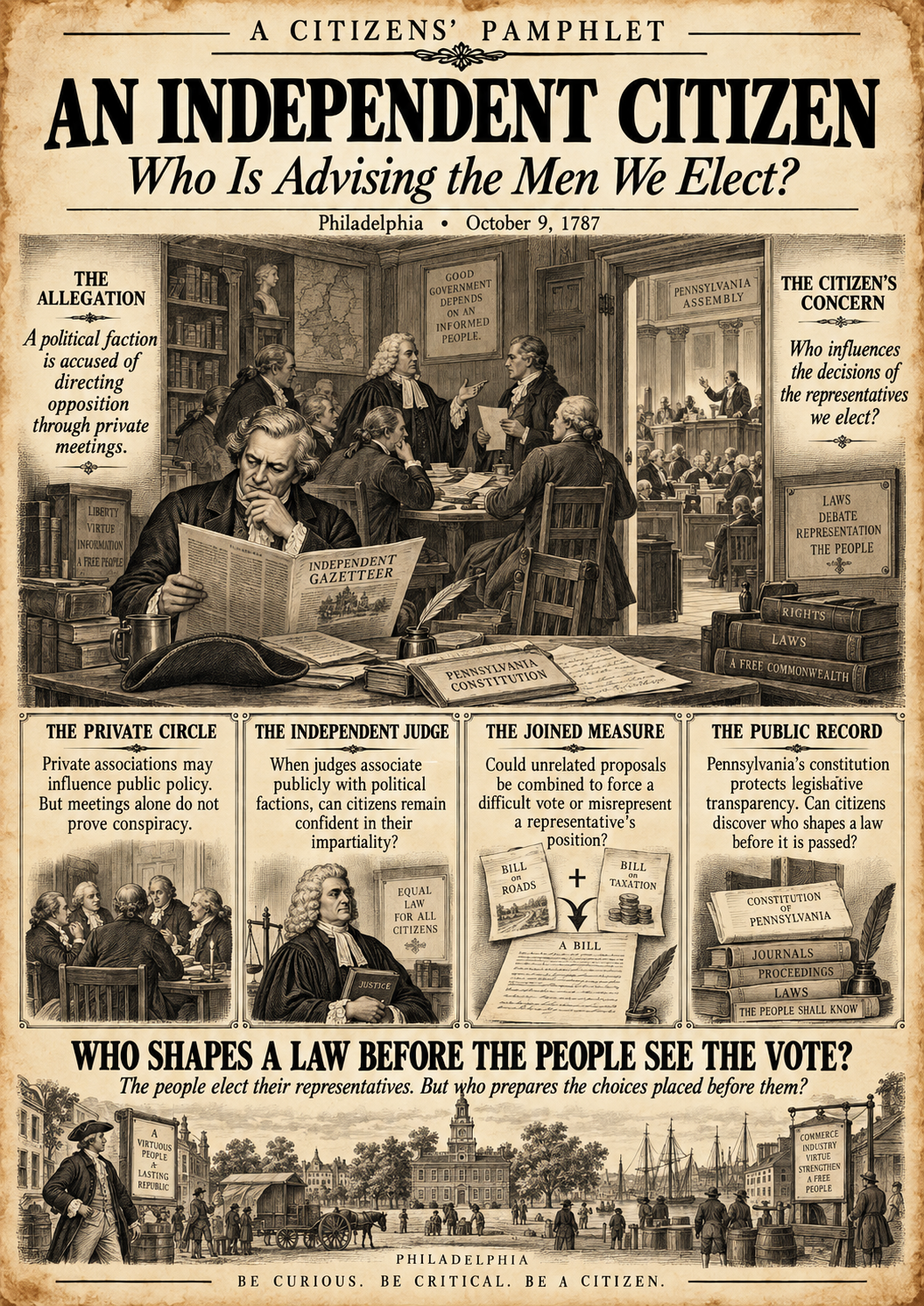
Author’s Note: On October 9, 1787, the Philadelphia Independent Gazetteer published an essay signed An Independent Citizen. The anonymous writer attacked the sixteen Pennsylvania assemblymen who had withdrawn to prevent a quorum, disputed their account of being forcibly returned, and accused their political allies of organizing privately to influence public affairs. His allegations included meetings at a clergyman's house near the university and visits involving a Pennsylvania Supreme Court judge. These accusations remain the writer's claims rather than established facts. The fictional narrator below considers those allegations alongside broader possibilities for political influence, legislative bargaining, and judicial independence. His imagined examples are questions about what might happen, not accounts of documented events.
The dispute over our Assembly has taken another turn, and I am beginning to wonder how much longer the proposed Constitution will remain the principal subject of our newspapers. This morning's Independent Gazetteer contains a letter signed An Independent Citizen, who appears considerably more interested in the conduct and motives of the men opposing the Constitution than in its individual provisions.
He begins by attacking the address issued by the sixteen assemblymen who withdrew from the House rather than allow a convention to be called. They had described the forced return of two of their members as an outrage against their persons and the communities they represented. An Independent Citizen disputes that account, accusing them of exaggerating their treatment to obtain the sympathy of their constituents.
I have now read several accounts of those proceedings, and each new explanation seems to leave the parties farther apart. The minority insists that its absence was necessary to prevent an extraordinary decision from being hurried through the legislature. Its opponents argue that elected representatives cannot abandon their duties merely because a majority intends to proceed without them.
The writer also answers the minority's complaints about Pennsylvania's delegation to the Philadelphia Convention and the timing of the Assembly's action. He argues that the Assembly had sufficient reason to choose the delegates it sent and that waiting longer for Congress would have accomplished little. In his judgment, the people would have ample opportunity to consider the Constitution through a convention elected expressly for that purpose.
Those arguments are familiar enough, but the letter soon takes a more troubling direction. Rather than merely questioning the wisdom of the sixteen members, the author claims that their resistance was encouraged by men operating outside the Assembly.
He describes what he calls a political junto meeting at a clergyman's house near the university. He also alleges that a judge of Pennsylvania's Supreme Court had been traveling between that house and the lodgings of another gentleman, whom he identifies only by an initial. The author suggests that these meetings reveal an effort to direct the opposition for private advantage.
I read the passage twice, partly because of the seriousness of the accusation and partly because of how little evidence accompanied it. Men visiting a clergyman, sharing dinner, or conferring with a judge may be discussing public affairs, but their association alone does not establish a secret design against the people. If the writer possesses letters, testimony, or evidence of some improper bargain, I should like to see it.
Yet the possibility he raises deserves more consideration than the particulars he offers in support of it. Our representatives make decisions in the Assembly, but their opinions are formed elsewhere as well. They consult attorneys, merchants, ministers, creditors, landowners, friends, and men whose wealth or reputation makes their advice difficult to ignore.
There is nothing surprising about this. The committees of correspondence that helped organize resistance to Britain depended upon citizens consulting one another, exchanging information, and coordinating action beyond the ordinary institutions of government. Public participation would be greatly diminished if citizens were forbidden to organize themselves around common concerns.
But I can imagine those same habits being used for less admirable purposes. Suppose a small company of influential gentlemen met regularly, collected subscriptions to support their work, employed writers to defend their preferred measures, and prepared arguments for sympathetic representatives to deliver in the Assembly. Such an association might never hold an elected office, yet it could influence a considerable portion of the business brought before those who do.
Perhaps its members would claim that they were serving the public by undertaking difficult research that busy representatives could not perform for themselves. They might examine foreign governments, propose improvements to our laws, and prepare entire plans of administration for the legislature's consideration. There could be genuine public benefit in such work, particularly when it was conducted openly and its reasoning remained available for examination.
The danger would arise if their influence became greater than the public understood. What if the same circle began recommending which men ought to be elected, which officers should be appointed, which magistrates deserved advancement, and which newspaper writers should receive its support? A private association could begin shaping the government long before voters were asked to approve any particular measure.
I wondered whether the representatives receiving such assistance would remain entirely independent. A man might believe a proposed law wise because he had examined it himself, or because the gentlemen who prepared it had already persuaded him of its merits. Either possibility could produce a reasonable vote, but citizens would have difficulty distinguishing independent judgment from habitual deference if they never knew who had written the proposal.
The mention of a Supreme Court judge made the question more serious. Pennsylvania's constitution does not permit its Supreme Court judges to serve simultaneously in the Assembly or executive council, a separation that appears intended to prevent several kinds of public authority from being concentrated in the same hands. Yet the rule cannot tell us everything about the friendships, interests, and political commitments a judge may possess.
A judge remains a citizen, and I would not expect him to abandon every public opinion upon receiving his commission. He may dine with friends, attend meetings, and hold strong views about the government under which he lives. But I wonder what becomes of public confidence when a magistrate begins appearing prominently at gatherings organized by one political faction.
Suppose a judge stood beside that faction's leaders during a public procession, applauded their speeches, or lent the dignity of his office to a meeting organized against their opponents. The following week, a citizen belonging to the opposing faction might appear before that same judge in a dispute involving property, debt, or an alleged offense against the law. Even if the judge resolved the matter impartially, would the citizen believe he had received an independent hearing?
The concern grows greater if the magistrate has privately advised the same men whose actions are later questioned in court. A judge may possess considerable knowledge of the law, but the authority to advise a political faction and the authority to decide disputes involving its members should not become indistinguishable. The appearance of independence may matter almost as much as its actual preservation, because citizens must be willing to submit their disputes to a court they believe will hear them fairly.
Still, I cannot fairly accuse the unnamed judge in this newspaper of such conduct merely because another writer says he visited certain lodgings. The difference between an ordinary acquaintance and an improper political arrangement must be established by something more substantial than repeated suspicion. If we condemn men solely for being seen in the wrong company, every friendship may eventually become evidence against its members.
My thoughts returned to the business of the Assembly itself. We have spent days arguing over whether the minority was justified in preventing a quorum, but another question occurred to me: how much freedom does a representative possess when the measure placed before him contains several matters upon which he holds different opinions?
I can imagine legitimate reasons for combining related provisions. A law establishing a new public work may also need to provide money for its construction, designate the officers responsible, and explain how their accounts shall be examined. Requiring a separate act for every small part of such an undertaking could make ordinary government unnecessarily cumbersome.
But what would prevent a less scrupulous legislator from joining together proposals that ought properly to be considered separately? Suppose a measure providing assistance to soldiers disabled in the war also contained an unrelated privilege benefiting a particular merchant. A representative might sincerely favor the relief while opposing the privilege, yet the Assembly could require him to accept or reject both together.
The difficulty would not end when the vote was taken. If the representative opposed the combined measure, his political enemies could announce that he had voted against relieving men who had sacrificed their health in the struggle for independence. They might say little about the objectionable provision that had caused him to oppose the bill, leaving constituents with a true account of his vote but a misleading explanation of its meaning.
Perhaps the arrangement could be made deliberately. Men who expected a particular representative to oppose a favored provision might attach it to something popular, hoping either to secure his reluctant consent or to furnish an accusation against him afterward. The result would be a vote in which the representative's recorded choice concealed the difference between what he supported and what he refused.
I do not know of such a scheme being employed in the present constitutional dispute, nor does An Independent Citizen offer evidence of one. But our recent arguments over the quorum have made me attentive to the ways procedure itself can alter the choices available to elected men. A legislature may follow the outward form of voting while arranging its business so that some judgments become difficult to express.
Pennsylvania's constitution already recognizes that hasty legislation can be dangerous. It requires public bills to be printed before their final reading and ordinarily delays their enactment until the next session, except in circumstances of sudden necessity. It also provides for the publication of legislative proceedings and permits members, under the prescribed voting procedure, to have the reasons for their votes entered into the minutes.
These precautions seem wiser to me the longer I consider them. A citizen should have an opportunity to discover what the Assembly proposes before the matter becomes law, while a representative should be able to explain the reasons for an unpopular decision. Yet even such provisions depend upon the willingness of public men to honor their purpose rather than merely satisfy their wording.
What if almost every disputed measure were declared a sudden necessity? What if a bill were printed for public consideration, then altered so extensively near its final passage that the version citizens examined was no longer the measure being enacted? What if a representative's reasons were recorded faithfully in the Assembly's minutes, while newspapers repeated only the accusation that he had voted against some popular object?
I can imagine each practice defended as necessary for dispatching public business. Sometimes speed is genuinely important, especially when delay threatens the safety or welfare of the community. But convenience can become a dangerous argument if it allows those directing the legislature to determine not only when decisions are made, but also which alternatives may be considered.
These questions bring me back to the gatherings described by An Independent Citizen. If men outside the Assembly can influence what is proposed, combine measures to secure particular votes, or determine how those votes are presented to the public, their influence may be considerable even without the power to enact a single law themselves.
That does not mean such associations are necessarily improper. Citizens must retain the freedom to petition, publish arguments, organize meetings, recommend public measures, and persuade their representatives. The same liberty that permits supporters of the Constitution to coordinate their efforts must also protect those who believe the proposed government dangerous.
The distinction, I think, lies partly in whether influence can be examined. Who prepared the measure? Whose interests would it advance? Which arguments persuaded its supporters? Were promises made concerning offices, contracts, appointments, or other advantages? These questions seem more useful than accusations based merely upon who was observed entering a particular house.
An Independent Citizen is less interested in maintaining that distinction. He accuses the minority and its associates of protecting lucrative offices, defending paper-money arrangements, and pursuing private advantage under the appearance of concern for public liberty. Some of those questions might deserve investigation, but his certainty seems to extend beyond the evidence he places before his readers.
The minority has likewise made accusations against the majority, alleging that its proceedings violated proper constitutional limits and that its members were subjected to force when they resisted. We have therefore reached a point at which each party presents its own conduct as necessary for the public good while describing the conduct of its opponents as proof of improper motives.
I fear that such accusations, repeated often enough, may obscure the very interests they claim to expose. If a writer can transform a dinner into a conspiracy without establishing what occurred there, citizens may eventually cease distinguishing evidence from conjecture. Yet if every private arrangement among influential men is dismissed as innocent association, genuinely improper dealings may escape examination altogether.
Perhaps our institutions will need better means of making influence visible. The Assembly may open its doors, print its bills, and record its votes, but those precautions cannot reveal every agreement reached before a proposal enters the chamber. Nor can they guarantee that citizens will receive a fair explanation of what their representatives considered when deciding how to vote.
The question of judges troubles me especially. A legislature's errors may be answered through elections and subsequent laws, while a judge is entrusted with applying the law to individual disputes. If the same private faction that promotes legislation also helps determine who receives judicial office, the public may eventually wonder whether the courts are examining the laws independently or protecting arrangements in which their own members have participated.
I cannot know whether such an arrangement will ever become a serious danger to our republic. Still, the possibility seems worth considering before we create a government with powers greater than those possessed by the present Congress. The more authority we entrust to public institutions, the more carefully we ought to examine the less visible relationships through which that authority may be influenced.
For all his accusations, An Independent Citizen has left me with a question I suspect he did not intend. He wishes readers to distrust a particular collection of men, but the standard we apply to their conduct must also apply to the men he supports. A private meeting is not innocent merely because its participants favor the Constitution, nor suspicious merely because they oppose it.
The difficulty is discovering when persuasion becomes improper influence, when legislative convenience becomes coercion, and when a public servant's political associations begin to compromise the independence expected of his office. None of those questions can be answered satisfactorily by deciding in advance that one faction contains all the patriots and the other all the schemers.
I folded the newspaper with a greater appreciation for how much of government takes place before a vote is ever called. The people elect representatives to make public decisions, but the proposals placed before them, the interests pressing for their adoption, and the stories told afterward may all be shaped by men who never appear upon the Assembly's roll.
If this republic is to remain answerable to its citizens, perhaps we must concern ourselves with more than the names of those who cast the votes. We must also learn to examine who prepares their choices, who influences their judgment, and whether the public can discover enough of those arrangements to hold the proper people responsible.
Further Reading
An Independent Citizen, Philadelphia Independent Gazetteer, October 9, 1787 The original essay responding to Pennsylvania's seceding assemblymen. It includes allegations concerning private political gatherings, judicial connections, public offices, paper money, and the motives of the Constitution's opponents. Reproduced in Pennsylvania and the Federal Constitution, 1787–1788, Chapter II.
Documentary History of the Ratification of the Constitution, Volume 32
The scholarly edition places An Independent Citizen at Document 118, pages 284-288, alongside the other October 9 writings in Philadelphia. It allows readers to compare the original newspaper arguments in chronological sequence.
Pennsylvania Constitution of 1776
Sections 13-15 describe open legislative proceedings, printed votes, public examination of proposed bills, and safeguards against hasty legislation. Section 23 establishes rules governing Supreme Court judges, including restrictions on holding other public offices.
The Address of the Seceding Pennsylvania Assemblymen The minority's explanation of its resistance to the Assembly's proceedings, including its concerns about representation, constitutional authority, and the treatment of the two members returned to establish a quorum. Reading it alongside An Independent Citizen allows the competing claims to be examined rather than simply accepted.
r/selfevidenttruth • u/One_Term2162 • 3d ago
Last week, readers offered several useful criticisms of this series. One said the volume of information was making the central argument difficult to identify, even for someone who works in finance. Another suggested beginning with a shorter explanation of the main story and key evidence before moving into the detailed analysis. A third reader asked whether household credit is increasingly being used to absorb living costs before financial strain appears in unemployment or delinquency statistics. Those are fair questions, and this edition is organized around them.
The central finding this week is that the energy shock we have followed for several weeks has moved another step through the economy. It began with oil production, refining and shipping. It then appeared in diesel prices, freight charges and business operating costs. This week, it became more visible in consumer inflation and real wages, while high borrowing costs began putting more obvious pressure on heavily financed artificial-intelligence investments.
That is why I am raising the Systemic Fragility Score from 9.0 to 9.2, remaining HIGH rather than moving to SEVERE. The shock is propagating farther than it was last Wednesday, but the financial machinery underneath the system continues to function. Treasury demand remains substantial, repo markets remain orderly, banks continue lending, consumer credit has not entered a broad delinquency spiral, and expensive fuel has still not become broadly unavailable fuel.
The pressure is reaching households
The clearest change this week is no longer buried somewhere inside the Treasury market. It is becoming visible in what households can purchase with the wages they already earn. September consumer prices rose 0.6 percent during the month and 3.7 percent from a year earlier. Gasoline rose 9.1 percent during September and accounted for more than half of the monthly increase.
Average hourly earnings increased only 0.1 percent before inflation. After adjusting for prices, real hourly earnings fell approximately 0.5 percent during the month and were lower than a year earlier. One monthly inflation report does not prove that every household experienced the same decline or that a new long-term inflation regime has begun, but it does make one of the transmission chains we have been monitoring easier to measure.
Expensive energy is no longer confined to commodity markets, refineries and shipping contracts. It is increasingly affecting the amount of food, housing, transportation and other necessities households can purchase with their existing income. Employment can remain stable while household resilience deteriorates through declining purchasing power.
Last week, a reader asked whether Americans are increasingly using credit cards to cover ordinary expenses before that strain appears in delinquency statistics. The latest New York Fed household-debt data show approximately $1.26 trillion in credit-card balances, an increase of roughly $21 billion during the second quarter. Auto debt stood near $1.71 trillion, while total household debt was approximately $18.8 trillion.
Those figures do not yet show a sudden national household-credit crisis. About 4.7 percent of household debt was in some stage of delinquency, slightly lower than during the previous quarter, while new serious credit-card delinquency was comparatively stable. Higher balances tell us that households are carrying more debt, but balances alone cannot tell us why that debt was accumulated or whether borrowers are suddenly unable to repay it.
The important question is what happens before delinquency begins rising. Households can spend down savings, postpone medical care, reduce discretionary purchases, borrow against home equity, carry revolving credit-card balances or fall behind on utility bills before they ever appear in an unemployment statistic. Employment remains an important firebreak, but it is not sufficient by itself to tell us whether household resilience is strengthening or weakening.
The Federal Reserve’s latest regional reports add another piece of evidence. Consumer spending was generally described as flat, with several districts reporting that higher-income households were supporting a disproportionate share of spending while lower-income households were cutting back or seeking additional assistance. Some regional contacts also reported greater use of short-term borrowing by financially stretched households.
That evidence does not establish that Americans broadly are putting groceries on maxed-out credit cards. It does show why household credit, savings, utility arrears and repayment performance deserve permanent attention alongside employment, inflation and wages. The first sign of a household break may appear in the methods people use to keep paying their bills rather than in the unemployment rate.
The fuel shock is showing up in prices
For several weeks, the Stress Test has followed a fairly straightforward chain. Disruptions to oil production, refining and shipping raise the cost of diesel and gasoline. Businesses initially absorb some of those increases, but freight and operating expenses eventually rise, and part of that pressure is passed along to consumers.
This week’s inflation data move us farther along that chain. Gasoline was the largest contributor to the monthly increase in consumer prices, while the broader energy index also rose sharply. Airline fares remain substantially higher than a year ago, and businesses across the country continue reporting elevated diesel expenses and transportation surcharges.
The Federal Reserve’s district reports describe companies attempting to absorb those costs where possible, then gradually passing them along through freight surcharges, contract renewals and price increases. That is similar to what a reader working for a company described to us several weeks ago. Businesses can accept lower margins while profits remain strong, but that buffer does not last indefinitely.
Every component of inflation is not accelerating together. Core inflation remains considerably lower than headline inflation, which means the evidence is stronger for an energy-driven inflation impulse than for a generalized return to rapidly rising prices across the entire economy. That distinction matters because the appropriate diagnosis depends on whether pressure remains concentrated or begins spreading through unrelated categories.
Even concentrated energy inflation can have broad consequences when real wages are moving in the opposite direction. If necessities rise faster than pay, households can become more fragile while employment remains stable and headline consumer spending continues. The economy can appear resilient in aggregate while individual households gradually lose room to absorb another increase in rent, fuel, food, insurance or borrowing costs.
Artificial intelligence is starting to feel the cost of money
Another development this week is occurring in a very different part of the system. For months, this series has tracked the extraordinary amounts of capital flowing into artificial-intelligence data centers, semiconductor facilities, electricity generation, transmission and related infrastructure. Much of that buildout depends on companies being able to raise enormous amounts of money at economically manageable rates.
Last week’s Stress Test noted that high Treasury yields create an increasingly attractive alternative for investors. When government debt offers returns near 5 percent, a highly leveraged private project must promise considerably more before the additional risk makes financial sense. That pressure became much more visible in market prices this week.
The Nasdaq fell almost 2 percent, while several heavily financed AI-related companies declined much more sharply. CoreWeave fell approximately 15 percent, Nebius around 10 percent, Oracle nearly 9 percent and Dell about 11 percent. Some CoreWeave debt was reportedly trading at yields near 15 percent.
The important point is not simply that technology stocks experienced a difficult trading session. The selling was concentrated among companies and projects requiring enormous amounts of capital. That is consistent with investors becoming more discriminating about which companies can finance the AI buildout comfortably and which depend on expensive borrowing and optimistic future revenues.
The evidence still does not support calling this an AI credit crisis. The largest technology companies remain profitable, investment continues and corporate-credit markets remain open. The better description is repricing rather than failure, because investors are reassessing the price of risk rather than refusing to finance the entire sector.
The transmission channel is nevertheless becoming clearer. Higher Treasury yields increase the return available on comparatively low-risk assets. That raises the return investors demand from riskier private projects, which makes refinancing more expensive and forces greater scrutiny of whether expected future revenue justifies current borrowing. Last week, that pressure was largely theoretical. This week, more of it is visible in actual equity and bond prices.
Treasury markets remain one of the strongest firebreaks
The Treasury picture has improved since the beginning of October, even though borrowing costs remain historically high. Last week, the 10-year yield briefly reached levels not seen since 2002. Treasury then offered $39 billion of 10-year notes into that stressed market, and investors absorbed them enthusiastically.
The following day’s 30-year auction was also solid. Those results mattered because weak auctions, heavy dealer absorption and deteriorating funding conditions were among the warning signals we had identified before the sales occurred. Instead of dealers being forced to warehouse unwanted securities, strong end-user demand appeared when yields became sufficiently attractive.
This week’s inflation report initially pushed the 10-year yield back above 5.3 percent. The move did not develop into a disorderly selloff. Investors bought Treasuries during the equity decline, and the 10-year yield moved back toward approximately 5.2 percent.
A 5.2 percent 10-year Treasury yield is still expensive money. Mortgage rates respond to it, business financing becomes harder, federal interest expenses rise, older bank securities lose market value and private projects must promise higher returns before investors will fund them. The economic consequences are real even when the market continues functioning.
High borrowing costs are different from a broken Treasury market. The dangerous chain we are watching begins with losses in long-duration securities and leveraged Treasury positions. It would then spread through forced selling into repo stress, rapidly widening credit spreads, bank liquidity pressure and indiscriminate equity liquidation.
The first source of pressure remains present because long-term yields are still elevated. The later stages remain largely absent. Treasury remains under significant strain, but the Treasury firebreak continues to function.
Last Wednesday’s post called the strong 10-year auction genuine positive evidence. It also argued that a warning system becomes an anxiety machine if favorable evidence is allowed only to prevent another increase rather than contributing to a lower assessment. That principle still applies, which is why the Treasury evidence limits the overall increase in tonight’s score.
Banks are carrying larger stresses without entering a liquidity crisis
Banks provide another example of the difference between substantial pressure and systemic failure. Higher interest rates continue reducing the market value of securities purchased when yields were lower. Bank of America reported unrealized securities losses of roughly $109 billion, an increase from the previous quarter.
Those losses are worth monitoring because unrealized losses can become realized when an institution suddenly needs to raise cash by selling depreciated securities. The danger is therefore connected to liquidity, deposit behavior and the ability to hold securities until maturity rather than to the accounting loss alone.
The broader banking picture remains considerably more stable. Large banks continue reporting substantial profits, while deposit and loan growth remain generally positive. The early third-quarter results have not shown a dramatic deterioration in consumer credit or a generalized withdrawal of deposits.
Commercial real estate remains difficult, and private credit remains less transparent than public debt markets. High borrowing costs continue challenging weaker companies and households, while banks must compete harder for deposits than they did when interest rates were near zero. Those vulnerabilities should not be minimized.
The pattern indicating a banking-system break has not appeared. Unrelated institutions are not simultaneously experiencing deposit flight, sharply increasing emergency borrowing, forced securities sales and a severe contraction in lending because liquidity itself has become scarce. Banks remain under strain, but they continue functioning as a firebreak between higher rates and a broader financial crisis.
The physical energy system remains the largest external danger
The Middle East remains the place where another physical shock could most quickly change this assessment. Saudi Aramco’s headquarters complex in Dhahran suffered significant damage during this week’s attack. Several floors were damaged, and work inside the complex was disrupted.
Saudi oil production and exports nevertheless continued, with some administrative functions redistributed or shifted to remote work. That distinction is important because an attack on the headquarters of an energy company is geopolitically significant and can create operational risk, but it is not the same as destroying a refinery, pipeline, export terminal or production facility.
Shipping around the Strait of Hormuz remains the more persistent danger. Tankers have been attacked or harassed repeatedly, crews have been injured, insurance and charter costs have risen, and alternative routes are carrying more of the burden. Governments and companies have maintained substantial petroleum flows by rerouting shipments, drawing inventories, changing shipping operations and expanding alternative export capacity.
Those adaptations are working, but the amount of continuous adaptation required is itself a measure of fragility. A system can route around one disruption while becoming more exposed to the next. The loss of another shipping route, refinery or export facility would matter more because so many existing buffers are already being used.
The vulnerability is even clearer in refined fuels. The latest EIA figures place national distillate stocks near 105 million barrels, approximately 12 percent below their five-year seasonal average. The country has enough fuel to keep transportation and industry functioning, but it has less inventory available to absorb another refinery, pipeline, shipping or weather disruption.
The physical-shortage threshold established in earlier Stress Tests has not been crossed. There is no verified national cluster of unrelated commercial airports unable to obtain Jet-A, widespread trucking diesel allocations or multiple independent terminals simultaneously losing supply. Expensive fuel and physically unavailable fuel remain different conditions, and that distinction still holds tonight.
Two risks that looked worse last Wednesday improved
Hurricane Isaias appeared particularly dangerous last Wednesday because it was approaching the Gulf while petroleum inventories were already unusually thin. The systemic concern was not the hurricane by itself. It was the possibility that a major storm could damage several refineries, ports and pipelines while the energy system had little spare room.
The hurricane caused serious regional damage, power outages and temporary offshore production shutdowns. The feared refinery catastrophe did not occur. Gulf production has been returning, ports reopened and critical energy infrastructure largely avoided the prolonged failure that would have turned the storm into a national fuel-supply event.
That outcome deserves to count as positive evidence. Emergency preparation, infrastructure design, rerouting and restoration prevented a severe weather event from producing the larger energy cascade we were watching for. The regional consequences were real, but the national firebreak held.
Agriculture also looks somewhat stronger than it did a week ago. Corn and soybean harvesting remains behind five-year averages, but farmers made substantial progress during the week. USDA’s latest production forecasts also improved the national corn and soybean supply outlook.
Farmers continue facing expensive diesel, higher financing costs and regional drought. Lower commodity prices can also create financial pressure even when national production is strong, particularly when input costs remain elevated. The evidence nevertheless does not support describing the United States as approaching a national crop failure, which means agricultural production remains another functioning firebreak.
Why the score rises to 9.2
Last Wednesday’s Systemic Fragility Score was 9.0 out of 10, HIGH and unchanged. The report concluded that Treasury demand had appeared when tested, repo continued functioning, credit remained available, banks were not experiencing generalized deposit flight, layoffs remained low and transportation continued operating despite expensive fuel.
The score rises to 9.2 tonight because more of the transmission chain has become observable. Energy prices are contributing materially to consumer inflation, while real wages fell. Businesses report transportation surcharges moving farther through supply chains, and household financial expectations remain weak while credit-card balances are historically high.
Highly leveraged AI investments are also showing greater sensitivity to borrowing costs. At the same time, shipping around one of the world’s most important petroleum corridors remains dangerous. These developments are connected more clearly than they were last Wednesday because physical energy pressure is now appearing in consumer prices, investment decisions and household purchasing power.
The score remains HIGH rather than SEVERE because the strongest propagation mechanisms have not broken through. Treasury demand remains substantial, repo markets continue functioning and banks remain profitable and liquid. Credit markets remain open, while household debt is elevated without a sudden national delinquency surge.
Employment has weakened through slower hiring rather than mass layoffs. Gulf infrastructure recovered from the hurricane, national agriculture remains productive and transportation continues operating despite high costs and limited fuel buffers. The system is more fragile than it was last Wednesday, but its central financial and physical machinery is still functioning.
What would move this to the next level
The financial picture would become considerably more serious if another Treasury selloff were accompanied by weak auctions, heavy dealer absorption, abnormal SOFR or repo behavior, confirmed forced unwinding of leveraged Treasury positions or rapidly widening corporate-credit spreads. High yields alone would remain painful, but the combination of high yields and deteriorating market plumbing would indicate that the Treasury firebreak was beginning to fail.
The AI selloff would matter much more if it spread from highly financed technology companies into broad corporate credit, private-credit redemption restrictions, failed debt offerings or unrelated equity sectors. A decline in speculative valuations remains a market repricing. A decline that triggers margin calls, financing failures and forced asset sales would represent a wider propagation channel.
The physical energy threshold remains comparatively straightforward. Damage to Saudi production, refining or export infrastructure would matter considerably more than damage to administrative offices. Within the United States, verified supplier failures at multiple unrelated airports, freight hubs or fuel terminals would show that the diesel and jet-fuel problem had moved from price and inventory pressure into actual physical unavailability.
Household stress would become more concerning if borrowing and repayment began deteriorating together. Rising credit-card balances accompanied by materially higher serious delinquency, increasing auto defaults, mortgage stress or utility arrears would indicate that households were exhausting the buffers that have sustained spending. That signal would become more serious if payroll growth turned negative and initial unemployment claims rose toward or above 250,000 for several consecutive weeks.
There are also clear developments that would justify lowering the score. Falling fuel and freight costs, rebuilding distillate inventories, improving real wages and stable household delinquencies would demonstrate that household pressure was easing. Continued Treasury and repo stability, contained AI repricing and sustained hurricane and agricultural recovery would show that the system was again absorbing more pressure than it was transmitting.
Where that leaves us
The question two weeks ago was whether the firebreaks could continue holding as pressure accumulated. Last week, we watched the Treasury market pass one of those tests directly. Buyers appeared when long-term yields reached extreme levels, while repo, banks and credit continued functioning.
This week’s change occurred farther down the chain. The pressures that began with oil markets, refinery constraints and dangerous shipping lanes are becoming easier to see in inflation, real wages and household budgets. High borrowing costs are also beginning to force sharper distinctions between well-financed investments and heavily leveraged ones.
The machinery is not failing, but more of the pressure is reaching the people and businesses standing at the other end of it.
r/selfevidenttruth • u/D-R-AZ • 3d ago
r/selfevidenttruth • u/D-R-AZ • 4d ago
r/selfevidenttruth • u/One_Term2162 • 4d ago
October 9, 1787 | Philadelphia
Author's Note: On October 9, 1787, the Philadelphia Independent Gazetteer published an essay signed A By-Stander, responding directly to an argument made by Cato in the New York Journal on September 27. Cato had pointed toward the troubled Dutch Republic as a warning about the proposed Constitution. A By-Stander challenged that comparison, drawing upon an earlier account of the Dutch government by the Earl of Chesterfield to argue that the real danger lay in allowing state and local interests to obstruct the Union. Cato's original essay had been reprinted in Philadelphia on October 3, allowing readers here to encounter both sides of the disagreement.
The argument had begun in New York, but this morning it reached me again through a Philadelphia newspaper. Several days earlier, I had read the warnings of a writer calling himself Cato, who urged Americans to examine the proposed Constitution carefully before surrendering powers that might prove difficult to recover. Among his warnings was a reference to the United Netherlands, whose present difficulties he believed offered a lesson for anyone considering the new federal government.
Now another writer, signing himself A By-Stander, had taken issue with that comparison. His letter appeared in the Independent Gazetteer, addressed to Mr. Oswald, and began by challenging Cato's understanding of the Dutch government. Rather than accepting Holland as a warning against the proposed Constitution, he argued that its difficulties demonstrated why America needed a more effective Union.
I found the disagreement interesting because both writers were asking Americans to learn from the same foreign republic. Neither disputed that the Netherlands was experiencing serious political difficulties, but they drew opposite conclusions about what those troubles meant for us. If history could be used to support such different arguments, I wanted to understand precisely what each man believed it demonstrated.
A By-Stander began sharply. He accused Cato of having made his comparison through ignorance or improper motives, leaving little room for the possibility that two men might examine the same circumstances and reach different conclusions. That struck me as unfortunate, particularly because Cato himself had warned readers against allowing personal accusations and prejudices to determine their political judgments.
The disagreement soon moved beyond those accusations. A By-Stander introduced an account written by the Earl of Chesterfield, who had served as Britain's ambassador to the Dutch Republic earlier in the century. Chesterfield described a government whose authority was distributed among provincial and municipal institutions, with representatives at The Hague possessing considerably less independence than their titles might suggest.
According to the account, the Dutch States General did not exercise the broad national authority an unfamiliar reader might imagine. Its representatives were delegates whose instructions came from provincial and town authorities, and they could not freely agree to important measures without returning to those authorities for permission. The government possessed an assembly speaking for the whole republic, but that assembly could encounter substantial difficulty when the interests of its constituent communities diverged.
Chesterfield's description contained another detail that caught my attention. He characterized the Dutch system as aristocratic, observing that ordinary people possessed little direct influence over its decisions. The local authorities whose consent mattered were not simply gatherings of all the inhabitants, but governing bodies exercising authority within their own communities.
That distinction seemed important. A government might distribute power among many towns and provinces without necessarily distributing power equally among the people living within them. Local authority and popular government were not automatically the same thing, just as national authority and arbitrary government were not necessarily the same thing.
A By-Stander then offered a particularly strange example from Chesterfield's account. During negotiations concerning the Treaty of Vienna, the town of Briel had reportedly withheld its consent until a military officer received a desired promotion. A matter affecting the wider republic had become entangled with a demand concerning one officer, demonstrating how a local interest might obstruct a decision whose consequences extended far beyond that locality.
I could understand why A By-Stander found the incident persuasive. If a country requires agreement from numerous governments before conducting important affairs, the demands of a single community may delay matters affecting everyone. Yet the anecdote also left me wondering whether an unusual incident was sufficient to establish the weakness of an entire constitutional arrangement.
A curious example can reveal a genuine danger without telling us how frequently that danger occurs. Chesterfield had described the problem decades earlier, and his observations deserved consideration, but the existence of one obstruction did not by itself settle every question about the Dutch Republic's government. I wanted to know whether its difficulties arose chiefly from its constitutional structure, the conduct of its leaders, or circumstances peculiar to the country itself.
A By-Stander had little uncertainty about the lesson. He argued that the Dutch system was nearly the reverse of the Constitution proposed at Philadelphia. Where Holland's national representatives depended upon repeated instructions from local authorities, the proposed American government would possess powers enabling it to act for the Union without seeking a fresh agreement from every state whenever an important decision arose.
That was the heart of his reply to Cato. The proposed Constitution, in his view, was intended to prevent the very kind of weakness that afflicted the Netherlands. Rather than producing another Holland, a stronger American government might protect the United States from becoming one.
The argument forced me to reconsider Cato's original warning. Cato had directed our attention toward the Netherlands as a reason to hesitate before accepting the proposed government, but he had not explained in that first essay precisely which constitutional arrangements made the two systems alike. A By-Stander supplied a more detailed description of the Dutch system and challenged his readers to compare its machinery with the government now proposed for America.
Still, his description of the American Constitution seemed somewhat broader than the document itself. He wrote of a Congress chosen for a short period by the people, but the proposed House of Representatives would be elected by qualified voters while Senators would be selected by state legislatures for six-year terms. The government would also possess powers specifically granted by the Constitution rather than unlimited authority over every subject that might concern the Union.
Those distinctions did not necessarily defeat his argument. The proposed government would undoubtedly possess greater capacity to act independently of state legislatures than Congress currently enjoys, and that difference was central to the Convention's design. But if the comparison was to guide our judgment, I thought it necessary to describe both systems with care.
A By-Stander then turned from the Netherlands toward the future of America. Without an effective federal government, he warned, the states might become increasingly jealous of one another, allowing local interests to weaken the bonds holding the Union together. What began as disagreement among thirteen states might eventually produce numerous smaller communities, each claiming the right to govern independently of the others.
He imagined the process continuing until even counties and towns demanded the power to prevent collective decisions. At that point, the country might retain the language of union while lacking the authority necessary to act as one. The danger he described was not simply that Congress might be slow, but that the principle of local independence might be carried so far that cooperation became nearly impossible.
I could not help thinking of the difficulties our own Assembly had recently experienced. Pennsylvania had been unable to proceed while enough members stayed away to prevent a quorum, and the argument over their conduct had occupied our newspapers for days. A By-Stander was describing a related difficulty on a much larger scale, asking what would happen if every community possessed an effective power to prevent the others from acting.
His examples became more alarming when he considered the common defense. Suppose Maryland were attacked by a powerful army, he asked, and its neighbors could provide assistance only after all their counties and towns had consented. Suppose Pennsylvania were invaded, with Philadelphia and the eastern settlements exposed while communities farther west debated whether they would permit troops to be raised.
Those were imagined circumstances rather than events taking place before us, but their purpose was clear. A government responsible for common defense must be able to respond when danger arrives, and a system that requires too many separate permissions may fail precisely when action is most urgently needed.
I understood that concern. The states had fought together for independence, and their ability to assist one another had been essential to the struggle. A union that could not provide mutual defense would offer considerably less security than its name suggested.
Yet I also wondered how far the argument should carry us. The present Articles of Confederation required the agreement of nine states for several major decisions, including important military measures, while constitutional alterations required the agreement of every state. They did not require every county and town to approve every national action, as A By-Stander's imagined future suggested. His example therefore warned of a possible deterioration beyond our existing arrangements rather than describing the rules under which Congress currently operated.
The distinction mattered because the writer's warning depended upon a chain of events that had not occurred. Jealousy among states might weaken the Union, and weakened federal authority might encourage still greater separation. But whether those tendencies would necessarily divide America into hundreds of competing communities remained a prediction rather than an established consequence.
A By-Stander ended with little patience for those who favored retaining such independence. His language became harsh, suggesting that a few obstructive men might place the whole country in danger. The implication was unmistakable: those who rejected a stronger federal government risked sacrificing the common safety to the demands of local interests.
That accusation brought me back to the difficulty I had noticed at the beginning. Cato feared that the proposed government might endanger liberty by gathering too much authority into distant hands. A By-Stander feared that the Union might become incapable of protecting liberty because too much authority remained divided among its constituent governments.
Both concerns appeared serious enough to examine. A government unable to act may fail those who depend upon it, while a government able to act without sufficient restraint may create dangers of its own. The challenge is determining what authority must be shared, what authority should remain local, and what limits are necessary to prevent either arrangement from becoming destructive.
The Dutch example had therefore given me something more useful than a simple answer. It had revealed how the same foreign government could become a warning about different constitutional dangers, depending upon which features a writer considered most important. Cato directed my attention toward the possibility that a proposed government might prove unsafe, while A By-Stander asked whether a government denied sufficient authority could remain effective at all.
I would like to know more about Holland before accepting either comparison without qualification. Its history might illuminate the difficulties of confederated government, but we must still examine whether those difficulties arise from arrangements resembling our present Articles or the Constitution now proposed. Similarities in political language are not enough to establish similarities in political operation.
As I folded the newspaper, I found myself considering a question that neither writer had entirely resolved. If every community may prevent the Union from acting, common government may become powerless. If the Union may act whenever its leaders consider action necessary, the restraints upon common power become equally important.
Perhaps the difficulty is finding a constitution that allows the whole to act without making its constituent parts helpless. A By-Stander has given me a serious reason to examine the dangers of divided authority, but I still want to know where the proposed government places its limits and whether those limits will be sufficient.
The republic we hope to preserve must be capable of defending its citizens while remaining answerable to them. Whether the Constitution offered at Philadelphia accomplishes both tasks is the question that remains before us.
A By-Stander, Philadelphia Independent Gazetteer, October 9, 1787
The complete original essay appears in The Documentary History of the Ratification of the Constitution, Volume 32, Document 116, pages 282–284. This is the primary source for the installment, including the quotations from Chesterfield, the comparison with the Dutch Republic, and the warnings about the consequences of weakening the Union.
Read the original essay in Volume 32 (PDF)
Cato I, New York Journal, September 27, 1787
The Anti-Federalist essay to which A By-Stander directly responds. Cato urges citizens to examine the Constitution without surrendering their judgment to prominent names, and he points toward the United Netherlands as a warning about the proposed government.
The Articles of Confederation, 1777
America's existing framework of government. Article IX establishes voting requirements for major congressional decisions, while Article XIII requires unanimous state approval for amendments. These provisions provide the necessary context for understanding A By-Stander's concerns about collective decision-making.
The Articles of Confederation, National Archives
The Constitution of the United States, September 17, 1787
The proposed alternative to the Confederation. Articles I and II establish the national legislature and executive, while other provisions describe the government's powers, limitations, and relationship with the states.
r/selfevidenttruth • u/One_Term2162 • 5d ago
Enable HLS to view with audio, or disable this notification
r/selfevidenttruth • u/D-R-AZ • 5d ago
r/selfevidenttruth • u/D-R-AZ • 5d ago
r/selfevidenttruth • u/One_Term2162 • 5d ago
On Closure, Vengeance, and the Power We Give the State
On October 9, I watched CNN NewsNight with Abby Phillip, and three discussions caught my attention: the planned public broadcast of Nidal Hasan’s execution, an ICE shooting in New York City, and President Trump’s diesel agreement with Vladimir Putin. What connected them was a question about power. When government promises something we want, do we examine what it is doing carefully enough?
The execution discussion centered on closure. Joe Borelli argued that watching Hasan die could offer relief to people affected by terrorism. Van Lathan questioned what the wider public would gain, while Corbin Trent argued that Americans should confront the reality of executions carried out in their name. Those are different arguments, even when they lead people toward the same position. CNN transcript
Hasan killed 13 people and wounded 32 others at Fort Hood in 2009. His execution is scheduled for December 3. Survivor Alonzo Lunsford supports the sentence and plans to attend, believing it could provide some closure. Yet he opposes opening the broadcast to everyone. He favors limiting it to survivors and victims’ families. His position draws an important line between a survivor’s wish to witness punishment and the government making someone’s death available for public viewing. ABC interview
In Christians Are Supposed to Have Empathy. Are Citizens?, I argued that understanding another person’s grievance does not require agreeing with it. That distinction matters here. We can listen seriously to survivors and families while still asking whether the government’s proposed response is justified. I understand why someone might want to see the sentence carried out. But officials should be careful about promising closure. A conviction establishes responsibility, and a sentence imposes punishment. Neither can bring back the dead or guarantee peace for those left behind.
A 2014 study by Judy Eaton and Tony Christensen examined statements that victims’ relatives made to the press immediately after attending executions. Only 23 percent mentioned closure, and that group was evenly divided over whether the execution had provided it. The study did not measure everyone’s private feelings or follow their grief over time. Relatives who did not mention closure may still have felt it. Even with those limits, the findings challenge the assumption that an execution reliably ends a family’s suffering. Study
That leaves a difficult question about punishment itself. Retribution means punishment deserved because of the seriousness of a crime. Vengeance is driven by the desire to make someone suffer for the suffering they caused. Those feelings can overlap. We should not assume every supporter of capital punishment is seeking revenge, or that opposing it means ignoring victims. The justice system still has obligations that go beyond anyone’s anger: evidence, a fair hearing, and limits on what the state may do.
Claims about preventing future violence also need evidence. A 2012 National Research Council review found that the research then available could not establish whether capital punishment increased, reduced, or had no effect on homicide rates. That does not prove executions have no deterrent effect. It means that review could not establish one. It also did not settle whether broadcasting an execution would discourage terrorism. National Research Council report
There is a serious argument for public scrutiny. If government can kill in our name while keeping the reality hidden, officials may find it easier to conceal mistakes or cruelty. But unrestricted livestreaming is only one way to make an execution visible. Independent witnesses, accurate records, reporting and court review can help establish what happened. The question is whether the public receives the evidence needed to hold officials accountable, and whether broadcasting someone’s final moments adds anything beyond spectacle.
The ICE discussion raised a different version of that question. Federal officers shot and wounded Oscar Belgal during an arrest operation in New York while a five-year-old child was in his vehicle. Officials offered conflicting accounts of the encounter. Police Commissioner Jessica Tisch said at least one officer fired seven rounds. Those details require investigation, rather than a verdict based on which side we already trust. Reporting on the shooting
What troubled me was how quickly the panel moved toward criminal history, immigration policy and whether ICE should exist. Those subjects matter, but they cannot answer the narrower question: was this use of force justified?
Under Graham v. Connor, courts examine whether force was reasonable in the circumstances facing the officer. They consider the threat, the seriousness of the suspected crime, and resistance or flight, while allowing for decisions made under pressure. The standard asks what a reasonable officer would have understood at the scene, rather than judging everything with hindsight. Graham v. Connor
A newer ruling makes the need for context even clearer. In Barnes v. Felix, decided in 2025, the Supreme Court rejected examining only the final instant before an officer fired. Relevant events leading up to the shooting also belong in the assessment. That makes the officers’ approach and the sequence of the encounter important. It does not, by itself, establish whether this shooting was lawful. Barnes v. Felix
A criminal record does not erase someone’s rights, and a badge does not settle whether an officer acted properly. Footage can help answer those questions. Its value comes from what it establishes about the encounter, rather than simply letting us watch violence.
The diesel discussion brought the same problem into household economics. Trump announced an agreement with Putin to release additional Russian diesel. On October 9, Treasury issued a temporary license allowing transactions involving Russian diesel, including imports into the United States, through early April 7, 2027. That confirms a sanctions exception. It does not establish how much fuel will arrive or what Americans will save. Treasury license
Cheaper diesel could matter to families because farms, trucks and delivery networks depend on it. But easing restrictions on Russian fuel also raises questions about revenue supporting Russia during its war against Ukraine. Americans deserve a clear account of both sides: how much relief is reasonably expected, who receives the money, and what other consequences follow. The same scrutiny should apply when a Democratic president seeks fuel from a government with a troubling human-rights record. In On Absolutism and Whataboutism, I explored that distinction: examining the actions of both administrations can reveal a larger problem, but pointing to one president’s conduct does not excuse another’s. Consistency means applying the same standards while examining each agreement’s facts.
In On Convenience, Efficiency, and the surrendering of one's Liberty., I asked, “What am I surrendering in exchange?” Convenience and efficiency have their place, but they cannot tell us whether a decision is right. That earlier question connects these three discussions: what power or compromise are we accepting in return for promised closure, safety or cheaper fuel?
These five questions can help keep these debates grounded. What authority is government using? What evidence supports the action? Who benefits, and who bears the costs? What safeguards prevent abuse? Would we accept the same standards if another administration were making the decision?
These questions cannot remove every disagreement. Some people will support capital punishment on moral grounds even without evidence of closure. Others will reject it. People may disagree about how much economic relief justifies a foreign-policy compromise. Making those choices honestly requires separating what we know, what we hope will happen, and what we believe government should be allowed to do.
I began the evening thinking about closure and vengeance. I ended it thinking about how difficult it is to maintain our standards when we dislike the person being punished, sympathize with the officer using force, or welcome the promise of cheaper fuel. Those are precisely the moments when our principles matter most. Government power does not become justified simply because we approve of its intended result.
A friend of Liberty.
Further reading from the SET archive:
A Letter to the Citizens: On Laws, Power, and the Path We Choose explores why good intentions alone cannot settle whether government power is justified.
A Federalist Essay on Federal Power and State Sovereignty in Minneapolis applies the demand for facts, lawful authority and accountability to an earlier dispute over federal force. It is an account written at that time, rather than a final finding about that incident.
r/selfevidenttruth • u/D-R-AZ • 6d ago
r/selfevidenttruth • u/D-R-AZ • 6d ago
r/selfevidenttruth • u/One_Term2162 • 7d ago
Enable HLS to view with audio, or disable this notification
Americans already pay for healthcare through taxes, employer premiums, worker premiums, deductibles, copays, out-of-pocket costs, and tax subsidies.
That is why a reform that increases federal spending does not necessarily increase total national healthcare spending by the same amount. Some of that money may simply move from private ledgers onto the federal one.
Before asking, “How much would reform cost?” we should ask a more basic question:
How much are we already paying, who pays it now, and which of those payments would disappear or change under reform?
r/selfevidenttruth • u/One_Term2162 • 7d ago
October 8, 1787 - Derby, Connecticut
Author’s Note: On October 8, Derby’s town meeting unanimously instructed its representatives in Connecticut’s General Assembly to use their influence to have a state convention called “as speedily as possible” to consider the Constitution proposed at Philadelphia. The town was not voting to ratify or reject the Constitution, but asking Connecticut to establish the convention through which that decision could eventually be made.
For weeks, the Constitution had reached us mostly through paper. A newspaper would arrive folded beneath someone’s arm, pass from the tavern to the shop and then to a neighbor’s table, and before long men who had read only part of it were prepared to explain what Philadelphia had done. Today the argument entered the town meeting, where conversation had to become a public decision.
The room was familiar, filled with faces I knew from church, the road, and ordinary town business. Nothing about it looked large enough to hold a question concerning the future government of thirteen states, yet Derby had to decide whether its representatives should urge Connecticut’s General Assembly to call a state convention.
We were not being asked whether Connecticut should ratify the Constitution. That decision belonged to a convention not yet called and delegates not yet chosen. Our question was whether Connecticut should establish the place where the proposed government could receive a formal hearing.
That distinction mattered because the newspapers increasingly spoke as though every American had already become either a supporter or an opponent. Calling a convention required neither conclusion. It required only the judgment that a proposal this important deserved a lawful process through which the people of Connecticut could examine it and decide.
A man might support the convention because he already considered the Constitution necessary. Another might fear its powers but still believe those dangers deserved a proper hearing, while a third might remain uncertain and simply prefer a public decision to endless argument in newspapers and taverns.
Those different motives led to the same result. Derby instructed its representatives to use their influence in the General Assembly to have a convention called as speedily as possible, in accordance with Congress’s recommendation. The surviving record says the resolution passed unanimously.
The unanimity did not mean that everyone in the room had reached the same judgment about the Constitution. It meant that men who might eventually disagree about ratification could still agree on the process through which that disagreement should become an official decision.
That seemed especially important after the reports from Pennsylvania. There, the effort to call a convention had become tangled in a denied quorum, absent legislators, physical coercion, and accusations over whether delay protected deliberation or merely prevented the majority from acting.
Derby’s response was quieter. The town assembled, considered what its representatives should do, and sent an instruction toward the state government without pretending that the final constitutional question had already been settled.
There was something almost ordinary about the procedure, which may have been what made it significant. A national government had been designed hundreds of miles away, but before it could claim authority in Connecticut, the question had to pass back through communities like ours.
The Constitution spoke of states and a general government, but states were made of towns, farms, households, congregations, and workshops. They were made of citizens accustomed to governing close to home, and ratification would require those local communities to connect themselves to a much larger political decision.
For weeks, I had read arguments asking whether the proposed government would remain close enough to the people. Today the people were moving one small step toward that government, using an institution they already understood to decide how the larger question should proceed.
That was when the word consent began to look different to me. It was easy to say that legitimate government rested upon the consent of the governed, but consent required rules for deciding who spoke, where the question would be heard, and how many private judgments became one public answer.
The Philadelphia Convention had proposed a Constitution, and Congress had sent it to the states. Neither body could declare that Connecticut had consented merely because respected men favored the plan, and neither Washington’s reputation nor the enthusiasm of citizens elsewhere could answer for us.
Connecticut would have to decide for itself. Derby could not make that decision on behalf of the state, but it could instruct its representatives to help create the convention where another group of delegates would eventually consider the Constitution.
The process might seem slow to anyone impatient for an answer. Yet it made consent look less like a slogan and more like a structure, because a people does not govern itself merely by holding opinions. Those opinions must move through institutions capable of turning judgment into legitimate public action.
The town meeting was one of those institutions. It was not the entire republic, but it gave citizens a way to move from hearing about government to participating in the process by which government would be accepted or refused.
I wondered how many men in the room had read every clause of the Constitution. I doubted that all of them had, and I was not certain that I had understood every provision myself. That uncertainty did not weaken the reason for calling a convention, because we were not pretending the examination was finished; we were asking Connecticut to create the place where it could formally begin.
The newspaper arguments would continue. Supporters would describe the weaknesses of the Confederation and the advantages of a government capable of acting on national concerns, while opponents would ask whether that strength threatened state authority, local representation, or liberties not expressly protected.
A convention would not remove those disagreements. It would give Connecticut a recognized place where they could be heard before one answer acquired the authority of the state.
When the meeting ended, nothing about the Constitution itself had changed. No new federal government had gained authority over Connecticut, and none of the difficult questions involving taxation, representation, courts, armies, or state sovereignty had been resolved.
Something had nevertheless changed. Until now, I had watched the Constitution move outward from Philadelphia through printed sheets, copied essays, letters, and arguments carried from hand to hand. Today a decision began moving in the opposite direction, from an ordinary town toward the state government.
The Constitution was no longer merely arriving in Derby from somewhere else. Derby had entered the debate by turning local opinion into an official instruction.
Perhaps that is what self-government looks like before history reduces it to famous speeches and final votes. Citizens gather in familiar rooms, decide what question should come next, record their judgment, and send it onward through institutions they already possess.
The Constitution would eventually ask Connecticut for an answer. Derby’s meeting did not provide that answer, but it asked Connecticut to let the people begin giving one.
Further reading
Derby Town Meeting Resolution, October 8, 1787. This local history reproduces the town’s instruction that its representatives seek a state convention “as speedily as possible” and records that the resolution passed unanimously. It also provides brief context about Derby citizens who later served as delegates to Connecticut’s ratifying convention.
Resolution of Congress Submitting the Constitution to the States, September 28, 1787. This primary document records Congress’s unanimous decision to transmit the Constitution to the state legislatures for submission to conventions of delegates chosen by the people. It shows the national procedural step that Derby’s town meeting was asking Connecticut to carry forward.
The Constitution of the United States, Article VII. Article VII establishes that ratification by conventions in nine states would be sufficient to create the new government among the ratifying states. Reading it beside the Derby resolution shows why calling a state convention was necessary before Connecticut could provide an official answer.
Connecticut Elects Delegates for Its State Convention. This collection records the later November elections through which Connecticut towns selected delegates to the state convention. Its Derby entry identifies Daniel Holbrook and John Holbrook as the town’s delegates, showing the next stage of the process Derby had requested in October.
r/selfevidenttruth • u/One_Term2162 • 7d ago
Enable HLS to view with audio, or disable this notification
Yvonne St. Cyr was convicted of six offenses related to January 6 and sentenced to 30 months in prison. After Trump pardoned her and her conviction was vacated, a federal judge ordered the return of $2,270 in restitution and court assessments.
These payments are legally distinct from reparations for slavery, segregation, and other historical injustices. The legal standards differ.
What is difficult to reconcile is the contrast: someone convicted of attacking our democracy can receive financial relief, while generations harmed by systemic injustice and their descendants face persistent resistance when seeking reparations.
The law can distinguish the claims. The deeper question is why it can promptly restore money to January 6 participants while resisting compensation for people harmed by government-sanctioned injustice.
r/selfevidenttruth • u/One_Term2162 • 7d ago
October 8, 1787 - Philadelphia
Author’s Note: Six members of Pennsylvania’s late General Assembly answered the seceding minority in a statement dated October 6 and published in the Pennsylvania Packet on October 8. The signers were William Will, Jacob Hiltzheimer, Thomas Fitzsimons, Daniel Clymer, George Clymer, and William Robinson Jr. Fitzsimons and George Clymer had also signed the proposed federal Constitution. Their reply focused mostly on defending what happened in the Assembly and answering the minority’s version of events, rather than defending every part of the Constitution itself. I also owe readers a quick apology for falling behind on the series. I’m working today to catch the chronology back up and get us back on pace. Thank you for your patience and for continuing to follow along.
The argument over our Assembly has now lasted more than a week. The sixteen members who stayed away have already explained why they thought delay was necessary, why they believed the Convention in Philadelphia had gone beyond its instructions, and why they feared the proposed government might threaten the rights and powers Pennsylvania already possessed. This morning, six men from the other side answered them in the Pennsylvania Packet.
I unfolded the paper expecting another broad defense of the Constitution. Instead, the six began by arguing about something more basic: what had actually happened in Pennsylvania, and whether the minority’s account of those events was fair.
Their first disagreement concerned Congress. The seceding members had argued that Pennsylvania moved too quickly because the Assembly began arranging a ratifying convention before receiving the proper recommendation from Congress. The six answered by looking back at how Pennsylvania had appointed its delegates to the Philadelphia Convention in the first place.
They pointed out that Pennsylvania had chosen those delegates before Congress formally approved the Convention. The state had acted after hearing warnings about the weakness of the Confederation and after Virginia had proposed a convention, while Congress did not formally support the meeting until later. If Pennsylvania had been willing to act without waiting for Congress then, the six asked, why should it suddenly be required to wait for Congress now?
I could see why that answer mattered. The minority saw the sequence as evidence that the process was being pushed too quickly and without proper authority, while the six treated the same history as proof that Pennsylvania had already acted on its own authority once before.
The second disagreement concerned the men Pennsylvania had sent to Philadelphia. The seceding members complained that the delegation was made up mostly of men from Philadelphia and did not properly represent the interests of the rest of the state. The six answered by reminding readers that members of the later opposition had taken part in choosing those delegates.
They pointed especially to William Findley and Robert Whitehill. According to the six, Findley had received very little support when delegates were chosen, while both men had earlier accepted the practical argument that representatives from Philadelphia or nearby were easier to send because they could attend more regularly. Their larger point was simple: if the makeup of the delegation was such a serious problem, why had it become an urgent objection only after the delegates returned with a Constitution the minority disliked?
That question had some force, but it did not settle everything for me. A man can agree to send someone to a convention and still become dissatisfied with what that person eventually proposes. Disliking the result does not necessarily mean the earlier choice was dishonest.
Still, the six had raised something worth thinking about. Sometimes an objection truly becomes clearer only after its consequences appear. Other times a principle becomes important only because a political result has become inconvenient. From the outside, it can be difficult to tell which is which.
The argument then turned to the authority of the Philadelphia Convention itself. The seceding members had said Pennsylvania’s delegates were sent to revise and strengthen the Confederation, not to throw it aside and design an entirely new system. In their earlier address, they had gone so far as to argue that once the delegates went beyond those instructions, they were acting more as private individuals than as official representatives of Pennsylvania.
The six did not pretend that the question was simple. They admitted that it was difficult to say exactly how far the delegates’ authority reached, but then they shifted the argument in another direction. The Constitution, they said, was only a proposal.
No state was required to accept it simply because the Convention had written it. The people of each state would still have the opportunity to approve or reject the plan through special conventions. From the point of view of the six, that meant the most important question was whether the proposed government was good or bad, rather than whether every part of it fit perfectly within the Convention’s original instructions.
That was a strong answer because it reminded me that the Philadelphia Convention had no power to impose its work upon Pennsylvania. The Constitution could still be refused. If the delegates had proposed more than some people expected, perhaps that was less dangerous if the people themselves still held the final decision.
Yet the answer also left me uneasy. If representatives may go beyond their instructions whenever the final result is only a recommendation, then instructions begin to look more like advice than limits. A proposal may bind no one, but the authority given to representatives must still mean something in a government built upon delegated power.
The six became much more certain when they reached the walkout itself. They described the minority’s absence as a deliberate attempt to make the Assembly unable to conduct business.
From their point of view, sixteen elected representatives had accepted public office and promised to perform its duties, but then left the chamber because they knew they would lose the vote. The six believed that went beyond disagreement. It turned absence into a weapon against the legislature itself.
The seceding members had described their actions very differently. They believed that staying in the chamber would provide the quorum needed to push Pennsylvania toward a convention before citizens had enough time to understand the Constitution. Because they could not stop the measure by ordinary voting, they treated their absence as the only remaining way to delay it.
They also argued that the delay had accomplished something. The election for convention delegates was moved later, giving Pennsylvanians more time to read the Constitution and consider what it might mean for them. From their point of view, the walkout had not destroyed public debate. It had created more time for it.
The six saw a dangerous principle in that defense. If a minority could stop legislation simply by staying away whenever it expected to lose, then a small group of representatives could repeatedly prevent the Assembly from doing anything at all.
That possibility was easy to understand. A quorum rule exists to make sure a legislature does not act when too few members are present. Yet the same rule can become a kind of veto if enough members deliberately stay away whenever the majority is ready to act.
The six took the argument even further. They said the seceding members had violated one of the basic rules of political society: eventually, the few must give way to the many. In their view, the minority had stopped being a dissenting group inside the legislature and had tried to make the legislature itself unable to function.
I understood what they meant, but the principle still made me uneasy. A republic must allow majorities to make decisions or government eventually stops working, yet a majority cannot be right simply because it has more votes.
Constitutions, procedures, rights, and quorum requirements exist partly because there are times when the majority itself needs limits. The real difficulty was deciding whether this was one of those times.
The minority believed the situation was serious enough to justify unusual resistance. They thought Pennsylvania was being rushed toward a decision that could affect the state’s government, its courts, its taxing power, and the rights of its citizens before ordinary people had been given enough time to understand what was being proposed.
The six saw the matter differently. The Assembly was not voting to ratify the Constitution. It was only calling a convention where representatives chosen specifically for that purpose could debate it and decide whether Pennsylvania should accept or reject it.
That difference may have been the strongest part of their case. If the Assembly had been deciding the Constitution itself, breaking the quorum might have looked more like resistance to a final and permanent decision. Instead, the Assembly was arranging the very process through which Pennsylvanians would be able to make that decision.
From the point of view of the six, the minority was not protecting the people from having the Constitution imposed upon them. It was preventing the people from reaching the place where they would be able to judge it.
Then came the part of their reply that troubled me most.
M’Calmont and Miley had been forced back to the State House after the Assembly failed to reach a quorum. The seceding members described broken lodgings, torn clothing, abuse, and physical force. The six denied that the Assembly itself had treated the two men badly and argued that the minority’s earlier misconduct deserved punishment rather than sympathy.
Yet whatever words either side used, the basic fact remained. M’Calmont and Miley had not returned freely.
That made the argument about majority rule much harder. If elected representatives should not be allowed to destroy a quorum simply because they expect to lose, does that mean people outside the legislature may physically force them back so the majority can proceed?
I could understand both arguments separately, but I could not make them fit together comfortably. The six wanted readers to see the force used against the two men as the consequence of the minority’s own obstruction, while the minority wanted readers to see that same force as proof that the majority had abandoned republican procedure when procedure no longer gave it the result it wanted.
Each side placed responsibility on the other. Each side believed its own unusual action had become necessary because the other side had already broken the proper rules.
That may be the most dangerous part of the whole affair. Once both sides believe ordinary procedure has failed, each begins to justify doing something extraordinary in order to save it.
The minority stays away because the majority is moving too quickly. Citizens force members back because the minority has made the Assembly unable to act. Then each side points to the other and says, in effect, that there was no other choice.
That reasoning can carry a republic a very long distance from ordinary government.
The six ended by returning to the point they believed mattered most. Whatever disputes surrounded the Convention’s authority, Pennsylvania’s delegation, or the conduct of the Assembly, the Constitution remained only a proposal until the people of the states approved it through their own conventions.
That brought me back to the question underneath the entire Pennsylvania fight. Who has the right to slow down a public decision, and who has the right to insist that the decision be allowed to happen?
The majority says representation stops meaning much if elected members can refuse to attend whenever they are likely to lose. The minority says deliberation stops meaning much if a majority can hurry an important decision and overcome resistance by force.
Both sides claim to be defending republican government. Both sides claim to be protecting the people from the actions of the other.
That is why the dispute cannot be reduced to majority rule against minority rule. A republic needs the ability to make decisions, but it also needs rules that keep decision-making power from becoming arbitrary.
Give the minority too much power and government can be paralyzed. Give the minority too little protection and debate can become little more than a ceremony performed before the majority does what it had already decided to do.
I folded the Packet less certain than the six men who had signed their reply. They had answered several of the minority’s claims and had given a serious explanation for why they believed Pennsylvania had the authority to call a convention.
Their broadest argument was also the hardest one. At some point, the few must give way to the many if government is going to function, but a free government must also decide when the few have a legitimate reason to resist before they give way.
Pennsylvania did not answer that question simply by restoring a quorum. The crisis showed why a republic needs rules both for action and for restraint, because once either side decides ordinary procedure no longer protects the public, the disagreement quickly becomes a fight over who is justified in breaking that procedure first.
The convention will now move forward, and Pennsylvanians will eventually decide whether the proposed Constitution should govern them. Yet the fight left behind by the Assembly may tell us almost as much about republican government as the Constitution itself.
A government has to be able to act, but the way it reaches a decision matters too. The Six Assemblymen have defended the need for action. The people answering them have made sure the question of restraint has not disappeared.
The Reply of the Six Assemblymen, Pennsylvania Packet, October 8, 1787. The primary document behind this installment, including the six members’ defense of Pennsylvania’s authority to act, their discussion of the Philadelphia delegation, their argument over the Convention’s authority, and their criticism of the quorum-breaking walkout.
Documentary History of the Ratification of the Constitution, Pennsylvania, Volume II. Places the reply directly alongside the Address of the Seceding Assemblymen and records its publication in the Pennsylvania Packet on October 8.
The Address of the Seceding Assemblymen. The minority’s own explanation of why they refused to attend, what they feared about the Constitution, and how they described the forced return of M’Calmont and Miley.
Pennsylvania and the Federal Constitution, 1787-1788. Wider background on Pennsylvania’s unusually bitter early ratification fight and the public responses that followed the minority address.
https://teachingamericanhistory.org/resource/chapteri/
r/selfevidenttruth • u/One_Term2162 • 8d ago
SET Research Archive
Self-Evident Truth is a public civic forum for examining how laws, institutions, economic systems, technology, and public decisions affect our lives. This archive gathers SET’s investigations, historical studies, policy analyses, and continuing research reports.
The collection focuses on work that examines a defined question, develops an analysis of evidence, and identifies documents, data, laws, cases, or other sources readers can inspect. Research remains open to correction, competing interpretations, and revision.
Each entry links to the original post. Defunding Democracy is entered through its main post, which contains the series links. Other studies are grouped by subject, with corrections linked beside the work they address.
Education and public institutions
Research on public education, funding decisions, and the institutions that support civic knowledge. The main Defunding Democracy post provides the series links and is listed once here.
Founding history and constitutional development
Studies of the ideas, documents, and institutional debates surrounding the American founding.
Representation, elections, and public office
Research on apportionment, electoral institutions, public records, and representation.
Federalism, executive power, and law
Studies of legislation, constitutional authority, state and federal power, and institutional accountability.
Civil rights, speech, and surveillance
Research on civil liberties, speech, policing, surveillance, and the use of public authority.
Economic history, money, work, and inequality
Historical and economic studies of wages, wealth, taxation, debt, labor, and the distribution of economic gains. Quantified policy scenarios belong here when they test their assumptions against evidence.
Corporate power, technology, and political influence
Investigations of organizations, funding, business interests, technology, and access to political power.
Media, political thought, and public knowledge
Historical and analytical studies of political ideas, media institutions, rhetoric, and public understanding.
International affairs, war, and security
Research on international influence, political systems, conflict, and public accountability.
Public health and institutional responsibility
Studies of public health institutions, government records, and decisions affecting public welfare.
Energy, environment, and public resources
Research on energy markets, environmental conditions, and their connections to public institutions and everyday life.
Research methods and systemic risk
Studies of research design and continuing reports on how pressure moves across connected systems. The Wednesday Stress Test entries are dated monitoring reports; their scores are the author’s assessments.
Reading and contributing
Follow the sources, check dates and context, and explain what a document or dataset establishes. Bring corrections, competing evidence, and questions that can improve the work. When a claim changes, the reason for the correction should remain visible beside the original study.
r/selfevidenttruth • u/One_Term2162 • 10d ago
October 7, 2026 - Systemic Fragility Score: 9.0/10 - HIGH, unchanged
Last Wednesday, the Treasury market was the clearest reason I raised the Systemic Fragility Score from 8.7 to 9.0. Long yields were rising, the five-year auction had been weak, the seven-year sale had been softer than normal, bond volatility was increasing and lower-quality corporate credit had begun repricing. The concern was never a particular yield by itself. It was the possibility that high yields would begin clustering with deteriorating auctions, heavy dealer absorption, unusual repo behavior, widening credit spreads or forced deleveraging.
Today, the market gave us a remarkably clean test of that concern. The infographic carries the channel-by-channel ratings, so this written report will concentrate on what changed, why the score remains at 9.0 and what would show that the pressure is finally breaking through the system’s remaining firebreaks.
The Treasury market faced a real test
The 10-year Treasury yield reached approximately 5.36 percent this morning, its highest level since 2002, while the 30-year yield approached 5.67 percent. Treasury then offered $39 billion of 10-year notes into a market already under substantial pressure from inflation concerns, oil above $100 and growing questions about the amount of public and private debt competing for capital.
Demand was exceptionally strong. The auction cleared at 5.30 percent, slightly below the rate investors had expected immediately before the sale. The bid-to-cover ratio reached 2.77, its strongest level for a 10-year auction since 2014. Indirect bidders, a category that includes foreign and large institutional investors, received 80.3 percent of the offering. Primary dealers were left with only 2.5 percent, their smallest share in a 10-year auction since the financial crisis. Yields retreated sharply from their morning highs after the results were released.
It directly tested one of the warning signals identified before the auction occurred. A week ago, weak demand and higher dealer absorption contributed to the score increase. Today, investors were offered long-term government debt at a generationally high yield, and they absorbed it without forcing dealers to warehouse a large unwanted position.
The auction does not prove that the long-bond problem has disappeared. It shows that buyers still exist when the price becomes attractive enough. The Treasury can sell long-term debt, but it is paying considerably more to do so, and future auctions may produce different results. Tomorrow’s 30-year sale will test the part of the curve where concerns about inflation, deficits, duration risk and future debt issuance remain greatest.
Treasury’s official closing curve places the 2-year yield at 4.77 percent, the 10-year at 5.28 percent, the 20-year at 5.71 percent and the 30-year at 5.67 percent. Last Wednesday, those yields were 4.88, 5.29, 5.68 and 5.64 percent. The 10-year ended almost exactly where it began the week, while the 2-year declined and the longest maturities moved slightly higher.
That produces a noticeably steeper yield curve. Investors became somewhat less convinced that short-term interest rates must remain as high, while continuing to demand greater compensation for holding debt over decades. The pressure is increasingly concentrated in the long end, where investors are being asked to carry uncertainty involving inflation, fiscal deficits, enormous Treasury issuance and the additional return required to hold long-duration securities.
The Federal Reserve’s September meeting minutes identified many of those same forces. Market participants told the Fed that geopolitical developments, uncertainty surrounding Treasury’s buyback program and heavy private-debt issuance for artificial-intelligence infrastructure were contributing to higher term premiums and Treasury yields. The minutes also noted that spreads on debt issued by major AI companies remained wider because of the size and duration of the borrowing involved.
The larger capital-market concern is therefore broader than the federal government alone. Treasury, corporations and AI infrastructure developers are all competing for long-duration capital. Higher Treasury yields give investors an increasingly attractive return without the construction, execution and revenue risks attached to private infrastructure projects. That does not establish an AI credit crisis, but it raises the threshold that heavily financed projects must clear before they remain economically attractive.
The plumbing beneath the bond market is still functioning
The auction would be far less reassuring if it were accompanied by a seizure in the machinery underneath Treasury trading. So far, that is not what the funding data show.
The Federal Reserve said short-term funding conditions remained stable during the period covered by its minutes. Repo rates traded slightly below the rate paid on reserve balances, the banking system still held ample reserves and a substantial increase in Treasury-bill issuance was absorbed with limited effects on money-market rates. Fed officials also said Treasury markets were functioning smoothly, although several wanted better plans, communications and tools ready in case dysfunction develops.
Officials are preparing for a potential problem because the amount of stress in the bond market is unusual. They are not describing a Treasury market that has already stopped functioning.
Credit remains available as well. The Fed reported that bank lending continued to expand and corporate bond issuance remained robust. Financing conditions were more restrictive for residential mortgages, small businesses and parts of private credit, but yields on investment-grade and speculative-grade bonds largely increased with Treasury yields rather than through a dramatic widening of credit spreads.
That still describes selectivity rather than seizure. Lenders are demanding more from weaker borrowers, and high government yields make uncertain projects less attractive, but functioning companies can still issue debt and banks have not entered a generalized liquidity event.
Equity markets also absorbed today’s bond-market movement without indiscriminate liquidation. The S&P 500 and Nasdaq each fell approximately 0.2 percent, the Dow declined about 0.7 percent and the more interest-sensitive Russell 2000 lost 1.3 percent. Those declines came one day after the S&P 500 and Nasdaq set records.
The weaker performance of smaller companies matters because those businesses are generally more exposed to financing costs. Still, a modest decline in stocks while Treasuries undergo a historically large repricing does not resemble a broad forced-deleveraging event.
The sequence we are watching would begin with large losses in long-duration Treasuries, then spread through leveraged positions into repo stress, credit widening, bank liquidity pressure and indiscriminate equity selling. The first source of pressure is clearly present. The later stages remain absent.
The energy system adapted, but the danger moved
Energy presents almost the reverse picture. The physical flow of Gulf petroleum has recovered substantially from the worst point of the disruption, but the security environment surrounding that flow has become more dangerous.
Maritime-security sources recorded at least 12 attacks, attempted attacks or harassment incidents involving oil, liquefied-natural-gas and liquefied-petroleum-gas tankers around the Strait of Hormuz between September 28 and October 5. That was the highest weekly total since the war began. Twelve crew members aboard one tanker were reportedly injured after the vessel was struck by a projectile.
The important point is that tanker traffic and energy exports have continued despite those incidents. Alternative routes, controlled passage, inventories and changes in shipping operations have kept large volumes moving. That is evidence of adaptation, but the amount of continuous adaptation required to maintain those flows is itself a measure of fragility.
A system can route around one disruption while becoming more vulnerable to the next. Ships are still moving, but they are operating through a corridor experiencing more attacks, surveillance and harassment. Insurance costs, chartering decisions, crew safety and tanker availability can transmit that security risk outward even when the physical quantity of crude leaving the region remains substantial.
The flow firebreak is working. The environment around that firebreak is becoming harder to sustain.
Diesel remains the clearest energy transmission channel
Today’s Energy Information Administration report did not show another major collapse in U.S. distillate inventories. National stocks were essentially unchanged at approximately 105.1 million barrels, declining by only about 42,000 barrels during the week ending October 2. Refinery utilization increased slightly to 92.7 percent, while crude inventories fell by 3.2 million barrels as exports and refinery activity increased.
The problem remains the starting level. Distillate stocks are still approximately 12 percent below their five-year seasonal average. Gasoline inventories are also unusually thin in several regions, including record-low Midwest stocks and Gulf Coast stocks at their lowest level since 2017.
That makes this week’s report neither a fresh alarm nor a clean improvement. The national distillate draw largely stopped, but the amount of inventory available to cushion another refinery, pipeline, shipping or weather disruption remains limited.
The available evidence continues to distinguish expensive and thinly supplied fuel from physically unavailable fuel. The sources reviewed do not show a national cluster of unrelated commercial airports unable to obtain Jet-A, broad diesel allocations across trucking networks or multiple independent terminals simultaneously losing supply. Transportation continues functioning, but it is doing so with less room for error.
That distinction remains essential. One airport fuel-farm malfunction, one delayed barge or one isolated fuel-unavailable notice can cause serious local disruption without establishing a national fuel shortage. The signal would change when unrelated hubs begin reporting supplier-delivery failures at the same time.
Emergency reserves are being accelerated
The International Energy Agency agreed today to accelerate the emergency-stock releases announced in March and to prioritize diesel where possible. Approximately 325 million barrels have already been released under that collective action. Completing the volumes already pledged but not yet delivered would bring approximately another 100 million barrels to market.
That is an important intervention, but it is not a completely new 100-million-barrel program added on top of the March commitment. Governments are accelerating the remaining portion of the existing response because refined-fuel markets remain exceptionally tight.
IEA members still hold approximately 1.1 billion barrels in publicly controlled emergency stocks, including more than 200 million barrels of diesel. Those reserves remain a significant shock absorber. Their use also shows that policymakers are actively drawing down buffers that normally remain untouched.
Oil prices reflected both sides of the story today. Brent rose above $102 as traders considered the Hormuz attacks and approaching Gulf storm, then settled at $100.20 after the IEA announcement and strong Treasury auction helped calm markets.
Government intervention is therefore working as a buffer. The need to accelerate that intervention shows how unusual the underlying conditions remain.
Isaias introduces the newest compound risk
Tropical Storm Isaias formed in the Gulf of Mexico today and is forecast to strengthen before reaching the northern Gulf Coast early Saturday. The National Hurricane Center warned that it could become a major hurricane, bringing dangerous storm surge, heavy rainfall, flooding, hurricane-force winds and possible tornadoes to parts of the northern Gulf Coast.
Energy companies have already evacuated personnel and shut in approximately 511,600 barrels per day of Gulf oil production, about one-quarter of regional output. Roughly 16.4 percent of Gulf natural-gas production has also been shut down. Those are precautionary measures ahead of the storm, not evidence that offshore platforms, pipelines, ports or refineries have been damaged.
Hurricane preparation is normal. The systemic relevance comes from the environment into which this storm is arriving.
The Gulf contains offshore production, refineries, ports, pipelines, terminals and petrochemical facilities. Isaias is approaching that infrastructure while U.S. distillate inventories are already thin, global diesel markets are strained, Middle Eastern shipping is dangerous and governments are accelerating emergency releases.
A major storm that passes without serious infrastructure damage would remain a weather emergency rather than a systemic economic event. Damage across multiple refineries, ports or pipelines would be different because it could tighten an energy system that already has little spare room. Fuel costs could then reach freight, aviation, agriculture and consumer prices before inventories have time to rebuild.
That is why the grid, energy and extreme-weather channel has moved higher tonight. The rating can move back quickly if the storm weakens, changes course or passes without significant damage to critical infrastructure.
The employment firebreak has weakened without failing
The September employment report produced the most important domestic deterioration of the week. Nonfarm payroll employment increased by only 29,000, while the unemployment rate reached 4.2 percent. The weak gain followed downward revisions to previous months and continued a pattern of subdued hiring.
Low hiring is different from mass layoffs. Initial unemployment claims recently fell to 197,000, near a multidecade low, and announced layoffs also declined in September. Businesses appear reluctant to add workers quickly, but they remain equally reluctant to dismiss the employees they already have.
The employment firebreak has therefore weakened through slower hiring, lower payroll growth and softer wages. It has not failed through widespread layoffs, rapidly rising claims or a sharp increase in unemployment.
Today’s New York Fed Survey of Consumer Expectations helps connect that labor picture to household experience. Median one-year inflation expectations increased to 3.9 percent, their highest level since May 2023, while three-year expectations rose to 3.3 percent. Respondents expected food prices to rise 5.5 percent, rent 6.8 percent and medical costs 9.2 percent during the coming year.
Labor expectations improved at the same time. The perceived probability of losing a job fell to 13.5 percent, its lowest reading since December 2024, while respondents became slightly more confident that they could find another job if they lost their current one. Their assessments of their current and future household financial situations nevertheless deteriorated.
Those findings are not contradictory. Households can feel relatively secure in their employment while becoming less secure financially. Food, fuel, rent, medical costs, mortgages and consumer credit can erode household resilience long before unemployment surges.
The purpose of tracking Treasury yields, diesel inventories and inflation expectations is to understand how those pressures eventually reach people who never trade a bond or commodity contract. Someone postponing a home purchase, paying more for groceries, carrying a higher credit-card balance or trying to keep a small business operating through higher fuel costs is experiencing the other end of the same transmission process.
Agriculture moved farther into the chain
The latest USDA crop data are weaker than they were last Wednesday. Corn harvest reached 23 percent as of October 4, compared with a five-year average of 27 percent. Soybean harvest reached 25 percent, compared with a normal 33 percent, while winter-wheat planting reached 36 percent, ten percentage points behind its five-year average.
Corn rated good or excellent declined from 57 percent to 54 percent, its lowest condition rating of the season. Soybeans slipped one percentage point to 57 percent good or excellent. Wet conditions across parts of the Midwest contributed to the delays, while drought and high diesel costs continue affecting other regions and farm operations.
Those figures do not establish a national crop failure. Corn maturity remains at its five-year average, harvesting is continuing and condition ratings late in the season do not translate directly into final yield losses.
They do show the agricultural pressure moving farther through the system. Farmers are combining delayed harvests with expensive fuel, weather variability and gradually tighter credit conditions. The next question is whether those costs remain inside farm margins or begin appearing more clearly in credit stress, livestock decisions, transportation costs and grocery prices.
Climate remains a background multiplier
NOAA says El Niño continues strengthening and places the probability of a very strong event during the Northern Hemisphere fall and winter above 90 percent. The agency assigns a 75 percent chance that the October through December three-month reading will exceed 2.5 degrees Celsius, which would surpass previous events in the record dating to 1950.
Those measurements change the probabilities surrounding temperature, precipitation, drought, agriculture, water and energy demand. They do not guarantee a particular outcome in any community, and they do not prove that El Niño caused Isaias.
Climate conditions become part of an acute systemic event when they begin causing measurable failures in food production, insurance, water supplies, electricity, transportation or infrastructure. Tonight, they remain a background factor that can increase the consequences of stresses occurring elsewhere.
Public health remains a watch channel
CDC reports that seasonal influenza activity remains low nationally but is increasing. During the week ending September 26, 3.4 percent of respiratory specimens tested by clinical laboratories were positive for influenza.
Measles remains the clearest established domestic outbreak. CDC reported 3,887 confirmed U.S. cases through October 1, with 42 outbreaks and 95 percent of cases associated with outbreaks. That is a serious public-health failure involving a known vaccine-preventable disease. It remains different from sustained transmission of a novel pathogen with uncertain biological characteristics.
The death of an employee at the Irkutsk anti-plague institute also belongs on the watchlist, but the evidence does not establish an expanding outbreak. Russian authorities have reported no confirmed plague cases among the worker’s contacts, while the World Health Organization says it still lacks enough information to identify the cause of the fatal pneumonia and continues asking Russia for further details.
Careful examination is justified because the cause remains unresolved and the worker was employed at a high-consequence pathogen institute. An outbreak conclusion would require confirmed diagnoses, epidemiological links or evidence of sustained transmission that has not been publicly established.
Cyber incidents remain serious but contained
The FBI personnel-data breach is a serious operational-security failure. Reuters reported that a contractor failed to install a security patch on a third-party platform, allowing hackers to expose sensitive personal information belonging to thousands of FBI employees. The compromised information reportedly included addresses, job descriptions and medical records.
That breach can create counterintelligence and personal-security risks without constituting a multi-sector systemic cyber event. The incident described in the reporting affected sensitive personnel data, but it did not disable financial settlement, payment processing, electricity, telecommunications, cloud infrastructure or other critical services.
Cyber therefore remains a channel where a genuine change could propagate very quickly. Tonight’s evidence shows a damaging breach rather than a coordinated operational cascade.
Why the score remains at 9.0
The Treasury auction was strong enough to count as genuine positive evidence. A warning system that raises its score for every adverse development while allowing good evidence only to prevent another increase eventually becomes an anxiety machine rather than an early-warning system. Last week’s post made that distinction explicit when it separated extreme pressure from actual funding-market dysfunction.
Several other channels deteriorated enough to prevent the overall score from falling. Tanker-security incidents clustered around Hormuz. Distillate inventories remain unusually thin. Agriculture moved behind its normal harvest pace. Hiring weakened. Household inflation expectations increased. A potentially major hurricane is approaching Gulf infrastructure while the energy system has less spare capacity than usual.
At the same time, the most dangerous propagation channels remain incomplete. Treasury demand appeared when tested. Repo markets continue functioning. Credit remains available. Banks are not experiencing generalized deposit flight or emergency liquidity pressure. Stocks are repricing rather than liquidating. Layoffs remain low. Fuel is expensive and inventories are thin, but the transportation network continues operating.
That combination leaves the score at 9.0 out of 10, HIGH and unchanged.
What would move this to the next level
Tomorrow’s 30-year Treasury auction will be one of the clearest immediate tests. A substantial auction tail, weak end-user demand and unusually heavy dealer absorption would become more concerning if the 10-year remains materially above 5.35 percent or the 30-year moves beyond roughly 5.75 percent. The financial threshold would become much more serious if those yield moves were joined by abnormal repo rates, meaningful use of the Federal Reserve’s Standing Repo Facility, rising settlement failures or confirmed forced unwinding of leveraged Treasury positions.
Credit would move closer to a systemic concern if high-yield spreads widened rapidly, major debt offerings failed, unrelated private-credit funds restricted redemptions or corporate defaults began clustering across sectors. A broad stock decline accompanied by worsening credit and funding conditions would matter far more than a single weak equity session.
Isaias would become a wider economic event if it damaged multiple Gulf refineries, ports, pipelines or terminals while distillate inventories remain near present levels. Fuel would move from a price and inventory problem toward an availability problem if multiple unrelated airports, freight hubs or terminals reported verified supplier-delivery failures, or if airlines began widespread tankering and diversions because Jet-A could not be sourced locally.
The labor firebreak would be failing if payrolls turned negative, initial claims rose toward or above 250,000 for several consecutive weeks, unemployment approached 4.5 percent and consumer delinquencies accelerated at the same time. Agriculture would become a broader food-system problem if USDA sharply reduced national yield estimates, harvest delays expanded, transportation bottlenecks developed and farm-credit deterioration appeared alongside retail food inflation.
There are equally clear ways for the score to decline. Another strong long-bond auction, lower long-term yields, orderly funding markets, successful delivery of emergency diesel stocks, an undamaging passage of Isaias, improving harvest conditions and continued low layoffs would show that the system is still distributing and absorbing the shock.
Two weeks ago, I wrote that pressure and failure were still two different things and that the shock had already spread far enough for us to begin discovering which firebreaks could hold it.
This week, one of those firebreaks faced a direct test. Treasury yields reached another extreme, yet buyers still appeared in force. Repo continued functioning, banks did not run, credit did not freeze and stocks did not enter forced liquidation.
Elsewhere, the pressure moved rather than disappeared. Fuel inventories remain thin, tanker security has deteriorated, agriculture has weakened, household inflation expectations have increased and a Gulf hurricane is approaching infrastructure that matters more because the energy system already has less room for error.
That is also why the score remains 9.0 rather than falling. It is also why the score remains HIGH rather than becoming SEVERE. The pressure is still moving through the system, but the machinery underneath it is still working.
r/selfevidenttruth • u/One_Term2162 • 10d ago
This investigation began with Operation Paperclip and questions about what happened to people and organizations associated with Nazi Germany after the war. It has developed into a broader question about American institutions: when someone possesses useful knowledge, money, political connections, or an organized constituency, how much access can that usefulness purchase?
The latest report gives us several concrete cases to examine. Some concern decisions to employ people despite serious objections to their past. Others concern private organizations supplying government with policy proposals, personnel, and public support. The task is to understand what happened in each case and determine where the relationships actually affected decisions.
What Eisenhower was warning about
In his farewell address on January 17, 1961, President Dwight Eisenhower warned about the influence of a permanent military establishment operating alongside a large arms industry. He acknowledged the need for defense while asking Americans to guard against “unwarranted influence, whether sought or unsought.” He also warned about the relationship between government money, scientific research, and the people whose expertise informed public policy.
Those last words deserve attention. Influence can develop without everyone involved agreeing on a secret plan. Imagine an agency that needs specialized knowledge, researchers who need funding, a company that wants a contract, and politicians who support the resulting project. Their reasons may differ, but their relationships could make one course of action easier to pursue than its alternatives.
That is a possibility to investigate, not a conclusion to assume. We would need to establish who participated, what they recommended, what officials decided, and whether competing evidence received a fair hearing.
When useful expertise outweighed objections
Operation Paperclip provides a documented example of officials reconsidering objections to people they wanted to recruit. Truman’s authorization excluded active supporters of Nazism. When security reviews nevertheless disqualified some proposed recruits because of their Nazi backgrounds, the Joint Intelligence Objectives Agency requested revised security reports in some cases so the scientists could participate. The National Archives describes that process in its 1999 interim report.
The same report documents American assistance to Reinhard Gehlen, who had directed German military intelligence against the Soviet Union. His postwar organization employed former colleagues and supplied intelligence that American officials considered valuable. These cases establish that strategic usefulness could outweigh serious concerns about past affiliations. They do not establish a later organizational connection to Heritage or Republican campaigns.
The intelligence history also contains disagreement and rejection. The National Archives study Hitler’s Shadow describes the CIA supporting the Ukrainian network associated with Ivan Hrinioch and Mykola Lebed despite adverse information about Lebed’s wartime history. The agency rejected an intelligence alliance with Stepan Bandera, whose politics and operational reliability it distrusted, and disagreed with other Western services about using him.
Different agencies selected different partners, and rival nationalist factions pursued different goals. Treating them as one organization would conceal the decisions we are trying to understand.
The political relationships need their own evidence
Decades later, Republican ethnic outreach provides a separate case. The official record of an October 1969 White House event identifies László Pásztor as director of the Republican National Committee’s Heritage Groups Nationalities Division and records that he introduced President Nixon. That establishes a specific position and direct participation in a presidential event.
Historian Máté Gergely Balogh’s archival study shows that senior Republican officials requested an explanation in 1972 after press allegations concerning Pásztor’s wartime background. In his response, Pásztor acknowledged Arrow Cross youth-movement membership, denied joining the party, and denied antisemitic activity. He remained in his position. His explanation should be identified as his account, while the full legal history requires examination of the underlying records.
This lets us ask a precise institutional question: what did officials know, how did they evaluate the allegations, and why did they retain him? It does not let us assign every member of a political coalition the beliefs or history of one participant.
Balogh also describes Pásztor’s disagreements with Nixon’s strategy, particularly over détente, the effort to reduce tensions with the Soviet Union. Pásztor’s anti-Soviet priorities entered the party’s internal debate, but they did not automatically determine its policies. Influence and disagreement could exist within the same relationship.
A think tank’s route into government
The Heritage Foundation is separate from the Republican Heritage Groups organizations. Heritage’s institutional history identifies Edwin Feulner and Paul Weyrich as its co-founders in 1973, with early support from Joseph Coors, Edward Noble, and Richard Mellon Scaife. Feulner had previously worked for Congressman Philip Crane.
By 1980, Feulner was serving on Reagan’s transition executive committee, and Heritage supplied the incoming administration with Mandate for Leadership, a collection of more than 2,000 policy recommendations. Heritage’s claims about how many recommendations were implemented require separate scrutiny because the organization was evaluating its own influence. Its production of the document and its leader’s transition role nevertheless establish a direct channel into government.
That is a concrete form of institutional capacity: an organization has resources to develop proposals before officials need them, and people positioned to place those proposals before decision-makers. Evaluating the resulting influence requires following individual recommendations through consideration, revision, rejection, or adoption.
Access can also supply the appearance of approval
Roger Pearson’s case shows another use of political connections. A 1984 Wall Street Journal investigation described his racialist writings, former World Anti-Communist League leadership, and place on the original editorial board of Heritage’s Policy Review. It reported that Heritage asked him to resign after learning about his background.
The article also described a 1982 letter bearing Reagan’s signature, drafted by Pearson associate Robert Schuettinger while serving on the White House staff. Pearson reproduced the letter in promotional mailings. The reporter found no evidence that Reagan knew Pearson personally and distinguished Reagan’s public racial views from Pearson’s writings.
The documented result was an endorsement Pearson could display. Whether recipients interpreted it as approval of his broader views is a further question. The article is reproduced in a federal appellate opinion, but it remains newspaper reporting rather than a set of judicial findings. That distinction should stay attached to the account wherever we use it.
Where defense advocacy makes the connection clearer
High Frontier, an organization advocating missile defense, brings the investigation closer to Eisenhower’s original concern. A 1986 letter preserved in Reagan Library files described a defense study completed with cooperation from aerospace companies and proposed a public campaign to build support for deployment. It sought organizational assistance and money for seminars around the country.
Here we have an identifiable document connecting technical proposals, industry cooperation, fundraising, and public advocacy. The letter helps us examine how a defense proposal was promoted. It does not establish that the campaign caused Reagan’s original 1983 announcement of the Strategic Defense Initiative, because the letter came afterward. Nor does a proposed seminar campaign, by itself, prove that every planned event occurred.
The next task is to follow the proposal through the records. Which officials received it? Which companies participated? Did its recommendations change a government decision? What did critics say, and how did policymakers respond? Those answers would tell us more than the existence of a large network diagram.
What Reagan’s speeches establish
Reagan’s engagement with ethnic anti-communist organizations is documented. In his May 1985 address to the National Republican Heritage Groups Council, he connected its organizing work with Republican electoral goals, defense, anti-communist broadcasting, and support for resistance movements in Afghanistan and Nicaragua. His July 1987 Captive Nations remarks included a request for help mobilizing American public opinion.
Those speeches establish political cooperation around stated goals. They also give us the language Reagan actually used, which we should examine alongside planning records, correspondence, and policy decisions. Public statements are evidence of the position presented to an audience; they cannot answer every question about the relationships behind an event.
Across these cases, access meant different things. A party organizer could reach campaign officials. A think tank could submit prepared recommendations. A publisher could circulate a presidential letter. Defense advocates could organize support for a technical proposal. The research becomes useful when we establish what each form of access made possible.
What the report still does not establish
The report does not establish one continuous organization running from Nazi Germany through Paperclip into the Reagan administration. It also does not demonstrate that Nazi or fascist doctrine became Reagan’s governing philosophy. Those remain much larger claims than the relationships described here support.
Several earlier claims need to remain outside the finished account. The alleged Heritage-ABN event in 1989 remains unverified in the working report. The precise employment relationship between Pásztor and Weyrich’s organizations still needs personnel or organizational records. Generated images and connecting lines cannot fill those gaps.
There is also a limit to the Eisenhower comparison. Party outreach, publishing, and foreign-policy activism are not automatically military procurement. His framework fits most directly where defense agencies, technical expertise, private industry, and government decisions intersect. Elsewhere, we may be examining a related problem of political access without establishing a military-industrial relationship.
My continuing concern is whether some of these arrangements shaped institutions long after the original participants departed. To answer that, we need to follow particular people, funding relationships, publications, or policy proposals through the years after 1989. A resemblance to something happening today is a reason to ask a question, not evidence of the intervening history.
Where citizens can help
I would like this to remain an open research project. You do not need to solve the whole history to contribute. One dated letter, a convention program, an old staff directory, or a correction to a claimed relationship could materially improve the account.
Particularly useful material would clarify Pásztor’s work with Free Congress or Coalitions for America, Pearson’s appointment and departure from Policy Review, or the early development and circulation of High Frontier’s proposals. Original correspondence and financial records would help distinguish a personal connection from an organizational commitment.
Firsthand memories are welcome too. Please explain what you witnessed, approximately when it happened, and how you encountered the organization. Distinguish your own recollection from something a relative told you or something you read later. Documents that contradict the working account are just as valuable as those that support it.
For anything you share, include the name, organization, date, document title, archive, page number, or source link where possible. Remove private addresses and unrelated information about living people before posting family material.
The question for this stage is where access became influence over a public decision. I want us to follow the records far enough to identify those decisions, understand the competing explanations, and recognize where institutions resisted pressure as well as where they accommodated it.
Ten sources to begin with
Read the complete address, especially the passages on military industry, research funding, expertise, and democratic accountability. This is the final speech, rather than a later interpretation.
This collection links to planning memoranda, drafts, edits, and later correspondence. It helps researchers distinguish Eisenhower’s stated concerns from interpretations subsequently attached to the speech.
National Archives: Implementation of the Nazi War Crimes Disclosure Act, October 1999 Start with “Utilizing Nazis and War Criminals.” The historical background discusses Gehlen, Paperclip, security-report revisions, and Arthur Rudolph. Remember that this was an interim report.
This National Archives study draws on declassified records. Chapter Five is useful for distinguishing Ukrainian nationalist factions and examining disagreements among Western intelligence agencies.
This scholarly article examines Pásztor’s work in Nixon’s reelection campaign. Printed page 57 discusses the 1972 allegations and response, with references identifying the underlying correspondence.
Read the entries on Heritage’s founding, Feulner’s employment, the Reagan transition, and Mandate for Leadership. Treat claims about policy success as Heritage’s own assessment.
Appendix A reproduces Rich Jaroslovsky’s Wall Street Journal article about Pearson and the Reagan letter. Keep the reporting separate from the court’s legal findings.
This official transcript establishes Reagan’s public engagement with the council. Compare its electoral and foreign-policy themes with event programs and planning correspondence.
Read the discussion of foreign policy and the request for help mobilizing public opinion. The event note identifies where Reagan spoke.
The October 15, 1986, High Frontier letter appears on PDF page 28. It discusses aerospace-company cooperation, a deployment proposal, and plans for public advocacy and fundraising.