I got this in today, it seems the sn is 33 and the model is 33-B, not documented historically previously by trumpet historian Jon Patton, who believes it to be a one of a kind, which adds to speculation that it may have been a prototype. Being a long cornet fits as it is modeled after a very popular design throughout the 1910-30's used by many makers in various slightly different forms.
bore at 2nd valve: 0.449"
bore at main tuning slide top: 0.417" bottom: 0.449"
Bell: 4.45"
Decent compression, good pops on slide pulls
All slides free
So, very cool, one of a kind horn, plays well. One thing I found very interesting is the extremely short valve throw and Buescher seems to have brought his male threaded valve caps used on many Buescher horns. I aligned the valves, had 1 too many felts under the buttons on valves 1 and 2. Plays with a very nice warm mellow tone.
Art Musical Instrument Co 1932-33 ART model 33-B sn 33. Top line long cornet made when Gus Buescher president of the company, evidently the 1st year in business from the serial number.
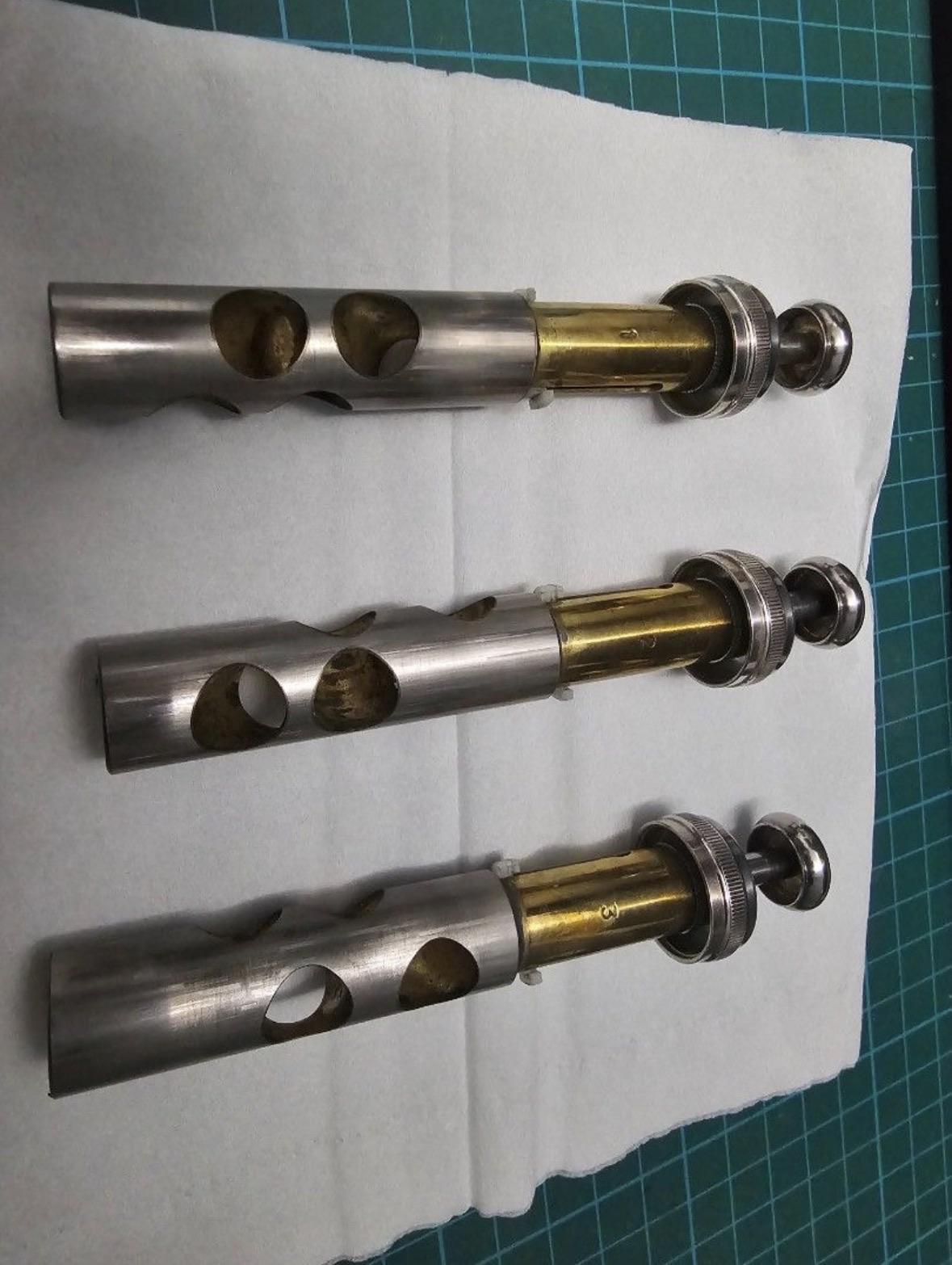
Low-Volume / Prototype Tracking: In standard high-volume assembly lines, makers only stamped digits corresponding to the serial number or casing position to avoid mixing up hand-fitted pistons. Stamping 33-B directly onto the valve barrel indicates F.A. Buescher's shop was manually logging a specific low-volume or pre-production part run through the bench setup, further supporting the one-of-one prototype hypothesis.
With wear out of the equation, the coppery finish on pristine pistons points to two specific manufacturing practices from early 1930s Elkhart shops:
- Solid Red Brass or Phosphor Bronze Pistons: Manufacturers frequently machined piston shells directly from red brass (85–90% copper) or phosphor bronze rather than nickel-plated yellow brass. These high-copper alloys were prized for their corrosion resistance against saliva and excellent wear characteristics when lapped directly into yellow brass casing walls. Unplated red brass pistons retain their reddish-copper hue across the entire surface regardless of age.
- Prototype / Early Production Bench Fitting: In low-volume, pre-production, or prototype builds—which aligns directly with Jon Patton's assessment of SN 33—piston sets were often hand-fitted and lapped in raw red brass or given a copper flash layer to test port registration and valve action without sending the block through the production nickel-plating line.
Having unworn red brass or bronze pistons lapped to exact tolerances explains both the coppery color and the tight compression.
Any additional info appreciated
According to Jon Patton at brasshistory.net:
"Art Musical Instruments was reported in the 1932 August/September edition of The Music Trade Review to have been recently incorporated with a capital stock of $450,000. FA Buescher, former founder and president of Buescher Band Instrument Co., was president, financial house owner RS Stryker was vice-president, and WH Dennison, a former auto executive, was secretary and treasurer. The factory was at 112 West Crawford St and was expected to begin production right away. There may have been limited production for 1932."
FA Buescher died in 1937, few ART horns have Buescher as President engraved on the bell.
- 1932 Gus Buescher and Harry Pedler Sr. form Art Musical Instruments with Buescher in charge of brass and Pedler doing the woodwinds, "American Triumph" models were the low-end brass and "Art" models were high end
- 1937 Buescher dies; Art becomes Harry Pedler & Sons 1939 Harry Sr. is president of Harry Pedler & Sons