r/SpeculativeEvolution • • Aug 31 '26

Subreddit Announcement Announcing r/SpeculativeEvolution's prompts for Spectember 2026!

Thumbnail
gallery
105 Upvotes

FAQ

Do I have to do every prompt in order to participate?

Nope! Do as many as you're comfortable with. If you miss a day, that's fine as well.

I like another prompt list better. Can I submit those instead?

Sure! We don't have a monopoly on Spectember, and this is all for fun. Just be sure to use the "Non-Subreddit Spectember Prompt" flair so it's easier for us to catalogue.

Can I get like to the Spec Evo Forum?

Sure: https://specevo.jcink.net/

Can I get a link to the Specposium Discord server?

Sure, here you go: https://discord.gg/4Ez8qmseY9

Will there be a community project/collaborative event this year?

That's the plan! Stay tuned.


r/SpeculativeEvolution • • 4d ago

Jurassic Impact [Jurassic Impact] Snow Frogs

Post image
335 Upvotes

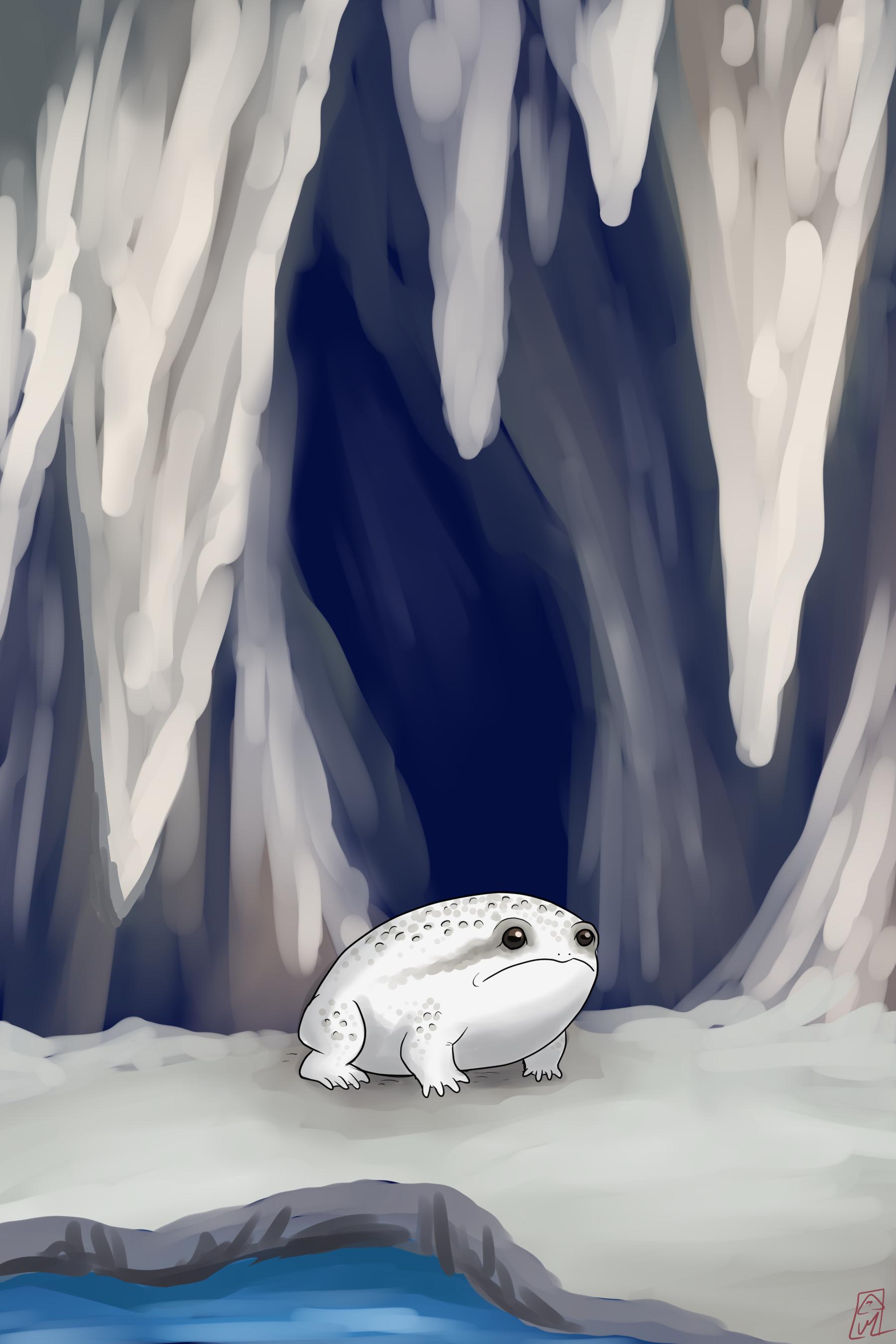
Snow Frogs

Throughout the Miocene, Antarctica has steadily transformed into the frozen expanse of desert we know today. For the most part, the continent is only populated by highly specialized dermorhynchid mammals and marine birds...but inside the continent's caves there is another species that managed to survive the freezing. It may seem unlikely, but Jurassic Impact's Antarctica is also home to marine frogs.

Chionobatrachus is a genus of small, round, cold-tolerant frogs which inhabit the Antarctic cave systems. As some of these caves can actually reach 75 degrees fahrenheit in the deeper sections, the higher temperatures and moisture have allowed small populations of frogs to remain as Antarctica became covered in ice. Snow frogs still have quite an arsenal of adaptations to endure the cold, however, such as a biological antifreeze in their bloodstream similar in composition to that of our timeline's wood frogs. Like toads, snow frogs also have dry, bumpy skin and can survive on less moisture than some of their kin.

With the majority of water on the continent being salt water, snow frog tadpoles have adapted to become salt-tolerant. This tolerance to marine conditions remains into adulthood, and adult snow frogs prey on various small undersea worms and invertebrates. Anything they can swallow is edible, and in the case of the tadpoles their diet consists mainly of plankton and algae, as well as rotifers and nematodes.


r/SpeculativeEvolution • • 2h ago

Maps & Planets [OC] Tahdora Hadean landscape

Thumbnail
gallery
26 Upvotes

Had lots of time to spare so managed to complete this piece within one day rather than across the span of a week like usual. This illustration represents a hadean analogue for the tahdora project ( Not my project im just an illustrator for it). I struggled with the lava as ive never drawn such a thing before but i think it didnt turn out too bad. Sky is dark due to thin atmosphere, sunset, and lots of outgassing from volcanoes across the infant planet. My next work for the tahdora project will be an archean eon scene but from space, and after that ill be able to finally get to work on some actual speculative organisms. I appreciate any forms of constructive criticism and ill take any artists advice!!


r/SpeculativeEvolution • • 11h ago

Alien Life [OC] Primordial Algal bloom

Thumbnail
gallery
66 Upvotes

Second piece of illustrative work for my previously mentioned ‘Tahdora’ Project. Project itself is not mine and i am simply working as a voluntary illustrator for their project. I am doing this so that i can advance my artistry skills while immersing myself in a large speculative world project so that i can learn and gain inspiration for eventually my own. The image depicts some generic analogue of algal mats, and two small green disks wich are what we call ‘Membranocorpusae’. I would appreciate any constructive criticism and feedback you may have, thankyou! (As always ive posted the progress alongside to prove its not ai because its getting difficult like that nowadays)


r/SpeculativeEvolution • • 3h ago

Future Evolution [OC] South American Herbivores - Post Holocene

Post image
12 Upvotes

15 Million Years P.H. - The Early Neocene - Chappies, Buckbunnies and Chuckers:

As North and South America split In the Neocene, they would both develope a very different biota to one another.

This Is also the case for their large Herbivores, since I have already shown off the North American Herbivores, Im gonna showcase the South American ones here.

Instead of the giant Ground Squirrels called Sciubaras which are found In North America, South America would have crowned another rodent as their large grazers.

South America Is home to the Chappies, which may look like Capybaras, but are Instead just close relatives of them.

These are giant Guinea Pigs that managed to survive the end Holocene Extinction and claimed the large grazer niche.

Guinea Pigs were widely spread through South America, which also has something to do with humans popularly keeping them as pets.

Similiarly to North America, South America would also create Its own lineage of large browsing Rabbids called Buckbunnies.

They arent very different to their northern cousins, they altough have a unique trait that the Rabbilopes dont have, which are their keratinized, hoof-like toes.

The last lineage of big Herbivores for the day are the Chuckers, who are the only large Herbivorous Reptiles outside of Autralia. (We will cover those soon enough as well!)

Chuckers are descendants of the desert-dwelling Chuckwalla, who would grow much larger as South America became greener.

While they are fairly oppurtunistic, they mainly use their strong front limbs and broad claws to dig up roots and tubers.


r/SpeculativeEvolution • • 1d ago

Alternate Evolution [OC] (Permian Sophont Project) : Neocalamites and Calamites: Farming in the Permian

Thumbnail
gallery
115 Upvotes

The Permian Sophont project was created by u/FloZone and u/MilezXC

These are intelligent Permian Anomodonts, relatives of Sumina.

For the people of Northern Pangea, one of the earliest cultivated plants are the giant prehistoric equisetums int he genus Neocalamites and Calamites. At this time Neocalamites was more common, although some older calamites lineages would persist until the end Permian extinction.

Neocalamites was a giant horsetail plant that could grow to the size of trees, found in wetlands and cloud forests across northern Pangea and South China Island. It grows very rapidly and doesn't require much in terms of actual cultivation.

The Sophonts use these plants for all sorts of purposes:

The shoots and roots are edible, including small potato-like nodules which can be used to propagate them. However they usually need to be cooked or fermented as when eaten raw they contain compounds that interfere with the functions of certain vitamins. They are a staple of many northern diets.

For the people's of the northern hemisphere of pangea, these plants are a common and popular building material, used to make almost anything and everything. Some varieties have long enough leaves to weave baskets from. However, it is considered too brittle to weave rope from, and conifer bark fiber or climbing fern or animal gut is often the preferred rope-making material.

Paper is also often made from Neocalamites and Calamites. Some cultures make paper clothing by mixing together pulp from both the giant equisetums and conifers, treating the resultant soft cardboard-like substance with conifer resin to make it more weather resistant.

Unfortunately, these plants, despite all their usefulness, will never be truly domesticated. Many of the giant prehistoric horsetails relied mostly on asexual reproduction. And even with out modern technology, it is almost impossible to breed equisetum from spores. The gametophytes are microscopic and non-photosynthetic, and often parasitic on mycorryzae like orchid seedlings.

Cultivars do occasionally emerge, often through random mutation of an individual plant which is then asexually propagated.

Sometimes hybrids appear when two plants are grown in close proximity. Sometimes the Sophonts take advantage of this by creating breeding plots, though this isn't a common practice.

Instead, most of the variety comes through shaping the environment and growth conditions of the Neocalamites and Calamites. For example, low silica soils are usually chosen for many eating varieties. Other methods of manipulation involve pruning, cutting, and trying knots around the plants to restrict certain growths.

While Neocalamites may never be domesticated, it will eventually become widely traded as an ornamental plant, becoming invasive across much of the continent, explaining the worldwide distribution of this plant during the Triassic.


r/SpeculativeEvolution • • 15h ago

Alien Life [OC] Schwartitan & Arpeigei

Thumbnail
gallery
18 Upvotes

Schwartitan (Picture one) & Arpeigei (Picture two) are the Gemäsirisen period descendants of Kuusitaani (picture three) and Tilkeäystävä (picture four). Over millions of years, the already impressive symbiosis between these two animals, has grown infinitely more intimate, to the point where Schwartitan has quite literally become a living hive for its avian-like companions.

Schwartitan remains a 75 ton giant, however, it has evolved a boney crest on its back, with tunnels and chambers throughout it, that house its Arpeigei swarm. In addition, the swarm titan has developed a prominent vocal sack, and its beak has transformed into a large resonance chamber, so it can communicate with its swarm over vast distances.

Now inhabiting temperate or even subtropical environments, Schwartitan's furry coat has grown considerably lighter when compared to its ice age ancestors, and may even be shed entirely during particularly hot summers, revealing the creature's leathery grey skin. However, for mating season, a strong colorful coat helps females attract mates, and thus their fur never fully vanishes.

The habitats Schwartitan prefers usually consist of larger rivers, bordering healthy forests. Here, Schwartitan can lounge near a source of clean water for weeks at a time, while its swarm of Arpeigeis collect shrubs, ferns, berries or fallen branches from nearby forests, which they can then feed to their host. All this is coordinated through the Schwartitan's low frequency vocalisations, through which the large animal functions almost like a queen bee.

Arpeigeis are entirely reliant on their host Schwartitans, as a large portion of their brains is exclusively dedicated to interpreting and understanding Schwartitans' orders. They feed exclusively on Schwartitan milk, which is produced by glands at the base of a Schwartitan's crest, and reproduce by injecting both their eggs and reproductive material into the Schwartitan's bloodstream, where the eggs grow until Schwartitan deposits them is specialized hatching chambers within its crest. At seven centimeters long, Arpeigeis are somewhat larger than their Tilkeäystävä ancestors, and may live to up to a year.

When a Schwartitan is threatened by a predator, it calls upon its swarm to defend it. In such a case, Arpeigei enter an aggressive frenzy, attacking the predator's vulnerable areas, such as its eyes, with very little regard for their own safety. Loosing its entire swarm would be a significant issue for a Schwartitan, however, due to the ever present supply of fertilized Arpeigei eggs within its bloodstream, the massive animal can recover from even this within just a week or two.

During the winter, Arpeigeis enter a deep hibernation state, during which it is the Schwartitan's responsibility to keep them safe. Schwartitans can often be found migrating towards the equator during this time, tho they cover only a few kilometres every day, and rarely reach significantly warmer habitats. It is believed that they mainly do this in order to produce enough body heat for their Arpeigei swarm to not freeze within their crest, however this usually leads to the Schwartitan being severely malnourished towards the end of winter.

Schwartitans are extremely intelligent and emotional creatures. When two members of the species encounter one another, their joyous and exited vocalisations may be heard for days at a time, even from many kilometres away. It is believed that during such encounters, Schwartitans may hold complex conversations amongst one another, exchanging knowledge and memories, as well as even members of their swarms, perhaps in order to ensure the genetic diversity of their Arpeigeis. However, after at most a week, Schwartitans are forced to separate again, as local ecosystems are simply not suited to endure the presence of two such titans.

Every five years, a female Schwartitan enters her fertile period, at which point her coat may grow dramatically more colorful. However, upon further study, it has been discovered that this is not linked to their biology at all, and instead, female Schwartitans in heat have been found instructing their Arpeigeis to smear colorful berries onto their coats, like some bizarre form of makeup. The more colorful a female is, the more likely she is to find a mate, who in some cases, may even respond by adopting a similar coat to the female. Once a pair of Schwartitans have found one another like this, they will enter a period of intense conversation, establishing which one of them is more suited to raising their young.

Once this has been established, a specialized courier Arpeigei is sent out to either transfer the female Schwartitan's egg to the male, or the male's reproductive material to the female. Both male and female Schwartitans have womb-like structures within their bodies, to be able to house and eventually hatch this egg, at which point they will give life-birth to a singular calf. After mating is complete, the two parents are forced to part ways once again, however, mated Schwartitans have been found reuniting with one another at their mating site every summer, and will likely never mate with another individual.

Once the calf is born, such reunions may also result in the calf being exchanged between the parents, spending one year with the mother, and the next with the father, so neither of them grow exhausted with raising their child. At one such reunion, if the parents decide that the child is mature enough, they will send the child off on its own, tho this has been known to cause all animals involved a great deal of emotional distress. In the following year, the mother will be ready to reproduce again, starting the cycle a new. Young Schwartitans inherit half of their Arpeigei swarms from each of their parents, with parents taking deep pride in their calfs developing a healthy and strong swarm.

Every family of Schwartitans has its own unique language, with every singular animal developing its own unique dialogue, so Arpeigeis may tell their hosts apart. Despite this, all Schwartitans have been shown to understand each other with little to no issues, raising questions about how exactly these languages actually form, and how knowledge of them is exchanged between the animals.


r/SpeculativeEvolution • • 1d ago

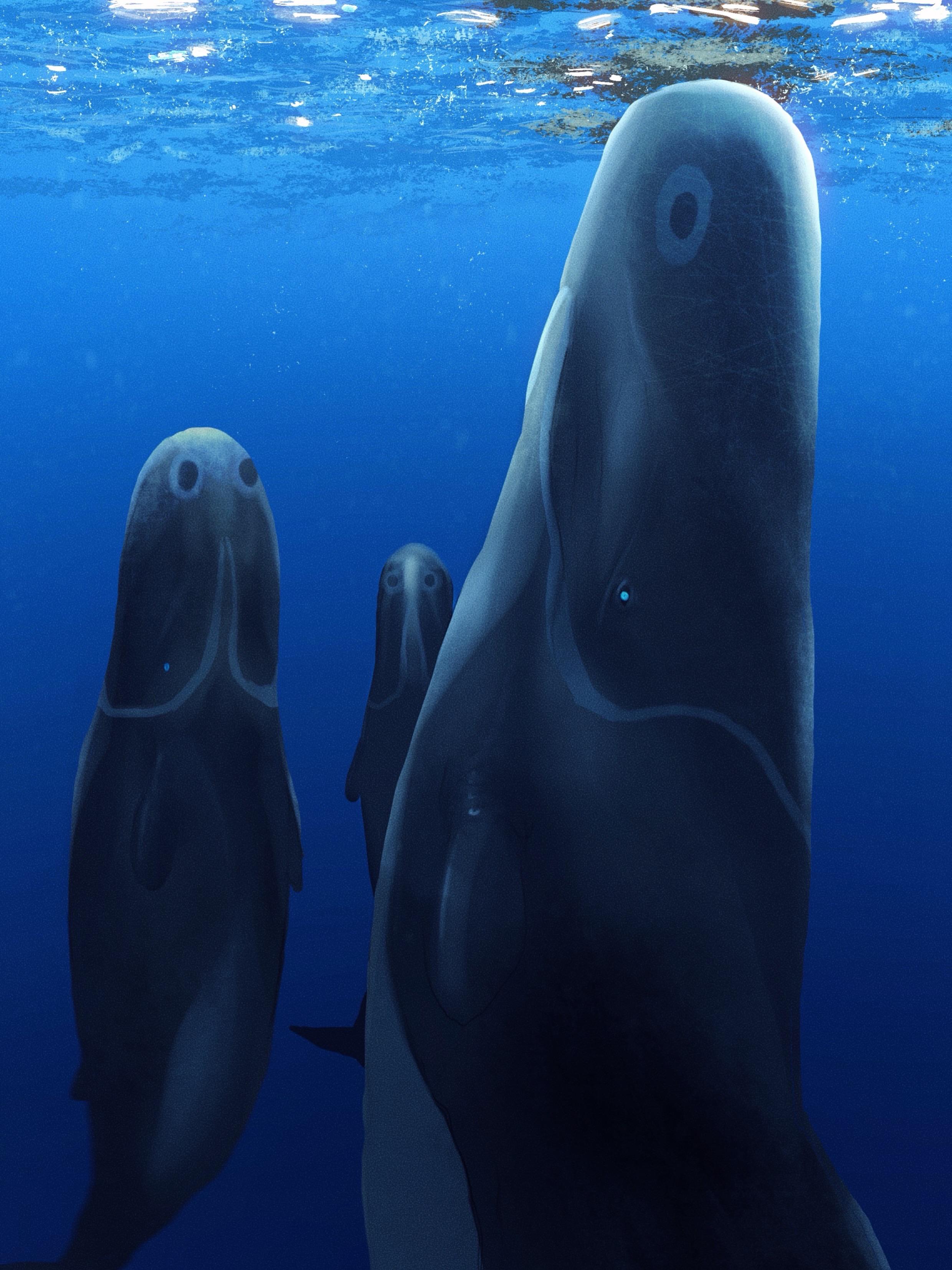
Fantasy/Folklore [Credit: Sianpoi66] The Umibōzu/Sea Monk As Enormous, Patterned Sperm Whales

Post image
806 Upvotes

Original Post/Description:

https://www.instagram.com/p/DehwMjNEl34/

"In 2003, a Japanese fishing vessel, the Seiun Maru, captured a startling encounter after a crew member reported seeing a colossal creature with enormous eyes emerging above the water before diving beneath the surface. The captain immediately ordered the sonar to be activated and an underwater camera to be lowered beneath the vessel. The resulting footage became the last known evidence of one of the world’s most mysterious whale species, a creature that has yet to be officially named or classified. Although it shares certain characteristics with sperm whales and pygmy sperm whales, its immense size remains a scientific mystery. Reaching a length potentially comparable to that of a blue whale, the creature has been speculated to be the origin of the Umibōzu legend. That encounter marked the last time it was ever recorded alive. Sadly, we still know almost nothing about it. Yet one detail continues to puzzle scientists: the enormous eyelike patterns covering its underside. For a creature nearly as large as a blue whale, with no known natural predators, what purpose could these markings possibly serve? And more importantly…..what, exactly, are those eyes watching in the depths of the abyss?"


r/SpeculativeEvolution • • 1d ago

Alien Life [OC] Bestiary of Lyrus Prime #10, the Ursa Rex

Post image
83 Upvotes

The Ursa rex is a facultative biped. While its primary mode of travel is a heavy, quadrupedal sprint, it has a massive tail that supports its upper body, allowing it to rise onto two legs with ease. 
Their primary limbs that can generate 30,000 Newtons of force are used for pinning prey. Their secondary limbs are slender, high dexterity arms held against the sternum. These are equipped with hooked claws for reaching into ribcages or narrow burrows while the primary limbs keep the target immobilized.
"I watched an Ursa rex 'play' with a tredhorn calf today. It didn't go for the throat. It nudged the calf, waited for it to run, then did a 'play bow', forelegs down, tail in the air before bowling it over with a playful swat that snapped the poor thing's spine.
The creature’s tail was actually wagging before it started using those tiny chest arms to pull the calf apart
This behavior is possibly due to how the Ursa Rex is largely unchallenged within its ecosystem. The idea that it is not used to using intimidation as a survival tactic raises the question of what would happen if it were actually provoked”


r/SpeculativeEvolution • • 5h ago

Question/Discussion Hypothetical adhesive mechanisms for wall crawlers? [Credit: hospitalGaming]

2 Upvotes

Pictured is the creature from the GMod mod "Evil crawling thing" by HospitalGaming, (human for scale). I was messing around with it and it can run quite fast across all surfaces, and as pictured, suspend itself from ceilings. This inspired me, and it made me wonder about larger creatures that are shown to crawl on ceilings and walls.

I figured it would be a fun thought experiment for this subreddit to ask what sort of mechanism would allow a creature such a this to not just stick to walls and ceilings, but also move rapidly across them, attaching and detaching their feet very quickly. To not limit discussion, let's say this is an alien entity with potential biological properties not seen on Earth, or at least not to this extent, barring anything too fantastical like gravity inversion. Obviously it has many individual points of contact, but each individual point is rather small. Would a biological glue that is able to turn "on and off" at a moment's notice be possible? Or maybe molecular bonding would be more likely? Or any better ideas you can come up with? Rather than stooping to asking any LLM, I figured this might make an interesting discussion.


r/SpeculativeEvolution • • 15h ago

Seed World [Seeded world concept thingy] The world of the arachnids; ERGANE

9 Upvotes

INTRODUCTION
Named after the Ancient Greek goddess Athena(specifically being one of her epithets, *Athena ergane* Which translates to 'Athena the craftswoman/worker' alongside Athena being known for being the patron goddess of the loom, weaving hence the name) Ergane as a planet overall is slightly larger then earth, standing at around 7'223 KM(or 4488.164 miles) in radius and around 7,222.9998044 kilometers in surface area(253,132,145 miles) residing inside the goldilocks zone when orbiting the systems star, an orange dwarf named Helios.
ENVIRONMENT PART 1: CLIMATE
Climate wise, Ergane is regarded as being fairly less humid then that of earth's(but not being completely dry) with its usual amount of rain per year being highly seasonal, with warmer months(January-August) getting around 400-500 Millimeters of rain and dryer months(August-December) getting a much dryer 250-300 Millimeters of rain overall, with some variation throughout the continents. Its also fairly cold, with temperatures surrounding the equator being around 16-26° C in the warm months before dropping down to 2°- -30° with some temperatures exceeding -30 on the highest mountains
ENVIRONMENT PART 2: GEOGRAPHY
There are currently three large continents surrounded by the Pelagossian(a large expanse of ocean between all three continents, the Hesperian( the western oceans) and the Cassandonian sea(east ocean named after the continent 'Cassandon'.
CONTINENTS:
Cassandon(Easternmost, temperate continent)
Ptolmia(North, near-Antarctic continent)
Antigonia(Warm, South western continent nestled on the equator.)
ENVIRONMENTS OF THE THREE CONTINENTS
ANTIGONIA: A very warm, arid continent known for its deserts, steppes and badlands.
PTOLMIA: an extremely cold, snow-covered continent known for the Heraklisian mountain ranges(specifically Mt. Gilead, which is slightly taller then MT. Everest)
CASSANDON: a moderate temperatured continent known for its woodlands, forests and extensive scrublands.
-----------------------------------------------------------------------------------------------------------
SEEDED WORLD INHABITANTS:(carnivores/predatory species)
- Alpiscorpius alpha(Alpine scorpion)
- achyloidellus goliath(harvestman)
- Hadronyche alpina(Alpine funnel web spider)
- Vesubia jugorum(alpine wolfspider)
- Selenocosmia stirlingi(whistling spider/tarantula)
- Taracus pallipes(harvestman)
- Sorensenella bicornis(harvestman)
- Ischyropsalis hellwigii(harvestman)
- Rhagodima nigrocincta(sun spider)
- Oparbella aciculata(sun spider)
- Aphonopelma iodius(desert tarantula)
- Pandinus imperator(emperor scorpion)
- Hadrurus arizonensis( giant hairy desert scorpion)
- Gigantometrus swammerdami( giant forest scorpion)
- Isopedella inola( desert huntsman spider)
- Isopedella cerussata( southern grey huntsman spider)
- Grammostola pulchra(tarantula)
- Grammostola pulchirpes*(tarantula)*
- Tetracanthagyna plagiata( hawker dragonfly)
- Petalura ingentissima( giant petaltail dragonfly)
SEEDED WORLD INHABITANTS(herbivorous/nonpredatory/omnivorous
- Dendroctonus ponderosae( mountain pine beetle)
- Upis ceramboides(alaskan darkling beetle)
- Grylloblattids( antarctic ice crawlers)
- Hemideina maori( mountain stone weta)
- Hypogastrura nivicola(stone fleas)
- Deinacrida heteracantha( wetapunga)
- Proscopia gigantea( giant jumping stick grasshopper)
- Tropidacris cristata(giant red winged grasshopper)
- alanga irregularis(Walanga/hedge grasshopper)
- Dynastes hercules( hercules beetle)
- Goliathus goliatus albatus( goliath beetle)
- Gryllotalpa major( mole cricket)
- Mellisuga helenae( bee hummingbird)
Loddigesia mirabilis( marvelous spatuletail hummingbird)
- Vespadelus vulturnus( little forest bat)
- Craseonycteris thonglongyai(bumblebee bat)

PLEASE NOTE THAT THIS WILL BE UPDATED AS TIME GOES ON!!!!!!


r/SpeculativeEvolution • • 16h ago

Question/Discussion Could an alien species combine their circulatory and hydrostatic skeleton?

8 Upvotes

If an alien species had a hydrostatic skeleton and a heart that pumps blood into said hydrostatic skeleton work? Like I mean what happens if this species skeleton mineralises and becomes a “proper” calcium skeleton, would the blood be pumped exclusively inside the bones?


r/SpeculativeEvolution • • 21h ago

Alien Life [oc] Introducing the quindaxa.

Post image
10 Upvotes

A serpentine species from a currently unnamed rainforest homeworld, the quindaxa (misspelled in the picture because fingers go too fast) are sophont herbivores that don’t have really advanced technology but are highly curious and flexible, with hooked claws that can cause serious wounds and injuries when threatened.


r/SpeculativeEvolution • • 21h ago

Resource Building a World from Scratch (Research to Keep Me from Losing My Mind) Part 1: The Planet/ 1. The Function of a Planet

4 Upvotes

Master Post // Next page ⏭️

Introduction:

I'm building a speculative evolution project from scratch, and when I say scratch, I mean absolute zero. No seed planet, no base animal. Since I want the project to have a solid logical foundation, I've had to do a lot of research. I thought it would be a good idea to share all this scientific research with you as I go, publishing it as a sort of reference guide.

This isn't about showing you my drawings or the process behind designing the personal project itself, although I might make a few illustrations to provide visual references for certain topics. This is purely about sharing the biology, geology, and physics information I discover along the way.

An important disclaimer: The only "intelligence" behind this project is whatever I can gather using my own brain through reading and burning the midnight oil. I have no intention of using AI to write the posts, compile the data, or develop the concepts. Everything is researched manually and put together by hand (and blood), with references included and cited in APA format (my Research Methodology professor would be proud). AI will only be used for translation purposes (unfortunately, my written English isn't the best).

To keep things from becoming a mess, every post will have an index at the top with links so you can jump between topics and keep everything organized. This will also include a link to a master post containing the full research index.

The idea is for these posts to serve as a foundational guide to understanding the scientific principles and rules we need to consider when creating a planet's natural history.

I hope you find the information useful and enjoy the project! I'm by no means a professional, so if you spot any scientific information that could be improved or corrected, feel free to let me know in the comments. I'd love to hear your feedback!

PART 1: THE PLANET

1. The Function of a Planet

Our goal in this first stage is not to decide what the planet will look like, but to understand and define what kind of world we are building, what it needs to allow, and what we need to know about it to develop it properly.

There is a distinction we need to keep in mind from the very beginning: a planet's narrative function and its physical properties are two different things. The first tells us which aspects are worth investigating in greater depth; the second determines what can actually happen in that world, according to the laws we establish.

For example, if we want to develop a biosphere with an enormous diversity of creatures, we will need to research evolution, ecology, energy and nutrient availability, geography, and environmental conditions. However, that doesn't mean we should give the planet a specific gravity just because we'd like to include giant animals. First, we'll study the conditions that make that kind of life possible, and then we'll examine the possibilities they offer.

The narrative function helps us formulate the questions. Science helps us evaluate the answers. So, before researching everything, ask yourself: What do I want for my planet? Start there to determine what makes a particular decision possible or impossible.

1.1. What Does It Mean to Define a Planet, and What Do We Need to Know About It?

A planet is a celestial body whose nature depends on its physical properties, composition, history, and relationship with other objects in its system. To understand it, observing its surface is not enough. We must study both its current characteristics and the processes that produced them.

Planetary science investigates these bodies through multiple disciplines, including astronomy, physics, chemistry, and geology.¹ Studying a planet may also require drawing on climatology, oceanography, and biology, especially when determining whether it can support life.² These disciplines do not examine entirely independent aspects of a planet. On the contrary, each provides information that helps us better understand the others.

Let's consider gravity as an example. A planet's mass and radius determine its surface gravity according to the following relationship:

\[ g=\frac{GM}{R^2} \] (Look, this thing had a very nice format in my original document.)

Where \(g\) is the surface gravitational acceleration, \(G\) is the universal gravitational constant, \(M\) is the planet's mass, and \(R\) is its radius.

This relationship helps us understand why two planets of different sizes, or even two planets of the same size, do not necessarily have the same gravity. It also shows that a change in one physical property can have consequences for other aspects of a world. Gravity, for example, influences the structure of the atmosphere and affects the mechanical stresses organisms must withstand.³

The atmosphere, in turn, plays a role in climate. Its composition, pressure, and circulation affect heat distribution and surface conditions. Climate influences the availability of liquid water, while water is involved in numerous geological and chemical processes.⁴ If life exists, organisms can also modify their surroundings and alter atmospheric composition.⁵

Therefore, a planet must be studied as a system of interconnected properties and processes, rather than as a collection of characteristics that can be selected independently.

1.1.1. What Does This Mean for Our Future Project?

Before building our planet, we will need to identify its fundamental properties and understand the processes that determine them. Among the questions we will investigate are its mass, radius, composition, internal structure, orbit, rotation, atmosphere, and geological evolution. If it supports life, we will also study the conditions that allow life to emerge, survive, and diversify.

Not all these questions will be equally important at every stage. That is why we first need to establish what we want to develop. If the planet is going to support a complex biosphere, for example, we will need to examine the interactions between the physical environment and living organisms in greater depth. If it is lifeless, our research will focus on other processes.

This does not mean that the narrative purpose determines the planet's physical properties. It means that it helps us identify which aspects we need to study in greater depth and which questions we need to answer to build our world coherently.

1.1.2. A Clarification on What We Consider a Planet

According to the official definition established by the International Astronomical Union (IAU) in 2006, a celestial body must meet three essential requirements to be classified as a planet:

  • It orbits a star: It must orbit the Sun (in the case of our Solar System) or another star or stellar remnant.
  • It is spherical (Ball™️): It must have sufficient mass for its own gravity to overcome the forces of rigid-body strength and assume a hydrostatic equilibrium shape (approximately round).
  • It dominates its orbit (clears its orbital neighborhood): It must be gravitationally dominant in its neighborhood and have cleared its orbit of other bodies or debris of comparable size. Pluto does not meet this last requirement and therefore cannot be classified as a planet⁶, but it will always live in our hearts as one.

These requirements distinguish planets from dwarf planets (such as Pluto) and other small Solar System bodies.⁷

However, and here's an important detail, these criteria were formulated to classify bodies in our Solar System. In the study of exoplanets, different criteria and categories are used to account for systems that may have very different conditions. For example, some planets orbit two stars, while others are not gravitationally bound to any star.⁸

This diversity matters to our project because we should not assume that our world will share Earth's characteristics. We can explore different configurations, but we will need to understand the physical conditions that make them possible before deciding whether they are suitable for our project.

Footnotes:

¹ National Academies of Sciences, Engineering, and Medicine. (2023). Origins, Worlds, and Life: A Decadal Strategy for Planetary Science and Astrobiology 2023–2032. The National Academies Press. doi.org (p. 1-15).

² Plaxco, K. W., & Gross, M. (2011). Astrobiology: An Introduction (2.ª ed.). Johns Hopkins University Press. (pp. 132–135).

³ de Pater, I., & Lissauer, J. J. (2015). Planetary Sciences (2.ª ed. actualizada). Cambridge University Press. (p. 4, pp. 55–57).

⁴ Kasting, J. F. (2010). How to Find a Habitable Planet. Princeton University Press. (pp. 42–48).

⁵ Kasting, J. F. (2010). How to Find a Habitable Planet. Princeton University Press. (pp. 188–193).

⁶ International Astronomical Union. (2006). IAU Resolution B5: Definition of a Planet in the Solar System. iau.org (p. 1).

⁷ International Astronomical Union. (2006). IAU Resolution B6: Pluto. iau.org (p. 2).

⁸ Perryman, M. (2018). The Exoplanet Handbook (2.ª ed.). Cambridge University Press. (pp. 12–15, pp. 248–251).

r/SpeculativeEvolution • • 1d ago

Seed World [OC] Some Species of Jellyfish from an Jellyfish Seed World with White-blue Star and very Inclined Axis

Post image
61 Upvotes

Source

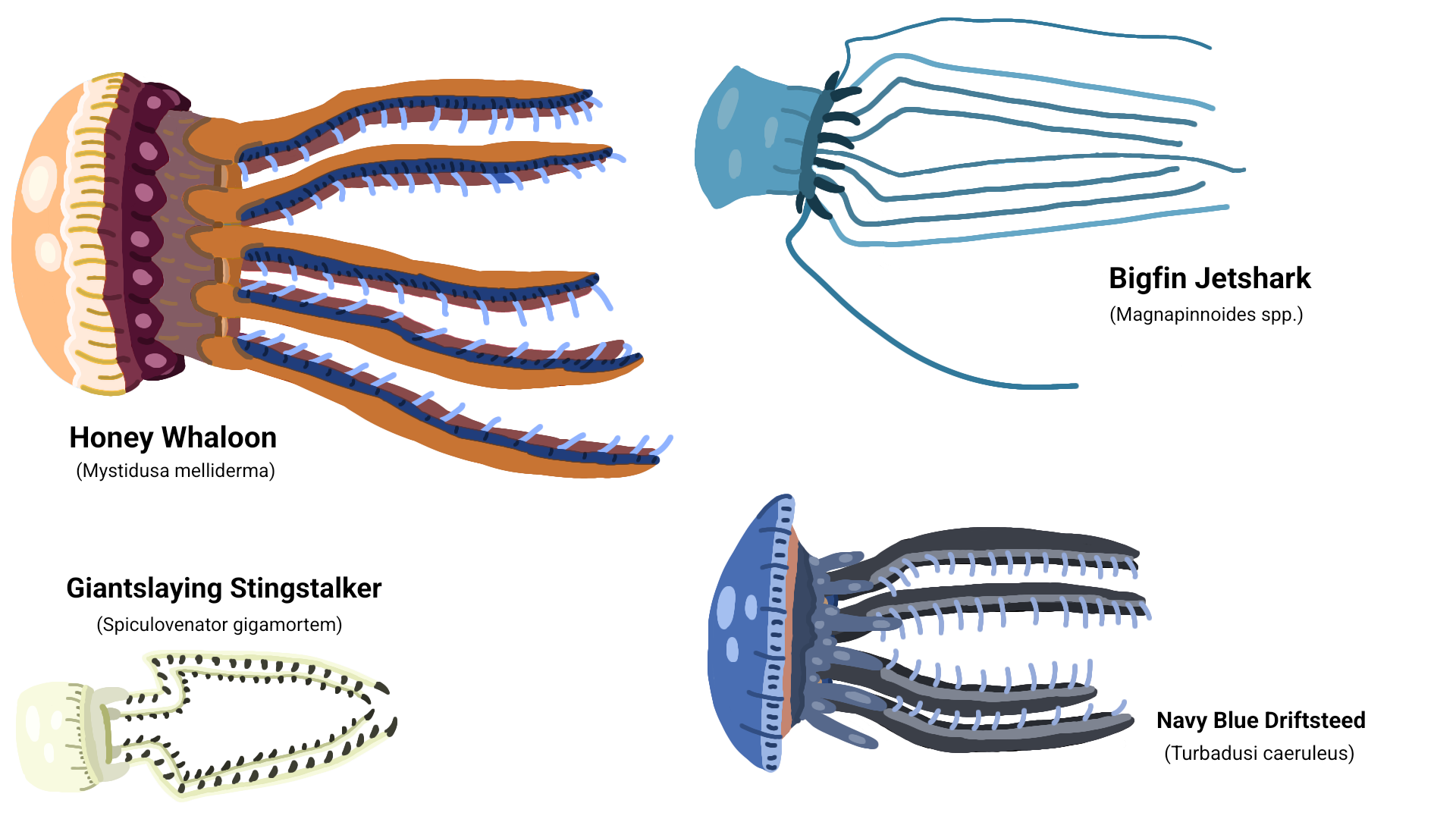
GL-02026—known colloquially as "Gellios"—orbits a blue-white (A5V) star and possesses a highly inclined orbital plane. It was once the target of a human colonization project; although the endeavor was an utter failure, a limited biological community was nonetheless introduced. This community contained no vertebrates or vascular plants (except Zostera marina, the Eelgrass);; instead, it consisted of microscopic plankton, algae, zooxanthellae, brine shrimps, nudibranchs, polychaetes, and five species of jellyfish representing three distinct classes. Released into these vast, extreme oceans, these organisms became the progenitors of a unique biosphere. In the absence of other animals or competing life forms, they underwent massive population explosions, eventually giving rise to fully functional, self-sustaining ecosystems.

In an environment devoid of species that might prey upon or compete with them, Aurelia aurita (Class Scyphozoa)—underwent extensive diversification caused bu very low competition; but in this same setting, they would serve as ideal prey for predators derived from Chironex fleckeri and Malo kingi. Meanwhile, lineages descending from Turritopsis dohrnii (class Hydrozoa) would come to occupy an ecological niche analogous to that of the planet’s corals and other reef-building animals. Alongside Chironex fleckeri and Malo kingi. Tripedalia cystophora (class Cubozoa), these organisms would evolve into entirely distinct forms—cnidarians that, following the emergence of algae, Artemia, and nudibranchs, would transition into amphibious life forms before eventually assuming the full-fledged role of tetrapods.

Yet, Gellios possessed a different star and orbital inclination than Earth; for a limited group of organisms arriving from Earth, this represented a complex set of factors that—over the course of millions of years—would fundamentally shape everything from their responses to extreme conditions to the patterns of their migratory waves.

By the Middle Medusocene, a fully-fledged equilibrium had emerged among the jellyfish; descendants of five original lineages underwent extensive convergent evolution, diversifying into hundreds of distinct species. Some Lineages sharing a common ancestor—such as the Honey Whaloon (Mystidusa melliderma) and the Navy Blue Driftsteed (Turbadusi caeruleus)—evolved to occupy specific ecological niches, becoming either zooplanktivores that consume vast quantities of Artemia or herbivores that feed on algal blooms. Naturally, the presence of herbivores implies the existence of predators. Cubozoan predators, such as the Jetsharks, developed muscular tentacles to hunt these giant jellyfish—though this does not apply to the Bigfinned Jetshark (Magnapinnoides spp.) , which preys on smaller jellyfish. Nevertheless, even these smaller species are not entirely without their own defenses or advantages.

The Giantslaying Stingstalkers (Spiculovenator gigamortem) they are, in the truest sense, micro-predatory jellyfish of megafaunal jellyfish. Similar to the modern-day Irukandji jellyfish, this species possesses a tiny, transparent, glass-like body. They often drift in the vicinity of megafaunal jellyfish, such as Whaloon or Driftsteed; unlike jetsharks or grapneljells, they do not immediately launch an attack. Instead, they linger near these larger creatures while they feed, siphoning off some of the prey for themselves. However, their most aggressive predatory behavior emerges during the sweltering summers of the Southern Hemisphere. In these seasons, the "giantslayer" jellyfish use the thousands of nematocyst cells lining their tentacles to sting prey much larger than themselves. They can kill an elderly or weakened Whaloon in just 3 to 8 minutes, subsequently consuming the entire carcass—a vital and highly nutritious food source for these small yet lethal creatures. Also these deadly jellyfish are descended from modern-day Malo kingi. Likewise, although it possesses a magnitude similar to that of its ancestor, it still retains its own distinct differences.


r/SpeculativeEvolution • • 1d ago

Alien Life [Credit: thenamesblurrito] High Class Cybertronian food (Transformers)

Thumbnail
gallery
191 Upvotes

artist

i found this post loved the world building stuff and i thought you guys may enjoy it so here's info on each piece of "Fancy food" for a robot in disguise (directly from the creator's page)

  1. a strange, rare, subterranean cyberflora species, goldleaf produces long delicate ivy strands of golden ore, cascading down and sometimes creating huge nests of golden flakes if left undisturbed for long enough. i based these off of those perfect pencil sharpening moments when you’ve managed to create a long thin strip of wood, or peeling apples in one super long coil of skin. this cyberflora will grow around any underground seam of soft metal, but it pops up around gold most often. finding them can be difficult, but harvesting the ivy without the strands breaking or even disintegrating completely is very delicate work. the scarcity and difficulty means a coil of authentic goldleaf ivy atop a dish is an expensive addition
  2. these truffles aren’t actually grown from cyberflora at all! manganese nodules form naturally in oceans, so they’re quite plentiful here on Earth. but on Cybertron, where bodies of water are hardly common... let’s just say they’re a little tough to get. on Eukaris and Caminus, planets with more water, truffles are more common and thus less expensive. they’re blobs of layered iron and manganese, which is an excellent source of repair material for mecha, and thin slices of these nutritious and delicious truffles are used in very fine, very pricey meals
  3. now this one is a little tricky. given the fact that most people consider it barbaric to eat mechanimals, and how mechanimals don’t even reproduce, instead emerging from hotspots, caviar on Cybertron is not fish eggs. it does however come from fish! specifically, the orange caviar is from cybersalmon living in the flooded parts of the Rust Sea. when the cybersalmon reach a point in their lifecycle where the corrosion and rust has decayed them too much, they migrate to the closest hotspot, consolidate much of their energon and other precious fluids into beads, and then scatter these beads nearby before dying, so newly forged mechanimals coming from the hotspot will have an immediate source of rich fuel. the beads are, like many things in the sea, stained orange from rust. the black caviar come from sturgeonoids, native to the underground Argon Sea. they don’t usually swim in schools, but they do forge minor drones for themselves, essentially becoming a single organism with multiple decoy bodies that they inhabit and control simultaneously. forging a drone takes some time, and it starts with a little bead of condensed energy and material. black caviar is more difficult to harvest, making it more expensive, but both varieties are considered luxurious
  4. saffronze isn’t a particularly unusual species. there are many types of cyberflora that harvest and forge metals as their ecological niche. but bronze specifically is not a common cyberflora byproduct, and saffronze is not a common species, making it one of the rarer and more “exotic” cyberflora spices. the thin, tightly woven bronze wires are incredibly high quality, making them an excellent additive to sweet, flavorful dishes. of course, you could just use bronze made in your local smithy, but people claim there’s a certain zest to genuine saffronze that just can’t be copied. the sheer scarcity is what makes it alluring

r/SpeculativeEvolution • • 1d ago

Fantasy/Folklore [Credit: Thought Potato] Hidebehind episode!!

Thumbnail
youtube.com
6 Upvotes

r/SpeculativeEvolution • • 1d ago

Uncategorized Speculative Biology [OC] Watch your Step

Post image
21 Upvotes

Brontoichtys titan or the Trapjaw Fulgur is a gigantic lungfish native to the seas of Alterra. It has developed a specialized relation with plants which it lets grow on its back, attracting prey. This one is about to ensnare a Tigersun fish attracted by Fruit Kelp

Physical traits: At 10 to 12,5m and weighing 12-15 tons, it is a rather large animal. Akin to monkfish on earth, they camoflague themselves within sediment and cover themselves with plant matter. This one is growing Fruit Kelp, a nutritious plant that grows incredibly fast. For this reason it positions the left side towards more food to let the fruit grow in that direction. It has an elongated body with massive fins. It lives usually 70-80 years.

Reproduction: It lays up to 50k eggs in the sea and does not care for them. However it is not natively cannibalistic. It reproduces every 7-8 years and has male and female.

Prey and predation: It hunts prey in the 0.5-6m range, by luring them in to swallow them whole with lighting fast reflexes. But it is not at the top. Most megafauna easily tackles them and eats them. However in youth they are covered by a mucus that makes them unappetizing. The plants on its back give it energy too, so it can vastly reduce its caloric need, in addition to being cold blooded.

Habitat:It lives in open sea where sun can shine for the plants and near reefs.

Senses and intelligence: It has moderate senses but excellent hearing. Although intelligence is low, it has reflexes in the 50-100ms range. The nerve signals in its head are faster than human ones.

Questions are welcome


r/SpeculativeEvolution • • 1d ago

Alien Life [OC] Hornchromis, a colonial polymorph from Ghouwiya

Post image
19 Upvotes

Solitary

Homogamous hermaphrodite

Highly venomous apex predator

Possesses two rostrum ”jaws”

Gill zooids are located at the top of the shell and can retract into the mantle

A bow-shapes compound eye sits just over the rostrum (not visible in this picture)

Lives in the xiagozunian sea in somewhat shallow/deeper tropical reefs (At least 6-12 m under the surface)

Around 2.5 to 3 meters in height, some regional subspecies max out at 4-5 meters.


r/SpeculativeEvolution • • 1d ago

Future Evolution [OC] Map Of The Early Neocene - Post Holocene

Post image
28 Upvotes

The Early Neocene takes place roughly 15 million years after the Holocene mass extinction.

Over this time frame, the world would start looking alot different then today.

I am not 100% sure how accurate this Map Is (Im a Biology enthusiast, not a Geography one...), so I apologize If this Is an unaccurate model.

The 2 Americas would have split from each other by the Neocene.

North America would mostly consist of open Grasslands (or rather Cloverlands...?). As you go further west tho, you´ll find more Forests and even a Desert.

South America Is filled with lush forests and temperate grasslands.

Africa would have fused with Eurasia, creating Afro-Eurasia, the largest continent as of now. It Is rather dry and mostly consisting of dry Grasslands and Deserts.

There however Is a lush tropical forest sandwiched between Its two Deserts.

Australia would have stayed largely unchanged, It has although fused with surrounding smaller landmasses like New Zealand.

The Antarctica Isnt depicted here because It Isnt on any modern maps and I dont really know how I should Include It here. Sorry about that...

I can still tell you some things about It tho. Antarctica would have largely melted due to the new Hothouse Age, making It habitable once more.

While the Antarctica Is rather mild, It can still develope permafrost on Its center.

It has slightly moved away from the pole, but not by much.

Thinking about It, I think this Is the first time I made a detailed map for any of my projects. Huh.


r/SpeculativeEvolution • • 1d ago

Future Evolution [OC] The Afro-Eurasian "Kangaroos" - Post Holocene

Post image
16 Upvotes

15 Million Years P.H. - The Early Neocene - The Springharoo:

I have already presented the Sciubaras and Rabbilopes, who are the new large herbivores of North America. But what about the other continents?

The large Grazers of Afro-Eurasia would be the Springharoos (Neomacropods). While they may resembles Kangaroos with their bipedal hopping gait and niche of large herbivores, their lack of a pouch and ability to give birth to well developed young give away their true Identity. Springharoos are Placental Mammals and descendants of the African Springhares, who would have taken a heavy hit from the End Holocene Mass Extinction, but would get back on their feet as other Herbivores declined.


r/SpeculativeEvolution • • 1d ago

Maps & Planets [OC] Carmilla map proposal

Thumbnail
gallery
15 Upvotes

A proposal for Carmilla’s maping in terrain, Köppa climat, heightmap. I made it with the world orogen website. But it’s too green the final version will probably be handmade based off of this map and will have more reddish grass as per the original design.(it’s hard to see but in my original image there are spots on the planet that are red.) also the highlighted spot in the right hand side was an accident I had it selected when I took the screenshots.

Disclaimer: No AI was used in the making of this map. I use websites that use procedural generation via seeds to determine terrain. I don’t condone the use of AI at all. The ones that I used, I determined them safe and compared them to each other and this is the best result I got. If the tool I used is discovered to be AI I will trash this map and make a new from scratch.

EDIT: I just discovered the fact that this planet was generated with an equatorial Alpine range So by random chance, the northern and southern climate could possibly have different biodiversity!


r/SpeculativeEvolution • • 1d ago

Alternate Evolution [OC] [Videogame]En las minas de la locura edición arcade.

Enable HLS to view with audio, or disable this notification

13 Upvotes

Este es el trailer de anuncio de la demo de "En las minas de la locura: edición arcade".

Adéntrate a una inmensa y hostil red de cuevas y enfréntate a la variopinta flora, funga y fauna endémica del lugar.

“Esta es una cueva donde solo los más valientes se atreven a entrar, que esconde horrores inéditos jamás antes vistos por ningún humano ¿serás capas de moverte y recibir los tesoros que se esconden en este laberinto subterráneo, o perecerás en el intento?”

Descubre los secretos de la inmensa red de cuevas, en este videojuego arcade, rpg de gestión de recursos y evolución especulativa.

Link de descarga: https://tiuver.itch.io/en-las-minas-de-la-locura-edicion-arcade


r/SpeculativeEvolution • • 2d ago

Seed World [OC] Colossal Girafilla

Post image
56 Upvotes

Known as the Nyamtocenic Apocalyptic Biosphere Collapse—the second major mass extinction event—this catastrophe wiped out 90% of the planet's vertebrate fauna, 35% of its invertebrates, and 25% to 30% of other organisms, marking it as the most severe extinction event ever witnessed on VLI-093. The primary cause was the Nyamtu—a species descended from baboon-like anteaters—whose societies, during an intermediate industrial era, engaged in a conflict involving lethal nuclear weapons that resulted in the destruction of the vast majority of life.

Yet, life inevitably found a way, ushering in the Archoliniozoic—the longest era the planet has ever witnessed—which spanned up to 70 million years, in stark contrast to the mere few million years of the Nyamtocene. Throughout this vast expanse of time, numerous lineages and dozens of species—ranging from survivors like the Anklyorhynchids to the final "endling" species of the Vermidillos and Pliotheres—managed to endure the great extinction event brought about by the Nyamtus. Their survival was made possible by traits such as small body size, a generalist nature, and an adaptability to environmental pollution; these same characteristics would go on to fuel a remarkable diversification over the course of this long era.

Anklyorhynchids diversified incredibly during the Archolinozoic; their "false teeth" now functioned just like true teeth. Previously, these structures—which only grew to a few centimeters in size—had offered a limited capacity for chewing, yet they had failed to permanently eliminate the need for the animals to swallow stones. Meanwhile, all lineages descending from the Semi-Aquatic (M. t. palustris) subspecies had gone extinct, with the exception of a single genus. It is now time, however, to discuss the Colossal Giraffilla ( Giraffillus maximus )—a long-necked, giraffe-like creature that evolved from the Anklyorhynchids and stood as one of the megafauna in its environment.

They use their actual "teeth" to chew and ingest leaves and wood from trees; to predators of a similar or slightly smaller size, they represent a walking abundance of meat. Furthermore, various species of parasite also feed upon their skin. In appearance, they resemble the long-extinct Chalicotheres. Yet, much like many other vertebrate species, they are actually a highly derived lineage of giant anteaters—though they no longer have much interest in ants, consuming leaves, wood, and branches instead.

In another realm, the terrestrial lanternfish gradually began to compete with anteaters; over time, however—much like what occurred during Serina’s Pangeacene era and the periods that followed—these terrestrial lanternfish would eventually become a natural, integrated component of their ecosystems.

Source


r/SpeculativeEvolution • • 2d ago

Alien Life [OC] The main character of my sci-story I am writing. Their name is Thirty-two.

Thumbnail
gallery
24 Upvotes

Very rough sketches, but I have finally settled on a design that is a mix of cute, personable, and capable of doing all the things they do in the story.

I know I could have made the design more alien but I wanted them to look cute, so monkey raccoon cat it is.

Colony members are given number names, after the day in the season their egg was laid. So essentially their name is their birthday.

A few facts about this species.

They are eusocial. The queen keeps a harem of drones, who have travelled from other colonies. Most eggs that are laid hatch into female workers.

These colonial creatures descend from a line of mammal like animals, where fathers nurse the young and mothers incubate eggs. In the colonials however, paternal lactation has gone from the usual method of feeding young to a method of cast differentiation. Fathers nurse selected nymphs, which triggers hormonal changes and puts them on the developmental track to become reproductive queens. From the evolutionary perspective, this allows fathers to only give this expensive resource to young that will actually pass down their genes.

The other youngsters are given mincemeat prepared from fish, hunted animals, or livestock raised by the colony. Adults are vegetarian.

The plot of the story revolves around Thirty-two and the nymph she has been assigned to care for being captured by human xenobiologists who are visiting their planet. A reverse alien abduction story.

I am very eager for feedback on the story itself, so if anyone would like to read my draft, please let me know. It is novella length.