r/ancientegypt • u/BurtonDesque • 7h ago
News Ancient Egyptians sacrificed servants when kings died, forensic tests show
51
Upvotes
r/ancientegypt • u/BurtonDesque • 7h ago
r/ancientegypt • u/Handicapped-007 • 7h ago
Funerary mask
Funerary mask and shroud of painted and plastered cartonnage, depicting a woman wearing a decorated wreath, tunic and holding a vase in one hand : Ancient Egyptian, Upper Egypt, probably Deir el-Bahari, Late Roman Period, 200-300 AD
This item is not on display
Collection
World Culture
Object number
A.1956.1187
Object name
Funerary mask, Shroud
Production information
Unknown
Egypt, Northern Africa
Roman Period
3rd century
Culture / Style
Ancient Egyptian
Collection place(s)
Deir el-Bahari, Upper Egypt, Egypt, Northern Africa
Associations
Previous owner: Rhind, Alexander Henry, 1833 - 1863
Exhibitions
Ancient Egypt (29 Jul 2011)
National Museum of Scotland
Egyptian Gallery, 2003 - 2008(2003 - 2008)
Royal Scottish Museum
References
MURRAY, M A 1900. Catalogue of Egyptian Antiquities in the National Museum of Antiquities, Edinburgh (Edinburgh: Society of Antiquaries of Scotland).33
PARLASCA, K 1966. Mumienporträts und verwandte Denkmäler (Wiesbaden: Harrassowitz).44, n.185, 128.143, n.135, 188.207 n.76, 209, pl. 52, 1, 3
GRIMM, G 1974. Die römische Mumienmasken aus Ägypten (Wiesbaden: Frank Steiner). 25, 95 n.32
WALKER S & M BIERBRIER 1997. Ancient Faces. Mummy Portraits from Roman Egypt (London: British Museum Press).158-159[178]
RIGGS, C 2000. “Roman Period Mummy Masks from Deir el-Bahri”, Journal of Egyptian Archaeology 86: pp. 121-144131, 141[1]
RIGGS, C & M DEPAUW 2002. “«Soternalia» from Deir el-Bahri, including Two Coffin Lids with Demotic Inscriptions”, Revue d’Égyptologie 53: p.89 with n. 57
RIGGS, C., 2005. The Beautiful Burial in Roman Egypt: Art, Identity and Funerary Religion (Oxford: Oxford University Press).232-233, 296 [128]
Manley, B and Dodson, A., (2010) Life Everlasting. National Museums Scotland Collection of Ancient Egyptian Coffins (Edinburgh: NMS Enterprises Ltd.), Cat. 63, p.144
Title
Funerary mask, Late Roman Period, 200-300 AD, Findspot Deir el-Bahari? Upper Egypt, Painted and plastered cartonnage, National Museums of Scotland
https://www.nms.ac.uk/collections/search/object?entry=300377&object-name=Shroud&page=1&view=cards
National Museums of Scotland
r/ancientegypt • u/Handicapped-007 • 11h ago
Funerary Mask 01
Funerary mask of cartonnage, painted in red blue black green and pink, with gilded gold face, and scenes of gods: Ancient Egyptian, Hawara, Middle Egypt, Roman Period, c20 BC - 70 AD
This item is on display
National Museum Of Scotland, Level 5, World Cultures, Ancient Egypt Rediscovered
View museum map
Collection
World Culture
Object number
A.1911.275
Object name
Funerary mask
Production information
Hawara, Middle Egypt, Egypt, Northern Africa
Roman Period
Culture / Style
Roman Period, Ancient Egyptian
Materials
Cartonnage, Plaster, Gold
Collection place(s)
Hawara, Middle Egypt, Egypt, Northern Africa
Associations
Depicted: Isis
Depicted: Nephthys
Hilton Price Collection
Collector: Hilton Price, Frederick George, 1842 - 1909
Excavator: Petrie, William Matthew Flinders, Professor Sir, 1853 - 1942
Exhibitions
Ancient Egypt Rediscovered (08 Feb 2019)
National Museum of Scotland
References
Hilton Price, F. G. (1897 and 1908), A Catalogue of the Egyptian Antiquities in the possession of F. G. Hilton Price, 2 Vols, London: Quaritch. 27.
Sotheby, Wilkinson & Hodge (1911), Catalogue of the important and extensive collection of Egyptian antiquities, the property of the late F. G. Hilton-Price, Esq. Lot no. 1043.
1897. A Catalogue of the Egyptian Antiquities in the Collection of F. G. Hilton Price, Dir.S.A. London: Bernard Quaritch, p. 5 (no. 27)
Manley, B. and Dodson, A. (2010), Life Everlasting: national Museums Scotland Collection of Ancient Egyptian Coffins, pp.130-131
Title
Funerary mask 01, Roman Period, c20 BC - 70 AD Roman Period, Findspot Hawara Middle Egypt, Cartonnage plaster and gold, National Museums of Scotland
National Museums of Scotland
r/ancientegypt • u/Handicapped-007 • 19h ago
Votive sistrum / fragmen
Upper part of a faience votive sistrum, each of the two faces in the form of the head and wig of the goddess Hathor: Ancient Egyptian, Lower Egypt, Tell Basta, Late Period, c.664-332 BC
This item is on display
National Museum Of Scotland, Level 5, World Cultures, Ancient Egypt Rediscovered
View museum map
Collection
World Culture
Object number
A.1956.1473
Object name
Votive sistrum / fragment
Production information
Egypt, Northern Africa
Late Period, Ancient Egypt
Culture / Style
Ancient Egyptian
Materials
Faience
Collection place(s)
Tell Basta, Lower Egypt, Egypt, Northern Africa
Exhibitions
Ancient Egypt Rediscovered (08 Feb 2019)
National Museum of Scotland
Ancient Egypt (29 Jul 2011)
National Museum of Scotland
Egyptian Gallery, 2003 - 2008(2003 - 2008)
Royal Scottish Museum
Title
Votive sistrum / fragment, Late Period, c.664-332 BC, Findspot Tell Basta Egypt, Faience, National Museums of Scotland
National Museums of Scotland
r/ancientegypt • u/Handicapped-007 • 1d ago
Stela
Stela in bright blue glazed faience with a design in dark manganese-purple line, showing the Maker of Faience for Amun Rekhamun making an offering to Osiris who is seated on a throne: Ancient Egyptian, Upper Egypt, El-Assasif, Thebes, 19th Dynasty, c.1295-1186 BC
This item is on display
National Museum Of Scotland, Level 5, World Cultures, Ancient Egypt Rediscovered
View museum map
Collection
World Culture
Object number
A.1956.153
Object name
Stela
Production information
Egypt, Northern Africa
19th Dynasty, New Kingdom, Ancient Egyptian
Culture / Style
Ancient Egyptian
Materials
Faience
Collection place(s)
Thebes, Upper Egypt, Egypt, Northern Africa
Associations
Depicted: Osiris
Depicted: Rekh-amun
Rhind, Alexander Henry, 1833 - 1863
Exhibitions
Ancient Egypt Rediscovered (08 Feb 2019)
National Museum of Scotland
Ancient Egypt (29 Jul 2011)
National Museum of Scotland
Egyptian Gallery, 2003 - 2008(2003 - 2008)
Royal Scottish Museum
Gifts of the Nile: Ancient Egyptian Faience (10 May 1998 - 25 Apr 1999)
The Cleveland Museum of Art
Museum of Art, Rhode Island School of Design
Kimbell Art Museum
References
Catalogue of the National Museum of Antiquities 1863, No. 8-9
Murray, 1900 Catalogue, p. 29, no. 449; p. 55, no. 11; p. 67.
Newberry 1914, 'Egyptian Historical Notes II' PSBA 36, no. 259 (Jan 1914) p. 36, 9b.
Porter and Moss, 1946, Top Bib I part 2, pp. 803-4.
Nolte 1968, Die Glasgefasse im alten Agypten, p. 8.
Luft 1977, 'Das Totenbuch des Ptahmose' ZAS 104, pp. 48-9.
Budischovsky and Genaille 1988, 'Les steles egyptiennes du Musee de Rennes (suite) Imen-Rekh', Annales de Bretagne et des pays de l'ouest 95, no. 3, pp. 231-5, pl. 2.
Friedman, F.D. 1998. Gifts of the Nile: Ancient Egyptian Faience, pp. 156, 250, cat. no. 166.
R. S. Bianchi, in F. D. Friedman (ed.), Gifts of the Nile. Ancient Egyptian Faience, Museum of Art, Rhode Island School of Design, (Providence: 1998), pp. 250 (no. 166).
H. Strudwick (ed.) with T. Clarke, (2026) Made in Ancient Egypt: cat 25, 63
Title
Stela, 19th Dynasty New Kingdom c.1295-1186 BC, Findspot Thebes Upper Egypt, Faience, National Museums of Scotland
National Museums of Scotland,
r/ancientegypt • u/MuralRural93kSteal • 6h ago
Hi everyone! I’m researching these five Egyptian faience amulets, reportedly dating to c. 1086–332 BC, and would love some help identifying them.
I suspect the top-left piece might be a stamp seal or seal amulet, while the bottom-right could be a falcon, possibly representing Horus.
I’m unsure about the other three. Does anyone recognise these forms or know of comparable examples in museum collections or reference catalogues?
Any insights would be greatly appreciated. Thanks!
r/ancientegypt • u/Handicapped-007 • 1d ago
Scarab
Winged scarab in blue-green faience with a plain base: Ancient Egyptian, Late Period
This item is not on display
Collection
World Culture
Object number
A.1965.215
Object name
Scarab
Production information
Egypt, Northern Africa
Late Period
Culture / Style
Ancient Egyptian
Collection place(s)
Egypt, Northern Africa
Exhibitions
Ancient Egypt (29 Jul 2011)
National Museum of Scotland
Egyptian Gallery, 2003 - 2008 (2003 - 2008)
Royal Scottish Museum
Title
Scarab, Late Period, Findspot unknown Egypt, Faience, National Museums of Scotland
National Museums of Scotland
r/ancientegypt • u/WallaceWells69 • 6h ago
r/ancientegypt • u/Ok-Tangelo-2869 • 12h ago
I'm curious what y'all think about this. I'm split between the one that existed during the Persian conquest and the Ptolemies.
On one hand, I'm pretty sure that the dynasty ruling before the Persians was a native one. The Ptolemaic dynasty came from Greece and brought their culture to Egypt. I think the forced culture shift is the important factor here.
How can the Ptolemies be ancient Egyptian pharoahs when they refused to fully adopt ancient Egyptian culture?
However, I heard that the Ptolemies adopted some Egyptian cultural practices, so maybe the shift was more gradual?
Personally, I would say they're similar to the Yuan in China.
r/ancientegypt • u/Handicapped-007 • 1d ago
Figurine / hedgehog
Blue faience figurine of a hedgehog in a marching pose, with the quills and other details indicatedin black/brown: Ancient Egyptian, Middle Kingdom, c.1985-1650 BC
This item is on display
National Museum Of Scotland, Level 5, World Cultures, Ancient Egypt Rediscovered
View museum map
Collection
World Culture
Object number
A.1965.244
Object name
Figurine / hedgehog
Production information
Egypt, Northern Africa
Middle Kingdom, Ancient Egyptian
Culture / Style
Middle Kingdom, Ancient Egyptian
Materials
Faience
Collection place(s)
Egypt, Northern Africa
Exhibitions
Ancient Egypt Rediscovered (08 Feb 2019)
National Museum of Scotland
Ancient Egypt (29 Jul 2011)
National Museum of Scotland
Egyptian Gallery, 2003 - 2008(2003 - 2008)
Royal Scottish Museum
References
von Droste zu Hülshoff, Vera. 1980. Der Igel im alten Ägypten, Hildesheimer Agyptologische Beitrage II, (Hildesheim: Gerstenberg), pl. XII, no. 106.
Title
Figurine / hedgehog, Middle Kingdom, c.1985-1650 BC, Findspot unknown Egypt, Faience, National Museums of Scotland
National Museums of Scotland
r/ancientegypt • u/Playfull_Kiss • 1d ago
Did ancient Egyptian adult pharaoh women wear earrings ?
r/ancientegypt • u/diet-cokeheadie • 1d ago
Ok obv i know they wrap the individual fingers and toes in the first layer of the mummification process so if they do the fingers and toes individually, do they also individually wrap the penis and balls
?
this is a dead serious question. I’m not being funny.
r/ancientegypt • u/Handicapped-007 • 2d ago
Bowl
Bright blue faience bowl with a slight annular foot, decorated with a lotus flower pattern: Ancient Egyptian, New Kingdom, c.1295 -1069 BC
This item is on display
National Museum Of Scotland, Level 5, World Cultures, Ancient Egypt Rediscovered
View museum map
Collection
World Culture
Object number
A.1952.176
Object name
Bowl
Production information
Egypt, Northern Africa
New Kingdom, Ancient Egyptian
Culture / Style
Ancient Egyptian
Materials
Faience
Collection place(s)
Egypt, Northern Africa
Exhibitions
Ancient Egypt Rediscovered (08 Feb 2019)
National Museum of Scotland
Ancient Egypt (29 Jul 2011)
National Museum of Scotland
Egyptian Gallery, 2003 - 2008(2003 - 2008)
Royal Scottish Museum
Title
Bowl, New Kingdom, c.1295 -1069 BC, Findspot unknown Egypt. Faience, National Museums of Scotland
National Museums of Scotland
r/ancientegypt • u/Handicapped-007 • 2d ago
Statue / man / part
Upper part of a greywacke statue of a seated man wearing a long wig with lappets: Ancient Egyptian, Middle Kingdom, 12th Dynasty, c.1922 - 1855 BC
This item is on display
National Museum Of Scotland, Level 5, World Cultures, Ancient Egypt Rediscovered
View museum map
Collection
World Culture
Object number
A.1965.8
Object name
Statue / man / part
Production information
Egypt, Northern Africa
12th Dynasty, Middle Kingdom, Ancient Egyptian
Culture / Style
12th Dynasty, Middle Kingdom, Ancient Egyptian
Materials
Greywacke
Collection place(s)
Egypt, Northern Africa
Exhibitions
Ancient Egypt Rediscovered (08 Feb 2019)
National Museum of Scotland
Ancient Egypt (29 Jul 2011)
National Museum of Scotland
Egyptian Gallery, 2003 - 2008(2003 - 2008)
Royal Scottish Museum
Title
Statue / man / part,Middle Kingdom, 12th Dynasty, c.1922 - 1855 BC, Findspot unknown
Egypt, Greywacke, National Museums of Scotland
National Museums of Scotland
r/ancientegypt • u/Handicapped-007 • 2d ago
Plate
Present location
RIJKSMUSEUM VAN OUDHEDEN [06/001] LEIDEN
Inventory number
AD 14
Dating
AMENHOTEP III/AMENOPHIS III/NEBMAATRE
Archaeological Site
UNKNOWN
Category
PLATE
Material
FAIENCE
Technique
FAYENCE; FORMED BY HAND
Bibliography
Leemans, C., Aegyptische Monumenten van het Nederlandse Museum van Oudheden te Leiden II, Leiden 1851, 12, pl. LIV, 118a-b.
Schneider, H. D. en M. J. Raven, De Egyptische Oudheid, Den Haag 1981, nr. 102.
Schneider, H. D., Egyptisch Kunsthandwerk, Amsterdam 1995, 52-54, nr. 19.
Friedman, F. D., Gifts of the Nile, Rhode Island 1998, nr. 79.
Quaegebeur, J., La naine et le bouquetin, Leuven 1999, fig. 26.
Goudsmit, J., De vondst van apenmummies in Egypte : expeditie op zoek naar oud DNA, Amsterdam 2000, fig. 8.12.
Title
Plate, Amenhotep III, Findspot unknown Egypt, Faience, The Global Egyptian Museum
https://globalegyptianmuseum.org/detail.aspx?id=13868
The Global Egyptian Museum
r/ancientegypt • u/ozondo • 1d ago
I came across the argument that ancient Egypt preserved its culture by resisting innovation and prioritizing stability. Some people even suggest this contributed to its eventual decline.
But I'm confused. Did ancient Egyptians really stop advancing, or did they continue developing in ways we don't always recognize?
How can a civilization last so long while maintaining so many traditions? And did preserving those traditions actually slow its progress?
I'm not trying to prove a point here. I genuinely want to understand what happened and what historians think about this.
r/ancientegypt • u/JackAGoldman • 2d ago
When Flinders Petrie excavated the Early Dynastic royal cemetery at Umm el-Qa'ab (Abydos) in the early 1900s, he uncovered one of the darkest chapters in ancient Egyptian statecraft: the burial complex of King Djer (First Dynasty, c. 3000 BC), surrounded by more than 300 subsidiary graves of young retainers, harem women, dwarf courtiers, and royal artisans.
For decades, historians debated whether these burials were sequential over time or a single mass ritual execution.
Modern bioarchaeological re-examinations (particularly by the German Archaeological Institute and excavators like Günter Dreyer) provided chilling physical proof: 1. The Mudbrick Mortar Evidence: The timber roofs of the subsidiary chambers were sealed beneath a single, continuous layer of damp mudbrick mortar while the king's central chamber was being enclosed. The wood had buckled under the weight while the mortar was still wet—proving every single courtier was interred on the exact same afternoon. 2. Age Demographics: The vast majority of the excavated remains belonged to young adults under 25 years old, with zero signs of chronic disease or battlefield trauma, strongly pointing toward forced or ritual poisoning. 3. The Religious Paradox: Less than two centuries later, by the Second Dynasty (under Peribsen and Khasekhemwy), the practice vanished entirely, replaced forever by inanimate funerary figurines (Ushabti).
Did the early Egyptian elite view this horrifying ritual as the supreme cosmic privilege of serving a living Horus in the afterlife, or was it a calculated exercise of political terror to enforce divine kingship over a newly unified land?
I recently produced a short 6-minute forensic documentary examining the bioarchaeological findings, the tomb of Queen Merneith, and the mysterious 14 wooden ships buried in the sand: https://www.youtube.com/watch?v=hDW3GkemMaA
Would love to hear your thoughts on why Dynasty 1 felt the ideological need for human sacrifice, while every subsequent dynasty abandoned it as taboo.
r/ancientegypt • u/Handicapped-007 • 3d ago
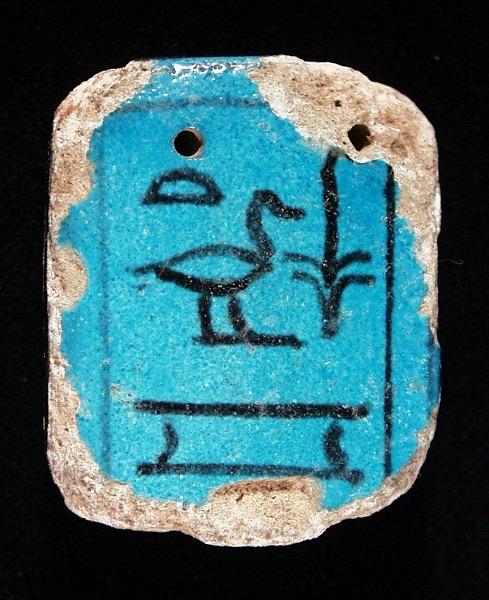
Pierced faience plaque
Faience plaque with part of a hieroglyphic inscription naming a 'beloved king's daughter' (name now lost). The piercing at the corner suggests that the object was suspended or attached to a larger votive item. In clearing the temple of Hatshepsut of the 18th Dynasty, the Egypt Exploration Fund discovered large numbers of votive offerings placed as prayers or thanks to the goddess Hathor. The majority of these offerings seem to have been made by women, and were probably intended to guarantee fertility and safe birth. Those making offerings to Hathor at Deir el-Bahari evidently included members of every level of society, up to and including the royal family.
Present location
NATIONAL MUSEUM OF IRELAND [30/002] DUBLIN
Inventory number
1904:540
Dating
18TH DYNASTY
Archaeological Site
DEIR EL-BAHARI
Category
MEDALLION ?
Material
FAIENCE
Technique
PRESSED IN A FORM/MODEL; PAINTED
Translation
[king's ?] beloved daughter [..]
OR king's daughter Mer[et-..]
The good god, Lord ...
Title
Pierced faience plaque,18th Dynasty , Findspot Deir el Bahri, Faience,The Global Egyptian Museum
https://globalegyptianmuseum.org/detail.aspx?id=2220
The Global Egyptian Museum
r/ancientegypt • u/JackAGoldman • 2d ago
When Flinders Petrie excavated the Early Dynastic royal cemetery at Umm el-Qa'ab (Abydos) in the early 1900s, he uncovered one of the darkest chapters in ancient Egyptian statecraft: the burial complex of King Djer (First Dynasty, c. 3000 BC), surrounded by more than 300 subsidiary graves of young retainers, harem women, dwarf courtiers, and royal artisans.
For decades, historians debated whether these burials were sequential over time or a single mass ritual execution.
Modern bioarchaeological re-examinations (particularly by the German Archaeological Institute and excavators like Günter Dreyer) provided chilling physical proof: 1. The Mudbrick Mortar Evidence: The timber roofs of the subsidiary chambers were sealed beneath a single, continuous layer of damp mudbrick mortar while the king's central chamber was being enclosed. The wood had buckled under the weight while the mortar was still wet—proving every single courtier was interred on the exact same afternoon. 2. Age Demographics: The vast majority of the excavated remains belonged to young adults under 25 years old, with zero signs of chronic disease or battlefield trauma, strongly pointing toward forced or ritual poisoning. 3. The Religious Paradox: Less than two centuries later, by the Second Dynasty (under Peribsen and Khasekhemwy), the practice vanished entirely, replaced forever by inanimate funerary figurines (Ushabti).
Did the early Egyptian elite view this horrifying ritual as the supreme cosmic privilege of serving a living Horus in the afterlife, or was it a calculated exercise of political terror to enforce divine kingship over a newly unified land?
I recently produced a short 6-minute forensic documentary examining the bioarchaeological findings, the tomb of Queen Merneith, and the mysterious 14 wooden ships buried in the sand: https://www.youtube.com/watch?v=hDW3GkemMaA
Would love to hear your thoughts on why Dynasty 1 felt the ideological need for human sacrifice, while every subsequent dynasty abandoned it as taboo.
r/ancientegypt • u/Dorian182 • 3d ago
r/ancientegypt • u/Handicapped-007 • 3d ago
Bust of a Female Statue
The bust of a female statue. The face, characterized as no longer young, is framed by a heavy and elaborate wig crowned by a wreath of lotus flowers, with two short tresses in front and three long ones behind. Around the neck is a decorated usekh collar; on the shoulders, the remains of the elaborate drapery of the dress (or of a cloak) are still visible. The right arm hangs down along the side, while the left one is bent, the hand holding a lotus flower. On the back, the upper part of the back of a seat can be seen.
Present location
MUSEO ARCHEOLOGICO NAZIONALE/MUSEO EGIZIO [05/027] FLORENCE
Inventory number
5626
Dating
18TH DYNASTY
Archaeological Site
UNSPECIFIED
Category
STATUE
Material
LIMESTONE
Technique
HEWN
Height
50.5 cm
Bibliography
E. Schiaparelli, Museo Archeologico di Firenze-Antichità Egizie, Roma, 1887, pg. 217, n. 1515.
D.Arnold, The Royal Women of Amarna, New York, 1996, pg. 124-126, fig. 122
Title
Bust of a female statue,18th Dynasty, Findspot unknown Egypt, Limestone, The Global Egyptian Museum
https://globalegyptianmuseum.org/detail.aspx?id=9882
The Global Egyptian Museum
r/ancientegypt • u/Handicapped-007 • 4d ago
Worship of Osiris
The large private stela of Mai bears a remarkable scene which fills the upper register, in which king Sethos I is shown approaching the triad of Abydos in a deferential manner. Osiris, 'ruler of eternity and lord of the everlasting' is seated on a royal throne, his body wrapped in a funerary shroud and wearing a typical Osirian crown. In front of the throne stands a large lotus flower, on top of which are the four Sons of Horus. The god of the dead is accompanied by his spouse Isis and his son Horus, 'the avenger of his father'. The king is followed by a young man, the future Ramesses II, carrying a flail in his left hand. On the lower part of the stela, the owner Mai, who was attached to the temple of Sethos I at Abydos, is shown in an adoring attitude in front of an offering table.
Present location
KMKG - MRAH [07/003] BRUSSELS
Inventory number
E.5300
Dating
SETHOS I/MENMAATRE
Archaeological Site
ABYDOS
Category
STELA
Material
LIMESTONE
Technique
LOW RELIEF; HEWN; ENGRAVED; PAINTED
Height
94.5 cm
Width
60 cm
Bibliography
L. Speleers, Recueil des inscriptions égyptiennes des Musées Royaux du Cinquantenaire à Bruxelles, Bruxelles 1923, 63 nº 262
(M. Werbrouck,) Musées Royaux d'Art et d'Histoire, Bruxelles. Département égyptien, Album, Bruxelles 1934, pl. 39
L. Limme, Egyptische stèles - Stèles égyptiennes, Bruxelles 1979, 28-31
J.-Ch. Balty, e.a., Koninklijke Musea voor Kunst en Geschiedenis, Brussel, Oudheid - Musées Royaux d'Art et d'Histoire, Bruxelles, Antiquité - The Royal Museums of Art and History, Brussels, Antiquity, Bruxelles 1988, 24-25
F. Lefebvre et B. Van Rinsveld, L'Égypte. Des Pharaons aux Coptes, Bruxelles 1990, 129
Title
Worship of Osiris, Reign of SETHOS I/MENMAATRE, Findspot Abydos, Limestone,The Global Egyptian Museum
https://globalegyptianmuseum.org/detail.aspx?id=762
The Global Egyptian Museum
r/ancientegypt • u/haberveriyo • 4d ago
r/ancientegypt • u/ahmxd_nemyar11 • 3d ago
[ Removed by Reddit on account of violating the content policy. ]
r/ancientegypt • u/Handicapped-007 • 4d ago
Lid of coffin of Khonstefnakht
The lid of the anthropoid coffin of Khonstefnakht dates from the 4th century BC. The head, which has a false beard, is distinguished by its large eyes and the red-brown skin colour. Khonstefnakht wears a blue and white striped wig and on his chest is a broad collar. The body of the coffin is covered with representations of divinities in two registers, and with hieroglyphic inscriptions in vertical columns. The first register shows an illustration of the famous chapter 125 of the 'Book of the Dead', perhaps better known as 'the weighing of the heart'. In the second register, the god Anubis is shown embalming the body of the deceased which lies on a funerary bed. The right-hand scene shows the god Re-Harakhty in the solar barque. The interior of the lid is covered with a figure of the goddess Nut, accompanied by 24 genies who represent the 12 hours of the day and the 12 of the night.
Present location
KMKG - MRAH [07/003] BRUSSELS
Inventory number
E.0586
Dating
LATE PERIOD
Archaeological Site
EL-HIBA
Category
COFFIN/SARCOPHAGUS LID
Material
WOOD; FLAX
Technique
SCULPTURED; PAINTED ON STUCCO; DRAWING; WRITTEN WITH A REED PEN/REED WITH SPLIT NIB
Bibliography
L. Speleers, Recueil des inscriptions égyptiennes des Musées Royaux du Cinquantenaire à Bruxelles, Bruxelles 1923, 89-91 nº 337
(M. Werbrouck,) Musées Royaux d'Art et d'Histoire, Bruxelles. Département égyptien, Album, Bruxelles 1934, pl. 87
M.-P. Vanlathem, Oudegyptische lijkkisten en mummies - Cercueils et momies de l'Égypte ancienne, Bruxelles 1983, 20-21
Koninklijke Musea voor Kunst en Geschiedenis. Algemene gids met plan - Musées Royaux d'Art et d'Histoire. Guide général et plan, Bruxelles 1989, 12
F. Lefebvre et B. Van Rinsveld, L'Égypte. Des Pharaons aux Coptes, Bruxelles 1990, 237, 241, 246, 252
Koninklijke Musea voor Kunst en Geschiedenis, Jubelparkmuseum - Musées royaux d'Art et d'Histoire, Musée du Cinquantenaire - Königlichen Museen für Kunst und Geschichte, Jubelparkmuseum - Royal Museums for Art and History, Cinquantenaire Museum, Bruxelles 1994, 16
Museumstukken als figuranten in een stripverhaal - ...Quand la BD s'inspire des objets du Musée (Exposition), Bruxelles 1996, 15
Title
Lid of coffin of Khonstefnakht, Late Period, Findspot EL-HIBA, Wood and Flax, The Global Egyptian Museum
https://globalegyptianmuseum.org/detail.aspx?id=139
The Global Egyptian Museum