Anyway this sounds like a good idea but idk how it works in practice. Are companies obligated to keep digital games downloadable for all time? What about games like Fortnite which are free? Or WoW which are subscription based? Games like GTA sure, but there are probably other cases I can’t even think of off the top of my head where this doesn’t make much sense.
Edit: Not a karma farmer but it kinda sucks/is kinda funny that I asked questions that led to interesting convos and only got two upvotes 😭😭 However thanks to everyone who shared their thoughts on here.
They shouldn't have to keep it download able for all time, but if they are going to take the servers offline, your copy needs to be made portable, so you can keep it on a flash drive etc.
It’s only an interesting thought if you’ve never thought about it as a software engineer. This is a fundamental misunderstanding of what the layperson calls “data.” It’s not as if there is some canonical version of what’s out there. Digital games are fundamentally a service.
No but restaurants’ products are also not a good analogy for digital games.
If the thing that game companies are selling you is tied to a dependency on something they keep control of, i.e. servers, then if the thing you bought cannot be used after them shutting down the servers, they fail to deliver what you purchased in the first place, unless they specifically outline that whatever you buy has a shelf life which they control.
If they wish to stop operating the servers, the right thing to do to let people keep using THE THING THAT WE BOUGHT AND PAID FOR, is to either release an update that removes the online dependencies (making it playable offline), or open-source the ability for people to run their own servers.
I would say it’s more akin to mining companies being required to clean up a site at end of life. By choosing to bake in online dependencies into the things they sell us, they create future obligations for themselves to keep up the maintenance so that we get WHAT WE PAID FOR. If they want out of the continuing obligations, they’ll have to ensure we can continue to use THE THING WE PAID FOR independently of their willingness to keep hosting.
I mean I’m not arguing for or against this idea’s constitutionality but as a consumer I believe this is the most fair approach that actually respects my rights of ownership as a purchaser of goods.
Actually in the case of live service games they actually have a lot more in common with the service you receive at a restaurant than say an NES cartridge. You’re paying for an experience that has limits, paying for a meal doesn’t entitle you to that meal as many times as you want in perpetuity. Read the TOS’s and if you don’t like the concept of revocable licenses don’t pay for it. It shouldn’t be up to the US government to enforce that all games have to function a specific way and have specific features developed.
I concede that for live service games like MMORPGs it’s more of a grey area for me. I don’t personally play them so I’m not super familiar, my own feelings about them are more that sunsetting them by open-sourcing the ability to run servers etc to the players is more of a decent thing to do to foster goodwill rather than an obligation.
I’m thinking more for like the situation where Sony pulled movies from people’s digital libraries which they had already purchased, due to some licensing issue; or others where the online component is minimal, just calling home to a central server (e.g. for DRM purposes), and because of shutting down that tiny component not critical to core gameplay, it essentially sabotages games in your library that you’ve already bought, paid for, and supposedly own. I don’t have a good analogy for that one at the moment but it’s not analogous to the restaurant example.
I think that’s reasonable on both counts. Open sourcing as good will rather than obligation from the state. And yeah the Sony movie situation was especially shitty, but I dunno I feel like we need better words than simply “buy”/“rent” for digital-only media, because yeah you DON’T own it, you own a license to access their content and that change on a dime. I’ve bought plenty of games on steam and if Valve collapsed tomorrow I’d be pissed but like that’s the trade off for a purely digital library just trust.
Go suck a companies cock Jesus, do you understand that it doesn't have to be like that, have you lost such faith in your lawmakers to make your life better?
I’m a game developer, the cock is mine bud and legislation like this would demonstrably make my life worse.
And yes obviously I have no faith that the US government will make my life better, are you serious?
In the case of a game like that, an offline version. But by portable I mean able to be downloaded and taken with you. Like on a hard drive or flash drive etc.
I don't care. I'm not interested in some convoluted nonsense about keeping servers running and downloads available forever. I'm saying there is a version of this proposal that makes perfect sense; the one where you own the data you download and can't be prevented from using it in the future after buying the license to download it.
What would that even look like? Your every movement in the game is server-authenticated, it's why there's things like the global cooldown to give your client a chance to communicate with the server.
13
u/Nikwoj 22h ago edited 10h ago
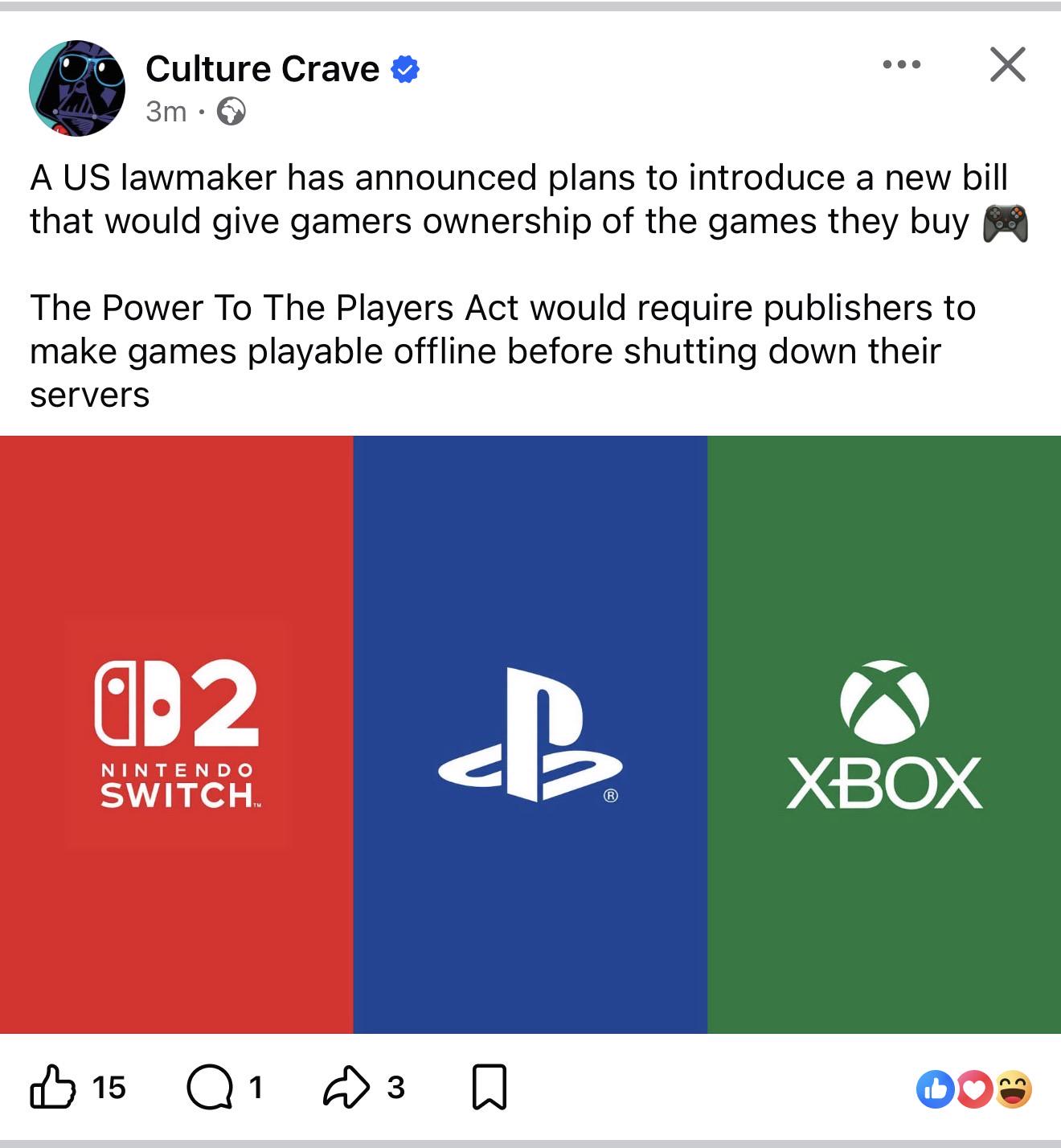
“Power to the players” act? Ain’t that already….
Anyway this sounds like a good idea but idk how it works in practice. Are companies obligated to keep digital games downloadable for all time? What about games like Fortnite which are free? Or WoW which are subscription based? Games like GTA sure, but there are probably other cases I can’t even think of off the top of my head where this doesn’t make much sense.
Edit: Not a karma farmer but it kinda sucks/is kinda funny that I asked questions that led to interesting convos and only got two upvotes 😭😭 However thanks to everyone who shared their thoughts on here.