If everyone in your field knew about Russia's disinformation campaign why did no one have any suggestion or ideas of how to stop it or try to warn society because it seems like no one on the internet or real life even wanted to acknowledge it ?
We have ideas, when also are sounding alarms since 2016. I worked on QAnon. I'm also one of the minority that says that passive defense is not effective (debunking) and that most of the damage is already done when those strategies are being deployed, so we need retaliation for adevrsarial campaign that try to influence our information environment (deterrence theory works everywhere). But you have old politicians that don't give a fuck and don't understand social media, or politician that are scared to intervene in the information environment because they feel any intervention could open them up to attacks on being censorious, or politicians that don't want to antagonize Russia for a few posts, or politician that even if they're not collaborating with the foreign threat, they benefit from their operations, or politicians that are collaborating with the foreign threat. I'm really generalizing here, but short answer is political will and ignorance of the issue. Something is starting to move, but fucking slowly. France is doing a nice job all considered TBH.
It's so frustrating the West has been so complacent as Russia brainwashed an entire generation when the solution was so simple.
My hot take is the West should have given Ukraine the means to do this so much earlier. Maybe a certain problematic head of state would have never gotten elected.
The EU is slow but not that slow. Russian oil dependence got turned around real quick when push came to shove, from what I vaguely recall the immediate cooperative covid response could have been better but was succesful after, IIRC buying vaccines together was succesful.
The EU gets a bad rep for the slowness inherent to consensus based decisionforming, but IMO that is really how it needs to be, it's not a tight cooperation between meddling states that really need to stop meddling, but between sovereign countries that will inherently have differences that can be overcome given time to discuss.
I think that EU functioning leans on ambitiousness and flexibility, not on forced rigidity which more and more seem to be expected from the EU. The EU will crack under rigidity, and only be resilitient under flexibility. I think a quick response decisionmaking framework can be worked out by coming to an agreement on how a this would look like, and not everyone may need to join in, much like how the Euro isn't used everywhere.
I would contest though that deterrence theory does not work with disinformation as well as cyberspace more generally. However, that does not mean I am against measures flooding the russian info environment.
I mean, it's a bit complex to discuss it here, I wrote a couple of articles on applying deterrence by denial and deterrence by punishment in the cyber/information space. I would argue that counterhacks can be a viable tit for tat strategy for example. But you need to mean it. Political pressure, hacks, sanctions, etc, the entire arsenal. But there's no political will to act tough, at most just to talk tough.
very cool. I was mostly referencing Gartzke and Lindsay's work (Elements of deterrence, Age of Deception). Though this is not my area really so I defer to your judgement.
I mean, I'm more into classical deterrence, and my point was theoretical, not concerning explicitly with political realities. Tho winds are slowly changing. VIGINUM in France and @FrenchResponse on Twitter are good examples (at least in my mind) of the cycle I tried to highlight. Early Warning capabilities, to anticipatory intervention, to reduced campaign effectiveness, to increased adversarial effort, to possibly deterrence by denial...
I mean, we're doing little and they're getting bolder and bolder. But yes, escalation is a genuine risk, but it is as much a risk as allowing the other side to believe that repeated provocations will go unanswered and unpunished. It's basically a big game of chicken: if you're always the one to steer off, the other side has little to no reason to change course. That mean establishing credible limits, automatic tripwires, and imposing proportionate costs before the stakes become much higher for both parties involved. In short, politician should learn to deter adversarial aggression without being escalatory. To conclude, both action and inaction have inherent risks, right now we just choose inaction and it's not going well. But on the other hand I can see how some people could view my position as too hawkish, tho in my opinion there's not a lot of wiggle room left, and I would like governments using deterrence instead of just waiting for the crash.
One of the biggest problems we have with disinformation is that it's talked about by defence and security people primarily, and as a result people throw around the word "countering" a lot. The problem is you can't counter disinformation. All you can do is provide a more compelling narrative.
Is debunking's ineffectiveness seriously still a minority view among researchers? I thought the research was pretty settled! Or is the opposition "marketplace of ideas" philosophical nonsense?
TBH it's a bit more nuanced, but here I can't write everything. There is some incentive to develop further ideas around debunking because that's more palatable. I got my fundings cut and now I'm trying to finish my PhD while working in the industry because my position on the issue was, to be fair, quite hawkish. I'm not saying that everywhere is like this, but yeah, it's complicated.
It's been a minute since I've done my reading, but I know a couple years ago there were papers put out about how immediate debunking, like the blurbs YouTube puts under videos related to covid or vaccines, are helpful, but I also remember there was a... more robust body of evidence indicating that the bigger issue is exposure to disinfo in the first place, because information itself is sticky, often stickier than the debunk. Sorry about your funding. We desperately need people like you.
Apparently what I wanted to say broke reddit rules even if it is not dissimilar from allowed discussion? Which seems arbitrary. Well I hope that my appeal goes through
Luckily for me the appeal was succesful! So it does look better once humans look at it on my end. I'll leave both comments that say basically the same thing up as trophies lol
But you seem to only really support counterhacks, are those too hawkish!? That's the minimal tit for the tat of something that undermines our democratic functioning!
Maybe I and this sub in general is just so much more of a hawk then because I would support covert arson and other physical sabotaging operations against these trollfarms. Combined with operations that undermine the
part of the functioning built on oppression of these regimes, like fighting their internal misinformation/propaganda, reveal the identities and addresses behind of the thug squads oppressive regimes often need to function, same for any officials whose secrecy and privacy must be maintained to play part in oppression, make the nation a hostile environment to the oppression operatus.
But no counterhacks are already too much apparently?
But all you support seem to be counterhacks, are those already too hawkish!? It is the minimal tit for the tat that undermines our democracy!
Through secret government operations have those centres could burst up in flames inexpliccably or suffer waterdamage or something else that sabotages it, or if the internal misinformation/propaganda got fought with more fervor, and the identities and addresses behind of the thug squads oppressive regimes often need to function got revealed, and any officials whose secrecy and privacy must be maintained to play part in oppression, to make the nation a hostile environment to the oppression operatus, that'd be the kind of hybrid countermeasures I'd like to see.
But no apparently counterhacks are too much already.
The silver lining is that there is no substance behind all the bullshit. Sure, they cause massive amounts of damage, they get idiots like Trump elected, but look how Trump is doing now. Once reality slaps you in the face, you tend to forget about Facebook posts.
Same thing would/will happen with the AfD in Germany. That's why there are some calls from establishment politicians to just let them have a (state) government, so they can try and fail.
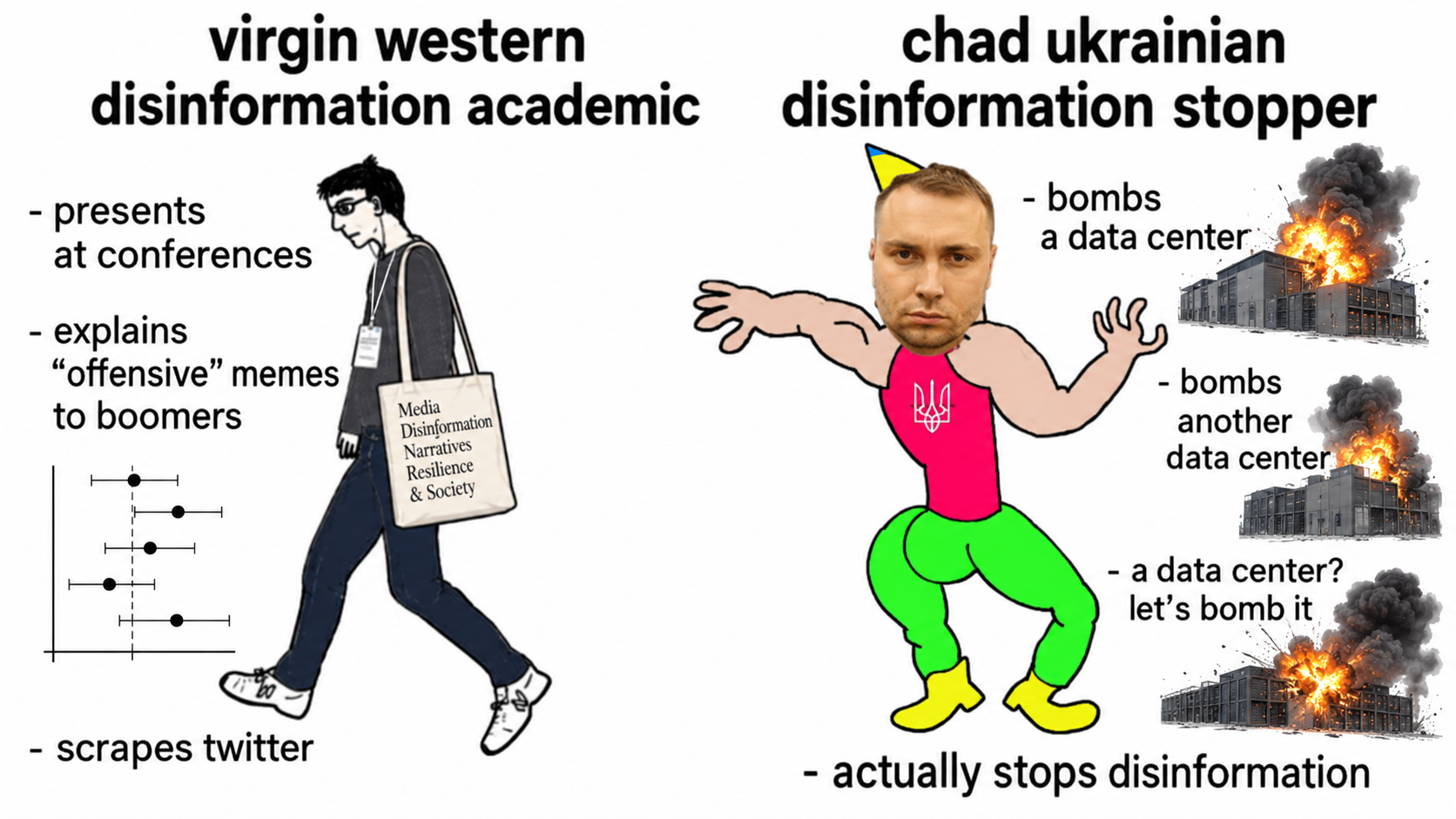
I also have a serious question. Is there any measurable difference in meme warfare waining after these data centers got taken out or is there enough domestic actors repeating russian rhetoric that the difference isn't measurable.
It just seems like something so hard to quantify both in efforts and effects.
I work as an engineer for certain aerospace companies. Qualitative data sucks.
I saw a couple of posts claiming this was just misleading, and info ops activity did not in fact go down, just Yandex web crawlers. Honestly I didn't look too much into it, but that sounds about right, it's a nice meme, that's it.
politician that are scared to intervene in the information environment because they feel any intervention could open them up to attacks on being censorious,
I mean this is a real risk. Unless you silence or label the bots themselves, you label the message - and then you invite the Streisand effect for whatever the topic du hour is.
France is doing a nice job all considered TBH.
I know the UK reached out to EU partners in 2022 and none were interested. What are you referring to with France's actions? Macron calling in opposition leaders to talk?
195
u/Kajort 5d ago
I feel personally attacked as a PhD in Russian InfoOps. Maybe I should enlist in Ukraine drone command.