r/selfhosted • • 29m ago

Release (No AI) I give to you... SURGE: for Plex (TestFlight) a Native Swift Plex Client

Thumbnail
gallery
• Upvotes

Hello everyone! I have spent almost a year working on a Plex app that felt built by Apple. Like, the day the official APIs dropped I started since I had started work on a Navidrome client. First off, a disclaimer that you are of course required to either be on a local network of your server or have the plex pass and all of that jazz. (For those that ask, I do have Jellyfin roadmapped, but it's gonna be a ways off because of needing to rewrite a lot of the backend for it.)

Well, it took onto a life of its own and I genuinely think I have something special. This app is for iOS/iPad OS/macOS26.1+ (I wanted to take advantage of Liquid Glass for my iPhone at the time of starting development). A tvOS version will be coming very soon. Each device has a slightly different UI to best fit each device so it just isn't an iPhone app blown up big lol. You can enjoy both music AND video libraries in this app. It also has support for in-line music videos for audio libraries. It does not support bitrate adjustments or EQ yet to music playback, but I do have bitrate adjustments available for video playback. If it can't be played natively, it will attempt a server transcode. I built everything based on AVFoundation and AVPlayer so it will support Apple's native playback controller.

In case someone asks, I also made the app icon from scratch so it will be improved down the line too. Just couldn't handle the idea of using AI for anything artistic because AI isn't capable of creating. That is strictly a human quality.

Oh! There is also a vintage mode to change your player into an iPod Classic too!! Once inside of the vintage mode, it'll have unique options too for changing the appearance of the iPod (it's limited at the moment, but it's going to expand trust me.) Even in iPod mode you will have access to lyrics that will sync if you use .lrc lyrics!!! There is even a watch together feature I've created using a CloudFlare worker to keep track of playback time positioning, so if you have friends on your plex server that have the same content as you, feel free to watch it together just like we used to be able to do with video streaming 15+ years ago. I'm sure I'm probably forgetting to mention other features because this has been a massive undertaking, but I'll just say those are bonus content if you come across them lol. I've attached some photos, and have the TestFlight link below. If all goes smoothly, I'm hoping for it hit the App Store in a few months.

One last thing!!! With the exception of vintage mode (that is locked to landscape), everything is meant for landscape on iPhone. That was the first reason I wanted to build one because until recently, Apple Music not having landscape pissed me off, so I wanted it to just work.

Here is a link to the first post I made, in case anyone is interested. https://www.reddit.com/r/PleX/comments/1por4gh/developing/

TestFlight: https://testflight.apple.com/join/MV16nHss

My apologies if I missed any of the rules, I don't believe I'm really trying to super publish myself, just wanting to release what is my perfect client for my self hosted media.


r/selfhosted • • 51m ago

Game Server Handheld Hub – A zero-build, edge-first gaming catalog syncing 15,000+ games across 5 devices (Cloudflare Workers + D1 + R2)

• Upvotes

Most self-hosted game collection managers (like RomM or LaunchBox) either require a 24/7 Docker homelab server or are locked to a desktop OS.

As a design systems engineer with 5 different gaming devices (Android phone, Linux handheld, modded Switch, PC, and cloud backup), I built an alternative architecture that runs entirely on Cloudflare's free edge tiers with $0/month in hosting costs.

A few engineering highlights:

  • Local Ingestion (Python 3.9+, standard library only): Scans hardware over Android ADB pipelines (<15ms per query), local filesystem mounts, and live FTP daemons (DBI on Switch).
  • Integrity & Deduplication: Reads the first 8 bytes of dumps to catch zeroed files without downloading GBs of data, and strips legacy 512-byte SNES/Genesis copier headers in memory for clean No-Intro CRC matching.
  • Pre-baked Catalog (−34% payload): Normalizes redundant cloud drive IDs into separate lookup indices, reducing the compressed catalog payload from 2.2 MB to 1.4 MB.
  • Edge Backend: Cloudflare Workers + D1 SQLite for structured queries, and Cloudflare R2 for 15,000+ WebP box covers with zero outbound egress fees.
  • Frontend (Zero-Build): Pure semantic HTML5, CSS custom properties, and native ES modules. 100% WCAG 2.2 AA and APCA (Lc ≥ 75) compliant, full keyboard command palette (⌘K), and HTML5 Gamepad API controller support.

The live showcase has ROM downloads disabled to keep it completely legal and open for anyone to explore:

Showcase: https://handheldhub.gustavoconstantino.com GitHub: https://github.com/guconstantino/handheld-hub Case Study: https://gustavoconstantino.com/work/handheld-hub.html

Handheld Hub dashboard running on Cloudflare edge (Workers + D1 + R2)

r/selfhosted • • 4h ago

Need Help Introducing HomeVault — A NAS project built in my spare time, looking for contributors 🚀

Thumbnail
gallery
0 Upvotes

Hi everyone! 👋

Before telling you about HomeVault, let me introduce myself!

I'm 40 years old, I live in Belgium, and I work in the medical field. I've been passionate about computers and new technologies since I was a kid.

HomeVault is a project I develop entirely in my spare time: late nights, weekends, and holidays, juggling work and family life.

The idea for HomeVault came to me a little over a year ago. None of the NAS software solutions available on the market really met my expectations.

On one hand, commercial NAS solutions were either too restrictive or too expensive. On the other, self-hosted solutions were sometimes resource-intensive, difficult to use, or came with other limitations…

So, after several days of research, I decided to give it a shot!

My requirements were simple:

  • Modern NAS software that's easy to use and accessible to everyone.
  • A solution that's reliable and robust.
  • 100% free software that fully respects your privacy: your data stays in your own home, period!
  • The lowest possible resource consumption, so it can run on older hardware too.

I'm also not going to hide the fact that I use AI in this project. First and foremost, it helps me save time, but it also assists me with certain aspects of development, particularly UI design. Since UI design isn't exactly my strong suit, tools like Stitch, Figma, and other AI-powered solutions have been a huge help in exploring and testing different ideas.

Today, I'm looking for contributors to join the HomeVault adventure! 🚀

I'd love to find motivated people who want to get involved and help me bring the first working version to life. Unfortunately, time is running short, and to my great regret, I can no longer make as much progress working on it alone as I'd like.

Whether you're a developer, a NAS enthusiast, a Linux user, or simply curious about the project, any help or contribution is welcome!

If you're interested, you can check out HomeVault and join the project on GitHub:

👉 https://github.com/nicoleroux35/HomeVault

Thanks to everyone who takes the time to check out the project, share it, or contribute! ❤️


r/selfhosted • • 4h ago

Need Help Eu.org domain

0 Upvotes

Does eu.org domain only available for folks applying from the eu region. Or someone sitting in India, can request such a domain, that can be accessible across the globe?


r/selfhosted • • 5h ago

Game Server OpenMW-Web 1.6.2: self-hosted Morrowind in the browser, with an admin dashboard and multiplayer in alpha

Thumbnail
gallery
82 Upvotes

OpenMW-Web is OpenMW (the open-source Morrowind engine) running entirely in a browser tab. Players install nothing. The part I think this sub will care about is the server, which I've spent the last couple of months building an admin dashboard for.

Getting it running is one command if you have Docker:

`git clone https://github.com/Virtastic/openmw-web.git && cd openmw-web && ./setup.sh` (Windows: `.\setup.ps1`)

It pulls prebuilt images from GHCR, so nothing compiles on your box, and opens the setup wizard at localhost/admin. The wizard asks for an admin account, single player or multiplayer, how people sign in (passwords, Google, Discord, Microsoft or invite codes), where storage lives (local disk or any S3-compatible bucket) and how the server is reached. Give it a domain and Caddy sorts out HTTPS on its own. It also walks you through adding your game files.

After that it's all the dashboard: who's online and where, every account with its characters and saves, CPU, memory, network and disk, kicks, bans and reports, logs and an audit trail of what admins did. Mods upload as .zip or .7z with a drag-to-order load order and conflict warnings, and Tamriel Rebuilt has its own setup step. Updates are a button, and rolling back is one line in .env. No config files to hand-edit.

Multiplayer has also moved out of the experimental flag and into alpha: one shared world simulated on the server, so everyone sees the same NPCs and fights. The last few releases fixed a lot (teleporting enemies, rubber-banding, restarts kicking people), and 1.6.2 stops new areas freezing while they load.

It's alpha, so there are bugs. If you want to help:

- Play on our community test server (UAT): https://morrowind.virtastic.app

- Grab an invite code in the Discord, and tell us what breaks: https://discord.gg/PzFfDkbSue

- Source, docs and changelog: https://github.com/Virtastic/openmw-web

Feel free to check out our other projects like this too: https://github.com/Virtastic


r/selfhosted • • 5h ago

Personal Dashboard Any homepages that have sports scores and game times?

4 Upvotes

I tried glance which has a community built version of this but its not always working and not actively maintained. I dont have the skills to fix it. Are there any other home page services that have this?


r/selfhosted • • 5h ago

Need Help Cal.com vs Cal.id

6 Upvotes

Hey, I'm not a developer and not really in this space at all, but I don't know where else to post this, I hope that's okay. I'm building my own business from scratch, so new to the game.

I was trying to find an open source schedular and of course was researching Cal.com (before I found out they closed source a few months ago). Which is when I stumbled across Cal.id. It seems to be almost identical to Cal.com but it owned by OneHash. They clearly took the code from when Cal.com was open source, or took it from cal.diy, I don't know. Anyway the reason I chose Cal ID was mainly because they offer Multi Slot bookings (on a paid tier) and Cal.com doesn't. Also some other small differences that cal.com was lacking from what I wanted.

Since I've started using Cal ID, I've noticed there are a lot of bugs. The tech support team was helpful, but obviously some are actual bugs that need fixing on system level, and it's exhausting to have to run into one bug after the other. I'm aware they're very new so I have to take this into account. However I can't find much of a footprint online about them. Hardly anyone is talking about Cal ID, which I find very surprising as people love cal.com. So I'm starting to wonder if I made a mistake by signing up so fast (already paid for a year). I also saw that OneHash has really bad reviews.

I've given up on finding something that's open source and has what I want, but if Cal ID really is such a nuisance, I might try to get a refund somehow and go back to cal.com. I appreciate the workflow of early stage platforms, but as a small independent one-person business (coach), I don't have the capacity to play along patiently, I need something that works now. I am rather tech savvy but definitely not to the degree or speed that would be necessary. The bugs are negligible for now, but when I start growing and have more clients, I need something solid. So if someone has compared the two and has some good insights I'd be very grateful!

Has anyone even heard of Cal ID? Used it? Compared it?

Why is there no online footprint?

Does anyone know more, and can tell me if this is just the way things go with start-up platforms or what is going on here?

Is it worth it for me to stay?


r/selfhosted • • 5h ago

Need Help Best practices and practical solutions for backups?

3 Upvotes

I apologize is this is a repeated question. I did not find a helpful (to me) answer yet...

I "discovered" the magic of self-hosting some weeks ago and am in the process of creating more and more services on my small homelab. I'm running Docker on Ubuntu server on a small Dell mini PC. I am quite new-ish to Linux and very new to Docker as a concept. I work as a Windows Sys admin by day.

So, naturally, before hosting any really important data myself, I am trying to learn how to do backups. I had hoped to find a "ready to use" solution but so far was not successful.

Did I understand it correctly that all the data worthy of a backup are NOT inside of the containers but in my Compose files or the volumes mounted into the containers?

So my next step would be to create a backup mechanism myself. This seems... daunting.
I think these might be the necessary steps:

  • iterate through all my stacks
    • stop all containers inside each stack so no file is in active use
    • backup all necessary files in TAR.GZ files to a temp directory
      • Docker compose files with their .env files
      • all volumes used in that stack
    • move that TAR.GZ file to my NAS
    • remove older backups there
    • re-start the containers in the current stack

Do I really have to create such a solution myself? Surely I am not the first person in need of a backup solution... Can you nudge me into the right direction so I do not re-invent the wheel?


r/selfhosted • • 6h ago

Automation Self-hosted custom AI camera alerts: define a specific problem, get a Telegram photo only when it happens

0 Upvotes

I got tired of generic motion alerts, so I built a small self-hosted system that alerts only for situations I define. My first real test: a cat that keeps sitting on my parked scooter.

How it works:
Any webcam or RTSP camera as input
Object detection with [YOLO11 / RT-DETR] plus tracking, so each object keeps the same ID across frames
Polygon zones drawn on the camera view
Rules like "cat inside scooter zone for 5+ seconds" or "person at gate for 30+ seconds"
Cooldowns so one event means one alert
A snapshot sent to Telegram; nothing leaves the machine except the alert

Hardware: runs on a [GTX 1060] at home. No cloud, no subscription.

Limitations: night-time accuracy depends on your camera's IR, small or distant objects are harder, and it needs a machine running 24/7.

How it compares: Frigate is great for full NVR and general detection. This is lighter and focused on custom, rule-based alerts for one specific problem.

Attaching the video link in comment, pls take a look.

Happy to answer questions on setup, rules or tuning false alarms. What would you use custom rules for?


r/selfhosted • • 6h ago

Media Serving Linearr for music

0 Upvotes

I use both Plex and Jellyfin. And creating playlists has always been a struggle for me.

I recently found Linearr and it’s great for tv shows. It solves problems I’ve had with sequencing shows. For example I have a playlist for tv that contains 8 different shows. It randomly plays an episode from one of the shows but makes sure each episode for that given show is played in air date order.

Music is my Achilles heel.

My music library is very complex. I have pop, rock, classic rock, religious, classical, opera, Christmas, ska and who knows what else.

Creating a playlist is such a pain. And using shuffle is a terrible solution. Ever get an opera aria in the midst of classic rock? How about a hymn in the middle of heavy metal?
Shuffle doesn’t seem to stick to the playlist or genre in my experience.

Someone suggested creating multiple libraries for different types of music. That didn’t seem to help me.

If Linearr could handle music, that’d be great.

Is there something similar to Linearr that does music?

Other than Plex and Jellyfin is there a good app (server and iOS) that just handles music and my large library?


r/selfhosted • • 6h ago

Need Help Questions regarding setting up *arr stack

0 Upvotes

Hi everyone, I just wanted to run my arr stack through here and make sure there's nothing crazy that I'm missing. I currently have Radarr and Sonarr set up with Prowlarr behind them to share information. My indexers include altHUB, NZBgeek, and NzbPlanet. My only download client is NZBget and my news servers are Frugual Usenet and NewsDemon, which I understand have different backbones.

Currently for finding movies and shows I haven't had too much trouble, but I do have trouble finding random episodes or having mismatched episodes of random anime shows so I was wondering if I have good coverage for that or if there might be any particular indexers currently available that I should consider? I also was wondering if it's worth having more than one download client - my use case is just self hosting for me and my family so there'll never be even a dozen people trying to download and I think after the first couple months of filling out the server then downloads will slow considerably. I do have problems with NZBget constantly having to repair files for what feels like longer than it takes to download but I'm not sure if that's an NZBget problem or a news server problem (I literally just added NewsDemon so I haven't tried it out yet).

So basically my questions are, do I have good coverage with my current set up or should I make any changes, and is it worth changing or adding the download client part of the set up? Also should I set up the whole recyclarr thing?

EDIT: Somehow completely forgot to add that if I can use something with BookOrbit and something for games as well then that'd be awesome. Currently I am having trouble with book coverage so if there's anything more specific for that use case that'd be awesome.


r/selfhosted • • 7h ago

Release (AI) Super Productivity v19.2: self-hosted task management, live Markdown notes, and bulk actions

Post image
77 Upvotes

I maintain Super Productivity, an MIT-licensed task manager and time tracker. It works offline, and you can self-host the web app and an optional sync backend.

My last update here was v18.16 in July. v19.2 is out now, so here's a catch-up on the changes since then.

For people running their own server

v19.2 adds ARM64 SuperSync server images alongside AMD64, versioned release images, configurable trusted proxy ranges, and fixes for fresh deployments. SuperSync is the optional sync backend, separate from hosting the web app.

SuperSync is still beta, and self-hosting support is limited. The documented Compose stack includes PostgreSQL and Caddy and needs SMTP for account emails. You don't need a server or an account to use the app locally.

What changed in the app

  • Notes without switching modes: live Markdown editing arrived in v19.0.1.
  • Less task-by-task housekeeping: multi-select and bulk actions arrived with v19, followed by keyboard navigation in the planner and boards. In v19.2, you can drag selected tasks between sections and projects, and multi-select in the mobile planner.
  • Integrations: v19.1 added two-way Trello card sync and support for multiple Google Calendar accounts.
  • Priorities and search: v19.2 adds numeric task priorities with icon presets, plus project and tag search.
  • Recovery and reliability: earlier releases added local recovery points and full worklog export. v19.2 fixes sync cases that could lose tracked time or overwrite concurrent task edits, plus incorrect success reporting for failed desktop backups.

Two upgrade changes to know about: v19 removed User Profiles; v19.2 moved Redmine and Nextcloud Deck integrations into plugins.

Project, web app and downloads

SuperSync setup and limitations | v19.2 release notes | Changes since v18.16

Disclosure: AI helped draft and fact-check this update against the release notes and deployment docs.

If you've tried self-hosting Super Productivity, what would make setup or day-to-day use easier?


r/selfhosted • • 7h ago

Guide Made an app to run the household side of life (nanny pay, appliances, warranties, the wifi password everyone asks for)

0 Upvotes

We have a nanny, and tracking hours, overtime, and pay was eating my Sundays. Then there’s all the house stuff: when the HVAC filter was last changed, which appliance is still under warranty, where the warranty paperwork even lives.

So I built HomeHQ to hold all of it:

  • Nanny timesheets and pay runs, with overtime handled
  • Appliances, warranties, and repairs
  • Family records
  • Your home network info

It can also print a house manual, a babysitter sheet, and a network sheet. The babysitter sheet alone gets used every time we have a sitter.

It runs privately on your own computer, with reminders by phone or email. It’s $19.99one-time. Happy to share the link if anyone wants it.


r/selfhosted • • 7h ago

Meta Post Any other selfhosters often feel that internal struggle between sharing your setup/systems to help guide others and never sharing information because of opsec?

0 Upvotes

As an avid homelabber and selfhoster, I want to share with the community details about how to use Traefik and ACME to https-iffy everything, what ports to open, how to implement Crowdsec, your own fault-tolerant OIDC provider, a WireGuard tunnel between your homelab services and VPS services, and more.

But I’ve worked in cybersecurity for a long time, and I’ve become paranoid about sharing all this information because we share what we know, and we know what we have done in practice, so I’d be sharing the details of how my infrastructure-as-code manages my stack, what tools and automations I have in place, including my Ansible playbooks, and how I protect myself from intrusion.

Yet at the same time, if nobody shared this information, I wouldn’t have had access to the wealth of videos, blogs, posts, and comments that taught me how to spin up robust self-hosted infrastructure.

And as my infrastructure gets more complex and I implement creative ways to store secrets, perform secret injection, and things of that sort, I know that sharing my scripts and architecture can help those who want to level up their security while also revealing intimate details of my own setup.

If I had taken the time, years ago, to blog and share my self-hosting journey, a person of any skill level in 2026 could feed my entire post history into AI, analyze my IPs, domains, and architecture, and almost certainly find a way in, given enough of a concentrated effort.

So I only share general knowledge instead of specific guides, hampering the progress of well-meaning enthusiasts who would like to step up their game with detailed, explicit walkthroughs.

I’m well aware that my NAS of personal photos and Linux ISOs is hardly of interest to any would-be attacker, but you know how it is. Some people simply do it to see if they can, or they do it out of curiosity or boredom.

Anyway, where do other people draw the line between sharing your setups, including your playbooks or IaC, and staying mute to avoid drawing attention to yourself?


r/selfhosted • • 9h ago

Need Help to github, or not to github?

20 Upvotes

Hey there r/selfhosted!

I am running a small homelab and selfhosts several things, including anime, manga, minecraft servers, etc.

My next thing to check off is git. Now i have already looked into forgejo several times, but i have never actually made the switch because of several reasons i list below. I want a second opinion on the matter and was wondering what you guys do and what you think is best in my situation.

My situation

I am a solo develpoer (hobbyist) who develops open source projects for fun, but i have never actually gotten a star, issue, pr or discussion opened on any of them because i dont really advertise my projects.

I am also skeptical about mirroring to github, while it solves most cons it also removes most pros, and makes it even more confusing for me, if i were to push code to forgejo with refrences to prs that are only on github.

Pros/Cons ( that i have thought of )

Pros:

  • privacy, not published to microsoft servers
  • selfhostable CI without limits
  • using open source software instead of githubs proprietary platform
  • moving away from github, microslop, its outages and ai

Cons:

  • Discoverability & engagement - people will need to create a user to contribute etc, which not many people want to, ive never gotten anyone who has done anything to my projects though so im not sure
  • Portfolio - A github page is widely recognized and a github with consistent activity for years would be good in a portfolio/resume, whilst a selfhosted git would not be as impressive or recognized by non-tech people. While im way too young to get tech jobs yet, building a portfolio for the future is important.
  • My servers limitations. I would be able to allocate maybe 20gb to the repos, which is plenty in my experience, i dont know how heavy runners can be (i know forgejo itself is relatively light), and i would only be able to give it a total of around 3-4gb ram and 1-2 cores.

Some questions

Would you think github is right in my situation or can i migrate to forgejo, or should i do something completely different?
Have you been in a similar situation, and what did you do?
Did i miss any pros/cons that would make me more probably to migrate / not migrate?


r/selfhosted • • 9h ago

Release (AI) Glosano: a self-hosted, MIT-licensed app for learning languages from texts and YouTube videos

1 Upvotes

Hi r/selfhosted!

I learn languages the LingQ way: read a lot of real content, click the words you don't know, review them later. It works for me, but I didn't like my whole vocabulary history living in someone else's cloud behind a subscription. So I built Glosano, a self-hosted version of that workflow.

What it does

- Import `.txt` / `.md` files, YouTube videos that have captions in the language you learn, or any web page through a Chrome/Firefox extension.

- Interactive reader. Every word is coloured by how well you know it: new, in study, known, ignored. Turning the page marks the remaining new words as known (with undo).

- Word cards with Wiktionary definitions, grammar tags, links to external dictionaries and an optional in-context AI translation, always labelled as AI-generated.

- Spaced repetition for saved words and phrases in one review queue.

- Stats that don't lie: words read, in study, known. Ignored proper nouns and junk tokens never inflate the "known" count.

- 10 learning languages (EN, RU, PT, ES, FR, DE, Simplified Chinese, JA, AR, HI), interface in 9.

- Multi-user: run one instance for your family or a small group, keep lessons private or share them on the instance.

The self-hosting part

- Docker Compose: app, worker, Postgres, Redis. Runs on 1 vCPU / 2 GB RAM, more is comfortable.

- Dictionaries are Wiktionary dumps from Kaikki.org (CC-BY-SA), imported into your own Postgres. Lookups never leave your server.

- AI is optional. Any OpenAI-compatible endpoint works: Ollama, LM Studio, vLLM, OpenRouter, OpenAI. Without it the reader, dictionary, vocabulary and reviews work as usual, and one env var cuts off all AI calls.

- No telemetry or analytics. Outbound traffic is only dictionary downloads, YouTube captions and your AI provider, if you set one.

- JSON export of all your data, account deletion, plain `pg_dump` backups.

- MIT license.

Honest caveats, it's an MVP

- No prebuilt images yet: `docker compose build` runs on your server and takes a few minutes.

- No admin panel yet, admin tasks go through a CLI.

- Email + password only: no SSO and no outgoing email, so password resets are done by the server owner via the CLI.

- Desktop and mobile browsers are the main target; no mobile app yet.

- The browser extension is installed unpacked for now, it isn't in the stores yet

- YouTube import only works for videos with existing captions in the language you learn.

Links

- GitHub: https://github.com/Glosano/glosano

- Self-hosting guide (empty server → HTTPS instance in about 30 minutes): https://github.com/Glosano/glosano/blob/main/docs/self-hosting.md

I'd love feedback on the install experience in particular: where the guide is unclear, what broke, what you'd expect from a stack like this. Issues and PRs are welcome.


r/selfhosted • • 9h ago

Cloud Storage I riced my nextcloud xd

Thumbnail
gallery
4 Upvotes

The theme is kinda primitive still, but it feels much more like home than bland nextcloud.. Even more after having multiple voicelines :3

I urge everyone to try it with the customcss nextcloud app for example: https://apps.nextcloud.com/apps/theming_customcss

I didn't create the images myself, here are the sources though:
BG https://wallpaperaccess.com/adventure-time-marceline
Talking marceline https://de.pinterest.com/pin/1131881318942714692/
I can't find the source for the logo gif in the top left anymore though :c


r/selfhosted • • 10h ago

Release (AI) I built three single-file HTML tools to document racks, IPs and IT inventory — no server, no database, your data stays in a JSON file you own

0 Upvotes

I'm a sysadmin and got tired of keeping the network documented in three spreadsheets that are never up to date, so I wrote three small tools. Each one is a single index.html: you open it in a browser and it saves to a JSON file on your disk or on a network share. No server, no database, no account, and a connect-src 'none' CSP so nothing ever leaves your machine.

- RackScope — racks, devices and cables. Click any port and it tells you where the cable goes. Free U are counted for you.

- SubnetScope — IP plan with one cell per IP, VLANs, IPv6 and NAT. Imports DHCP leases and reservations from MikroTik, Windows Server, pfSense and Kea exports.

- AssetScope (new this week) — inventory with a traffic light of warranties and end-of-support dates, a PDF fleet report and QR labels.

They talk to each other: devices from RackScope go to SubnetScope to get an IP and to AssetScope for the inventory. English and Spanish UI, AGPL-3.0.

Demos (open with sample data):

https://marcosblg.github.io/rackscope/

https://marcosblg.github.io/subnetscope/

https://marcosblg.github.io/assetscope/

Most of what people asked for on the first versions is already in. What would you add?


r/selfhosted • • 10h ago

Need Help Transfer Server setup to a new machine

3 Upvotes

I have my setup, its just Debian in CLI that i ssh into.

I want to transfer this setup, exactly, files and all, to a new machine(machine b), without transplanting the hard drive, as this machine is being repurposed (machine a).

What's the cleanest way for me to get machine a with ALL its files, essentially a copy of its drive, to machine b with its fresh clean drive.

I can think of a few different ways, but reddit always always has some new niche cool way to surprise me and makes my solutions look like a bodge job lol.

Thanks


r/selfhosted • • 10h ago

Need Help Where do you host your personal apps if you're not self-hosting yet but would like to?

6 Upvotes

Are there any cloud based-hosting options you'd recommend as a way to get in to self-hosting?

I'm looking for something worth checking out that could help me learn and build with self-hosting in mind. I don't have any plans to release them publicly or make money off them.

For context, right now, I'm using Vercel and Firebase for micro apps made just for myself and my family. It's nothing fancy, but it gets the job done and lets us access everything remotely.

I'd like to move to self-hosting in the future, but buying the hardware just isn't in my budget at the moment.


r/selfhosted • • 10h ago

Software Development Sovereign Apps

2 Upvotes

Hey folks! I wanted to share an epiphany I had during the last 9 months of building a personal self-hosted project for music library management and personal streaming.

During the summer, I added Iroh as a replacement of having to deal with tailscale or wireguard to the app suite (with all the user complexity that requires). It took me quite some time to implement it correctly and build some custom modules here and there. But in the end, I had this amazing moment of realizing that with this networking layer spreading, all at the app level instead of at server level, plus local LLMs pushing forward, the number of personal, self-hosted, customized apps, both paid and open-source, will skyrocket. Removing the networking setup complexity, plus, customization complexity, is just key for self-hosting into the masses.

The addition of easy local intelligence (not yet here) to these self-hosted apps could be the final tipping point, allowing for a variety of non-technical, easy-to-set-up "Personal Home Hubs" that anyone could have.

The user experience of self-hosting, thanks to these two vectors, Iroh networking and AI customization, could improve so dramatically that I think we'll soon see a wave of amazing, personal apps running on our "home hubs" that are as easy to set up as installing a simple app.


r/selfhosted • • 10h ago

Need Help Self hosting docs and spread sheet sharing that have decent mobile apps. Alternatives to Nextcloud?

1 Upvotes

I’ve been trying to self host my own doc and spreadsheet sharing with decent mobile apps. I keep stumbling upon Nextcloud for this. I’ve had it set up for 6 months and the mobile app just keep breaking. It’s been very unreliable and I want to replace it with something else.

I share these documents with multiple people and really do like the collaboration features that let multiple people edit at the same time. However, I can give this up for something that is much more consistent. I just need to have shareable files that other people can edit.

I need it to have reliable, working mobile apps. What are some good options?


r/selfhosted • • 10h ago

Software Development Testing legacy limits: Forcing a local AI pipeline to successfully execute an OpenCL fallback on a 2013 Ivy-Bridge Laptop (Geforce 720M)

Thumbnail
gallery
0 Upvotes

Hey r/selfhosted,

I wanted to see what happens when you push local inference architectures onto absolute vintage consumer hardware. I dug out an old ASUS X75VC laptop (originally released back in December 2013) to run a strict CPU/legacy GPU fallback survival test.

The Legacy Specs:

  • Processors: 4 × Intel® Core™ i5-3200M CPU @ 2.60GHz (IVY-BRIDGE)
  • Memory: 12 GiB of RAM (11.6 GiB usable)
  • Graphics 1: Mesa Intel® HD Graphics 4000
  • Graphics 2: NVD7 Geforce GTS 720M

Environment Configuration:

NODEAI_VULKAN_SUPPORTED="FALSE"
NODEAI_RUN_ACTIVE_BACKENDS_LIST="OPENCL"

The Results:

  • 🔴 CPU Fallback Render Time: 5 hours, 8 minutes, and 35 seconds.
  • The Takeaway: The render time is obviously terrible for a production workflow, but the fallback engine layout actually works cleanly. Even on a 2013 machine with zero native Vulkan support, the backend pipeline successfully rerouted execution paths, handled the driver constraints, and completed the generation safely without throwing an out-of-memory kernel panic or crashing the underlying loop container.

(Attached gallery showing the ComfyUI nodes tracking the multi-hour terminal clock execution loop, alongside the final output render).

What is the oldest or weakest "potato" hardware you guys have successfully forced to finish an offline inference run without the kernel dropping out?


r/selfhosted • • 10h ago

Webserver Webserver benchmarks on arm64 / Raspberry Pi

Post image
8 Upvotes

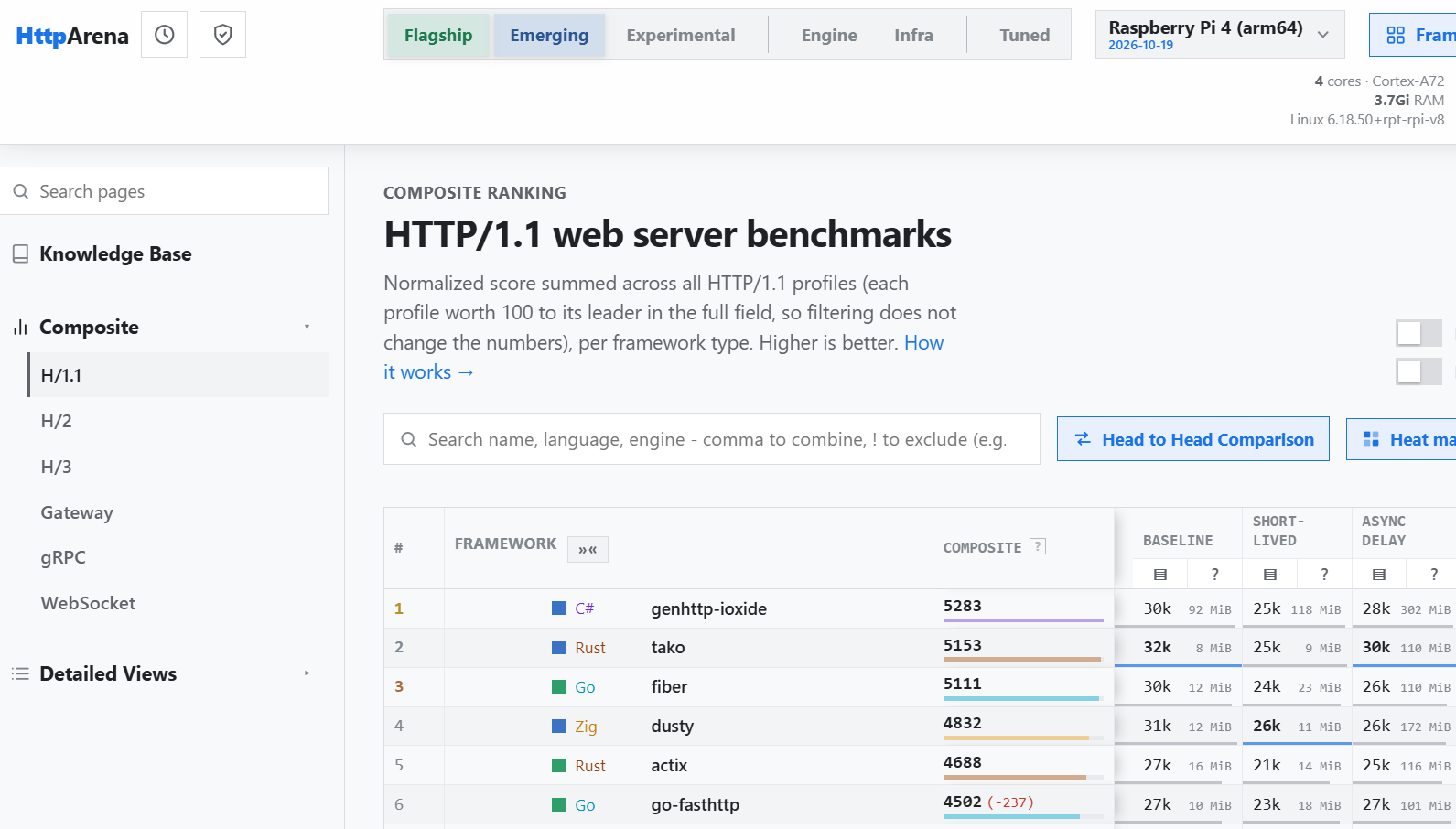
Usually we only see big x64 servers on such benchmarks (e.g. Techempower FrameworkBenchmarks) but it looks like someone did run the HTTP Arena test suite on a Raspberry Pi 4B, with some interesting results, find them here: HTTP Arena (RPI)

Rust, Go and Zig on top is expected, but there is also a C# framework. For lots of cases you may only receive a few requests an hour so this does not matter, but some frameworks serving only 50 requests per second through TLS is quite devastating.


r/selfhosted • • 12h ago

Media Serving Tv stream box

11 Upvotes

I just want to get rid of sponsors and ads on YouTube on my tv and I am wondering if I can use a rassberry pi or some mini pc for a stream box and what os’s are used for something similar